Showing posts with label Alfred Hitchcock. Show all posts

Wednesday, July 17, 2013

Cristina Raines and Yaphet Kotto are "Prisoners" on "Alfred Hitchcock Presents"


In the mid-1980s, one of my favorite hours of television was the back-to-back half-hour anthologies that NBC offered for the 1985-86 season.  On Sunday at 8:00 PM, we were treated to an episode of "Amazing Stories," a fantasy, horror, and science fiction anthology series produced by Steven Spielberg, and at 8:30 PM right afterwards was "Alfred Hitchcock Presents," a revival of the classic 1950s/1960s anthology series that remade many episodes of the original series, using colorized versions of the original episode's intros and closings featuring Hitchcock himself, but made with their own unexpected twists and unique spin to them.  Both shows were produced by Universal and received great publicity and attention that season.  However, given the level of attention they received, neither show was a ratings hit and "Amazing Stories" was ultimately cancelled after two seasons.


"Alfred Hitchcock Presents" only lasted one season on NBC and later continued on the USA Network in increasingly inferior episodes that were produced in Canada.  It's a shame, because for that one season, when they were paired side-by-side, both shows provided a stimulating, imaginative, and exciting modern-day twist on the sort of anthology storytelling that hadn't been tried by network television for quite some time.  I loved them both, but I think I preferred the darkly suspenseful and witty storytelling of the "Alfred Hitchcock Presents" half of the hour.  There were some very good episodes produced that season on NBC, but my favorite segment was the one entitled "Prisoners" starring Yaphet Kotto and Cristina Raines, which aired December 8, 1985.


In the episode, Cristina Raines plays Julie Nordstrom, an upper middle class housewife whose husband Glen is continually absent on business trips.  Julie's only friend is her white dove named Mr. Chips as she spends her days watching game shows on television and caring for her home.  Her sheltered existence is turned upside down when her home is invaded by escaped convict Jack Royce (Yaphet Kotto) who at first terrorizes Julie and orders her to cook for him.  As Jack enjoys the luxuries of Julie's house, the two become acquainted and find that they actually have much in common with one another.  They both enjoy the same game shows and they both realize they are lonely individuals who each felt stifled, isolated, and imprisoned in their own confined existence.


When Jack says that he plans to escape to Jamaica, Julie announces that she intends to accompany him as his "hostage" for a week so that she can finally travel without her husband.  Julie starts packing her luggage when the phone starts to ring.  Jack becomes alarmed that someone might be alerted to the house if Julie doesn't answer the phone and act like everything is OK.  At gunpoint he forces Julie to pick up the receiver and tell the caller that everything is normal at the house and that her husband Glen is expected back home at 10:00 PM.  Jack later apologizes for having been rough with Julie.  He asks her if she still wants to go with him and Julie declines.


The festive mood broken, Jack leaves the house as night falls, only to find himself confronted by a SWAT team who have surrounded them.  As Julie watches helplessly, Jack turns to her and says "People weren't meant to be prisoners, Princess" and pulls his gun on the officers.  He is shot down in a hail of bullets.  As the SWAT team members surround Jack's body, one of them muses aloud, "I can't believe she got him to fall for that trick...Mrs. Nordstrom's deaf...She can't communicate except by reading lips.  She can't talk on the telephone."  Later, with her bags packed, Julie releases her dove Mr. Chips from his cage and leaves her imprisoning home forever. 


A poignant and insightful episode, the "Prisoners" segment of the new "Alfred Hitchcock Presents" is a remake of the January 15, 1956 segment of the original series entitled "You Got to Have Luck."  John Cassavetes played the escaped convict in that episode, with Marisa Pavan playing the hearing impaired housewife held hostage.  Even though the original episode is a good segment on its own terms, it has nowhere near the depth and nuance of the "Prisoners" remake starring Kotto and Raines.  Kotto brings a swaggering, bull-in-the-China-shop quality to Jack that masks his sensitivity and vulnerability.  Even though Jack is undoubtedly a dangerous criminal, he also has an honesty and directness to him that allows Julie to eventually see through his tough exterior and grow fond of him.  He helps encourage Julie to break out of her shell by pointing out how the refined and pristine household that her husband Glen has established for her to maintain has become its own prison-like environment.


I particularly like the scene where Jack enjoys the living room and notices how all the furniture are covered by protective plastic and that the nuts are all stale because Julie and Glen have never had guests over in the entire time they've lived there.  Julie reveals that it's not easy making friends in such a private and rarefied neighborhood, because everyone keeps to themselves, and that they've moved four times in seven years.  Jack responds, "Oh, I know what you mean.  My father moved me about when I was a kid.  And I hated moving.  And sometimes I think that if it weren't for all that moving around I might not have been a criminal."  An incensed Julie chastises Jack and asks him, "Am I supposed to feel sorry for you?!...Who do you think you are?!  I mean you come in here waving your gun and scaring me to death!  Don't you expect me to feel sorry for you and your 'deprived' childhood!  I won't do it!  I mean there are other people who have problems.  They don't have guns!  And they don't go to prison!...I've got problems too and I don't have a gun!  I don't go out terrorizing people in their own home!...And I don't particularly like the plastic on the sofas either!"


In so doing, Julie gets Jack to see the hypocrisy of his statement, which causes him to apologize for playing "victim" to her when he has been victimizing her at gunpoint all afternoon.  Concurrently, Jack gets Julie to see the irony of how her husband Glen has created an imprisoning atmosphere for her by covering the furniture with plastic and making her feel unwelcome to spend time in her own living room.  As Julie admits to Jack, "I just never come in here...I consider it Glen's room."  Jack encourages Julie to free herself from the confines of her existence by reminding her, "This is your living room, too" and proceeds to cut open the plastic covering the furniture.  A shocked Julie says "You're crazy."  Jack corrects her, "You're crazy.  This is your living room.  And you're afraid to come in it!" 


Jack and Julie become more at-ease around one another when they realize that they are both game show fans who watch "The Price is Right" and "Wheel of Fortune" every day.  As Jack starts to understand Julie better, he apologizes and tells her, "I'm sorry about your sofa and all.  As soon as the sun goes down, I'm out of here.  I'm out of here and you'll still be afraid of going into your living room!  I mean, you're just as much a prisoner in this house as I was yesterday!  Only I blew that top.  I'm never going back."  Jack's words resonate with Julie as she takes out a knife while Jack sleeps and starts cutting open the plastic protective covering on the furniture. 

 
As the day progresses, Julie continues to break out of her shell in Jack's presence.  They begin cutting open all the furniture, not just the plastic, and start tossing the feathers and stuffing inside into the air.  At one point Jack opines, "You know something?  This place is disgusting!"  Julie laughs and responds, "I think it looks lived in!"  We further understand the extent of Julie's sense of confinement when she refuses to be the Iron while playing Monopoly with Jack because, as she puts it, "I'm gonna be the Top Hat this time.  I think the Iron is a symbol of oppression."  We realize that Glen had long stopped seeing Julie as a genuine partner long ago and began to see her more as a servant and as one of his belongings.  Even though Jack may have initially terrorized her, his entry into her life became Julie's wake-up call to take proactive measures to do something about her life.


What makes the episode work is the effortless chemistry between Yaphet Kotto and Cristina Raines, both of whom started their careers appearing in offbeat feature films in the 1970s.  Kotto continually brings out the warmth and humanity of Jack, while Raines effectively demonstrates Julie's stifling repression and suppressed sense of childlike enthusiasm.  Raines has the more difficult role to play, as she has to maintain an air of mystery in order to conceal the knowledge of Julie's hearing impairment from the audience until the very end.  As such, the role allows Raines to play to her strengths as an actress as she has always been effective at playing roles that combined earthy intelligence with an intriguing air of mystery as well.  Because of the fine performances of Kotto and Raines, you really grow to care for these two individuals throughout this episode, and it packs more depth and nuance within its 30 minute running time than most 2 hour feature films. 


Later, in the episode, after Jack grabs Julie when the phone is ringing, and forces to to answer it, there is a genuine sense of loss as Jack's violent gesture breaks the mood and causes the bond established between these two individuals to be severed.  I remember feeling sad at the first viewing of this episode over 28 years ago upon realizing that their friendship has no chance of continuing.  You realize that Jack and Julie have no future together on the run, even though Julie asks Jack "Are you sure you have to go?" when he announces that it's time for him to depart.  As Jack tenderly kisses Julie before leaving, you sense that this unlikely pair of individuals have fallen in love with each other in the short time they've been together.  Even though Jack dies in a hail of gunfire at the end, his death was not in vain, as he ultimately helps to give Julie the courage to leave her own prison forever.  The final scene, of Julie opening up her patio doors, releasing her fellow "cellmate" Mr. Chips from his cage, and walking out into the night with her luggage, has a quiet poetic quality that has been lost from current network TV shows, which now tend to emphasize the obvious and overt.  The scene is haunting because Julie has finally left her confining existence now that she has the courage to face an uncertain future.  It's because of episodes such as these--which combined elements of suspense, dark humor and unexpected poignancy--that the 1980s NBC remake of "Alfred Hitchcock Presents" proved to be such a worthy companion piece to the original series. 

Tuesday, February 12, 2013

Admiring Cary Grant's Suit from "North by Northwest"


A couple of years ago I was shopping for a new suit when I found a light blue/grey suit that caught my eye.  As I was trying it on and looking at myself in the mirror, I realized that it reminded me a great deal of the suit Cary Grant wore while playing hapless Madison Avenue advertising executive Roger Thornhill, pursued by both spies and the police, in Alfred Hitchcock's "North by Northwest" (1959).  I purchased the suit and always enjoy wearing it, particularly because of the compliments I get from people.  As an inside joke with good friends, I dubbed my suit "The Cary Grant Suit."  (I subsequently dubbed other suits that I bought "The James Stewart Suit," "The Sean Connery Tuxedo," "The Joel McCrea Suit," etc.)  In actuality, my "Cary Grant Suit" doesn't come anywhere close to being as perfectly tailored and elegant as the one Grant actually wore in the movie.  Mine was bought at Jos. A Banks and, even though it's a good suit, it's missing that attention to detail that made Cary Grant's actual suit from "North by Northwest" so special.  This made me wonder what it was about the Cary Grant suit that has made people continue to admire it through the years.


I think one reason has to do with the utter simplicity of the suit.  It's a two-piece, lightweight wool Kilgour suit, in a blue/grey fine glen plaid pattern, that is easy to move around in and is just elegant enough to be impressive without ever becoming overly ostentatious.  As such, it's the perfect suit for a Madison Avenue advertising executive like Roger Thornhill to wear to work and attend conferences and meetings in.  It's also ideal for cocktails and dinner with clients and friends after work because it balances elements of formality and leisure to compliment both types of occasions.  It's also the perfect suit for Thornhill to wear while he is being pursued across the country by law enforcement officials and enemy agents out to kill him.  It allows him to blend into the crowd easily without being noticed and is also tailored for comfort as well as elegance so that he can make a quick getaway when necessary.  It may be the most athletically tailored article of clothing in the history of cinema. 


The understated elegance of the suit also comes in handy for Thornhill when he is enjoying a romantic flirtation and interlude with the industrial designer he meets on the 20th Century Limited to Chicago, Eve Kendall (Eva Marie Saint).  The simple and clean lines of the suit help to enhance Thornhill's handsome features and athletic physique and ensure that he doesn't come across as stuffy and officious the way a less flattering suit might make him appear.  The suit allows Thornhill to be relaxed around Eve Kendall so that he can turn on his charm and let his guard down for just a brief moment as he is making love to her in her cabin.  The comfortable flexibility of the material used for the suit is also essential for the moments in the movie where Thornhill is forced into uncomfortable positions and situations while eluding either capture or death.  Because the suit is not overly layered with thick, heavy material, he can easily hide in the upper berth of Eve Kendall's train cabin when the police inspect the room in order to question her about her conversation in the dining car with Thornhill.


It also allows him to easily run to safety when being pursued by the crop dusting plane pursuing him in the middle of the cornfield, and provides enough of a cushion when he is knocked to the ground by the gasoline tank truck that screeches to a halt and almost runs him over as he tries to signal it to stop in the middle of the highway.  The light blue color of the material of the suit also does a good job of camouflaging the pesticide from the crop duster that is covered all over his suit, after he survives that attempt on his life, so that he does not make himself overly conspicuous when he arrives in Chicago and seeks out Eve Kendall at her hotel.  The elegance of the suit allows Thornhill to maintain his dignity when he is forced to do embarrassing things to stay alive, including making nonsensical bids at an auction where he is surrounded by enemy agents, so that he can become enough of a nuisance and be saved by the police who have been called in to remove him.  Later, in the movie, when Eve Kendall pretends to shoot Thornhill in a crowded cafeteria at the base of Mount Rushmore, in order to deflect suspicion away from her true identity as an agent for American intelligence, the flexibility of the suit again allows Thornhill to gracefully fall to the ground, and pretend to be dead, for the benefit of fooling villain Philip Vandamm (James Mason) into believing that Eve is on his side.


But what's really special about the suit is its ability to enhance Roger Thornhill's inherent charm and sex appeal without ever making him too larger-than-life and, as a result, inaccessible to the audience.  The suit helps to accentuate Thornhill's warm, friendly, down-to-earth qualities that make it easy for the audience to root for his survival throughout the movie.  The suit never makes Thornhill come across as an elitist fop who the audience would have difficulty sympathizing with.  The suit makes Thornhill look dapper, not dandy, and also enhances his inherent masculinity so that it makes sense he would proactively and assertively attempt to uncover the nature of the conspiracy that has made him a wanted man with both the police and Vandamm's men.  Thornhill already has many positive qualities as an individual that the suit merely helps to augment and illustrate.  The same suit wouldn't have the same effect if it were worn by another actor because it wouldn't be as complementary.


James Stewart, who purportedly wanted to play Thornhill in "North by Northwest," wouldn't have been as effective if he had been cast as Thornhill, instead of Grant, and wore the same suit.  Because of his more folksy nature, had he been cast in "North by Northwest" instead of Cary Grant, Stewart would likely have worn a suit made of heavy wool, flannel, or tweed instead of the lightweight wool used for Grant's suit.  The only other suit that has a similar effect on a movie character are the perfectly tailored Tom Ford suits Daniel Craig has worn in the James Bond movies "Quantum of Solace" (2008) and "Skyfall" (2012).  Like the famous Cary Grant suit, Craig's suits as Bond help reflect and enhance his own sex appeal, masculinity and other inherent strengths.  I think the reason why people admire the Cary Grant suit so deeply is because they seem to subconsciously understand that it was the perfect blending of the right man wearing the perfect suit under ideal circumstances.  In this instance, it's neither the suit that makes the man, nor the man that makes the suit, but a combination of both.  Cary Grant's suit in "North by Northwest" demonstrates how it's both the man and the suit that help to bring out the best in each other. 

Sunday, February 3, 2013

The Hitchcock Brunette

 
Suzanne Pleshette was probably the most overrated "underrated" actress in the history of Hollywood.  Every write-up on Pleshette describes her as an actress who never fulfilled her potential in feature films.  With all due respect, as much as I acknowledge that she was a talented and interesting actress, I don't think she was as great as people allege.  Especially in her later years, when she did TV movies like the one where she played Leona Helmsley, Pleshette became overly mannered and harsh in her acting, almost as if she had become frustrated and disappointed at the types of films being offered to her and was unable to hide her annoyance anymore.  Whatever sense of subtlety and sensitivity that may have been there in her early years was gone by the time she was in her 40s and 50s as her voice deepened to a gravelly growl that no longer purred with the sexy sophistication that it once had.  Unlike her peers, her acting did not improve with experience and maturity as she began dipping into her usual bag of tricks and played "Suzanne Pleshette" far too often.  I know that I am in the minority, but I never responded to her brash work on "The Bob Newhart Show" the way other people did.  She simply didn't have the acting range that the similar Jessica Walter or Elizabeth Ashley (two other husky-voiced brunettes from the same era) had.  That's a shame, because she did have a directness and forthright quality that made her appealing and interesting to watch in the early years of her career.  Even though she's got a relatively minor role, perhaps her best work as an actress in feature films was her supporting role in Alfred Hitchcock's "The Birds" (1963).


In "The Birds," Pleshette plays Annie Hayworth, the lovelorn school teacher of Bodega Bay, California.  Sophisticated Annie originally came to Bodega Bay years ago for a long weekend visit with the family of her beau Mitch Brenner (Rod Taylor), who she had been dating in San Francisco.  Because of the icy reception Annie receives from Mitch's uptight mother Lydia (Jessica Tandy), Annie and Mitch's relationship fizzles after the weekend is over and they've returned to the city.  However, Annie remains hopelessly in love with Mitch to such a degree that she moves to Bodega Bay and takes a job teaching at the local schoolhouse so that she can remain part of Mitch's life by establishing friendships with his mother and with his sister Cathy (Veronica Cartwright), who becomes one of her charges at school.  All of this is told by Annie in hindsight and occurs before the movie even takes place.  Annie's complacent existence in Bodega Bay starts unraveling with the arrival of socialite Melanie Daniels (Tippi Hedren), who met Mitch at a pet store in San Francisco and impulsively ordered some love birds, which Mitch had been inquiring about as a birthday gift for his sister, in order to bring them to Bodega Bay.  Through a series of events, Melanie ends up staying in Bodega Bay over the weekend and takes a room at Annie's house.  Over the course of several days, Bodega Bay is besieged by a series of violent bird attacks where Annie is killed while attempting to save Cathy's life.


What I liked about Suzanne Pleshette's work in "The Birds" is how controlled and civil Annie is during the course of the story.  Annie is a character who would normally be portrayed as a spiteful old maid, but Pleshette makes her attractive, sophisticated, appealing.  Pleshette brings an inherent decency to the character that make her scenes much more interesting and enlightening than expected.  The highlight of the movie are the scenes between Annie and Tippi Hedren's Melanie.  Rarely in movies or television do you find two women interested in the same man behave as compassionately and sympathetically as Annie and Melanie treat one another.  The first Annie/Melanie scene, where Melanie arrives at Annie's home while she is tending to her garden, feature both characters subtly making pointed remarks meant to elicit information as to how the other woman feels about Mitch.  When Melanie indicates that she met Mitch in San Francisco, Annie says tellingly "I guess that's where everyone meets Mitch."  Annie realizes Melanie's intentions when she learns that she has brought love birds with her from San Francisco.  Pleshette's close-up at that moment, with her slightly raised eyebrows, reflects a woman who has recognized a potential adversary for winning Mitch's heart.  But she remains polite to Melanie nevertheless.  When Melanie returns to Annie's house later to rent a room from her, Annie's knowing reactions and facial expressions at hearing about Melanie's decision to spend the night at Bodega Bay underscore her character's sadness and discomfort at realizing the extent of Melanie's successful efforts to attract Mitch's attention.  Annie seems resigned to the fact that Melanie appears to be succeeding with Mitch in areas where Annie had failed. 


In most films, one would normally expect Annie to turn into the jealous "other woman," but Hitchcock and Pleshette refreshingly turn this cliche upside down by portraying her as a warm and mature individual who continues to treat Melanie with decency and respect.  Even though it's clear from Pleshette's reactions and gestures that Annie is heartbroken at realizing Mitch will never be in love with her, she never takes out her frustration on Melanie because she has accepted her fate as second-best in Mitch's life.  Pleshette never forgets to instill Annie with traits of kindness and understanding and continually surprises us throughout "The Birds."  Annie remains a thoughtful host to Melanie during her stay at her house and offers supportive advice to Melanie on how best to handle Mitch and his mother.  My favorite scene in the movie is the one where Annie offers Melanie brandy and insight after the latter returns from a frustrating dinner at the Brenner's house.  With her subtle gestures and discerning glances, Annie explains the circumstances of how she fell in love with Mitch and ended up in Bodega Bay.  In so doing, Melanie begins to understand the strange relationship Mitch has with his mother.  Melanie also realizes that Annie's limbo existence in Bodega Bay could potentially be her own future if she is not careful with how she deals with the Brenners. 


Annie is an interesting character in Hitchcock's filmography, the rare Hitchcock woman who is forthright and honest and not prone to duplicity nor subterfuge.  I like how Annie's story about Lydia's possessive grip on Mitch's life is told without any bitterness or resentment towards Mitch nor Lydia.  Because she's unselfishly in-touch with her emotions, she's an incredibly wise and sympathetic character who we hope the best for.  That's why it's so sad when Annie admits to Melanie that the reason she moved to Bodega Bay is because "I wanted to be near Mitch.   Oh, it was over and done with and I knew it, but I still wanted to be near him.  You see, I still like him a hell of a lot.  And I don't want to lose that friendship...ever."  You realize the paralyzing degree to which Annie has put her life on hold for Mitch.  I also like the moment when Annie answers the phone during her conversation with Melanie and hands the phone over to Melanie so that she can speak with Mitch.  Pleshette does some subtle gestures during this scene that speaks volumes.  When she answers the phone and hears Mitch's voice, Pleshette demurely glances downward and spontaneously breaks into a low-key smile that demonstrates how happy she is to hear his voice.  Moments later, as Annie sits nearby and listens to Melanie's conversation with Mitch, she quietly lowers her eyes and turns her head slightly when she realizes that Mitch is inviting Melanie to attend Cathy's birthday party tomorrow.  We realize that, even though Annie is a realist, she still harbors some hope that her relationship with Mitch may resume.  However, the emotions and behavior generated by Melanie's presence has made Annie realize that that will never happen.  These small moments speak volumes regarding Annie feelings of disappointment concerning Mitch.  In the end however, Annie wins our respect and admiration because she saves Cathy's life and, in the process, sacrifices her own when she pushes Cathy back into the house when the birds attack.  We realize that Annie's love for Mitch was not shallow and that she sincerely cared about him and his family and was willing to put her life on the line to prove it.  It's too bad that Mitch always took Annie for granted and never appreciated her as much as he should have. 


Suzanne Pleshette never again worked in as important a feature film in Hollywood as "The Birds."  Throughout her otherwise decent career, Pleshette mostly worked in television and in mediocre feature films that did little to elevate her status as an actress.  Her frequent appearances in episodic guest appearances on TV shows established her as an appealing, reliable presence on the small screen, but it may have also caused the Industry to take Pleshette for granted.  The prevailing wisdom in Hollywood could have been, "Why should the public pay to see her when they can watch her for free on television?"  Pleshette was always popular with the general public but, because she spread herself too thin by being overly prolific, she rarely had opportunities to work with a major director like she did in "The Birds."  Pleshette makes the most of the opportunity and allows you to realize the direction her career could have gone had she been offered film roles as good as the one she had here.  Even though "The Birds" is meant to be Hitchcock's star-making showcase for Tippi Hedren, he doesn't short change Pleshette and allows her an opportunity to create a fully-dimensional character within her limited screen time.  Hitchcock appears to have been fully engaged while working with Pleshette because he seems much more interested in exploring Annie's inner psyche.  The result is that Suzanne Pleshette ends up playing a fully-dimensional individual in "The Birds" that ranks as another fascinatingly complex female character in the entire Alfred Hitchcock filmography. 

Tuesday, January 8, 2013

Characters to Root for in "Dressed to Kill"


Brian De Palma's work as a director is not often discussed these days, which is surprising considering how revered and important he was during the 1970s and 1980s.  I think this is because many of his films were entertaining exercises in style over substance.  You were often dazzled by his story construction and visual imagery, but rarely were you touched by the characters in his films.  For someone who purported to take after Alfred Hitchcock, De Palma rarely had any genuine insight into his characters the way Hitchcock did.  For De Palma, his characters were often plot devices to move the story along.  This is not meant as a condemnation, because I have enjoyed many of his films, but it does explain why his work is not as revered as Hitchcock or other major directors of his generation.  You are rarely touched by any of his films.  However, there is one De Palma film that I do think rises to the level of deserving greater acclaim and that's 1980's "Dressed to Kill."  I think what distinguishes this film from others is that De Palma seems to actually care about his protagonists for a change.  In "Dressed to Kill," he creates a trio of characters that the audience identifies with, and genuinely cares about, to the degree that their deaths and/or survival in the movie really matters for a change.


As has already been noted, "Dressed to Kill" takes on the structure of Alfred Hitchcock's "Psycho" in that we begin the movie with the story focused on one blonde woman (Janet Leigh in the Hitchcock movie, Angie Dickinson in the De Palma movie) as she throws caution to the wind and embarks on a series of risky endeavors on the last day of her life that indirectly lead to her premature and violent death at the hands of what appears to be a vicious, violent woman in an enclosed, claustrophobic and otherwise ordinary setting (a shower in "Psycho," an elevator in "Dressed to Kill").  At that point, another blonde (Vera Miles in "Psycho," Nancy Allen in "Dressed to Kill") takes over as the new, heretofore unexpected protagonist who collaborates with a man who had a close relationship with the deceased woman (John Gavin, playing Janet Leigh's lover in "Psycho," Keith Gordon, playing Angie Dickinson's computer geek son in "Dressed to Kill") to solve the mystery and nab the killer.  The killer in each movie turns out to be a man suffering from a split personality disorder that causes them to dress as a woman when they commit their violent crimes (Anthony Perkins as Norman Bates in "Psycho," Michael Caine as the repressed psychiatrist in "Dressed to Kill.")  Even though there are some superficial similarities, "Dressed to Kill" has enough intrigue and nuances to it that it is able to stand on its own as a worthy companion piece to "Psycho," instead of another cheap knock off.


One of the reasons I like "Dressed to Kill" is because Angie Dickinson gives one of her best performances as the sexually repressed upper middle-class housewife Kate Miller.  Dickinson courageously opens the movie with both a nude shower scene (a dream sequence) as well as a racy scene in bed where Kate is making love to her husband.  Later, Dickinson has another racy love scene in the back of a taxi cab with a handsome stranger she has encountered in a museum.  Dickinson gives a brave performance throughout these sequences by conveying the loneliness and longing for affection that Kate experiences in her stifling marriage.  Because De Palma directs these love scenes by lingering on Dickinson's expressive face--which convey her feelings of passion, surprise and delight--these scenes do not come across as tasteless or exploitative.  Instead, they come across as a sincere and sensitive expression of a woman's longing for romantic, emotional, and sexual fulfillment.  The normally feisty and bawdy Dickinson suppresses her typically exuberant screen image to create a confused and sympathetic character that the audience feels compassion for.  Kate is a kind and decent person who is clearly a good wife and mother, but is still attractive and vibrant enough to yearn for love and passion in her life.  Dickinson has a good rapport with Keith Gordon, playing Kate's nerdy son Peter.  The scene where Kate and Peter discuss his latest computer invention at home, while arguing over whether he will accompany her to the museum that day, has an authentic sound to it that makes it completely believable that they are mother and son.  Because Dickinson makes a strong impression as to the quality of person Kate is in a short amount of screen time, it is devastating when she is brutally killed in the elevator.


However, Kate's departure from the film allows for the introduction of another fascinating blonde woman in the movie, streetwise high-class prostitute Liz Blake (Nancy Allen).  As individuals, Kate and Liz are polar opposites.  Unlike Kate's sexually repressed comfortable, suburban middle-class housewife existence, Liz makes her living selling her sexuality.  She is completely at ease with that aspect of her life and does not have the insecurities as to her sexual self-worth the way Kate did.  Liz is an ambitious, proactive woman who lives in a classy Manhattan loft, invests money in art and the stock market, and who likely will move on to another line of work once she decides what she wants to do next with her life.  Liz transcends the stereotypical "hooker with a heart of gold" in that she retains her tough exterior, but still demonstrates evidence of being a decent human being.  The only scene where Kate and Liz meet is in the elevator after Kate has been viciously attacked and is bleeding to death, and when Liz is about to board.  Kate silently reaches out to Liz, begging her to help.  Liz, in shock and horror, reaches out to Kate to try and help her until she notices the killer standing nearby, whereupon she snatches the razor from the ground after the killer has dropped it.  Liz was helpless to do anything to save Kate, but her innate decency allows her to have the courage to reach out to another human being in danger.  This is in contrast to Liz's cowardly middle-aged client from out of town, who ran off in horror the moment he saw the bleeding and wounded Kate.  (Ironically, Liz's attempt to help Kate causes her life to be endangered, as her continued presence at the elevator allows the killer to become aware of her.)  Despite the seedy underbelly of society that Liz has seen in her line of work, she's still a good person.


In some respects, when Kate desperately reaches out to Liz in the elevator, she is metaphorically handing over the care and responsibility of her teenage son Peter to Liz.  From the moment of his mother's death, Peter rises to the occasion by mounting an effective and unconventional investigation to bring the perpetrator to justice.  He proves to be a young man of strength and character that his mother would be proud of.  Peter might be presented in the movie as a nerdy computer-whiz, but Keith Gordon portrays him with sympathy and respect.  There's nothing weird, socially inept or off-putting about his character.  When Peter saves Liz from the killer on the subway, he finds an unlikely ally and surrogate mother/sister in the streetwise hooker.  The Peter/Liz scenes are some of the best moments in "Dressed to Kill."  As he did with Angie Dickinson, Keith Gordon has a wonderful rapport with Nancy Allen that you can believe that these beautiful women are delighted to spend time with him.  In turn, Nancy Allen shows a different side to Liz's personality with her friendship and concern for Peter.  Liz still has a tough edge, but demonstrates a responsible, maternal side that suggests she would make a good mother someday.  The scene where Liz tries to comfort Peter when he expresses how much he misses his mother Kate is quite touching.  You root for Peter and Liz to successfully unmask the killer and survive "Dressed to Kill."


In contrast to the Vera Miles/John Gavin characters in "Psycho," Liz and Peter actually have depth and personality.  Miles and Gavin did fine work in "Psycho," but it's clear in that earlier film that Hitchcock had no interest in who Lila Crane and Sam Loomis were as individuals.  Lila and Sam were there to move the plot along, whereas Liz and Peter look like people whose lives, and friendship, will continue long after "Dressed to Kill" ends.  Because his main protagonists are not mere plot devices, "Dressed to Kill" is perhaps Brian De Palma's masterpiece.  For once, he actually seems interested in his protagonists and cares about what happens to them.  He allows them moments of humor, warmth, and sympathy that help to make them engaging characters.  As a result, Kate's death scene never has the cold, clinical quality that is evident in the brilliantly staged, but impersonal, scenes of violence from other De Palma movies.  It's an emotionally shattering experience after everything the audience has shared with Kate.  And, as mentioned before, you enjoy spending time with Liz and Peter so that the finale, with Liz imperiled with the killer nearby, is incredibly suspenseful.  Kate, Liz, and Peter are all vibrant, interesting people who would be fascinating to watch in other kinds of stories, not just the horror-suspense narrative that De Palma has devised for this film. 

Saturday, December 15, 2012

The Cowardly Condescension of James Stewart in "Rear Window"


I've always been a big fan of James Stewart, particularly in his films by Alfred Hitchcock.  I think he was, next to Cary Grant, the cinema's most flawless actor.  Both men knew how to evoke nuance and feeling out of any scene or situation.  What I always respected about James Stewart was his ability and willingness to play unsympathetic roles that went against his admirable public image as a family man, World War II veteran and military officer, and consummate Hollywood professional.  It's a quality that most film critics and scholars, but not necessarily all movie goers, recognized because his own personal charm and real life strength-of-character often overcame and shielded the negative aspects of some of the characters he played.  It's not always obvious at first viewing how flawed and unsympathetic his characters can be, and there is no more flawed a character in Stewart's oeuvre than his incapacitated-in-a-wheel-chair-due-to-a-broken-leg news photographer L.B. "Jeff" Jeffries in Hitchcock's "Rear Window" (1954).


It's only been in recent years that I've started to understand the extent of how cruel and condescending Stewart's Jeff is to Grace Kelly's socialite Lisa Fremont in the movie.  I used to believe that the character development scenes between Jeff and Lisa were just a distraction from the central plot of Jeff believing his neighbor Lars Thorwald (Raymond Burr) has murdered his wife.  But I now believe that it's the murder plot that is the true distraction in the film, and that Hitchcock is much more interested in the dynamics of the Jeff/Lisa relationship than he is with the Thorwald murder storyline.  This is because Hitchcock takes a very relaxed, measured approach throughout the whole movie regarding the murder plot.  He is willing to let it take its time to develop in the background while he spends more time developing the Jeff/Lisa scenes.  Another director would have dispensed with the relationship aspects of the movie entirely and simply focused on the storyline of Jeff spying on his neighbor in order to gather enough evidence that he has committed a homicide.


The Jeff/Lisa scenes are fascinating because of Jeff's resistance to making a sincere commitment to a woman he appears to love.  He is a globe-trotting news magazine photographer who takes a lot of false pride in telling Lisa how his existence is purportedly more realistic and substantial than hers because of the unglamorous and rugged locales and dangerous experiences he has had during his career.  He is condescending to Lisa and makes a mockery of her New York socialite background and fashion-industry career, alleging that her background makes her too frivolous to be prepared to accompany Jeff on his photojournalist assignments that he intends to resume once the cast is off his leg.  What's interesting about their characters is the contrasting degrees to which they are willing to make personal sacrifices in order to allow the relationship to flourish.  Even though Lisa hopes Jeff will take a comparatively cushy photography position that will allow him to stay in New York City, she is still willing to consider giving up her luxurious lifestyle and career and accompany Jeff to wherever his career takes him.  At one point Lisa says "It doesn't make sense.  What's so different about it here from over there, or any place you go, that one person couldn't live in both places just as easily?...It's ridiculous to say that it can only be done by a special private little group of annointed people...I can't fit in here, you can't fit in there.  According to you people should be born, live and die on the same spot!"  What's touching about Lisa is that she loves Jeff to such a degree she's willing to give up her creature comforts just to be with him.  If anything, Lisa might have made herself too available to Jeff for him to take seriously, as (unfortunately) no attractive man wants someone they can get easily, even if she is as beautiful and charming as Grace Kelly.  Men are usually interested in the pursuing the next challenge or mystery, rather than settling for what's safe and accessible.  I believe that Jeff thinks that a life with Lisa will be too predictable and mundane and will hold no challenges or surprises for him.  At the very least, Lisa's intentions in the relationship are much more honest and pure than Jeff's.  Grace Kelly does an exemplary job of portraying Lisa's sincere love for Jeff and commitment to their relationship.  She makes Lisa much more substantial, dynamic, and adventurous than Jeff gives her credit for. 


On the other hand, Jeff won't consider taking a cushy job locally, nor is he willing to entertain the notion of allowing Lisa to accompany him wherever his career takes him.  He makes every excuse in the world for why he won't stay in New York, and why she can't accompany him wherever he goes, that I start to wonder if his feelings for her as sincere as hers are for him.  He responds to Lisa's complaints by saying, "Did you ever eat fish heads and rice?...Well, you might have to if you went with me.  Did you ever try to keep warm in a C-54 at fifteen thousand feet twenty degrees below zero?...Did you ever get shot at, did you ever get run over, did you ever get sandbagged at night, because somebody got unfavorable publicity from your camera?...Those high heels, they'll be great in the jungle.  And the nylons and and those six-ounce lingerie...Well, they'll make a big hit in Finland--just before you freeze to death...Lisa, in this job you carry one suitcase, your home is the available transportation.  You don't sleep very much, you bathe less, and sometimes the food that you eat is made from things that you couldn't even look at when they're alive!...You just have to face it Lisa you're not meant for that kind of a life, few people are!"  Jeff makes every excuse in the world for why their relationship won't work, which leads me to suspect that he already rehearsed that speech in his mind countless times because he didn't have the guts to come clean and simply say that he doesn't love or want her as much as she loves and wants him.  I always found Jeff's speech rather pompous because he delivers it with a condescending air of superiority.  Jeff's existence is no more substantive or grounded in reality than Lisa's.  The irony to that is, even though it is rugged and less glamorous than Lisa's, Jeff still enjoys a privileged lifestyle and career that would be considered foreign to most of his neighbors.  Whether he realizes it or not, he propensity to look down on Lisa's elegant and glamorous lifestyle prevents him from realizing his own shortcomings as well as Lisa's virtues.


What's ironic about Jeff's speech is the fact that, in both the movie with regards to the murder plot, as well as in his photojournalist career, Jeff remains a passive voyeur at all times.  Jeff's speech makes his career sound impressive and exciting, but take a close look at what he says:  at no times does he ever indicate he takes a proactive, as opposed to reactive, role when he is taking pictures of scenes of turmoil.  Things might be in a state of flux around him, but he takes no active role in it, and one could argue that he is the classic example of a passive/aggressive personality.  He relies at all times on Lisa, his nurse Stella (Thelma Ritter), and his police detective friend Doyle (Wendell Corey) in order to investigate his neighbor Thorwald, and ends up bickering with each of them at some point or another.  Jeff is actually a cowardly wimp and creep who is unable to find anything constructive to do during his convalescence than spy on his neighbors, ogle the shapely dancer Miss Torso from across the courtyard, and vicariously watch the young newlywed couple who moved in next door make love.  Rather than using his time to build his relationship with Lisa, which would require him to take a stand and make decisions about his life, he distracts himself by being far too concerned with what's going on with his neighbors.  His interest in the murder plot has nothing to do with having any sense of justice or concern for the alleged murder victim, but is merely a vehicle to enliven his empty existence.  Whichever way you look at it, Jeff is hardly an admirable individual.  James Stewart deserves his commendations for his willingness to play Jeff honestly, and with foibles, as most movie stars with a squeaky-clean image would probably be averse to allowing their personas to be tarnished in any way.


Later in the film, when Lisa climbs up the fire escape, sneaks into Thorwald's apartment to look for evidence, finds it, and is caught by Thorwald, all Jeff can do is sit helplessly and watch as Lisa is assaulted.  Rather than being assertive by going to his window and yelling out at Thorwald across the courtyard, which might be enough to startle and scare Thorwald so that Lisa can make a break for it, he just sits in his wheelchair and helplessly wimpers.  Broken leg or not, that is probably, at the very least, what any of us would do if we were watching someone we cared about being assaulted.  The only thing Jeff does to help Lisa is to call the police to rescue her where, again, he is leaving it up to another party to take care of things he should be doing himself.  In fact, Jeff gets the most upset during this sequence when Lisa calls out the window for Jeff to come help her.  From his almost-embarrassed reaction, Jeff seems more unnerved that his voyeuristic presence has been exposed to Thorwald than he is about watching his own girlfriend being assaulted.  If I were Lisa, I'd be upset that all my boyfriend did was sit quietly in the background and let the police get her out of that jam.


The sequence at the end not only proves what a sham Jeff is about being such a worldly adventurer, but also what an adventurous and daring individual Lisa truly is, when given the opportunity.  Lisa, along with Stella, is the one who courageously digs up the Thorwald's flower patch to see what he might have buried in it; who climbs up the fire escape into Thorwald's apartment (while wearing a gorgeous Edith Head gown!) to search for his wife's wedding ring; and who has the presence of mind to slip the wedding ring on her finger right before Thorwald assaults her so that she can bring it to the police station later, after she's been arrested for breaking and entering, and show it to the authorities to prove that Mrs. Thorwald was murdered.  One of my favorite moments in "Rear Window" occurs a bit earlier after Lisa excitedly returns to Jeff's apartment after she has sneaked across to Thorwald's apartment and slipped an accusatory note under his door to provoke a guilty reaction from him.  When Lisa runs in breathlessly exhilarated by what she has done ("Wasn't that close?!  Well, what was his reaction?!  I mean, when he looked at the note?!"), Hitchcock briefly cuts to a silent close-up of Jeff smiling because of Lisa's excitement.  Jeff looks admiringly at Lisa as if he has seen her for the first time in his life because he now realizes how truly special she is.  I've always loved that reaction because Stewart and Hitchcock perfectly capture the kind of moment when a man unexpectedly realizes how much he truly loves someone he has taken for granted.  I think, by that moment, Jeff is ready for a real commitment to Lisa because he knows she can handle any environment or challenges that awaits them.  She is not as predictable, safe, or mundane as he assumed, but someone who has the ability to challenge him and keep him on his toes because she's got an air of adventure and mystery he never realized before.  But I do not believe for a second that Jeff's epiphany is due to any inherent change in Lisa's personality.  Her sense of daring and adventure were always there.  Her choice of Jeff, someone not from her social strata, as her romantic partner shows her already-established willingness and ability to think outside of the box.  He was just too busy wrapped up in himself and spying on the neighbors to have noticed.


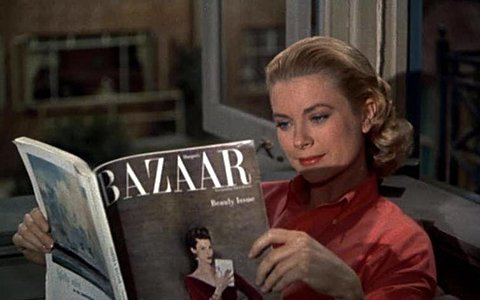
However, I'm still not sure that Jeff is worthy of Lisa because of the way he passively sat back and didn't do enough when Lisa was assaulted by Thorwald.  She might have daring and initiative, but he doesn't.  He is the sort of man who would not have enough backbone to take care of Lisa, or anyone else around him for that matter, when the going gets tough.  That's why I'm glad at the end of the film--after the murder has been solved, Jeff is sleeping contentedly with his two legs in a cast, and Lisa is sitting nearby wearing jeans and reading a book about foreign travel entitled "Beyond the High Himalayas"--she notices he is asleep, puts away the foreign travel book, and pulls out her Harper's Bazaar fashion magazine.  Even though she's modified her appearance and interests for the good of their relationship, she is still true to herself.  She would never completely lose her identity for Jeff.  At some point, if she ever decides that Jeff is not right for her, we know she has the will and strength to not be ruined by him and to still be ready for anyone worthy who comes along.