Sunday, October 27, 2013

Holly Harwood's Memorably Graceful Exit from "Dallas"


A few months ago I commented on the wrong way to write a character out of a TV show, but now I want to comment on the appropriate way to close out a character that had made a strong impact and impression upon a series.  Throughout the 1982-83 season of "Dallas," Lois Chiles gave a marvelous performance as intially-naive, but ultimately strong-willed oil heiress Holly Harwood.  After having inherited her father's oil company, Harwood Oil, after his death, she foolishly hires JR Ewing (Larry Hagman) to help her run it.  Rather than asking for traditional remuneration, JR asks for 25% ownership of Harwood Oil, which Holly agrees to give to him.  Holly would later regret this decision after she realizes that JR is using Harwood Oil assets to help give him an edge in his competition against his brother Bobby (Patrick Duffy) to win Ewing Oil.  Throughout the season, Holly often consulted with Bobby, who she found herself falling in love with.  After JR gets her involved in an illegal deal to sell oil to Cuba, Holly decides to manipulate JR's wife Sue Ellen (Linda Gray) into believing that they are having an affair in order to force Sue Ellen to issue an ultimatum with JR for him to cut all ties with Holly.


When Sue Ellen catches Holly and JR in bed, she goes on a bender that eventually leads to a tragic car accident that leaves Sue Ellen facing criminal charges and Ray Krebbs' cousin Mickey Trotter (Timothy Patrick Murphy) paralyzed from the neck down.  JR agrees to return his 25% share of Harwood Oil to Holly, but only if she pays him $20 million.  Bobby urges Holly not to pay JR for fear that the payment would put JR far ahead in the competition.  In the finale of that season, Holly attempts to stall JR by suggesting to him that she stagger the payments over a period of time.  JR at first refuses, but eventually relents, warning her not to take too long with the payments because "Holly Harwood is not on my list of all-time favorites."  It would have been easy to assume that that was the end of Holly Harwood on "Dallas," but in the next season the writers and producers of the show gave her a proper exit that also laid the groundwork for the long-term impact the character would have on the show.


When the show returned in the Fall, Holly was nowhere to be seen in the first four episodes.  It appeared as if her storyline was over and done with.  But Holly reappeared in the fifth episode of the season entitled "The Quality of Mercy," which aired October 28, 1983.  It would be the first of three appearances in the new season spread across three consecutive episodes.  In the first scene, Holly reappears when she interrupts a luncheon between Bobby and his ex-sister-in-law Katharine Wentworth (Morgran Brittany), who conspired with JR to break up Bobby's marriage with her half-sister Pam (Victoria Principal), and is scheming to win his affections now that he and Pam have divorced.  We learn that Holly left town for awhile to try and regain perspective on what has happened to her life in the last year.  Holly expresses condolences to Bobby for his divorce from Pam and apologizes to him for paying JR $20 million to leave her company.  Holly is surprised when Bobby informs her that he and JR have decide to call off the competition and split the company 50/50.  Lois Chiles expresses the right air of self-reflection and regret as she reacts to the news "That battle was so bitter!  I mean, I'm an outsider and look at the things that I did.  I suppose it changed all of us.  It's taken me quite awhile to start liking myself again."


Bobby admits how he understands the way Holly feels--and that it's taking him a long time to like himself again after all the scheming and manipulative things he did the previous season to try and win Ewing Oil.  In so doing, Bobby expresses a level of empathy for Holly's regrets and mistakes that puts the two characters on a level playing field.  After Bobby comments that he's glad to see Holly again, she breathes a sigh of relief and says, "Thank goodness.  It took all the courage I had to come talk to you....well because I know that I've done things that you don't approve of.  But you know how I always felt about you Bobby.  And I just wanted us to be friends again."  After Bobby assures Holly that "right now I could use all the friends that I can get," an irritated Katharine Wentworth attempts to interrupt this conversation by asking Bobby to order her another drink.


A wise and perceptive Holly immediately picks up on Katharine's personal interest in Bobby and refuses Bobby's offer to get her a drink as well.  The two women, both carrying an unreciprocated romantic interest in the same man, eye one another competitively across the table.  Both Lois Chiles and Morgan Brittany are marvelous in articulating the different modus operandi of these two women.  Chiles projects a directness and honesty in Holly's dealings with Bobby that strikes an interesting contrast with the devious manipulation that is Katharine's hallmark on the show.  I particularly like the way Holly evokes Katharine's quietly seething animosity when Holly asks Bobby out to dinner some night.  When Bobby tells Holly that he "wouldn't be very good company," Holly responds, "I'm willing to risk it if you are...I just thought that, for once, the two of us could sit down and have a civilized meal.  No business.  Just kind of get to know who we are.  Not Harwood Oil, not Ewing Oil, just us."


Bobby finally agrees, which further irritates Katharine, as he promises to contact Holly and set a date soon.  As Holly departs, I believe she is sincere when she says, "Nice meeting you Katharine.  I hope you'll forgive me for monopolizing Bobby like that."  Katharine leans forward, possessively marking her territory as Bobby's companion for this meal, and responds, "Oh that's all right.  We have plenty of time."  Amused and challenged by Katharine's maneuver, Holly lightly chuckles under her breath, rises from her seat and delivers another blow back at Katharine as she pointedly remarks, "And I think it's...admirable, you're helping Bobby get over your sister."  Recognizing how Holly has seen right through her underhandedness, Katharine smirks and says "Thank you," as an oblivious Bobby kisses Holly goodbye as she departs back to her office.  Bobby is so naive as to what's just transpired between these two women to such a degree that, after he comments, "Nice lady, isn't she?," he fails to recognize the sarcasm in Katharine's voice when she responds, "Wonderful."


This beautifully written, acted, and naunced scene is notable because it demonstrates the different tactics of two women who are clearly interested in Bobby and who hope that he might reciprocate their feelings now that he is divorced from Pam.  Despite Holly's manipulation of Sue Ellen, seducing JR so that his wife will catch them in bed together, she's essentially a straight-forward, honest individual who was driven to setting JR up out of desperation.  In all of her dealings with Bobby, she has been completely honest about her emotions and motives.  The previous season, when she attempted to seduce Bobby while dressed in a bathing suit at her pool, she is direct about her longings and desires for him.  Once Bobby makes it clear that he is a faithful husband, Holly stops trying to seduce him and instead forges a genuine friendship with him.  Even though she and Pam only encountered each other in one scene at the Ewing barbecue, I always had the impression that Holly, after being rejected by Bobby, genuinely respected, as well as envied, Pam's role as Bobby's wife.  She only waited until Bobby and Pam were divorced before making another effort to make her feelings to Bobby known.


In contrast, Katharine has no such respect for Pam's role as Bobby's wife, even though they are half-sisters.  She schemed with JR to break them up, and even forges a fake letter, purportedly from Pam to her attorney, that she shares with Bobby in order to make him believe that Pam no longer wanted to be married to him.  In contrast to Holly's directness and honesty where Bobby was concerned, Katharine continually operated in a state of deception and subterfuge.  She initially did not reveal to Bobby, until later, her own romantic feelings for him.  By not being honest with Bobby from the beginning, Katharine continued to allow herself to believe in a fantasy she had created in her mind that Bobby would eventually fall in love with her.  For all of her villainy, there was a delusional quality to Katharine that just seemed desperate.


The next time we see Holly is in the following episode "Check and Mate," which originally aired November 4, 1983.  Bobby and Holly are seen walking together at an outdoor shopping area, alongside an elaborate waterway, as they come from a distance and walk closer to a bridge, where the camera filming this scene is situated, so they can stop and confront each others feelings once and for all.  The first section of the scene is shot in one long, unbroken take, where we see both characters from a distance as they walk closer to us, the audience, until both characters have reached and stepped onto the bridge, upon which time the remainder of the vignette is dramatized in long shots and close-ups that underscore the divide that has come between them.  They chit chat about the end of the Battle for Ewing Oil competition, which is due to end the next day, and the wounds and damage that the competition has caused.  Holly attempts to be cheerful and hopeful as she reassures Bobby that "Wounds heal after awhile, at least mine do.  I'm not even so angry at JR anymore."  She then pointedly asks, "What about you Bobby?  Can you forget what happened?...with me and JR?"


Bobby curtly asks "Holly, what are you really saying?" A frustrated Holly admits, "It's hard to fall out of love."  Bobby becomes uncomfortable and attempts to deflect her statement by saying "Please, Holly," as she continues saying "And I was just wondering if I was gonna get another chance with you now that you're a free man."  Bobby's tone of voice becomes slightly impatient as he says "Look, Holly, we can be friends, we can help each other, but I can't see havin' the kind of relationship that you want to have."  A disappointed Holly continues pressing Bobby as she asks him "Tell me somethin'...is it because I set JR up that time?"  Bobby says, "I don't know, maybe."  Holly continues, "Is it because I set him up, or because I slept with him to do it?"  Bobby responds, "I don't know.  Maybe both."  A perceptive and slightly annoyed and frustrated Holly observes how "Men have such fragile egos.  If this conversation were reversed, and you'd done the sleeping and the setting up, you'd expect me to just forget about it.  You wouldn't care how I felt."  After having witnessed the way Bobby expected Pam to accept the scheming and blackmailing and manipulation that he resorted to in order to win Ewing Oil, we're not surprised how Bobby realizes the truth of Holly's statement and the hypocrisy of his perspective.  He acknowledges to Holly, "You know something, you might be right.  But I don't see myself changing, Holly."


A disappointed Holly accepts Bobby's rejection and says, "Guess that's the end of the road then.  Not that there ever really was a road for you and me."  In saying that, Holly reveals that she is not only direct and honest, she's also a realist, a point which is further emphasized a moment later, after Bobby tries to reassure her that they can remain friends.  A slightly bemused Holly scoffs, "Friends?  No, we won't.  I could never be comfortable being just your friend."  In so doing, Holly demonstrates how she is unwilling to live a fantasy, the way Katharine has, where she can accept crumbs and remain second-best by being just platonic friends with Bobby.  Holly appears to understand that remaining Bobby's friend will perpetuate a fantasy that he might some day become romantically interested in her.  In the previous episode, when she interrupted his lunch with Katharine, Holly expressed an interest in being friends with Bobby, which this scene later contradicts.  I believe Holly has changed her mind because, after witnessing Katharine's obvious interest in Bobby, and sensing how Bobby has no interest in his own ex-sister-in-law, Holly has seen for herself how desperate and fruitless it would be to cling to Bobby forever.  If Katharine is the dangerous delusional, then Holly remains the healthy realist who knows what she needs, and doesn't need, for herself.  She's willing to say goodbye to Bobby in order to retain her dignity. 


For her final scene with Bobby, the writers gave Lois Chiles a killer exit line.  Holly kisses Bobby on the cheek and, looking straight into his eyes, tells him "You know what really kills me?  There's someone out there, somewhere, who's gonna end up with you.  And it won't be me."  She then turns and walks away from Bobby forever, never looking back at him.  She leaves a dumbfounded Bobby speechless on the bridge, too stupid to understand how he has allowed this terrific lady to slip from his life.  Considering how the lady Bobby does end up with, the incredibly bland Ann Ewing (Brenda Strong) on TNT's new "Dallas," is not nearly as compelling or interesting a character as Holly Harwood was, it's not hard to understand Holly's frustration with the situation.


We might be forgiven in believing that Holly was over and done with, but in the following episode, "Ray's Trial," which aired November 11, 1983, the writers gave Holly an additional exit scene to tie up her character and storyline once and for all.  Having resolved her dangling, unrequited relationship with Bobby, the writers now focus on tying up her contentious dealings with his brother JR, who she has not encountered in about 6 episodes.  At the end of the previous episode, as the executor of Jock's estate, Punk Anderson, and the accountants and attorneys wrap up the last details of the competition for Ewing Oil that Bobby and JR's father has set up for them, JR attempts to break the deal that Bobby made with JR to stop the competition and split the company 50/50 by asking for a full audit of both their earnings that year.  It looks as if JR will end up the majority owner of Ewing Oil, if not for the last minute arrival of Bobby's Canadian business partners, who has shown up to bring Bobby a check for $26 million for his share of investing in drilling for oil in ice covered Canadian oil fields.  This puts Bobby far ahead of JR in the competition, making him the winner and majority owner of Ewing Oil.


At the start of the episode in "Ray's Trial," we find a grieving JR in a bar, drinking away his anger and frustration at losing the competition to Bobby and having to share in the company with him.  After telling his waitress to keep the drinks coming, a gloating Holly, grinning from ear-to-ear like a Cheshire cat, shows up to gloat about JR's failure.  Lois Chiles plays the scene with the right air of schadenfreude as she tells JR, "I just heard the most astounding news!  That you and Bobby are gonna run Ewing Oil side-by-side.  Share and share alike."  In contrast to the scene where Holly interrupted Bobby and Katharine's lunch, and Bobby graciously asked Holly if she would like a drink, when the waitress in this scene returns to JR's table, and asks Holly what she would like to drink, JR curtly remarks, "The lady's leavin'...aren't you?"  Holly continues gloating as she observes how "Looks like the only friend you've got left is in that glass.  I just think it's wonderful!  That despite all your manipulations, despite all your crooked deals, despite your hitting me up for $20 million bucks to get you out of my company, despite all that you still couldn't beat Bobby!"


JR attempts to save face by trying to make it appear that he and Bobby agreed to split up the company long before the final audit for the competition.  Holly slyly responds, "Maybe you did, but the way I heard it, you were gonna double cross Bobby.  It was Bobby who agreed to share Ewing Oil with you, not the other way around."  JR attempts to demean Holly by insinuating that she got the information as to what actually happened in the final audit room by having slept with one of the auditors, "or all of them as the case may be."  A sanguine Holly remarks, "Same old JR.  Losin' has done nothin' for your soul.  But I'm happy that you lost because you cost me the one thing in the whole world that I ever really wanted."  JR realizes that she is referring to his younger brother Bobby and encourages her to pursue him because "he's free now, honey.  You can go after him, free as a bird."


 A bitter Holly responds, "You made that impossible."  JR seems truly surprised at Holly's revelation "I did?  You mean because of that one night that I spent in your bed?  Oh, my saintly brother."  A disgusted Holly gets up from the table, as JR grabs her by the arm to finish his thought, "Darlin' I'd like to make a little toast...to the fact that you will never, ever be my sister-in-law.  And I want to thank you too, for reminding me how, how ethical my brother is.  It's a flaw in his character that eventually will cause his downfall in the oil industry.  I'm not finished yet, honey.  Not by a long shot.  Thank you, I'm feelin' better."  Holly wrests her arm out of JR's grasp as she turns and walks out of "Dallas" forever.


In so doing, the scene establishes several themes that will continue to dominate "Dallas" in seasons to come.  One is how Bobby will continue to have an aversion to any women who were romantically involved with his older brother.  In Bobby's eyes, they have become "tainted" for having been with JR.  JR uses this to make Katharine believe that Bobby will reject her once he finds out that she has been sleeping with his brother.  JR later causes Katharine to believe that he has played Bobby an audio tape of him and Katharine in bed together, which leads to Katharine to confess all of her sins to Bobby and destroys their friendship forever.  In later seasons, when Bobby is dating April Stevens (Sheree J. Wilson), JR attempts to blackmail April into doing his bidding or else he will tell Bobby about their previous romantic relationship.  He refers to Holly Harwood as an example of what April has to look forward to if she does not comply with JR.  April admits her relationship with JR to Bobby, which causes their breakup.  It's only later, when Bobby gets over his prudishness and realizes how much he loves April, that he can stop seeing women who were involved with JR as "fallen women."  In the 1988-89 season of "Dallas," Holly Harwood is once again mentioned when Sue Ellen is planning to produce a film about her life with JR and she tells Don Lockwood (Ian McShane), the writer/director she has hired, about Holly's scheme to have Sue Ellen catch her and JR in bed together.  Later, we see a scene being filmed where Sue Ellen and JR quarrel over his sexual involvement with "Molly Woodward."


The final scenes of Holly Harwood are notable in the prime time soap genre because they not only provided an appropriate finish for her character, but also established how she would continue to have a long term impact on the show.  She was not a character who came and left without a trace after she was gone.  Her specter continued to haunt "Dallas" for years to come.  What's great about Holly Harwood is that she never wore out her welcome on the show, the way other characters like Jenna Wade (Priscilla Presley) did.  In so doing, Holly left fans with good feelings for her character, rather than impatience and contempt.  After all these years, fans of "Dallas" continue to discuss Holly on fan message boards, and wonder whatever became of her.  I think this helps demonstrate how she was such a memorable and compelling presence on the show, which is why I imagine they would welcome an appearance from her character in the new TNT "Dallas" at some point.  Throughout her time on "Dallas," Lois Chiles admirably underplayed her scenes as Holly so that the humanity of the character continued to shine through.  She never overacted, the way others in the prime time soap genre are capable of doing, and the character never degenerated into camp.  Chiles' sincerity in her work ensured that that would never happen.  As with all great TV characters, Lois Chiles' Holly Harwood makes such a strong impact that she leaves you wanting even more from her. 

Saturday, September 7, 2013

Welcome Back, Arsenio Hall


A few months ago, a married couple who are good friends invited me over for dinner with their family.  We had a great time laughing and socializing and they both told me that they enjoyed having me over because I let them relax and just be themselves.  I thought that that was one of the greatest compliments that a person could receive--that somehow you were able to put people at ease that they didn't need to put on any airs and they could express themselves naturally.  Which brings me to Arsenio Hall.  I am very happy to see Arsenio Hall return to the late-night arena this coming Monday night with the revival of his 1989-1994 syndicated "The Arsenio Hall Show."  I have good memories of Hall and his show because he was part of my regular TV viewing during high school and college.  What I liked about Hall was the warmth and good humor that he brought to hosting a late night talk show.  There was never any cruel, self-satisfied, post-modern snarkiness from Hall that I see from too many late night talk show hosts these days.  He just seemed like the kind of regular guy that you wanted to have as your friend and who always seemed to bring joy to any situation.


I first became aware of Arsenio Hall when he became one of a series of temporary hosts that the newly launched Fox Network had hired to replace original host Joan Rivers on "The Late Show" after they had fired her back in 1988.  He was funny and irreverent and kept me in stitches.  I recall how Hall, as far back as "The Late Show," dispensed with interviewing people from behind a desk and set up an easy chair in its place so that he and his interviewees could be more at ease with one another.  I still remember the time he had Eddie Murphy on as a surprise guest on "The Late Show," probably the most exciting episode of that short-lived talk show.  I was always disappointed everytime I tuned into "The Late Show" and found one of the other alternate hosts were on that night instead of Hall.  As such, I was very excited when I heard later in 1988 how Paramount had signed a deal with Hall for him to host his own self-titled talk show starting in January 1989.  I was fully prepared to welcome him into my home when his show debuted.  He had great guests, great music, and always asked great questions.


What I liked about Hall was how he let his guests be themselves, allowed them to shine and talk about what they wanted, and never tried to impose his own subjective viewpoint on them.  Occasionally, he could pull a joke on them, but it was never cruel and was always funny.  I recall the time he had Kirstie Alley on his show and screened a clip from an unsold 1983 NBC TV pilot called "Highway Honeys" that she did early in her career.  Alley laughed good naturedly as Hall dredged up this skeleton from her past and didn't seem angry or annoyed at his cheeky display of humor.  Rather, showing the clip appeared to help Alley put into context how far she had come in her career so that it was a positive look at her past, rather than something embarrassing.  I'll also never forget the night Arsenio Hall surprised Eddie Murphy on his show with an appearance by Michael Jackson, who was there to present an MTV Viewer's Choice Award to Murphy for his brilliant career in comedy.  If there were surprises on Arsenio Hall's show, it was always to enhance the people who were on, rather than the other way around (as it too often is on talk shows these days.) 


The thing about Hall that I always remember is what a good listener he was to all of his guests.  It always appeared to me that he was excited to be in that job and he really wanted to get to know who his guests were.  As such, he allowed them room to discuss the things that were on their mind.  This quality was evident in Hall even back when he hosted "The Late Show" on FOX before he got his own show.  I recall one instance when actress Margaret Ladd, who played Emma on "Falcon Crest," was making a guest appearance on "The Late Show."  After Hall introduced Ladd, and described her character on her series as "the mentally deranged Emma Channing," Ladd diplomatically disagreed with that description of Emma and took the time to describe how Emma was a much more nuanced character than that.  Hall never seemed annoyed with how Ladd was correcting his description of her character and allowed her room to express herself.  You'd never see that with Letterman or even Leno, who probably wouldn't have even allowed Ladd to get in a word edgewise.


One of my favorite segments on the original "Arsenio Hall Show" was when Margaret Ladd's colleague from "Falcon Crest," Ana Alicia, appeared on the May 16, 1989 segment in order to discuss her return to "Falcon Crest" after the new producers in Season 8 had decided to kill off her character, Melissa Agretti.  You can see the interview on YouTube here.  I really appreciated the way Hall acknowledged what had happened to Ana Alicia--and also acknowledged the frustrations of fans like myself who hated the creative decisions the new producers made that season--when he said "Well, obviously they (the new producers) don't know what they're doing because you make decisions for demographics and the fans didn't agree at all with what they did."  It was good to have someone prominent in the media underscore the importance of Ana Alicia's contribution to "Falcon Crest," as well as validate the feelings of frustrated fans like myself.  But, more importantly, Hall gave us a good interview with Ana Alicia that night where he was respectful, yet playful, and the two had genuine rapport and chemistry playing off of one another that you just can't manufacture.

 
At one point in the interview, Ana Alicia good-naturedly ribs Arsenio Hall for having asked her friend and "Falcon Crest" colleague Lorenzo Lamas, when he was on the show two months earlier, about Apollonia while Lamas was discussing his working relationship with Ana Alicia.  Hall becomes sincerely bashful, assures her that he has seen her work on "Falcon Crest" and knows who she is, but explains that "You know, I guess I just had this thing for Apollonia, you know, since she was a Rams cheerleader, you know, even before she was into television."  When Ana Alicia reassures Hall she isn't offended, he suddenly interjects "Have you ever seen (Apollonia's) nude scene in 'Purple Rain'?...You know what I mean?  Once you take off some leather on 'Falcon Crest' and jump in the water, I'll be asking about you all over town!"  I remember how Hall's comedic timing at that moment brought down the house.  But what made the moment work was the fact that Hall remained respectful of Ana Alicia's dignity even while playfully bantering with her.  Hall was laughing along with her throughout this segment, which is why it came off so endearing, charming and funny.


Later in the interview, when Hall asks Ana Alicia if she's married, without missing a beat, she responds with "No, are you asking?" to which Hall playfully retorts "If that skirt goes up any higher, I might!"  Moments later in the interview, Ana Alicia asks Hall if he's ever conducted an interview with a guest sitting on his lap, leading him to invite her to sit on his lap, which causes the audience to go wild.  Ana Alicia jokes, "This is really intimate here" to which Hall responds "Johnny would never give you this, baby!"  When Ana Alicia gets up and sits back down on the couch, Hall playfully exclaims "I was fine!" and sits on her lap for the remainder of the segment.  Even though they are being playful and flirtatious with one another, it never becomes undignified because Hall's respect for Ana Alicia as an individual still registers strongly.  Both individuals know just how far to take the playful bantering without ever going over the line.  She even gets an opportunity during this part of the interview to discuss her new movie "Romero" (1989) with Raul Julia in a substantive and sincere manner.  As Ana Alicia describes the movie to Hall, she jokes "I feel like I'm telling a good-night story!" before the segment wraps up with Ana Alicia and Arsenio Hall giving one another a heartfelt and sincere hug.  I remember seeing this segment when it first aired and laughing all the way through it because Hall touched upon all of the subjects I wanted to hear about--Ana Alicia's return to "Falcon Crest" and her new movie "Romero"--as well as the fact that it allowed the viewer an opportunity to get to know who these two people are as individuals.  (Hall and Ana Alicia have such great chemistry together, it's too bad the two of them have not worked together in a scripted comedy movie or TV show.)  I felt at the time, and still feel now, that this was the perfect example of how an interview segment on a late-night talk show should be--funny, energetic, and full of good humor and warmth.


Over two decades later, Arsenio Hall's innate kindness and respect still leaves a lasting and vivid impression on guests from his original show like Ana Alicia.  She recently recalled how "I was blessed to have been on Arsenio's show twice, and I found him to be a real gem of a human being.  He was as kind and funny off the show as he was on, which is unusual in the talk show circuit.  He was always supportive and, from my experience, had a great deal of respect for women, which I--as a young actress--truly appreciated.  I wish him the greatest success in his comeback, and I will be watching and rooting him on."  She's not the only one who wishes Arsenio Hall well.  There are many so-called "Generation X-ers," now in our early 40s, who have fond memories of watching Hall in our dorm rooms after a long day of classes and studying.  He was a good role model for young people in the early 1990s and set a good example of how hard work, talent, and kindness is always preferable to cruelty, sarcasm, and snarkiness (which characterizes too much of the media these days).  I also wish him all the best and expect to see him around for years to come.  Welcome back, Arsenio Hall. 

Tuesday, August 13, 2013

Two and a Half Bond Girls on "The Fall Guy"


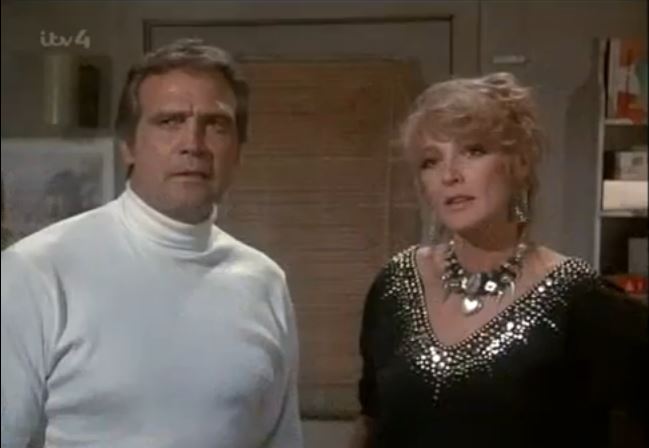
In 1984, in the wake of the dueling James Bond movies that were released the previous year--the official Cubby Broccoli produced Bond film "Octopussy" (1983) starring Roger Moore and the unofficial "Never Say Never Again" (1983) starring Sean Connery--the Lee Majors adventure television series about a veteran stuntman who moonlights as a bounty hunter, "The Fall Guy" (1981-86), did a tongue-in-cheek episode that paid tribute to all things James Bond entitled "Always Say Always," which aired February 22, 1984.  The title of this episode was itself a pun on the title of the aforementioned Sean Connery Bond movie.  In the storyline, Lee Majors' character Colt Seavers is in Hong Kong working on a fictional James Bond movie called "Always Say Always."  While over there, Colt and his colleagues Howie Munson (Doug Barr) and Jody Banks (Heather Thomas) become involve in a hunt for three Ming vases that involves unscrupulous smugglers (played by James Hong and Barry Ingham), a well-meaning art expert trying to find the vases and also clear his name of a murder charge (played by pre-"Star Trek: The Next Generation" Jonathan Frakes), and Chinese government agents (among them, famed character actor Soon-Tek Oh, who appeared in the 1974 James Bond movie "The Man with the Golden Gun) who are trying to ensure that the vases do not end up in the wrong hands.


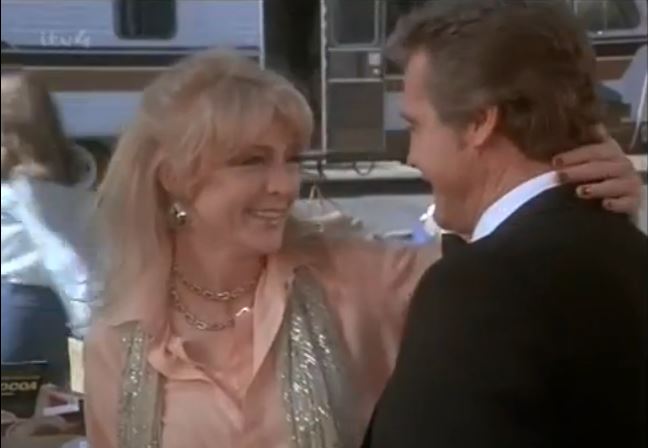
The most interesting aspect of this charmingly lame and goofy episode was how the story integrated the presence of Two and a Half former Bond Girls, playing themselves in this episode, who are supposed to be on-location reprising their prior Bond movie roles in this fictitious "Always Say Always" movie.  The Two Full-Fledged Bond Girls are Britt Ekland, who played Mary Goodnight in "The Man with the Golden Gun" (1974), and Lana Wood, who played Plenty O'Toole in "Diamonds are Forever" (1971).  The "Half" Bond Girl is Joanna Pettet, who played Mata Bond, one of the female leads in the James Bond spoof "Casino Royale" (1967), which was loosely based on Ian Fleming's first James Bond novel.  One of the amusing conceits of this episode is the presumption that there would ever be a James Bond movie where a prior love interest would ever return, something that's never happened in any of the real Bond pictures.  The other amusing conceit is the presumption, if there were to be a Bond picture with a prior love interest coming back and being involved in a new adventure, out of all the iconic Bond Girls who brightened the series, that they would be the ones who would be asked to return.


Despite whatever virtues these women have to offer, they hardly represented the best Bond Girls the series had to offer.  Britt Ekland has always been considered one of the weakest of all the James Bond Girls, chastised for having given a whiny and unsympathetic characterization in her Bond picture.  Lana Wood, while appealing and charming, had a very brief role in "Diamonds are Forever" and was killed off within minutes in the storyline of her movie.  As such, the likelihood of her ever returning in a future Bond movie was particularly dim.  And Joanna Pettet, who had the best part and gave the best performance of any of these three actresses in her so-called "Bond" movie, suffers simply by virtue of the fact that her "Casino Royale" was not part of the official series of James Bond movies.


As such, we're left with a second-rate group of Bond Girls in a James Bond tribute episode that shamelessly cuts corners left-and-right by utilizing stock footage, attempts to substitute obvious California locations in place of actually filming in Hong Kong (at one point, in a sequence that is supposed to take place at a construction site, you can see the office buildings that comprise the Century City section of Los Angeles in the background), utilizes cheesy faux-Bond inspired musical cues to try and emulate Monty Norman's famous James Bond theme song, and concludes with a toothless cover version of Carly Simon's "Nobody Does it Better"--the theme song from "The Spy Who Loved Me" (1977)--playing over the end credits.  Somehow, the episode manages to rise above all of these deficiencies and still delivers an entertaining hour of television.


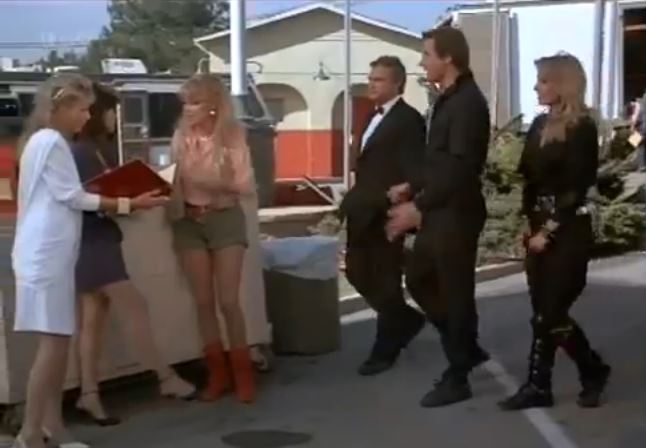
It's hard not to be amused with this episode right from get-go during the scene where Lee Majors' Colt Seavers, along with his partners Howie and Jody, spot the Bond Girls intently studying the script and going over their lines together.  In this fantasy-reality of Hollywood, these former Bond Girls are chummy and hold no grudges or competitiveness against one another.  The scene then establishes how each of the Bond Girls already know Colt Seavers personally and how each are very attracted to him.  (It's suggested that Colt may have had a prior relationship while working with each of them on their previous Bond movie.)  As "Joanna Pettet" tells Colt "I saw the stunt.  You haven't changed a bit!  You're still going for the brass ring!"  Then "Lana Wood" tells Colt "I'm always amazed how easy you make everything look!"  And finally "Britt Ekland" tells him "You appear to be in great shape!"


The scene then becomes a delightfully embarrassing mass of self-indulgence as the hapless Howie character ends up putting his foot in the mouth by complimenting "Joanna Pettet" on her performance as Plenty O'Toole, only to have her correct him by saying "Well, actually, I wasn't Plenty O'Toole.  I was Mata Bond.  But that's OK."  Howie then compliments a crestfallen "Lana Wood" on her performance as Mary Goodnight," only to have an indignant "Britt Ekland" interject, "Howie, I was Mary Goodnight."  As tacky as this scene sounds, I admired how it acknowledged the actual roles that each of these actresses played in their Bond movies, makes a joke about how some people find the actresses who played Bond Girls interchangeable, and then concludes by emphasizing that each and every one of them are actually their own unique individual and personality.


Throughout the episode, each of the former Bond Girls becomes involved with helping Colt and his crew in the search for the missing Ming vases.  Britt Ekland does absolutely nothing with her vignette, a final-act storyline where her character is kidnapped by the smugglers and held hostage in exchange for Colt returning the vases to their custody.  Ekland pouts and ambles through the proceedings with her usual air of haughty indifference, causing no damage but also adding nothing to the proceedings at the same time.  Ekland is particularly poor during the scene where the villains threaten to pump her with narcotics in order to make it appear that she died from a self-inflicted drug overdose.  Her emphatic line readings and facial expressions throughout the scene painfully underscores the extent to which she over emotes.


Lana Wood does better with a disappointingly short sequence where she charms a fawningly admiring British official into using his influence to help Colt and his team in the search for the coffin containing the Ming vases.  Even though it's a short sequence, Wood has the right air of conniving charm and light-hearted bantering.  She does particularly well with the double-take she registers when the British official informs her that his wife died at his country club's last golf tournament, and that they'll be dining alone.  It's too bad that the script doesn't allow her to get more involved in the action, as she is clearly game under the circumstances.  In contrast to Ekland, Wood tries hard to do as much as she can within the confines of the thin material and her professionalism is admirable. 


In the end, it's Joanna Pettet who walks off with the acting honors, as the script gives her the most substantive role to play of all of the "Bond Girls" appearing in this episode.  She is the one who inadvertently makes contact with Jonathan Frakes' art expert; convinces Colt Seavers to meet him at an acupuncture clinic in a dangerous part of Hong Kong in order to help him; is kidnapped by the villains; ends up in a car chase where Colt arrives by helicopter to rescue her; kicks her kidnapper in the shin so that he loses his weapon and is knocked unconscious by Colt; takes Colt to where Jonathan Frakes is hiding; witnesses two henchman enter the room and get the upper hand on Colt, Howie and Jonathan Frakes; and has the presence of mind to knock the remaining henchman unconscious by smashing a chair over his head.  In so doing, Pettet demonstrates the vivacious sense of adventure that she projected in "Casino Royale" while playing Mata Bond and even gets to make some fast and funny quips.


When Pettet comments how the neighborhood Jonathan Frakes is hiding at "is the sort of place where anything's for sale," Heather Thomas' sardonic Jody observes "Sounds like Hollywood," only to have Pettet wryly quip "With an egg roll on the side."  During the car chase, when Pettet's kidnapper asks her where Jonathan Frakes went to after she spoke with him, she petulantly pouts, "How should I know?  I'm an actress, not a tour guide."  When she knocks out one of the smuggler's henchman by smashing the chair over his head, a flustered Pettet jokes, "Well, it's not exactly an autograph, but he won't forget me!"  At the end of the episode, when Howie attempts to compliment Ekland, Wood and Pettet by indicating that their roles in Bond movies have ensured their places in film history, Pettet effectively mimics the voice of an elderly lady and jokes "Lordy, Lordy.  Where's my wheelchair?"  Pettet makes the most of the episode and appears to be enjoying herself even when it's clear that she's probably only doing this TV guest appearance for the remuneration.  (She also indirectly inspires the funniest line in this episode.  When villainous police inspector Barry Ingham informs James Hong's smuggler that a beautiful actress--Pettet--has become involved in the search for the Ming vases, an exasperated Hong bombastically reminds him, "There are many beautiful women in this world, but only three Ming Dynasty vases!") 


"The Fall Guy" episode "Always Say Always" remains one of the most elaborate examples of celebrating both the iconic images and motifs connected with the world of James Bond, as well as the individual contributions of the actors and actresses associated with the series.  For many Bond Girls--as well as the male actors who have appeared in the series--their Bond movie appearance is often the acting credit they can point to, out of many, that continues to be their calling card to be remembered in the annals of cinema. The episode underscores the fact that Britt Ekland and Lana Wood will always be remembered as Bond Girls, and I'm also glad it included Joanna Pettet in order to acknowledge her tangential, but ultimately undeniable, connection to the world of 007.  The episode is also unique in that it directly acknowledges the contributions of almost every variation of James Bond films up until that time.  The presence of Ekland, Wood and Soon-Tek Oh (and the use of "Nobody Does it Better" over the end credits) directly acknowledges the films of Sean Connery and Roger Moore in the official EON Productions-produced Bond films.  The presence of Joanna Pettet acknowledges the unofficial Charles Feldman-produced "Casino Royale" in 1967.  And, as indicated earlier, the title of the episode "Always Say Always" references the unofficial Warner Brothers-released Bond film "Never Say Never Again," which was Sean Connery's one-shot return to the role.  At the time, the series was only 22 years old, but James Bond had already made a strong enough  impact upon pop culture to inspire this unofficial tribute.  As Bond spoofs go, "The Fall Guy" episode "Always Say Always" still holds up as good, gimmicky fun.