Showing posts with label Diamonds are Forever. Show all posts

Tuesday, August 13, 2013

Two and a Half Bond Girls on "The Fall Guy"


In 1984, in the wake of the dueling James Bond movies that were released the previous year--the official Cubby Broccoli produced Bond film "Octopussy" (1983) starring Roger Moore and the unofficial "Never Say Never Again" (1983) starring Sean Connery--the Lee Majors adventure television series about a veteran stuntman who moonlights as a bounty hunter, "The Fall Guy" (1981-86), did a tongue-in-cheek episode that paid tribute to all things James Bond entitled "Always Say Always," which aired February 22, 1984.  The title of this episode was itself a pun on the title of the aforementioned Sean Connery Bond movie.  In the storyline, Lee Majors' character Colt Seavers is in Hong Kong working on a fictional James Bond movie called "Always Say Always."  While over there, Colt and his colleagues Howie Munson (Doug Barr) and Jody Banks (Heather Thomas) become involve in a hunt for three Ming vases that involves unscrupulous smugglers (played by James Hong and Barry Ingham), a well-meaning art expert trying to find the vases and also clear his name of a murder charge (played by pre-"Star Trek: The Next Generation" Jonathan Frakes), and Chinese government agents (among them, famed character actor Soon-Tek Oh, who appeared in the 1974 James Bond movie "The Man with the Golden Gun) who are trying to ensure that the vases do not end up in the wrong hands.


The most interesting aspect of this charmingly lame and goofy episode was how the story integrated the presence of Two and a Half former Bond Girls, playing themselves in this episode, who are supposed to be on-location reprising their prior Bond movie roles in this fictitious "Always Say Always" movie.  The Two Full-Fledged Bond Girls are Britt Ekland, who played Mary Goodnight in "The Man with the Golden Gun" (1974), and Lana Wood, who played Plenty O'Toole in "Diamonds are Forever" (1971).  The "Half" Bond Girl is Joanna Pettet, who played Mata Bond, one of the female leads in the James Bond spoof "Casino Royale" (1967), which was loosely based on Ian Fleming's first James Bond novel.  One of the amusing conceits of this episode is the presumption that there would ever be a James Bond movie where a prior love interest would ever return, something that's never happened in any of the real Bond pictures.  The other amusing conceit is the presumption, if there were to be a Bond picture with a prior love interest coming back and being involved in a new adventure, out of all the iconic Bond Girls who brightened the series, that they would be the ones who would be asked to return.


Despite whatever virtues these women have to offer, they hardly represented the best Bond Girls the series had to offer.  Britt Ekland has always been considered one of the weakest of all the James Bond Girls, chastised for having given a whiny and unsympathetic characterization in her Bond picture.  Lana Wood, while appealing and charming, had a very brief role in "Diamonds are Forever" and was killed off within minutes in the storyline of her movie.  As such, the likelihood of her ever returning in a future Bond movie was particularly dim.  And Joanna Pettet, who had the best part and gave the best performance of any of these three actresses in her so-called "Bond" movie, suffers simply by virtue of the fact that her "Casino Royale" was not part of the official series of James Bond movies.


As such, we're left with a second-rate group of Bond Girls in a James Bond tribute episode that shamelessly cuts corners left-and-right by utilizing stock footage, attempts to substitute obvious California locations in place of actually filming in Hong Kong (at one point, in a sequence that is supposed to take place at a construction site, you can see the office buildings that comprise the Century City section of Los Angeles in the background), utilizes cheesy faux-Bond inspired musical cues to try and emulate Monty Norman's famous James Bond theme song, and concludes with a toothless cover version of Carly Simon's "Nobody Does it Better"--the theme song from "The Spy Who Loved Me" (1977)--playing over the end credits.  Somehow, the episode manages to rise above all of these deficiencies and still delivers an entertaining hour of television.
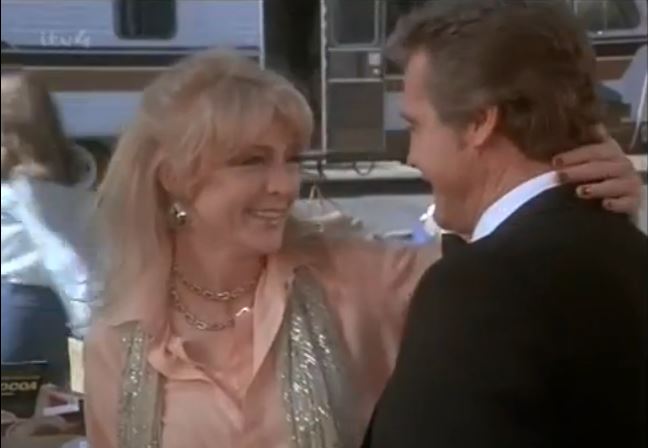

It's hard not to be amused with this episode right from get-go during the scene where Lee Majors' Colt Seavers, along with his partners Howie and Jody, spot the Bond Girls intently studying the script and going over their lines together.  In this fantasy-reality of Hollywood, these former Bond Girls are chummy and hold no grudges or competitiveness against one another.  The scene then establishes how each of the Bond Girls already know Colt Seavers personally and how each are very attracted to him.  (It's suggested that Colt may have had a prior relationship while working with each of them on their previous Bond movie.)  As "Joanna Pettet" tells Colt "I saw the stunt.  You haven't changed a bit!  You're still going for the brass ring!"  Then "Lana Wood" tells Colt "I'm always amazed how easy you make everything look!"  And finally "Britt Ekland" tells him "You appear to be in great shape!"
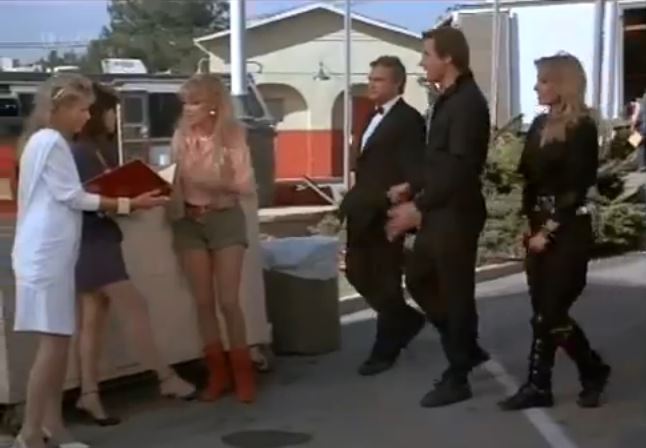

The scene then becomes a delightfully embarrassing mass of self-indulgence as the hapless Howie character ends up putting his foot in the mouth by complimenting "Joanna Pettet" on her performance as Plenty O'Toole, only to have her correct him by saying "Well, actually, I wasn't Plenty O'Toole.  I was Mata Bond.  But that's OK."  Howie then compliments a crestfallen "Lana Wood" on her performance as Mary Goodnight," only to have an indignant "Britt Ekland" interject, "Howie, I was Mary Goodnight."  As tacky as this scene sounds, I admired how it acknowledged the actual roles that each of these actresses played in their Bond movies, makes a joke about how some people find the actresses who played Bond Girls interchangeable, and then concludes by emphasizing that each and every one of them are actually their own unique individual and personality.


Throughout the episode, each of the former Bond Girls becomes involved with helping Colt and his crew in the search for the missing Ming vases.  Britt Ekland does absolutely nothing with her vignette, a final-act storyline where her character is kidnapped by the smugglers and held hostage in exchange for Colt returning the vases to their custody.  Ekland pouts and ambles through the proceedings with her usual air of haughty indifference, causing no damage but also adding nothing to the proceedings at the same time.  Ekland is particularly poor during the scene where the villains threaten to pump her with narcotics in order to make it appear that she died from a self-inflicted drug overdose.  Her emphatic line readings and facial expressions throughout the scene painfully underscores the extent to which she over emotes.


Lana Wood does better with a disappointingly short sequence where she charms a fawningly admiring British official into using his influence to help Colt and his team in the search for the coffin containing the Ming vases.  Even though it's a short sequence, Wood has the right air of conniving charm and light-hearted bantering.  She does particularly well with the double-take she registers when the British official informs her that his wife died at his country club's last golf tournament, and that they'll be dining alone.  It's too bad that the script doesn't allow her to get more involved in the action, as she is clearly game under the circumstances.  In contrast to Ekland, Wood tries hard to do as much as she can within the confines of the thin material and her professionalism is admirable. 


In the end, it's Joanna Pettet who walks off with the acting honors, as the script gives her the most substantive role to play of all of the "Bond Girls" appearing in this episode.  She is the one who inadvertently makes contact with Jonathan Frakes' art expert; convinces Colt Seavers to meet him at an acupuncture clinic in a dangerous part of Hong Kong in order to help him; is kidnapped by the villains; ends up in a car chase where Colt arrives by helicopter to rescue her; kicks her kidnapper in the shin so that he loses his weapon and is knocked unconscious by Colt; takes Colt to where Jonathan Frakes is hiding; witnesses two henchman enter the room and get the upper hand on Colt, Howie and Jonathan Frakes; and has the presence of mind to knock the remaining henchman unconscious by smashing a chair over his head.  In so doing, Pettet demonstrates the vivacious sense of adventure that she projected in "Casino Royale" while playing Mata Bond and even gets to make some fast and funny quips.
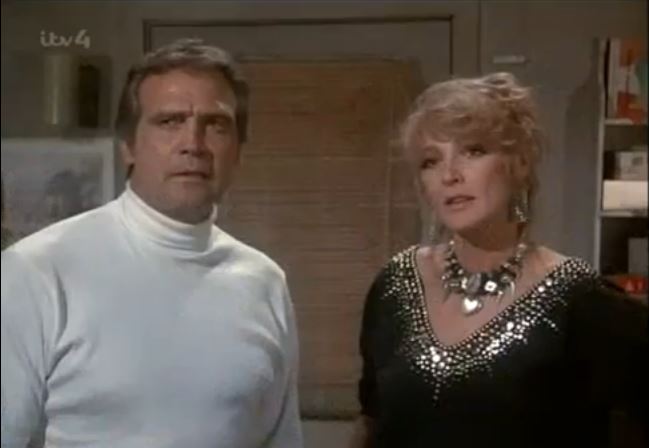

When Pettet comments how the neighborhood Jonathan Frakes is hiding at "is the sort of place where anything's for sale," Heather Thomas' sardonic Jody observes "Sounds like Hollywood," only to have Pettet wryly quip "With an egg roll on the side."  During the car chase, when Pettet's kidnapper asks her where Jonathan Frakes went to after she spoke with him, she petulantly pouts, "How should I know?  I'm an actress, not a tour guide."  When she knocks out one of the smuggler's henchman by smashing the chair over his head, a flustered Pettet jokes, "Well, it's not exactly an autograph, but he won't forget me!"  At the end of the episode, when Howie attempts to compliment Ekland, Wood and Pettet by indicating that their roles in Bond movies have ensured their places in film history, Pettet effectively mimics the voice of an elderly lady and jokes "Lordy, Lordy.  Where's my wheelchair?"  Pettet makes the most of the episode and appears to be enjoying herself even when it's clear that she's probably only doing this TV guest appearance for the remuneration.  (She also indirectly inspires the funniest line in this episode.  When villainous police inspector Barry Ingham informs James Hong's smuggler that a beautiful actress--Pettet--has become involved in the search for the Ming vases, an exasperated Hong bombastically reminds him, "There are many beautiful women in this world, but only three Ming Dynasty vases!"


"The Fall Guy" episode "Always Say Always" remains one of the most elaborate examples of celebrating both the iconic images and motifs connected with the world of James Bond, as well as the individual contributions of the actors and actresses associated with the series.  For many Bond Girls--as well as the male actors who have appeared in the series--their Bond movie appearance is often the acting credit they can point to, out of many, that continues to be their calling card to be remembered in the annals of cinema. The episode underscores the fact that Britt Ekland and Lana Wood will always be remembered as Bond Girls, and I'm also glad it included Joanna Pettet in order to acknowledge her tangential, but ultimately undeniable, connection to the world of 007.  The episode is also unique in that it directly acknowledges the contributions of almost every variation of James Bond films up until that time.  The presence of Ekland, Wood and Soon-Tek Oh (and the use of "Nobody Does it Better" over the end credits) directly acknowledges the films of Sean Connery and Roger Moore in the official EON Productions-produced Bond films.  The presence of Joanna Pettet acknowledges the unofficial Charles Feldman-produced "Casino Royale" in 1967.  And, as indicated earlier, the title of the episode "Always Say Always" references the unofficial Warner Brothers-released Bond film "Never Say Never Again," which was Sean Connery's one-shot return to the role.  At the time, the series was only 22 years old, but James Bond had already made a strong enough  impact upon pop culture to inspire this unofficial tribute.  As Bond spoofs go, "The Fall Guy" episode "Always Say Always" still holds up as good, gimmicky fun.

Tuesday, March 12, 2013

A Grudging Reassessment of Jill St. John


One of my least favorite actresses of all time is Jill St. John.  I dislike her about as much as I dislike Morgan Fairchild.  There are a couple of reasons I don't like her.  I've heard enough stories from various 1960s starlets I've gotten to know personally that she sounds like someone I would not enjoy spending time with.  I also never really thought she was sexy and attractive and found her voice very harsh and severe, particularly when she tried to make it sound breathy and light for the comedy roles she was dreadfully unsuited for.  Her voice has the uncanny ability of being both grating and whiny at the same time.  As such, she was never really well-cast in the roles she played throughout her career because she was never funny nor sympathetic in the comedies she was often cast in.  She's also my least favorite Bond Girl, playing the tawdry Tiffany Case in "Diamond's are Forever" (1971).  Coming after the sublime Diana Rigg in "On Her Majesty's Secret Service" (1969), St. John was particularly crass and unappealing as she brought little warmth or depth to that role.  I don't really understand why St. John ends up on some people's lists of favorite Bond Girls.  She and Sean Connery lack any genuine chemistry with each other.  I guess some people really are fooled by her looks, which I always found kind of plastic and artificial.


I must admit that one reason I never liked St. John is because I feel she got the roles that Tina Louise, who I acknowledge is my favorite actress, should have gotten.  Tina Louise and Jill St. John are sometimes compared and confused with one another because they are both shapely, red-haired actresses whose hey-day was the 1960s and early 1970s.  I used to wish that Tina Louise had been Tiffany Case opposite Sean Connery, and had acted in major movies with the likes of Vivien Leigh (in 1961's "The Roman Spring of Mrs. Stone"), Jason Robards (in 1962's "Tender is the Night"), Jerry Lewis (in 1963's "Who's Minding the Store?), and various members of The Rat Pack (in 1963's "Come Blow Your Horn" and "Who's Been Sleeping in My Bed?" and 1967's "Tony Rome") the way St. John did.  Even though St. John worked opposite such legends, her own work was not as impressive.  As DVD Savant reviewer Glenn Erickson said, in his review of "The Roman Spring of Mrs. Stone" (1961), "Even though she's playing to type, Jill St. John is unconvincing even being an unconvincing starlet; when she's in the same frame with Vivien Leigh, it's like a fine engraving standing next to a crayon squiggle."  (Erickson went even further, in a recent review of 1966's "The Liquidator" on DVD when he opined, "Jill St. John's sex appeal has always eluded me.  Although I understand she's a very intelligent woman, I think her voice has always sounded hollow and unappealing, almost as if she doesn't know English and is speaking phonetically.")


I completely agree with the ever-perceptive Erickson, as his comments reflect St. John's utter lack of charm and acting ability.  But, as I've grown older, even though I still like Tina Louise better overall, I also acknowledge her faults and weaknesses as they help to illuminate Jill St. John's strengths, such as they are.  Even though I still believe she was an underrated actress, and much more talented than Jill St. John ever was, Tina Louise suffered from being overly self-conscious about proving herself as a serious actress.  As a result, she turned down roles in "Operation Petticoat" (1959), a blockbuster hit which would have gone a long way to helping her establish herself as a genuine leading lady in motion pictures, and the TV movie "Rescue from Gilligan's Island" (1978), which she should have done if for no other reason than for old time's sake and to also help foster good will with both her former co-stars and, more importantly, fans of the show, who resent her to this day for acting as if she was better than everyone involved by turning down that movie.  If she had done that movie, it would have given Bob Denver, Russell Johnson and, especially, Dawn Wells less ammunition to publicly attack her for her decision to try and disassociate herself from the series in order to forge a serious acting career.  (Louise foolishly plays into their pettiness by not taking proactive measures to generate good will with the public that would help to counteract their attacks on her.) 


This is not an easy thing to write because I am a big Tina Louise fan and have always enjoyed her work and sincerely believe she had the ability to evoke moments of depth, nuance, and subtlety that Jill St. John never could.  However, I feel Louise is often her own worst enemy by being too headstrong and making bad choices for herself.  Rather than foolishly going off to Italy in 1960, just as her film career was getting underway, to make movies that nobody cared about, she should have stayed in Hollywood and prevented people like Jill St. John and Stella Stevens from getting roles she would've done great things with.  Louise should also have not turned down acting roles when she returned to the United States just to spend a year studying with Lee Strasberg at the Actors Studio.  Even if it helped her hone her craft, it kept her out of sight and allowed her competitors an opportunity to establish themselves in the film community in her absence.  I can't imagine Jill St. John doing anything as counter-productive as that.  Tina Louise also needs to stop giving interviews where she refuses to discuss her acting career and only wants to talk about her volunteer work in New York City as a literacy volunteer.  While I respect the fact that she wants to live in the present and appears to be a conscientious person who is interested in current events (and does not want to be a Norma Desmond-like figure living in the past touting her decades-ago acting roles like Francine York) Tina Louise needs to also realize that the only reason why people are even interested in her is because she was once an actress.  I can understand if she doesn't want to only discuss "Gilligan's Island" all of the time, because she has done a lot of other films and TV shows worth noting, but if she doesn't even want to discuss "God's Little Acre" (1958) or "The Stepford Wives" (1975), what does she expect people to discuss with her?  Her philosophies on life?


On the other hand, even though I don't like Jill St. John and don't think she was as versatile an actress as Tina Louise (St. John never had the ability to change her voice to fit the role she was playing the way Louise did), I have grown to grudgingly respect her streetwise shrewdness in handling her career.  With a rail-thin acting range, St. John managed to forge a film career in the 1960s appearing in some major productions opposite some of the biggest stars of the period.  She was much wiser in promoting herself as an actress than Tina Louise ever was, which is why St. John ended up making major movies during that time, playing mostly lead roles, and Tina Louise ended up on "Gilligan's Island" and appearing in minor films where she played supporting parts with limited screentime.  Clearly, St. John made friends with the right people in Hollywood.  One reason why I have started to see St. John in a slightly (only slightly) different light is because I've seen her in a few things she made later in her career where I thought she was more effective than I expected.  Cast in unsympathetic, villainous roles in the 1980s, I realized that St. John was miscast earlier in her career playing sympathetic leads and comedic bombshell roles.  She was too hard, cold and brittle to be truly effective in those kinds of parts.  However, when cast in roles allowing her to play treacherous, evil, malevolent, and cruel women, St. John truly thrived.  It's not that she necessarily demonstrated here-to-fore untapped acting talent in these roles.  It's that these roles appeared to tap into unsympathetic mannerisms and aspects of her screen personality that made her ideal to play them. 


St. John gave a good performance as evil Warden Fletcher in the women's prison drama "The Concrete Jungle" (1982).  A less exploitative, more credible example of the genre than "Chained Heat" (1983), "The Concrete Jungle" stars future soap actress Tracy Bregman as a young girl tricked by her boyfriend into unknowingly smuggling drugs through an airport.  Bregman is sentenced to serve time at a corrupt women's prison run by treacherous Warden Fletcher (St. John), who conspires with in-house prison drug dealer Cat (Barbara Luna) to supply narcotics to other prisoners.  St. John is the queen bee of the prison, allowing her guards and prisoners such as Cat to commit murder, abuse, and other forms of mayhem under her watch.  Her harsh, grating speaking voice, which was always at odds with the lighter roles she played, finally becomes appropriate while playing this role.  St. John gets a couple of juicy, campy speeches that are the highlight of this movie.  When Bregman's character meets St. John for the first time, after getting into a fight with her fellow prisoners, the cruel Warden reminds her that "There's one thing you better learn fast.  You've got nothing anymore!  No clothes, no rights.  You're here for discipline.  That's my job.  You're no longer a citizen of the United States!  They didn't want you.  They gave you to me.  Doesn't matter to me whether you're innocent or guilty.  You're in prison.  That makes you guilty.  If you weren't guilty when you came in, you're guilty now.  You understand what I mean, don't you Deming?...Now, to your little infraction of the rules, since this is your first night we can afford to be lenient.  'I' can afford to be lenient.  No commissary privileges, no mail, no phone calls, no visitors, for one month....What's the matter, seems too harsh to you?"


St. John sneers with pleasure as she says these lines, almost cackling with glee at the prospect of playing a role where she can cut loose and cause pain and misery.  You start to realize that she had been misused all the years she played comedy and sympathetic roles and that her true calling was to play malevolent villains and monsters.  There's no subtlety to her acting in "The Concrete Jungle," but St. John has a cold, controlled, cruel quality that allows her work here to stand out from the less impressive performances she gave earlier in her career.  She should have played many more of these types of villains throughout her career.  St. John has a good, adversarial chemistry with both Barbara Luna and Tracy Bregman that allows the acting of this film to rise above what's expected in this disreputable movie genre.  At the end of the film, when St. John's character is finally arrested by a conscientious prison administrator (played by Nita Talbot), rather than turning vulnerable and contrite, St. John remains defiantly proud of her dubious accomplishments, "Get rid of me and someone will take my place.  It's the system!...This is a prison, not a finishing school!  The only thing these women understand is power!  It's the only way to break them!...You think you're better than I am?  Spend some time in here with me and the animals.  We'd love to have you.  And then tell me if you're any better."  It's probably St. John's finest moment as an actress.


St. John had another shot at playing an evil character in the British police drama "Dempsey and Makepeace."  In the two-part episode titled "The Burning" from 1986, St. John played Mara Giordino, a wealthy and glamorous American businesswoman who happens to be a vicious drug dealer.  Her character is in London helping to engineer a gold heist to help finance her cartel.  Like Warden Fletcher, Mara Giordino is a character that allows St. John to pull out all the stops and allow her unsympathetic qualities to come out.  At one point, beautiful British police detective Makepeace (Glynis Barber) meets Mara Giordino and sizes up her character, "Call it what you like, you're a pusher...I'm just telling you the way I see it...I see a glamorous, sophisticated woman.  Well traveled.  With all the luxury that money can be.  And I'll tell you what else I can see.  The thousands of ruined lives and the dead children that have made all this possible.  Hurts, doesn't it?  The truth."  St. John's character is so outraged at having a mirror held up to her corrupt, immoral life that she slaps the female police detective across the face at being spoken to that way.  Unlike Warden Fletcher, Mara Giordino is a character who has fooled herself into forgetting she is part of the cesspool of society, and St. John effectively conveys that delusional narcissism.  At the end of the episode, when her character is arrested, St. John is as defiant as she was in "The Concrete Jungle," telling the hero of the show, "Just remember, I come from a large family and we've got a lot of friends...and they can visit you anytime.  Goodbye Johnny, you're gonna need a lot of luck."  It wouldn't be hard to imagine Mara Giordino ending up holding court in the same kind of vicious women's prison that Warden Fletcher ran in "The Concrete Jungle."  What I liked about St. John's villainous performances in both "Concrete Jungle" and "Dempsey and Makepeace" is that there's no self-pity from her when she is finally defeated by the forces of good.  For an actress with the sort of glamorous looks that St. John has, it's notable that she's comfortable with "owning" her villainy and makes no attempts to soften or humanize these characters in an effort to retain audience sympathy.  It suggests that St. John is the rare actress who isn't as self-conscious about her image compared to some of her peers.


St. John had probably the meatiest role of her entire career when she was cast as resident schemer Deanna Kincaid in the short-lived prime time soap "Emerald Point N.A.S" (1983-84).  Created by Richard and Esther Shapiro, creators of "Dynasty" and focusing on the denizens of the eponymous Naval Air Station, St. John played Deanna Kincaid, the show's Alexis Carrington/Abby Cunningham archetype.  In the series, Deanna Kincaid is the unhappy wife of Naval Officer Bill Kincaid, and is also the sister-in-law of Rear Admiral Thomas Mallory (Dennis Weaver), the Commanding Officer of the Emerald Point Naval Air Station, who was married to Deanna's late sister Jenny.  Deanna doesn't get along with her brother-in-law, who she felt let her late sister down by being too focused on his Naval career.  In her debut episode, Deanna stands up to her boorish, judgmental brother-in-law Rear Admiral Mallory when she tells him, "What am I supposed to, apologize to you because my marriage failed?...He's the one who wants to end it.  He asked for a transfer to sea duty just so that he could be away from me.  Now what am I supposed to do?  Sit down and knit him a warm sweater?  Like Jenny did for you?...You're damned right I'm not (like my sister) because I won't let the Navy do to me what it did to my sister...I'm not a member of your little Boy Scout troop, I don't just disappear whenever you turn your back on me!  It's not my fault that Bill was a second-rater.  Don't make the same mistake about me.  I'm not like Bill.  Or Jenny.  And I won't be ignored by anyone!  Including you!"


A bored, restless trouble-maker, Deanna meddles in Mallory's relationship with his grown daughters--her nieces--and embarks on an affair with treacherous industrialist Harlan Adams (Patrick O'Neal and, later, Robert Vaughn both played this role).  Deanna ends up becoming entangled with a Russian military officer (Robert Loggia) who manipulates her into helping him spy for the KGB.  She later tries to exonerate herself by turning double-agent and helping her brother-in-law Mallory by spying on the Russians for the Americans.  One of the stupidest and most unrealistic shows ever made set in the military, "Emerald Point" attempted to sell the fallacy that military officers live a glamorous, upscale life comparable to the Carringtons on "Dynasty" when, at best, they probably live an upper-middle class lifestyle like the early seasons of "Knots Landing."  (Even "The Phil Silvers Show" and "Gomer Pyle, USMC" had more credibility.)  The show is particularly insulting in its portrayal of the wives of military officers, showing them mostly as unhappy, unstable, scheming women who can't handle the pressures of being married and find destructive ways to pass the time.  Clearly, the show struggles between a post-Vietnam attitude of being suspicious of the military, due to its inability to try and understand or sympathize with the characters living and working in this milieu, while at the same time focusing far too much on the purportedly glamorous side of the United States Navy, which never feels credible for one moment on the show.  The Shapiros clearly demonstrate their utter empty-headed shallowness with this show. 


St. John was probably the most interesting character in this hackneyed, cliched series.  A desperately unhappy woman whose dissatisfaction fuels a malevolent, irresponsible side, Deanna is a child-like bad-girl typical of prime time soaps of the 1980s.  Bored of being married to a stable, dependable man, she starts dabbling in all the wrong things, and inadvertently commits treason by becoming a spy for the enemy.  If she has any redeemable side, she seems genuinely concerned about her nieces, risks her life to help double-cross the Russians who have entrapped her in their scheme, and shows some genuine humility in light of her brother-in-law's disdain of her after learning of her treachery.  St. John's hard, cynical quality is used to good advantage on the show, illuminating a selfish, shallow woman only out for herself, and willing to do anything to get her way.  When she realizes she's gone too far, she becomes contrite and tries to get back in the good graces of her brother-in-law.  At one point, after her treason has been exposed, Deanna admits to her lover Harlan Adams, "I've just been thinking of how I squandered my life away.  I flopped at marriage.  Betrayed my country.  It's not much of a record, is it?...If I was to die tomorrow, who'd care?...No, the truth is I'm a loser...I wish I could live my life over again.  Erase all my sins.  What I've done to my family and my country...I want to start fresh and I want to be part of the Mallory family again."  Even though I still don't like her overall, I think "Emerald Point, N.A.S." represents St. John's best work as an actress in terms of successfully creating a character with different shades of nuance and emotion.  She evokes some sympathy and pathos demonstrating the more vulnerable aspects of this character.  Taking her cue from other prime time soap villains, St. John appeared to understand that an antagonist on these sorts of shows is only effective if there are traits of humanity interspersed throughout their treachery and malevolence.  If the show deserved a second season, which it never got, it's on the basis of St. John's performance alone.


It may sound like I've changed my tune about Jill St. John, but I haven't.  I am merely acknowledging that she's had some moments as an actress that demonstrated what she was capable of if given the right role.  I still think her acting range is limited and that she wasn't very good or particularly versatile overall.  Nevertheless, I give her kudos for managing to maximize her potential by making the most out of her limited thespian resources.  She seemed to know how to market "Jill St. John" as a viable brand name to producers during the 1960s and 1970s and had a far better career than she had any right to.  As mentioned before, I do have grudging respect for St. John's longevity and keen show business acumen.  In an interview she gave during the time she was on "Emerald Point, N.A.S.," St. John stressed the importance of networking at Hollywood parties when she commented that, "Parties in themselves don't mean anything to me.  But it's the only chance you get to see certain people.  For example, at a recent party, I sat next to Cary Grant all evening.  This is not torture.  Last year, I went to a party in honor of Aaron Spelling and I was wearing this incredible red sequined dress.  And I saw Esther Shapiro (creator of 'Emerald Point, N.A.S.')"  St. John then explains to the interviewer that, a week later, she received a call to meet with Richard and Esther Shapiro and was cast on "Emerald Point."  When she started working on the series and was picking out her wardrobe, "the wardrobe girl said to me, 'You know, Mrs. Shapiro told me about this great red sequined dress you have.'  As it turned out, I didn't wear the dress on the show, but I have a feeling it might have gotten me the part."  The anecdote demonstrates St. John's shrewd awareness that talent and ability alone are not enough to ensure success in a competitive career field.  Maintaining a healthy level of visibility also goes a long way to helping one establish good contacts to help propel one's career forward.  It's just too bad that, just as St. John started playing more interesting roles that played to her strengths of being a calculating and malicious personality, she gave it up to focus more on her marriage to Robert Wagner and to writing best-selling celebrity cookbooks.  It's clear that Jill St. John's a very shrewd businesswoman who has thrived by making smart decisions.  If only she was a good actress.  Imagine what Jill St. John could've accomplished in her career if she actually had some talent?