Showing posts with label Lana Wood. Show all posts

Tuesday, August 13, 2013

Two and a Half Bond Girls on "The Fall Guy"


In 1984, in the wake of the dueling James Bond movies that were released the previous year--the official Cubby Broccoli produced Bond film "Octopussy" (1983) starring Roger Moore and the unofficial "Never Say Never Again" (1983) starring Sean Connery--the Lee Majors adventure television series about a veteran stuntman who moonlights as a bounty hunter, "The Fall Guy" (1981-86), did a tongue-in-cheek episode that paid tribute to all things James Bond entitled "Always Say Always," which aired February 22, 1984.  The title of this episode was itself a pun on the title of the aforementioned Sean Connery Bond movie.  In the storyline, Lee Majors' character Colt Seavers is in Hong Kong working on a fictional James Bond movie called "Always Say Always."  While over there, Colt and his colleagues Howie Munson (Doug Barr) and Jody Banks (Heather Thomas) become involve in a hunt for three Ming vases that involves unscrupulous smugglers (played by James Hong and Barry Ingham), a well-meaning art expert trying to find the vases and also clear his name of a murder charge (played by pre-"Star Trek: The Next Generation" Jonathan Frakes), and Chinese government agents (among them, famed character actor Soon-Tek Oh, who appeared in the 1974 James Bond movie "The Man with the Golden Gun) who are trying to ensure that the vases do not end up in the wrong hands.


The most interesting aspect of this charmingly lame and goofy episode was how the story integrated the presence of Two and a Half former Bond Girls, playing themselves in this episode, who are supposed to be on-location reprising their prior Bond movie roles in this fictitious "Always Say Always" movie.  The Two Full-Fledged Bond Girls are Britt Ekland, who played Mary Goodnight in "The Man with the Golden Gun" (1974), and Lana Wood, who played Plenty O'Toole in "Diamonds are Forever" (1971).  The "Half" Bond Girl is Joanna Pettet, who played Mata Bond, one of the female leads in the James Bond spoof "Casino Royale" (1967), which was loosely based on Ian Fleming's first James Bond novel.  One of the amusing conceits of this episode is the presumption that there would ever be a James Bond movie where a prior love interest would ever return, something that's never happened in any of the real Bond pictures.  The other amusing conceit is the presumption, if there were to be a Bond picture with a prior love interest coming back and being involved in a new adventure, out of all the iconic Bond Girls who brightened the series, that they would be the ones who would be asked to return.


Despite whatever virtues these women have to offer, they hardly represented the best Bond Girls the series had to offer.  Britt Ekland has always been considered one of the weakest of all the James Bond Girls, chastised for having given a whiny and unsympathetic characterization in her Bond picture.  Lana Wood, while appealing and charming, had a very brief role in "Diamonds are Forever" and was killed off within minutes in the storyline of her movie.  As such, the likelihood of her ever returning in a future Bond movie was particularly dim.  And Joanna Pettet, who had the best part and gave the best performance of any of these three actresses in her so-called "Bond" movie, suffers simply by virtue of the fact that her "Casino Royale" was not part of the official series of James Bond movies.


As such, we're left with a second-rate group of Bond Girls in a James Bond tribute episode that shamelessly cuts corners left-and-right by utilizing stock footage, attempts to substitute obvious California locations in place of actually filming in Hong Kong (at one point, in a sequence that is supposed to take place at a construction site, you can see the office buildings that comprise the Century City section of Los Angeles in the background), utilizes cheesy faux-Bond inspired musical cues to try and emulate Monty Norman's famous James Bond theme song, and concludes with a toothless cover version of Carly Simon's "Nobody Does it Better"--the theme song from "The Spy Who Loved Me" (1977)--playing over the end credits.  Somehow, the episode manages to rise above all of these deficiencies and still delivers an entertaining hour of television.
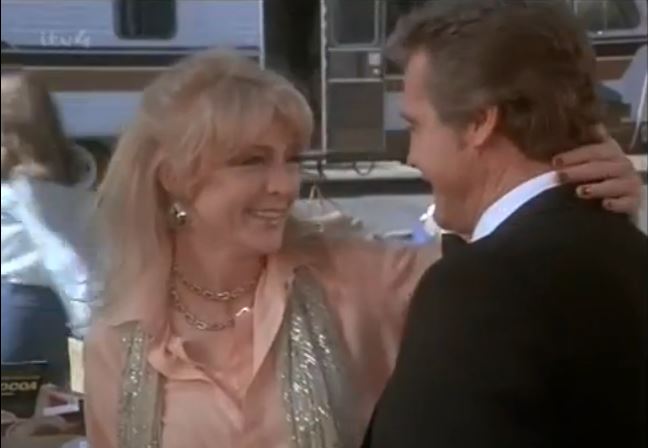

It's hard not to be amused with this episode right from get-go during the scene where Lee Majors' Colt Seavers, along with his partners Howie and Jody, spot the Bond Girls intently studying the script and going over their lines together.  In this fantasy-reality of Hollywood, these former Bond Girls are chummy and hold no grudges or competitiveness against one another.  The scene then establishes how each of the Bond Girls already know Colt Seavers personally and how each are very attracted to him.  (It's suggested that Colt may have had a prior relationship while working with each of them on their previous Bond movie.)  As "Joanna Pettet" tells Colt "I saw the stunt.  You haven't changed a bit!  You're still going for the brass ring!"  Then "Lana Wood" tells Colt "I'm always amazed how easy you make everything look!"  And finally "Britt Ekland" tells him "You appear to be in great shape!"
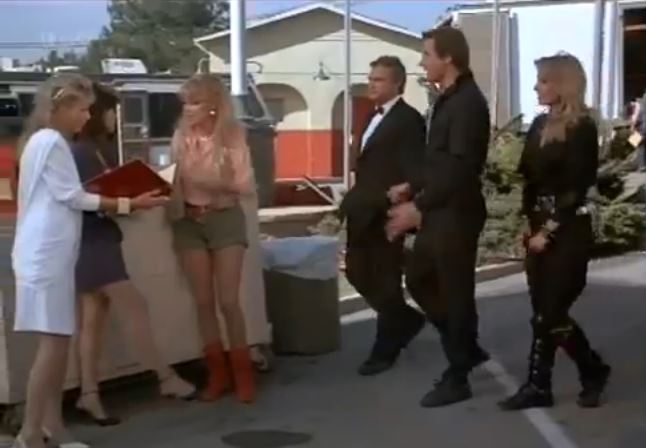

The scene then becomes a delightfully embarrassing mass of self-indulgence as the hapless Howie character ends up putting his foot in the mouth by complimenting "Joanna Pettet" on her performance as Plenty O'Toole, only to have her correct him by saying "Well, actually, I wasn't Plenty O'Toole.  I was Mata Bond.  But that's OK."  Howie then compliments a crestfallen "Lana Wood" on her performance as Mary Goodnight," only to have an indignant "Britt Ekland" interject, "Howie, I was Mary Goodnight."  As tacky as this scene sounds, I admired how it acknowledged the actual roles that each of these actresses played in their Bond movies, makes a joke about how some people find the actresses who played Bond Girls interchangeable, and then concludes by emphasizing that each and every one of them are actually their own unique individual and personality.


Throughout the episode, each of the former Bond Girls becomes involved with helping Colt and his crew in the search for the missing Ming vases.  Britt Ekland does absolutely nothing with her vignette, a final-act storyline where her character is kidnapped by the smugglers and held hostage in exchange for Colt returning the vases to their custody.  Ekland pouts and ambles through the proceedings with her usual air of haughty indifference, causing no damage but also adding nothing to the proceedings at the same time.  Ekland is particularly poor during the scene where the villains threaten to pump her with narcotics in order to make it appear that she died from a self-inflicted drug overdose.  Her emphatic line readings and facial expressions throughout the scene painfully underscores the extent to which she over emotes.


Lana Wood does better with a disappointingly short sequence where she charms a fawningly admiring British official into using his influence to help Colt and his team in the search for the coffin containing the Ming vases.  Even though it's a short sequence, Wood has the right air of conniving charm and light-hearted bantering.  She does particularly well with the double-take she registers when the British official informs her that his wife died at his country club's last golf tournament, and that they'll be dining alone.  It's too bad that the script doesn't allow her to get more involved in the action, as she is clearly game under the circumstances.  In contrast to Ekland, Wood tries hard to do as much as she can within the confines of the thin material and her professionalism is admirable. 


In the end, it's Joanna Pettet who walks off with the acting honors, as the script gives her the most substantive role to play of all of the "Bond Girls" appearing in this episode.  She is the one who inadvertently makes contact with Jonathan Frakes' art expert; convinces Colt Seavers to meet him at an acupuncture clinic in a dangerous part of Hong Kong in order to help him; is kidnapped by the villains; ends up in a car chase where Colt arrives by helicopter to rescue her; kicks her kidnapper in the shin so that he loses his weapon and is knocked unconscious by Colt; takes Colt to where Jonathan Frakes is hiding; witnesses two henchman enter the room and get the upper hand on Colt, Howie and Jonathan Frakes; and has the presence of mind to knock the remaining henchman unconscious by smashing a chair over his head.  In so doing, Pettet demonstrates the vivacious sense of adventure that she projected in "Casino Royale" while playing Mata Bond and even gets to make some fast and funny quips.
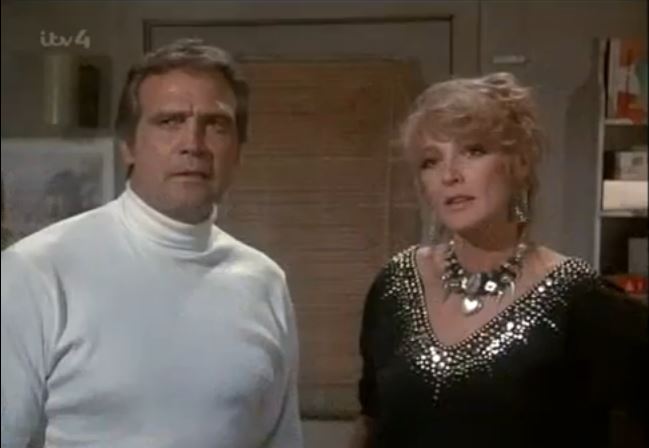

When Pettet comments how the neighborhood Jonathan Frakes is hiding at "is the sort of place where anything's for sale," Heather Thomas' sardonic Jody observes "Sounds like Hollywood," only to have Pettet wryly quip "With an egg roll on the side."  During the car chase, when Pettet's kidnapper asks her where Jonathan Frakes went to after she spoke with him, she petulantly pouts, "How should I know?  I'm an actress, not a tour guide."  When she knocks out one of the smuggler's henchman by smashing the chair over his head, a flustered Pettet jokes, "Well, it's not exactly an autograph, but he won't forget me!"  At the end of the episode, when Howie attempts to compliment Ekland, Wood and Pettet by indicating that their roles in Bond movies have ensured their places in film history, Pettet effectively mimics the voice of an elderly lady and jokes "Lordy, Lordy.  Where's my wheelchair?"  Pettet makes the most of the episode and appears to be enjoying herself even when it's clear that she's probably only doing this TV guest appearance for the remuneration.  (She also indirectly inspires the funniest line in this episode.  When villainous police inspector Barry Ingham informs James Hong's smuggler that a beautiful actress--Pettet--has become involved in the search for the Ming vases, an exasperated Hong bombastically reminds him, "There are many beautiful women in this world, but only three Ming Dynasty vases!") 


"The Fall Guy" episode "Always Say Always" remains one of the most elaborate examples of celebrating both the iconic images and motifs connected with the world of James Bond, as well as the individual contributions of the actors and actresses associated with the series.  For many Bond Girls--as well as the male actors who have appeared in the series--their Bond movie appearance is often the acting credit they can point to, out of many, that continues to be their calling card to be remembered in the annals of cinema. The episode underscores the fact that Britt Ekland and Lana Wood will always be remembered as Bond Girls, and I'm also glad it included Joanna Pettet in order to acknowledge her tangential, but ultimately undeniable, connection to the world of 007.  The episode is also unique in that it directly acknowledges the contributions of almost every variation of James Bond films up until that time.  The presence of Ekland, Wood and Soon-Tek Oh (and the use of "Nobody Does it Better" over the end credits) directly acknowledges the films of Sean Connery and Roger Moore in the official EON Productions-produced Bond films.  The presence of Joanna Pettet acknowledges the unofficial Charles Feldman-produced "Casino Royale" in 1967.  And, as indicated earlier, the title of the episode "Always Say Always" references the unofficial Warner Brothers-released Bond film "Never Say Never Again," which was Sean Connery's one-shot return to the role.  At the time, the series was only 22 years old, but James Bond had already made a strong enough  impact upon pop culture to inspire this unofficial tribute.  As Bond spoofs go, "The Fall Guy" episode "Always Say Always" still holds up as good, gimmicky fun.

Tuesday, February 26, 2013

Journey to "A Place Called Today"

 
When I was in High School, I saw a late movie on TV titled "A Place Called Today" (1972).  I watched the movie because it starred Lana Wood, who discussed it in her memoirs.  I recall she said that she thought the movie would turn out well because of the script, but felt the end result was a terrible film.  She joked in her book that the late movie is often populated with awful movies made with the sincerest of intentions and that this was one of them.  I had read a review and plot description of the movie and thought it sounded interesting.  That's why I was interested in seeing "A Place Called Today."  When I saw it that night on TV, I was appalled.  I thought it was ineptly-made and over-acted.  Director Don Schain stages close-ups in the movie with characters looking almost directly at the camera, which has an unsettling effect upon the viewer.  For years, I used to think it was the worst movie I'd ever seen until "American Beauty" (1999).  Having seen it again recently, I was pleasantly surprised at how it appeared to have improved with age.  Despite its deficiencies, it has a provocative premise and is never boring.


"A Place Called Today" tells the story of African American attorney Randy Johnson (J. Herbert Kerr), who is running for Mayor of an unnamed major American city.  His candidacy threatens the establishment, who vow to campaign vigorously against him.  Unknown to many is the fact that Randy Johnson is the engineer behind violent acts of terrorism throughout the city that are designed to frighten all voters into looking to him as their savior for the city.  Randy promises to work to stop the violence if he is elected.  Randy is aided by Caucasian radical Carolyn Schneider (Lana Wood), who helps him plan and engineer the violence with two other radicals, one African American and the other Caucasian, who are the ones who actually carry them out.  Carolyn is in love with TV news producer Ron Carton (Richard Smedley) who frustrates Carolyn because he refuses to take sides in the election, and also because he refuses to end his affair with wealthy, spoiled heiress Cindy Cartwright (Cheri Caffaro), whose powerful father is backing incumbent mayoral candidate Ben Atkinson (Peter Carew).


The election campaign turns heated and heightens the racial tension and inequality characterizing the city.  When the election appears too close to call, Randy urges his followers to commit one final act of violence to convince voters into voting for him: the kidnap and murder of Carolyn's romantic rival Cindy Cartwright, who Ron has decided to marry even though he loves Carolyn.  After Randy's radicals kidnap Cindy from her home, Ron's TV station broadcasts an editorial endorsing Randy as mayor, effectively helping him win the election.  Now realizing that Cindy's murder is unnecessary, Carolyn races against time to get to the city Country Club, where the radicals have taken Cindy, only to find out that she's been raped and murdered by them.  Ron arrives with the police, who get into a shoot-out with the radicals.  Ron and Carolyn run to each other but are caught in the middle of the gunfire and killed.  As they lie dead next to one other, Randy receives confirmation that he has won the election.  As his aide tells him "Atkinson has conceded!  The City is yours!," a grim Randy remarks, "I have a feeling someone must've said that to Cesar as he stood out on one of those seven hils and looked at Rome." 

 
At its worst, "A Place Called Today" is a misguided, self-important early 1970s melodrama overwhelmed with archetypes "Discussing Important Issues" rather than creating interesting and fully-dimensional characters.  Whatever high-minded purpose the movie had is also undermined by its violence and sexploitation elements exemplified by the presence of Cheri Caffaro (wife of the film's writer/producer/director Don Schain), who briefly enjoyed R-Rated exploitation stardom starring in a series of violent "B" movies including "Ginger" (1971), "The Abductors" (1972), and "Girls Are For Loving" (1973).  Caffaro's participation in the movie ensures the presence of explicit nudity and sex scenes that earned "A Place Called Today" an X-Rating at the time of its release.  However, these scenes, which were clearly aimed to titillate the audience, throw the film's serious intentions off-balance and call into question what director Don Schain ultimately intended with this film.  The sequence where Caffaro's Cindy Cartwright character, is brutally raped and killed in the nude outdoor at the Country Club is truly gratuitous and disturbing.  It leaves a bad taste in one's mouth.


On the other hand, at its best, I give "A Place Called Today" some kudos because there are moments when there are intelligent, provocative ideas being discussed by the characters concerning racial and economic equality, and whether violence or discourse is the best method of achieving such goals.  A lot of these issues, for better or worse, remain relevant in 2013.  Very few of the characters come off well in "A Place Called Today," so the movie never completely shows a bias for either the African American or Caucasian characters.  Randy Johnson proves to be a very flawed, ruthless character and not the noble, well-meaning savior that he thinks he can be for the city.  After the radicals have kidnapped Cindy, they bring her to Randy's office because they feel that he has maintained too impersonal a distance from the violence they have perpetrated on his behalf.  The radical tells Randy "I wanted you to be able to remember very clearly that it's the things we're doing, and not those fancy words of yours, that's going to push the levers in the voting booths tomorrow!"

 
For once, Randy is forced to look face-to-face with a victim of the violence he has instigated.  Randy tells Cindy, "Until I'm sure of winning, there's nothing to save you.  Not your money, not that body of yours that you flaunt so well.  In fact, those are the very reasons you're here.  You're what might be called a 'political abduction.'  Because to the haves and the have-nots alike, you're the symbol of the have-it-all, damn-it-all of this city.  And if this can happen to you, then nobody's safe...Unfortunately, for you, to us you're Cindy Cartwright.  A symbol.  Not a person."  For all his purported noble intentions, Randy Johnson proves he is indeed an evil man, no better than the establishment figures he purports to be a superior alternative to, and without any genuine compassion for other human beings because of the hurt he has caused others, despite his claims otherwise.  Randy Johnson is an interesting and complex character, and J. Herbert Kerr does a fine job with the role.  Kerr's scene where Randy meets with his working-class mother in her modest apartment shows that he is still a human being, with people in his life that he cares about, but he is ultimately evil because he is a man who does have a conscience, but chooses to ignore it.


As I said, the movie doesn't play favorites, so the Caucasian characters are not portrayed as being any better than Randy.  They are simply flawed in their own, different ways.  Cheri Caffaro's Cindy Cartwright is a spoiled, one-dimensional character who remains generally unsympathetic.  (Morgan Fairchild would have been perfect for this role.)  One wonders why Ron would have anything to do with her.  Caffaro has a harsh quality as an actress that makes it difficult to understand why she was considered sexy in her movies.  As a result, little suspense is generated in the race-against-time finale because the audience never grows to care for Cindy.  She remains as shallow as she was designed to be.  (To be fair, I found some candid production stills of "A Place Called Today" on IMDB where Caffaro, out of character, projects more warmth while interacting with crew members on the movie than I've ever seen from her on-screen.)  If Cindy has any redeeming quality, it's that she doesn't really intentionally harm anyone in the movie.  She's one dimensional, but has no malevolence about her.  The one sympathetic moment Cindy has in the movie occurs right before she is kidnapped, after Ron has asked her to marry him and he tells her that they are moving to New York so that he can take a job with a major network.  For once, Cindy demonstrates a level of sincerity that hadn't been seen earlier in the movie when she says "Ron, I made the first commitment I ever made in my life to you.  I don't care if we go to the South Pole."  To our surprise, she appears to genuinely love him.  In addition, Cindy's completely honest about who she is and what her shallow purposes and goals in life are.  She has no noble delusions about herself.

 
In contrast, Lana Wood's radical Carolyn Schneider might believe she has noble intentions in helping Randy plan violence acts throughout the city, but she's ultimately nothing more than an immature, politically misguided terrorist.  She never acknowledges or realizes that her actions are not effecting a proactive, progressive response from the city's voters, but a reactive one in response to fears of violence.  The people of the city aren't voting for Randy because they believe in him, but because they're afraid of him and what will happen if they don't.  At the beginning of the film, Carolyn mouths Hippie Radical Cliche 101 when she says "Money, credit cards, car keys, right there is what it's all about.  Either everyone has them, or no one has them.  Better still, throw them away and start over.  They're the wrong...set of values to begin with!"  Ron sensibly responds, "All you do is take one group from power, and put another one in, which for the most part wants and does the same kinds of things as the ones they threw out.  But the average guy...well, nothing ever changes for him does it, Carolyn?...You forgot something.  You forgot the guy who doesn't give a damn.  The guy who wants his own life on his own terms and has it.  What about him, Carolyn?"

 
Carolyn is probably one of the meatiest roles in Lana Wood's career, a character whose presence in the movie is not purely decorative, despite her brief topless love scene with Richard Smedley.  Despite the flaws in Carolyn's logic, it is still a substantial role for Wood and she gives a sincere and committed performance in it.  Wood filmed this right after appearing as Bond Girl Plenty O'Toole in "Diamonds are Forever" (1971).  I can't imagine two such dissimilar back-to-back roles for any actress.  Some of the best moments in the movie are Carolyn's frequent arguments with her lover Ron.  They sincerely love each other, but are at an impasse.  Ron can't imagine being married to someone with such radical views on how the world should be.  Carolyn can't imagine being married to someone who chooses not to take sides on issues.  At one point Carolyn pleads with Ron, "I'm not asking you to think like I do, I'm just begging you to give a damn about the way I think!"  Even though it feels at times that "A Place Called Today" is a movie featuring issues, not people, talking, at least it has ambitions about itself.  That's more than can be said for most movies or TV shows these days.


Richard Smedley's Ron is probably the most sympathetic character in "A Place Called Today," a person who may not appear to be taking sides, but who appears to have the most truthful perspective on what is happening in the city.  He may not satisfy Carolyn's radical expectations, but he proves to be a sincere journalist who is not easily bought by Cindy's father or Mayor Atkinson.  When Ron approves the editorial supporting Randy Johnson at the end, it's the only sincere expression of principled thinking in the whole movie.  On his own, without Carolyn's influence, or being influenced by the violence, Ron concludes that Randy might offer the best hope for the city.  He knows that Randy is a hypocrite, but decides on his own that the establishment has used up its chances, and that Randy's ideas might be better for the citizens, despite all of his flaws.  At one point, Ron tells Randy that what the city needs is a "dedicated idealistic fool like I thought you were, who's willing to waste his life and pull 'em out!  But you let me down!  You sold out for glory or whatever!"  Ron may have compromised his integrity by choosing to marry Cindy instead of Carolyn, but it's because he has enough sense to realize that marrying Carolyn would not work, despite their love for each other.  They are simply too different to be able to live peacefully with one another.


I don't want to give the impression that "A Place Called Today" is some sort of undiscovered masterpiece.  It's an extremely flawed, at times crudely made and trashy movie with performances that are mostly solid, but are occasionally screeching and overbearing, due to the uneven direction by Don Schain.  The violence and sexploitation elements ultimately undermine whatever noble purposes the filmmakers had in-mind for this movie.  But, in this day and age, with movies containing gross low-brow humor and even lower aspirations, "A Place Called Today" is almost admirable with its naive ambitions of attempting to combine serious drama, political messaging, and drive-in grindhouse elements into one motion picture.  In the end, after Ron and Carolyn are shot to death, director Don Schain effectively super-imposes a montage over their dead bodies showing, side-by-side, Cindy and Carolyn each making endorsement speeches for their respective candidates, as well as Mayor Atkinson and Randy Johnson side-by-side making campaign speeches in front of crowds of supporters, as we see the hands of voters pull the levers in the election booth.  As the sound mix blurs each pair of speeches into a deafening wall of noise, you realize that Cindy and Carolyn, and Mayor Atkinson and Randy Johnson, are just two sides of the same coin.  As Ron indicated at the beginning of the movie, one group of people in power have simply been replaced by another who ultimately want, and will do, the same things as the previous regime.  In "A Place Called Today," nothing has changed for the city with Randy Johnson's election.