Saturday, December 15, 2012
"Mr. Pupkin? I'm Cathy Long..."
In college, I had a friend who was a big Martin Scorsese fan. I have never been a huge admirer of his work, though I do respect him, but my favorite of all his movies was "The King of Comedy" (1983). I think it's a hilarious movie and it's portrayal of obsessed fans is dead-on for anyone who has ever attended a celebrity autograph show and chatted with other people who are there. Most people who talk about "The King of Comedy" usually end up discussing the scenes involving Robert DeNiro's Rupert Pupkin and Jerry Lewis's talk show host Jerry Langford, or about DeNiro and Sandra Bernhard's wealthy stalker Masha. But the scenes I enjoy the most in the movie are the scenes between DeNiro's Pupkin and Shelley Hack's very cool and efficient Cathy Long. My college buddy and I used to enjoy acting out and reciting the dialogue from these scenes as a running joke between us. I would enter a room, see my friend, walk over to him while extending my hand and say "Mr. Pupkin? I'm Cathy Long..." (a paraphrase of Hack's opening line of dialogue in the movie) and we would launch into a re-enactment of those scenes.
I think the reason why we enjoyed acting out those scenes is because of the underlying tension that exists between these two characters. In their scenes, DeNiro's Pupkin is attempting get in touch with talk show host Jerry Langford through Hack's Cathy Long, the assistant of Langford's Executive Producer Bert Thomas (Frederick De Cordova). The interaction between Rupert and Cathy Long are very entertaining, as both are trying to "one-up" and manipulate the other for their own purposes. Rupert is on his best behavior with Cathy Long and trying hard to impress her so that she will grant him access to Jerry Langford and, in turn, appear as a guest on his late night talk show. In turn, Cathy Long is trying hard to maintain her cool and calm as she seeks various ways to try and get rid of this persistent guy who has suddenly appeared out of nowhere at her workplace, insisting on speaking with her boss. Cathy Long is a character that most critics overlook when they review the movie. They usually talk about Rupert Pupkin's adversarial relationship with fellow Jerry Langford fan Masha, or his attempts to impress his would-be girlfriend Rita (Diahnne Abbott) with his alleged friendship with Jerry. But it's really Cathy Long, from amongst this trio of women in Rupert's life, who seems to have the ability to help further his career if she chooses to do so. She is a much more important character in "The King of Comedy" than she is given credit for.
Cathy Long remains a bit of an archetype in "The King of Comedy." We never hear anyone, much less Rupert, address her in the film as simply "Cathy." She is called "Cathy Long" or "Miss Long" by everyone in the movie. Paul Zimmerman's script, which is available online, always refers to her in the character cues and stage directions by her complete name, "Cathy Long." This is a formal indication of how detached, impersonal, and archetypal she is meant to be. She is part of the faceless, monolithic entertainment establishment that refuses to grant access to weirdos like Rupert. But I don't think she's meant to be an unsympathetic character. Cathy Long is always polite to Rupert when he visits the office, listens patiently as he rambles on incessantly, and is honest with him about his chances of appearing on the show. She tries to give him constructive criticism about the demo tape he gave her to listen to, and even advises him to try out his act in front of a live audience at comedy clubs. She does not string him along unnecessarily and takes a much more direct and diplomatic approach. She never even loses her cool or yells at him when he barges into Langford and Bert Thomas' private offices, nor when he shows up uninvited backstage at Langford's TV studio, after he has kidnapped Jerry, to announce that he is the "King" who is to appear on the show in exchange for Jerry's safe return. Cathy Long never denigrates Rupert as an individual the same way as other characters do in the film who openly mock and disrespect him.
In the latter half of the film, after Rupert has kidnapped Jerry Langford, we see Cathy Long in scenes with Langford's Executive Producer Bert Thomas, her boss, as he receives the phone call from Jerry that he has been kidnapped, and later meets with network executives and FBI agents. Cathy Long sits silently in the background as these middle-aged men in suits debate what to do about the situation. At no point do the men ever turn to Cathy Long to ask for her opinion on how to handle the matter. This indicates how Cathy Long's function in Langford's universe is of a reactive, supportive nature. Even though one would argue that she could've been more sympathetic and helped Rupert gain access to Jerry and his show, it's not her call to make that decision. She's simply following the directive of Jerry Langford and Bert Thomas to keep Rupert away from Jerry. I think Cathy Long's role in Langford's organization reflects how women working at the executive level in the entertainment world in the early 1980s were still seen in a support function because the field was still dominated by older men who had been working for decades and who still did not consider women as their peers. It is apparent watching the movie that Cathy Long's duties and responsibilities were probably beyond being an administrative assistant, but she was still not yet at a managerial level where she could call the shots. I get the impression that Cathy Long is intelligent and capable enough to continue to rise in Langford's organization until she reaches the point where SHE would be the Bert Thomas of Langford's show (or whoever is his replacement) by now.
"The King of Comedy" represented an opportunity for Shelley Hack to redeem herself as an actress after she was fired from "Charlie's Angels" in 1980 after appearing on it for just one season. I remember reading that director Martin Scorsese became interested in Hack for "The King of Comedy" after seeing her in the stage play "Vanities" that also starred Annette O'Toole and Meredith Baxter. On "Charlie's Angels," Hack was likeable, but awkward at times. Her line delivery on that series seemed stilted and overly cheerful, and her stage movement were clumsy and gawky, even though her performance improved considerably towards the end of that season. In "King of Comedy," Hack rewards Scorsese's confidence in her with an assured and intelligent performance. Even though Hack is smart enough to maintain a stylized distance and coolness to Cathy Long, she does humanize the character so that she does not come across as a cold-hearted jerk. In her hands, Cathy Long becomes a mature professional with enough decency to her that she treats Rupert with a certain degree of dignity before, and even after, he crosses the line with her. None of the awkwardness that characterized her work in "Charlie's Angels" is on display here, and she shows us a different side to herself that should have been utilized more often by major filmmakers. She more than holds her own opposite the powerhouse DeNiro, and I sense that DeNiro is comfortable enough not to dominate his scenes with Hack so that he allows her an opportunity to shine. Even though Hack left acting in the mid-1990s and went on to an admirable career as a media consultant who, among other things, helped produce the first-ever televised presidential debates in Bosnia-Herzegovina, I have a feeling that, if "The King of Comedy" and not "Charlie's Angels" had been Shelley Hack's proper introduction to audiences, she would have enjoyed a much more rewarding acting career.
Labels:
Bert Thomas,
Cathy Long,
Frederick De Cordova,
Jerry Langford,
Jerry Lewis,
Martin Scorsese,
Robert DeNiro,
Rupert Pupkin,
Shelley Hack,
The King of Comedy
The Cowardly Condescension of James Stewart in "Rear Window"
I've always been a big fan of James Stewart, particularly in his films by Alfred Hitchcock. I think he was, next to Cary Grant, the cinema's most flawless actor. Both men knew how to evoke nuance and feeling out of any scene or situation. What I always respected about James Stewart was his ability and willingness to play unsympathetic roles that went against his admirable public image as a family man, World War II veteran and military officer, and consummate Hollywood professional. It's a quality that most film critics and scholars, but not necessarily all movie goers, recognized because his own personal charm and real life strength-of-character often overcame and shielded the negative aspects of some of the characters he played. It's not always obvious at first viewing how flawed and unsympathetic his characters can be, and there is no more flawed a character in Stewart's oeuvre than his incapacitated-in-a-wheel-chair-due-to-a-broken-leg news photographer L.B. "Jeff" Jeffries in Hitchcock's "Rear Window" (1954).
It's only been in recent years that I've started to understand the extent of how cruel and condescending Stewart's Jeff is to Grace Kelly's socialite Lisa Fremont in the movie. I used to believe that the character development scenes between Jeff and Lisa were just a distraction from the central plot of Jeff believing his neighbor Lars Thorwald (Raymond Burr) has murdered his wife. But I now believe that it's the murder plot that is the true distraction in the film, and that Hitchcock is much more interested in the dynamics of the Jeff/Lisa relationship than he is with the Thorwald murder storyline. This is because Hitchcock takes a very relaxed, measured approach throughout the whole movie regarding the murder plot. He is willing to let it take its time to develop in the background while he spends more time developing the Jeff/Lisa scenes. Another director would have dispensed with the relationship aspects of the movie entirely and simply focused on the storyline of Jeff spying on his neighbor in order to gather enough evidence that he has committed a homicide.
The Jeff/Lisa scenes are fascinating because of Jeff's resistance to making a sincere commitment to a woman he appears to love. He is a globe-trotting news magazine photographer who takes a lot of false pride in telling Lisa how his existence is purportedly more realistic and substantial than hers because of the unglamorous and rugged locales and dangerous experiences he has had during his career. He is condescending to Lisa and makes a mockery of her New York socialite background and fashion-industry career, alleging that her background makes her too frivolous to be prepared to accompany Jeff on his photojournalist assignments that he intends to resume once the cast is off his leg. What's interesting about their characters is the contrasting degrees to which they are willing to make personal sacrifices in order to allow the relationship to flourish. Even though Lisa hopes Jeff will take a comparatively cushy photography position that will allow him to stay in New York City, she is still willing to consider giving up her luxurious lifestyle and career and accompany Jeff to wherever his career takes him. At one point Lisa says "It doesn't make sense. What's so different about it here from over there, or any place you go, that one person couldn't live in both places just as easily?...It's ridiculous to say that it can only be done by a special private little group of annointed people...I can't fit in here, you can't fit in there. According to you people should be born, live and die on the same spot!" What's touching about Lisa is that she loves Jeff to such a degree she's willing to give up her creature comforts just to be with him. If anything, Lisa might have made herself too available to Jeff for him to take seriously, as (unfortunately) no attractive man wants someone they can get easily, even if she is as beautiful and charming as Grace Kelly. Men are usually interested in the pursuing the next challenge or mystery, rather than settling for what's safe and accessible. I believe that Jeff thinks that a life with Lisa will be too predictable and mundane and will hold no challenges or surprises for him. At the very least, Lisa's intentions in the relationship are much more honest and pure than Jeff's. Grace Kelly does an exemplary job of portraying Lisa's sincere love for Jeff and commitment to their relationship. She makes Lisa much more substantial, dynamic, and adventurous than Jeff gives her credit for.
On the other hand, Jeff won't consider taking a cushy job locally, nor is he willing to entertain the notion of allowing Lisa to accompany him wherever his career takes him. He makes every excuse in the world for why he won't stay in New York, and why she can't accompany him wherever he goes, that I start to wonder if his feelings for her as sincere as hers are for him. He responds to Lisa's complaints by saying, "Did you ever eat fish heads and rice?...Well, you might have to if you went with me. Did you ever try to keep warm in a C-54 at fifteen thousand feet twenty degrees below zero?...Did you ever get shot at, did you ever get run over, did you ever get sandbagged at night, because somebody got unfavorable publicity from your camera?...Those high heels, they'll be great in the jungle. And the nylons and and those six-ounce lingerie...Well, they'll make a big hit in Finland--just before you freeze to death...Lisa, in this job you carry one suitcase, your home is the available transportation. You don't sleep very much, you bathe less, and sometimes the food that you eat is made from things that you couldn't even look at when they're alive!...You just have to face it Lisa you're not meant for that kind of a life, few people are!" Jeff makes every excuse in the world for why their relationship won't work, which leads me to suspect that he already rehearsed that speech in his mind countless times because he didn't have the guts to come clean and simply say that he doesn't love or want her as much as she loves and wants him. I always found Jeff's speech rather pompous because he delivers it with a condescending air of superiority. Jeff's existence is no more substantive or grounded in reality than Lisa's. The irony to that is, even though it is rugged and less glamorous than Lisa's, Jeff still enjoys a privileged lifestyle and career that would be considered foreign to most of his neighbors. Whether he realizes it or not, he propensity to look down on Lisa's elegant and glamorous lifestyle prevents him from realizing his own shortcomings as well as Lisa's virtues.
What's ironic about Jeff's speech is the fact that, in both the movie with regards to the murder plot, as well as in his photojournalist career, Jeff remains a passive voyeur at all times. Jeff's speech makes his career sound impressive and exciting, but take a close look at what he says: at no times does he ever indicate he takes a proactive, as opposed to reactive, role when he is taking pictures of scenes of turmoil. Things might be in a state of flux around him, but he takes no active role in it, and one could argue that he is the classic example of a passive/aggressive personality. He relies at all times on Lisa, his nurse Stella (Thelma Ritter), and his police detective friend Doyle (Wendell Corey) in order to investigate his neighbor Thorwald, and ends up bickering with each of them at some point or another. Jeff is actually a cowardly wimp and creep who is unable to find anything constructive to do during his convalescence than spy on his neighbors, ogle the shapely dancer Miss Torso from across the courtyard, and vicariously watch the young newlywed couple who moved in next door make love. Rather than using his time to build his relationship with Lisa, which would require him to take a stand and make decisions about his life, he distracts himself by being far too concerned with what's going on with his neighbors. His interest in the murder plot has nothing to do with having any sense of justice or concern for the alleged murder victim, but is merely a vehicle to enliven his empty existence. Whichever way you look at it, Jeff is hardly an admirable individual. James Stewart deserves his commendations for his willingness to play Jeff honestly, and with foibles, as most movie stars with a squeaky-clean image would probably be averse to allowing their personas to be tarnished in any way.
Later in the film, when Lisa climbs up the fire escape, sneaks into Thorwald's apartment to look for evidence, finds it, and is caught by Thorwald, all Jeff can do is sit helplessly and watch as Lisa is assaulted. Rather than being assertive by going to his window and yelling out at Thorwald across the courtyard, which might be enough to startle and scare Thorwald so that Lisa can make a break for it, he just sits in his wheelchair and helplessly wimpers. Broken leg or not, that is probably, at the very least, what any of us would do if we were watching someone we cared about being assaulted. The only thing Jeff does to help Lisa is to call the police to rescue her where, again, he is leaving it up to another party to take care of things he should be doing himself. In fact, Jeff gets the most upset during this sequence when Lisa calls out the window for Jeff to come help her. From his almost-embarrassed reaction, Jeff seems more unnerved that his voyeuristic presence has been exposed to Thorwald than he is about watching his own girlfriend being assaulted. If I were Lisa, I'd be upset that all my boyfriend did was sit quietly in the background and let the police get her out of that jam.
The sequence at the end not only proves what a sham Jeff is about being such a worldly adventurer, but also what an adventurous and daring individual Lisa truly is, when given the opportunity. Lisa, along with Stella, is the one who courageously digs up the Thorwald's flower patch to see what he might have buried in it; who climbs up the fire escape into Thorwald's apartment (while wearing a gorgeous Edith Head gown!) to search for his wife's wedding ring; and who has the presence of mind to slip the wedding ring on her finger right before Thorwald assaults her so that she can bring it to the police station later, after she's been arrested for breaking and entering, and show it to the authorities to prove that Mrs. Thorwald was murdered. One of my favorite moments in "Rear Window" occurs a bit earlier after Lisa excitedly returns to Jeff's apartment after she has sneaked across to Thorwald's apartment and slipped an accusatory note under his door to provoke a guilty reaction from him. When Lisa runs in breathlessly exhilarated by what she has done ("Wasn't that close?! Well, what was his reaction?! I mean, when he looked at the note?!"), Hitchcock briefly cuts to a silent close-up of Jeff smiling because of Lisa's excitement. Jeff looks admiringly at Lisa as if he has seen her for the first time in his life because he now realizes how truly special she is. I've always loved that reaction because Stewart and Hitchcock perfectly capture the kind of moment when a man unexpectedly realizes how much he truly loves someone he has taken for granted. I think, by that moment, Jeff is ready for a real commitment to Lisa because he knows she can handle any environment or challenges that awaits them. She is not as predictable, safe, or mundane as he assumed, but someone who has the ability to challenge him and keep him on his toes because she's got an air of adventure and mystery he never realized before. But I do not believe for a second that Jeff's epiphany is due to any inherent change in Lisa's personality. Her sense of daring and adventure were always there. Her choice of Jeff, someone not from her social strata, as her romantic partner shows her already-established willingness and ability to think outside of the box. He was just too busy wrapped up in himself and spying on the neighbors to have noticed.
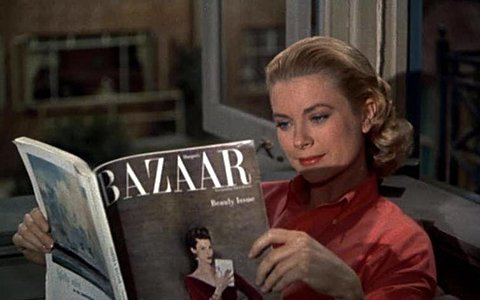
However, I'm still not sure that Jeff is worthy of Lisa because of the way he passively sat back and didn't do enough when Lisa was assaulted by Thorwald. She might have daring and initiative, but he doesn't. He is the sort of man who would not have enough backbone to take care of Lisa, or anyone else around him for that matter, when the going gets tough. That's why I'm glad at the end of the film--after the murder has been solved, Jeff is sleeping contentedly with his two legs in a cast, and Lisa is sitting nearby wearing jeans and reading a book about foreign travel entitled "Beyond the High Himalayas"--she notices he is asleep, puts away the foreign travel book, and pulls out her Harper's Bazaar fashion magazine. Even though she's modified her appearance and interests for the good of their relationship, she is still true to herself. She would never completely lose her identity for Jeff. At some point, if she ever decides that Jeff is not right for her, we know she has the will and strength to not be ruined by him and to still be ready for anyone worthy who comes along.
Labels:
Alfred Hitchcock,
Grace Kelly,
James Stewart,
L.B. Jefferies,
Lisa Fremont,
Raymond Burr,
Rear Window,
Thelma Ritter
Thursday, December 13, 2012
A Seemingly Unlikely, Yet Genuine, Movie Star
This is a big week for Judi Dench. Her latest James Bond movie, "Skyfall" (2012), went back to the top of the list of highest grossing films in the United States. She was part of the ensemble nominated for a SAG Award for "Outstanding Performance by a Cast in a Motion Picture" for "The Best Exotic Marigold Hotel" (2012). Her own performance in that movie was nominated today for a Golden Globe as Best Actress in a Best Actress in a Musical or Comedy Film. And she celebrated her 78th birthday earlier this week, December 9th. That's a heady list of accomplishments for an actress who defies our usual expectations of what constitutes a movie star. But that's what Judi Dench is. Despite all her awards, and the position she enjoys as perhaps the most esteemed and respected actress of our time, she really is a true movie star of the classic definition. My late friend Polly Platt once said that her definition of a movie star is someone that men and women equally like. If only one or the other gender like you, you're not really a movie star. Not only does Judi Dench have the esteem and affection of men and women, she also gets it from young people who, not only know who she is, but they also like her and revere her the way their elders do.
I have been fascinated with Judi Dench's success since she burst onto the scene in America in the mid-1990s when she debuted as "M" in the James Bond series and soon followed that up with her Oscar nominated performance in "Mrs. Brown" (1997). I already knew who she was from her BBC romantic comedy series "As Time Goes By," which aired on PBS, and her earlier movie roles like "A Room with a View" (1985), "84 Charing Cross Road" (1987), and "A Handful of Dust" (1988). I also remembered her from her early performance as a young actress in the Sherlock Holmes mystery thriller "A Study in Terror" (1965). I already had a vague understanding that she was an established and respected stage actress in the U.K. even before Bond and "Mrs. Brown." So it was kind of wonderful to see how she reached a much broader audience in the last 17 years when she was already in her sixties and at an age when most of her peers are probably starting to collect their pensions and prepare for retirement. I liked her from the moment she debuted as "M" in "GoldenEye" (1995). She gave the Bond movies respectability, and Bond returned the favor by giving her visibility. What's interesting is how Judi Dench has maximized her opportunities since then to put herself in a position where she is offered the best roles available for an actress of any age. She could've just done "Mrs. Brown" and the Bond movies and left it at that, but her continuing success appears to be boundless. Whether it's luck, good instincts, or by design, she has done all of the right things to allow herself to rise beyond just being considered a respected character actress to being a true movie star.
And Dench is a movie star, whether or not she fits our stereotypical expectations of one. Even though she is not tabloid fodder, her life and career represents the best aspects of what a movie star should be. She is well-known and well-liked by critics and audiences. Her name and image are always prominently on display, sometimes even above the title, in the advertisements of any films or shows she appears in. You always see her doing publicity and interviews for every project she is in. Unlike other actors with false modesty who shun publicity, Dench appears to realize that effectively promoting the project she has performed in is as important as acting in it. She also does not disdain appearing at the Oscars. In her interviews, she talks about how she still gets a little starstruck and excited at the people she encounters at the Oscar ceremonies, a refreshing counterpoint to English (or American, for that matter) "thee-uh-tah" actors who act like they're too good to attend such events, much less be nominated for the award. And, even though she admits that the stage is where she is the most comfortable, she does not pooh-pooh the cinema. Dench pays it the respect it is due, which keeps her in high esteem among movie aficionados like me. What does not get discussed often is that she also has a subdued and understated elegance about her that is glamorous in its own unique way. Her flattering and distinctive silver pixie hairstyle has become her recognizable trademark. She looks absolutely stunning on the red carpet, whether it's at the Oscars or at a Royal premiere for a Bond movie in London. And I genuinely believe that people like her to such a degree that they will see her in anything she is in. As unlikely as it sounds, I believe she's got box office appeal and that her name is enough to attract people to see something they might normally have overlooked if she did not otherwise appear in it.
The success of "The Best Exotic Marigold Hotel" is a perfect example of this. Even though it is a beautifully written and directed movie, everything about it went against the grain of what you expect a successful movie to be. It was an ensemble piece, starring actors well in their 60s and 70s, about a group of pensioners from the U.K. who settle in a hotel in Jaipur, India because they are unable to keep up with the high cost of living in England. Dench was the lynchpin of this movie. Even though it had a wonderful ensemble, she was the lead character and the heart and soul of "The Best Exotic Marigold Hotel." She played a widow named Evelyn who comes to the painful realization that her late husband has made unwise investments and left her in a precarious financial position. Evelyn is forced to sell her flat to cover her husband's debts and moves to the film's eponymous hotel in India so she will not become a burden on her family. While there, she must start over again and face new and exciting challenges, which she keeps a daily record of on her blog. Evelyn gets a job working at a call center where she can advise her youthful colleagues how to better understand and effectively interact with British customers. She befriends and advises a young Indian couple she has gotten to know on the joys and pitfalls of relationships. She even falls in love with one of her married neighbors at the hotel, a relationship which allows Evelyn to truly and openly share her feelings and emotions with someone in a way she never did with her late husband. In Dench's skillful hands, Evelyn blossoms in this new environment, as she welcomes new friends and potential romantic interests into her life. She really carries this movie on her shoulders and proves to be as lovely and romantic a leading lady as the cinema has ever seen.
I recently read Dench's memoir "And Furthermore." I thoroughly enjoyed it because it was everything a memoir should be. She told good anecdotes about the making of the films she appeared in, while at the same time opened up a bit about her life so that the reader had an understanding as to who Judi Dench is as a human being. She didn't stint on the personal or the professional aspects of her life in that book. One anecdote that sticks out in my mind is the section dealing with why she acted in the Vin Diesel vehicle "The Chronicles of Riddick" (2004). She explained how another film she was slated to appear in fell through, Diesel showed up backstage at a play she was appearing in with a bouquet of flowers and asked her to appear in his film, and she agreed to do it because she liked him. Even though it is probably the worse film she has ever appeared in, Dench never denegrates it or the experience. She simply says that she never understood the script while they were filming, and still does not understand the completed movie, but she was impressed with the sets and enjoyed working with her colleagues, and would never trade the experience for the world. It was so refreshing to see her not take the easy way out and trash the movie, a critical and financial failure, when she easily could have. Many other, lesser actors, have not shown such respectful tact and restraint in discussing some of the projects they've chosen to appear in.
A good friend, who is the daughter of an actress who has worked a lot in movies and TV, recently reiterated in a phone conversation how she hates all actors because the ones she grew up encountering turned out to be unjustifiably pompous and snooty (especially the New York "theater" actors). My friend said "I think the only actress who has the right to be snooty is Judi Dench, because she's earned it. But, somehow, I don't think she would be snooty because you never sense an attitude from her." I agree. Dench deserves to be haughty if she wants to be. The fact that she chooses not to be proves to be her most endearing quality. There is something about Dench that evokes a sense of warmth and humility in a way that Vanessa Redgrave and Glenda Jackson do not. (Only Maggie Smith and Helen Mirren are also able to inspire that sense of awe and accessibility with audiences as Dench does.) Dench also seems like she is someone who would be a good sport. I recall an appearance on a British telethon during the 1980s where Joanna Lumley was asked to take off her dress by a caller who promised to make a huge donation. You can see it on YouTube here. My understanding is that, after the caller's donation pledge was independently verified, Lumley agreed to drop her knickers on-air while Dench, who sat nearby, reacted by delightedly clapping and laughing in a good-natured manner. Dench clearly wasn't uptight or fazed by Lumley's provocative gesture. So, during this notable week for Judi Dench, I wish her a Happy (belated) Birthday and I hope she enjoys the attention and accolades that her latest nominations have brought her. I also hope that the Oscars follow suit and recognize her work in "The Best Exotic Marigold Hotel" with another well-deserved nomination. With the help of her co-stars, as well as the script and direction, she brings depth and gravitas to what could have been a "cutesy" role and movie if it had been in the wrong hands. In her many transcendent close-ups throughout that wonderful movie, Judi Dench truly glows as only the best movie stars do.
Tuesday, December 11, 2012
Affected Acting and Activism: Morgan Fairchild
Anyone who reads this blog has probably noticed how I tend to defend actresses who normally get short-shrifted in any discussion of "real actors." I guess it's because I always root for the underdog and am always looking for those little nuances that demonstrate that an actor has brought something to a scene that might have been more than what was on the page. As such, I've extolled the virtues of Tina Louise, Lois Chiles, Priscilla Barnes, Anita Ekberg, and Joan Collins on this blog. You won't see me doing the same for Morgan Fairchild. It's strange, but I've never liked Fairchild, even when I was a kid and she was starring on one of my favorite TV shows, NBC's short-lived prime time soap "Flamingo Road" (1981-82). I've seen and followed much of her work through the years (more than the average mortal), I think she's perfectly adequate, I have enjoyed some of her performances, and I grudgingly respect the longevity and prolificacy of her career. But I still don't like her.
It would be easy to dismiss Morgan Fairchild by calling her a "bad" actress, but I don't think she is. As I said, she is perfectly adequate in her acting and she has never given a performance where she has embarrassed herself. But, concurrently, she's never given a performance where she has really stood out and demonstrated an unexpected nuance or gesture that was not thoroughly predictable. There's absolutely no depth to her acting. She's a celebrity who is famous for being famous. Her interviews and bios usually tout her as a "star" of "Dallas" and "Falcon Crest," but she only guest-starred on one episode of "Dallas" in 1978 and appeared as a regular in only one season out of "Falcon Crest's" nine-season run. I also don't really understand why people considered her a sex symbol. There's always been a kind of thin, wispy artificiality and plasticity about Fairchild that I don't remotely think is sexy. There was never an earthy warmth about her as a sex symbol in the same manner of someone like Farrah Fawcett. When she was on "Flamingo Road," Fairchild played snooty Constance Weldon Carlyle, the richest girl in Truro, Florida. She is married to handsome Fielding Carlyle (Mark Harmon) who she starts out loving deeply, but is hurt when she learns that his heart belongs to saloon singer Lane Ballou (Cristina Raines). In any other instance, your sympathies should go to Fairchild's Constance because she is the "wronged woman," but you don't because Fairchild never presents Constance as anything more than a spoiled, petulant brat. She doesn't provide any level of nuance to Constance to demonstrate she might have underlying depth beneath the pout and blonde hair. In contrast, Joan Collins's Alexis on "Dynasty" (even though I wasn't a fan of that series) had a wry, satirical edge, and Donna Mills's Abby Cunningham on "Knots Landing" had unexpected moments of maternal warmth (she was a single mother) that gave her more texture than she might otherwise have had.
In the second season of "Flamingo Road," when adopted Constance learns that she is actually the illegitimate daughter of Lute Mae Sanders (Stella Stevens), the town prostitute/proprietress of Truro's very own local brothel and a woman who Constance has looked down on all her life, she reacts to the news with the sort of unsubtle hysteria you'd expect from someone who just broke a fingernail. Fairchild's performance during that storyline never demonstrates any warmth, vulnerability or self-awareness that raises the character above a shallow stereotype. Fairchild never provides any sense that Constance has been deeply affected by this revelation and, by the end of that episode, she is back to her lustful and scheming ways. As such, there's a missed opportunity to explore the psyche of a shallow woman who is faced with the reality of how empty her existence truly is. "Flamingo Road" was a fabulous series during the first season when the storylines were based on the original 1949 Joan Crawford movie about a carnival girl from the wrong side of the tracks trying to make a life for herself in a corrupt Florida town. Cristina Raines was marvelous playing the Crawford character--she had an earthy, heartfelt, scrappy quality that made you root for her every week--and Fairchild was effective during that first season as Raines's blonde contrast and antagonist. In the second season, the producers mistakenly changed the focus of the series from Raines to Fairchild, and the show slowly unraveled as it became clear Fairchild simply did not have the depth or screen presence to carry the entire series on her shoulders. So it was no wonder it was cancelled after its second season.
It would be easy to assume that the shallowness of Fairchild's acting was limited to "Flamingo Road," but she's just as uninspired in other roles that might have afforded her opportunities to demonstrate what she was capable of. Probably her best shot at being a real actress was her 1982 starring vehicle "The Seduction," an erotic suspense thriller where Fairchild plays Jamie Douglas, a glamorous Los Angeles newscaster who becomes stalked by an obsessed fan (Andrew Stevens). "The Seduction" was made in the wake of her success with "Flamingo Road" and was her one-shot attempt at big-screen stardom. Fairchild's acting is OK in "The Seduction," but she again fails to take advantage of any chances to bring depth to that character. In Fairchild's hands, Jamie Douglas comes off as whiney and unsympathetic. The audience never feels any genuine suspense in the story because Fairchild fails to elicit any sympathy for her character's predicament of being stalked by a persistent admirer. Fairchild's big acting moment in the movie has her on the air during a news broadcast, reading from a teleprompter, when suddenly she sees a typed message from her stalker on the teleprompter that causes her to have an on-air breakdown. She tells the audience she is being stalked and pleads for someone to help her. Fairchild resorts to a predictable bag of tricks of crying and letting her voice go down to a baby-like whisper, but doesn't do anything else particularly unique with the scene. Somehow the vulnerability and empathy she is striving for does not come through. It might have been more effective if she had played the scene without tears and approached it from a more controlled, subtler perspective. Even though she's OK in the scene, nothing remotely interesting transpires from it. You start to feel contemptuous towards Fairchild because you want to see her go for broke and really challenge herself, which would be interesting to watch even if she was unsuccessful at it, but I always get the impression that she doesn't have the guts to do it because she doesn't want to muss herself.
Fairchild had another opportunity to demonstrate what she might be capable of when she played an incest survivor on Season 5 of "Falcon Crest." Unfortunately, because it is such a serious subject matter that should be dealt with sensitively, the pain that her character purports to feel never really comes through to the audience. She cries on cue in that performance when the script calls for her to do so, but that's about it. She never creates a consistent, underlying emotional thread for that character throughout the season to give one a true impression of how such a traumatic experience has truly affected her. As if the writers knew they couldn't count on her to find genuine nuance in such a character, they devised a subplot where she suffers from a split-personality disorder as a result of her childhood abuse. This split-personality subplot simply allows Fairchild an opportunity to slip into "seductive vixen" mold that people expect from her. The two personalities Fairchild plays on "Falcon Crest" never quite convincingly gel into being one person. To be fair, the writers don't give her much, but she didn't bring much to the table to inspire them either.
In my opinion, it's not simply that Morgan Fairchild has been typecast by her glamorous looks and, as such, has been denied roles that would have shown what she is truly capable of. Unlike other actresses who are considered glamorous sex symbols, Morgan Fairchild has never had that one universally respected or praised role that she can point to which proved she was a unique and talented actress. Farrah Fawcett had "The Burning Bed" (1984); Raquel Welch had "Kansas City Bomber" (1972) and "The Three Musketeers" (1973); Anita Ekberg had "La Dolce Vita" (1960); Jayne Mansfield had "The Wayward Bus" (1957); Tina Louise had "God's Little Acre" (1958); Stella Stevens had "The Ballad of Cable Hogue" (1970); etc, etc. There are indeed rare opportunities for sex symbol actresses to truly distinguish themselves if they have something notable as an actress that allows them to stand out from the crowd. The fact that Morgan Fairchild has had nothing that's even comparable to that in her career seems to indicate that she truly has nothing unique or special to offer as an actress. But that's not to say she hasn't been given opportunities to shine as an actress. As unlikely as it may seem, and whether she realizes it or not, Fairchild has had a rather respectable career and has played decent roles that a talented actress would have made more interesting. The problem with Fairchild, as I have indicated, is that she only meets the bare minimum requirements of what is expected of her in these roles and nothing more. The few times she has actually given an interesting performance include the TV movie "The Initiation of Sarah" (1978), where she was memorably nasty and vile as a sorority sister who makes mousey Kay Lenz's life a living Hell, and her guest role as the original Jenna Wade on "Dallas" in 1978, where she instilled in Jenna a self-awareness regarding her scheming and manipulation that Priscilla Presley never gave the role when Jenna became a regular character years later. But, as effective as she was in these roles, they were just two roles in a 40-year career that she still did not invest with depth or sensitivity.
Fairchild seems to have earned some respect for branching out into comedy roles with guest appearances on "Friends," "Roseanne," "Murphy Brown," and "Cybill." However, even though these scripts gave her amusing things to do that spoofed her image, her actual acting performance wasn't really that funny because she's still giving the same performance she always gives when she's playing these roles straight. There's an overly serious quality to Morgan Fairchild that suggests an inability to laugh at herself because she is trying so hard to be taken seriously. She has touted herself as a political and social activist through the years, an effort that seems to have won her plaudits in some circles. She has even appeared on news programs and discussion shows like "Hardball," "Nightline" and "The O'Reilly Factor." While I acknowledge that Fairchild comes across as articulate, well-versed and intelligent in these appearances, there's something about Fairchild's activism that never quite seems sincere to me. It's as if she realizes she'll never really be taken seriously as an actress, so she touts herself as an activist in an effort to improve her public image in Hollywood in the hope that that will make people take her seriously. I never get the feeling that it comes from a genuine and sincere interest in helping humanity, but from blatant self-promotion. Fairchild proves to be overly-impressed about her own political and social activism. For instance, Fairchild's official website shamelessly posts countless photos of her posing with political and news figures in a thinly-veiled attempt to impress people into thinking that the esteem and luster of the people she is posing with is rubbing off on her. She gets praise in some circles for her gay activism, but I don't think it's that impressive or special when you consider how most actresses in Hollywood (or just people in Hollywood in-general) have publicly proclaimed themselves pro-gay. Fairchild's not going against the grain when she does it. It is simply not as cutting-edge, daring or unique as having someone unexpected or unlikely as former United States Solicitor General Ted Olson, who served under President George W. Bush from 2001 to 2004, expressing pro-gay sentiments.
In an interview with the Washington Post in 2005, Fairchild discusses how she was in Bosnia and Croatia making a movie during the time of the Bosnian War and boasts how she "got to go into . . . Serb-held territory, and stuff like that, which is always kind of fun...And so one day I said, 'You know, if you're going anywhere that I would be allowed to go, a refugee camp or anything like that, I would love to go.' And (the American ambassador) was very sweet and called up and said, 'Well, you know, I'm going over into this no-man's land today, there's a big meeting of generals and stuff, and we can go to a refugee camp, and I can show you a couple of cities.'...And this Polish U.N. guy comes over, and he speaks English -- 'Oh, Morgan Fairchild, we have your series in our country -- what are you doing here?' And all these press people, because it was a meeting of generals -- 'Morgan, what are you doing here?'...a lot of the other actors, when we're in Zagreb, you know, they'll be at the casinos every night, and I'm hanging out with the war correspondents to find out what's really going on. So you may not have seen the movie. I had a good time making the movie because I learned a lot." In discussing her experiences, Fairchild sounds like a shallow and narcissistic starlet with her failure and inability to acknowledge the suffering of the refugees around her. She might have been having "fun" and a "good time" while she was in Bosnia making that film, but I'm sure the people staying in the refugee camps she visited weren't enjoying themselves. I feel that there is no demonstration from Fairchild of any genuine insight or humility as to what she witnessed during that time. Fairchild appears far too busy being impressed at how her celebrity status allowed her access to areas that were off limits to average individuals to be able to realize the gravity of the situation before her. She seems to behave as if her activism makes her better or more special than others. After reading that interview, I have never taken her activism seriously.
Fairchild frequently Tweets articles concerning political or foreign affairs on her Twitter page, but has nothing new or insightful to add to the dialogue. You look at her Tweets and go "So?" In the aforementioned Washington Post interview, she also includes medicine and paleontology as amongst her interests. There are even some very odd YouTube videos showing Fairchild speaking on a panel at a convention discussing dinosaur fossils and then walking amongst the audience modeling a collection of fossils. It is clear that Morgan Fairchild seems to be trying hard to impress people by trying to demonstrate how broad her interests are. However, I feel that Fairchild has so many "interests" that she doesn't have time to be genuinely sincere or serious about anything. It's not for nothing that Catherine O'Hara got a lot of mileage out of spoofing Morgan Fairchild on "SCTV" comedy skits back in the early 1980s. In one hilarious vignette, O'Hara plays "Morgan Fairchild" in a scene where she is sitting in a director's chair, looking straight into the camera, talking presumably to an off-camera audience about her Civil War antebellum handguns collection. You can see it on Youtube here. O'Hara's "Fairchild" becomes perturbed when she senses the audience is snickering at her efforts to make herself sound substantial by demonstrating her broad knowledge in unlikely topics and interests. O'Hara's "Fairchild" gets annoyed and pouty and says to the audience "What are you smiling at? You're not taking me seriously are you? You know, I know you all have this image of 'Morgan Fairchild.' I've created that image myself. But that's not necessarily me. And it's very difficult when I am trying to project another side, the many sides of 'Morgan Fairchild.' And you can't seem to accept that. I really hate it." O'Hara's "Morgan Fairchild" then makes a suggestive gesture with her lips as the camera pulls back and the skit draws to a close. O'Hara perceptively and hilariously captures Fairchild's seemingly urgent need to prove her self-worth with her efforts to impress people by discussing the various subject areas she dabbles in. It is apparent to me that Fairchild is trying hard to build a legacy for herself when, the reality is, if there is a legacy to be built for Morgan Fairchild, others will build it for her. Fairchild would not have to do it for herself if it were real.
A couple of years ago, Fairchild appeared on a VH1 reality show called "But Can They Sing?" where B-level celebrities, not known for their vocal talents, competed with one another to prove their singing prowess. Other 1970s/1980s celebrities such as Linda Evans, Britt Ekland, and Stephanie Beacham have also appeared on reality shows (mostly in the UK) where they won praise from the public for revealing an unexpected side to their personalities. For instance, Linda Evans impressed people in the UK version of "Hell's Kitchen" with her dedication and professionalism in demonstrating her culinary skills. Britt Ekland proved in the UK "I'm a Celebrity...Get Me Out of Here" that she was much earthier and warmer than people would have expected from her. And Stephanie Beacham impressed people in the UK version of "Big Brother" with her wise and self-possessed maturity amidst the gallery of eccentrics she shared time with. In my opinion, when Fairchild appeared in "But Can They Sing?," she came off as mean, snooty, petty, self-centered, and ungenerous, especially with regards to her competitor the Chinese actress Bai Ling. I seem to remember one scene where Fairchild complained how Bai Ling's outrageous antics was "humiliating" because Fairchild feared being associated with her, even though whatever Bai Ling was doing wasn't necessarily directed at Fairchild. (Screenshots from the show which affirm this can be found here.) In so doing, Fairchild failed to take advantage of this opportunity to present a different side of herself to the public. I believe she simply reinforced whatever stereotypes and expectations the public has of her. A few years ago, I met Bai Ling and told her how my friends and I were rooting for her to win "But Can They Sing?" and that we hoped she would beat Morgan Fairchild in the competition. I remember that Bai Ling smiled warmly and said "Thank you for saying that...she was so mean to me!"
Somehow, I was not surprised.
Labels:
Bai Ling,
But Can They Sing?,
Catherine O'Hara,
Cristina Raines,
Falcon Crest,
Flamingo Road,
Morgan Fairchild,
SCTV,
The Seduction
Sunday, December 9, 2012
Humanity and Hope in "28 Days Later"
I am a big horror movie fan--ask anyone who knows me--but my least favorite kind of horror movie has to be the zombie sub-genre popularized by the George Romero "Dead" movies and the AMC TV series "The Walking Dead." I am just not interested in seeing a nihilistic view of humanity that suggests mankind has brought about the breakdown of society through its own greed and shallowness. It reflects an elitist view that says only a handful of people are worth saving because the rest of humanity are out to devour one another literally and figuratively. I have never agreed with the pessimistic outlook and subtext that pervades most zombie movies and, as such, have never responded to them.
Probably the only film in the subgenre that I truly liked was director Danny Boyle's "28 Days Later" (2002). The movie depicts the effects of a contagious viral outbreak that causes the mass population in the U.K. to turn into violent, enraged monsters out to attack those who remain uninfected. The movie focuses on a quartet of survivors who attempt to find refuge amidst the horror and chaos surrounding them. These characters include a bicycle messenger named Jim (Cillian Murphy) who avoided being infected because he was lying in a coma in a hospital when the outbreak began; Selena (Naomie Harris) a pharmacist who lost her family in the outbreak and declares that she is determined to survive at all costs (even if it means sacrificing those around her the moment they become infected); Frank (Brendan Gleeson) a friendly cab driver whose wife was killed in the outbreak; and Hannah (Megan Burns) Frank's intelligent and emotionally mature teenage daughter.
Unlike other zombie movies, such as Romero's hateful "Land of the Dead" (2005), I don't think "28 Days Later" takes a dim view of humanity. "28 Days Later" always maintains a compassionate view of its characters and environment that never suggests that humanity brought the contagion on themselves, nor that they deserve suffering the consequences of what transpires. The four protagonists are good, decent people who deserve to survive, and who do not deserve to experience the loss and suffering they have endured. The most interesting and complex character in the group is undoubtedly Naomie Harris's determined Selena. At the outset, she is someone who has decided that "Staying alive is as good as it gets" and is initially unwilling to let Frank and Hannah join her and Jim because she feels that they will be a liability and slow them down. It is only after spending time with Jim (a good-hearted soul who is unwilling to throw anyone under the bus for self-preservation) that Selena's inherent humanity resurfaces. She becomes a protective older sister to Hannah (especially after Frank accidentally becomes infected and has to be killed) and falls in love with Jim. Selena even acknowledges to Jim that, after witnessing the caring and affection Frank and Hannah are still able to express to one another amidst all the chaos, she realizes she was wrong to have felt that staying alive at all costs was as good as it gets. The manner in which a person lives and chooses to survive also counts a great deal.
The scene in the movie that I am always moved by takes place later in the film after Frank has been killed and Jim, Selena, and Hannah are taken into custody by a platoon of soldiers who have fortified themselves inside an abandoned mansion. The soldiers have lured them to Manchester by a pre-recorded radio broadcast which claims a cure for the infection has been found and invites any survivors to take refuge with them. As it turns out, the soldiers broadcast the message in order to lure female survivors into becoming sexual slaves for the soldiers in order to rebuild the population. Selena takes Hannah into the restroom in order to give her drugs so that she will not remember being raped by the soldiers. When Hannah sees the pills and asks "Are you trying to kill me?," Selena responds "No, sweetheart. I'm making you not care. Okay?" I am always deeply touched by Selena's concern for Hannah mental well-being in this scene because it demonstrates how she has completely changed from when we first met her in the film. Later, when Selena encounters Jim and believes he might be infected, she hesitates to strike him with her machete because she now finds it difficult to knee-jerkedly kill someone she has grown to love. Selena no longer believes that survival at any costs is the only thing that counts, and has also grown to deeply care about the companions she has acquired along the way. As such, Selena has found a new family who she is willing to sacrifice herself to protect.
I liked how "28 Days Later" showed how humanity was still worth saving, and gave us people who are still able to enjoy the little things in life even when danger lurks nearby. One of my favorite scenes is the delightful sequence where Jim, Selena, Frank and Hannah come upon an abandoned supermarket in the heart of London and happily shop for fresh groceries. After weeks of surviving on candy bars and soft drinks, the quartet finds themselves rhapsodizing on fresh fruit and other essentials they once took for granted. These are people who have not lost their sense of hope, which makes their efforts to survive all the more poignant and urgent for the audience who have grown to care about them. The middle portion of "28 Days Later" turns into a pseudo-road movie, as Frank navigates his taxi through London and out into the countryside towards Manchester. As Frank drives through wreckage and empty streets, director Danny Boyle stages scenes reflecting desolation and turmoil as we see images that allow us to comprehend the full extent of how this disaster has turned the U.K. upside down. We feel safe only when the taxi keeps moving down the road. An almost-cozy feeling settles in at this point as we realize that, if the world as we know it has to end, this is a good group of people to be with.
The DVD of "28 Days Later" shows several grimmer, alternate endings to the movie that Boyle considered before settling on the one he uses in the movie. The movie ends with Jim, Selena, and Hannah safely ensconced at a remote cottage where they have laid out a large cloth banner on the grass to say "HELLO" to a fighter jet flying overhead looking for survivors. The jet sees them, realizes that they are not infected, and calls for a rescue helicopter to come get them. It would have been satisfying enough if Boyle simply allowed these characters we have grown to love to survive, but he goes further and provides indication that the contagion has run its course and is eventually killing off those who were contaminated. We see infected zombies dying alongside the road. In so doing, Boyle shows respect and mercy for his audience by giving them hope that society will be given another chance to rebuild itself after this disaster. I think this ending demonstrates how Boyle has a better grip on the perseverance of mankind than does George Romero, whose movies seem to say that we're all doomed to be destroyed and, not only that, we deserve it. I believe that, even with all the turmoil happening in the world within the last decade, people still manage to pick themselves up and keep going no matter what. As such, I always consider "28 Days Later" an ironically hopeful, not pessimistic, comment on humanity and the world we live in.
Labels:
28 Days Later,
Brendan Gleeson,
Cillian Murphy,
Danny Boyle,
Megan Burns,
Naomie Harris,
zombie movies
Saturday, December 8, 2012
"Hitchcock": A Wonderfully Entertaining Lie and Fabrication
I finally got around to seeing the new bio-pic "Hitchcock" (2012) starring Anthony Hopkins and Helen Mirren. As I blogged a few weeks ago, I was curious to see it because it has helped bring attention to the career of Vera Miles, a long-time favorite of mine. I also said at the time I had concerns that, because I was very familiar with the life of Alfred Hitchcock and had read the book "Alfred Hitchcock and the Making of 'Psycho,'" I might object at the first sign of anything that reeked of exaggeration or fabrication. As I watched the film, however, its charms took over and I very much enjoyed it on its own terms, even though I knew much of it was essentially a lie. It is well known to anyone who has been on their studio tour that "Psycho" was actually shot on the Universal lot, and not Paramount as this movie alleges, even though Paramount was the studio that initially released it in 1960. Janet Leigh once stated in an interview that she barely interacted with Vera Miles during the filming of "Psycho," which makes the scenes in "Hitchcock" where Jessica Biel as Miles befriends Scarlett Johansson's Janet Leigh charmingly fanciful hogwash. In all the books that I've read about the marriage between Hitchcock and his wife Alma Reville, there are no suggestions that Reville felt frustrated that her own talents had been overlooked, that she felt any need to be recognized on her own terms (as this film suggests at times), nor that her friendship with writer Whitfield Cook was of a close enough nature to make Hitchcock feel threatened and jealous.
But the fact that much of the film is a lie ultimately doesn't matter because, as I watched "Hitchcock," I realized it was ridiculous to complain about its factual inaccuracies because cinema, essentially, is a fabrication and a lie, even when it attempts to dramatize a real-life incident or subject. You're not going to get the "truth" (whatever that is) unless you are attempting to create a documentary. I read a few reviews by critics who were put-off with "Hitchcock" because of its inaccuracies. I think the basis for this animosity is because film critics are the ones who likely know their Hitchcock film history and don't like it when a film plays fast and loose with a subject THEY know about. The double standard with that, of course, is they can accept it much more easily in a historical or biographical movie on subjects where they are not experts. (Ben Affleck's brilliant "Argo" is a perfect example.) In these instances, critics defend inaccurate films that they personally like on the grounds of "artistic license." As such, "Hitchcock" should not be considered the definitive, true-life story of one of the cinema's greatest directors. Instead, it should be seen as an affectionately exaggerated homage of Hitchcock and his wife and colleagues, during a period of time he was working on one of his finest masterpieces, and of a by-gone Hollywood era that existed before summer blockbusters, sequels, and multi-plexes changed the face of the entertainment/cinematic landscape forever.
What makes the movie work is how it etches a gallery of engaging characters who just happen to be based on true-life figures in Hollywood history. They are playing an interpretation of who these people were, not the actual persons themselves. It's likely that Helen Mirren's character bears little actual resemblance to the real-life Alma Reville, but Mirren's Alma proves to be the heart and soul of the movie. She effectively portrays an intelligent, talented, and supportive woman who proves to be her husband's best collaborator and ally. She's always got his back. Anthony Hopkins is great playing Hitchcock himself. I disagree with others who felt that they were taken aback by Hopkins's performance and that it took them awhile to get used to it. I bought it from the very first scene he appeared. In his skillful hands, Hopkins makes Hitchcock self-indulgent, childish, insecure, insensitive, difficult, brilliant, sympathetic. He and Mirren have genuine chemistry portraying a married couple who understand one another completely after decades of sharing a professional and personal life together. What's interesting is how the film portrays both Hitchcock and Alma Reville as two people who love one another so much that they are still able to make each other jealous when their professional attention is diverted by third parties.
In its portrayal of the real-life actors who starred in "Psycho," the movie plays fair in its depiction of Janet Leigh and Vera Miles. As played by Scarlett Johannson, Leigh comes across as a consummate, conscientious professional and family-oriented woman and never once succumbs to any shallow movie star stereotypes. Jessica Biel brings understanding and sympathy to the role of Vera Miles, the Hitchcock protege who fell out of favor with him by becoming pregnant and bowing out of acting in "Vertigo" (1958). Even though the movie demonstrates how Hitchcock didn't give Vera Miles an easy time of it, Biel portrays her as an intelligent, strong-willed woman who holds her own opposite him, gave as good as she got, and didn't end up becoming his victim, even if he tried to punish her for disappointing him. At no point does Vera Miles ever come across as Hitchcock's victim the way actresses Tippi Hedren and Diane Baker have alleged they were treated by him in real life. In "Hitchcock," Miles simply comes across as too self-possessed to ever let it happen. I am a little disappointed that James D'Arcy was underutilized as Anthony Perkins. It's a bit perplexing that the screenplay of "Hitchcock" chose to ignore the dramatic potential of further exploring the psyche of the closeted Perkins during a period of his life when he was still seen as a romantic leading man and was wrestling with his sexuality. Nevertheless, in his few scenes, D'Arcy is sympathetic and convincing in portraying Perkins's insecurity and mannerisms.
This is the second of two films this year dramatizing the life of Alfred Hitchcock. HBO's TV movie "The Girl," which purports to be about the relationship between Hitchcock and Tippi Hedren during the making of "The Birds" (1963) and "Marnie" (1964) was the other. Even though both films deal with Hitchcock's obsession with his leading ladies, "Hitchcock" is much less hateful towards its subject matter than "The Girl." It might touch upon his obsessions and indulgences, but never degenerates into portraying him as a monster. Some of the best moments in "Hitchcock" are the scenes portraying Hitchcock's interaction with both Janet Leigh and Vera Miles. We get to see him being both tough and tender with both actresses, and this allows us mere mortals to get a glimpse at the complex relationship that exists between a director and his leading ladies. My favorite moment is the scene when Vera Miles has completed her work on "Psycho" and bids a poignant farewell to her disappointed mentor. Biel effectively conveys the respect Miles still feels for Hitchcock despite their professional differences. Likewise, in the same scene, Hopkins superbly demonstrates the affection Hitchcock felt for Miles and never allows him to come across as a degenerate creep the way Toby Jones played him in "The Girl." The only thing I objected to in "Hitchcock" were the fantasy scenes depicting Hitchcock being visited by Ed Gein, the real life serial killer that writer Robert Bloch based the Norman Bates character upon. The scenes suggest that Hitchcock felt an affinity with Ed Gein, which exaggerates things a little too much for my tastes. Even though I recognize the filmmakers' need to create intrigue, because the making of "Psycho" probably didn't have enough on-set drama to justify a feature-length movie, I simply don't feel that there are enough commonalities between Hitchcock and Gein to warrant that juxtaposition. But that's a minor quibble for a movie that, even though I don't consider it award-worthy material, is still genuinely delightful and entertaining.
Labels:
Alfred Hitchcock,
Alma Reville,
Anthony Hopkins,
Anthony Perkins,
Helen Mirren,
Hitchcock,
James D'Arcy,
Janet Leigh,
Jessica Biel,
Psycho,
Scarlett Johansson,
Vera Miles
Back to "Boomtown"
Ten years ago, NBC debuted the short-lived crime drama "Boomtown," the story of police officers, paramedics, reporters, and prosecutors who live and work in the metropolis known as Los Angeles. It was often compared to "Rashomon" in that the structure of the episodes (at least, in the beginning) was to show different aspects of a crime told from the perspective of each of the characters. Throughout an episode, you saw a particular incident from one point of view, and then you would take a step back and see that moment from another character's perspective. It was not that each character saw it completely differently than the other. It was that each character picked up on a piece of information that the other had not so that, by the end of the episode, you knew everything that had happened that brought about that incident. The episodes are much easier to follow than the description I just provided, and they never failed to provide compelling television each week.
What made these characters so special was how dedicated they were to their professions and to doing what was right in the end. Unlike the cliche of showing people who outwardly appeared decent, but were morally bankrupt underneath, "Boomtown" had characters such as seemingly corrupt (and loudmouthed) patrol officer Hechler and double-dealing prosecutor McNorris who appeared, at first glance, to be unsympathetic but whose humanity continued to illuminate their personalities in spite of themselves. McNorris, in particular, turned out to be the standout personality in the entire cast. He is egotistical, treacherous, adulterous, ambitious, manipulative, alcoholic. On the surface, he appears to want to do everything necessary to further his political and career ambitions, but his conscience gets in the way of allowing him to be as sleazy as he expects himself to be. What redeems McNorris is his hilariously sardonic outlook on everything around him, particularly himself. He is a mean character who can be even meaner about himself, which makes his jibes at the other characters less hurtful than it might have been if he were single-mindedly self-aggrandizing. In the end, McNorris proves to be one of the most sympathetic, sensitive characters in "Boomtown." He loves his wife and his lover Andrea equally, but doesn't have the emotional maturity and confidence to do right by them, and ultimately wants to ensure that the criminals that threaten Los Angeles are dealt with appropriately. Despite his flaws, he ends up being the person you want most on your side.
When "Boomtown" debuted in Fall 2002, it was critically acclaimed and it looked as if it had a bright future ahead of itself. I looked forward to spending the next several years becoming more and more acquainted with this wonderfully nuanced cast of characters. But it wasn't to be. NBC, put off by the fact that "Boomtown" wasn't an immediate ratings blockbuster on the level of their "Law & Order," "Dateline," and reality TV nonsense, instituted changes to the series after the first 12 episodes. They put the show on hiatus; made changes the multiple-perspectives format of the series so that the stories would be more linear, less circular, in structure; and focused the storylines more on the police and the prosecutor, and less on the reporter and paramedic perspectives, in an effort to reach out to the "Law & Order" audience. All of these measures ensured that "Boomtown" would have less opportunity to reach the audience it needed in order to become a viable hit. I still maintain that the show was not so oblique and esoteric that it was above the heads of general audiences. It just needed to be nurtured, and NBC didn't have the patience for that. But it was so critically acclaimed, NBC seemed forced to bring it back in spite of itself.
In the second season, reporter Andrea Little was phased out of the cast; Vanessa Williams was brought in to, essentially, replace Andrea as a female police captain who appeared to be a potential love interest for David McNorris; paramedic Teresa Ortiz's character joined the police academy (perhaps in an effort to integrate her further into the storylines, as the series was abandoning the paramedic perspective); and the show was moved from Sunday to Friday nights. The first two episodes of Season 2 did so poorly in the ratings that the show was abruptly pulled from the air and ceased production after just six episodes. I remember the remaining four completed episodes were aired over two nights on December 27th and 28th, 2003. I savored those episodes as I knew I was watching the end of something special. The Season 2 episodes were all quite good and showed the promise the series continued to have even in its modified state. Vanessa Williams proved to be a good addition to the series. I even had hopes that maybe the series would bring back reporter Andrea Little later on if it had had a chance to survive.
I still mourn the fact that NBC did not allow "Boomtown" to complete its initial 13-episode order for its second season. We would have at least had seven more episodes to spend time with these wonderful characters before they would be wrested away from us forever. Even though it's been almost a decade since "Boomtown" ended, I still think about what a missed opportunity it represented. I think the show would do much better now than it did back then. Sometimes, I wish the show's Executive Producer/Creator Graham Yost would pitch an idea to a cable network like TNT for a series of reunion TV movies in order to see where these characters are 10 years later. At the very least, it would give those of us who still care about "Boomtown" the sort of satisfying closure we were denied. Anyone else agree?
Labels:
Boomtown,
Donnie Wahlberg,
Graham Yost,
Jason Gedrick,
Lana Parrilla,
Mykelti Williamson,
NBC,
Neal McDonough,
Nina Garbiras
Subscribe to:
Posts (Atom)