Saturday, January 26, 2013

Favoring "Falcon Crest": The Other Major Prime Time Soap


I watched PBS's "Pioneers of Television" segment concerning prime time soaps this week with considerable interest.  I noticed how the testimony from the cast members of the shows that were profiled seemed to reflect the stature of each individual series.  The actors interviewed from "Dynasty" appeared to realize that their show was utter fluff and talked about their series, and their experiences with it, with a light-hearted sense of fun.  (However, Linda Evans' anecdote about kissing Rock Hudson on the series, and the controversial aftermath when it was revealed he was dying of AIDS, is genuinely affecting and poignant.)  In contrast, "Knots Landing" cast members Michele Lee, Joan Van Ark, and Donna Mills all heavy-handedly attempted to build their case concerning their show's purported sense of ordinary social realism.  (Mills has such airs about the show that she can't even bring herself to call the series a "soap.")  As I've blogged about before, I am really tired of hearing of how "Knots Landing" purportedly had more depth because it was initially set in (upper) middle class suburbia.  For instance, I sincerely hope that Lee will stop giving interviews touting her character's self-indulgent and theatrical "Pollyanna" speech in Season 12 (which was compelling at first viewing, but now comes across as forced and artificial).  I also hope that they all stop self-servingly alleging that "Dallas" was a show about "them" and that "Knots" was purportedly a show about "us."  "Knots Landing" wasn't any more realistic than the other prime time soaps, so they really need to get off their soapboxes (no pun intended) and give it a rest.  It was apparent to me how Lee, Van Ark, and Mills were all straining to build a case that their show was the most important of them all.  In contrast, I was pleased to see how assured and self-confident the "Dallas" cast members participating in this documentary were in discussing their series.  Because they know their show was the pick of the litter, proven by the fact that their revival series on TNT (which is returning Monday, January 28th, for a second season) has been well-received thus far, they don't have to work overtime to prove their worth.  The supremacy of "Dallas" speaks for itself.


Probably the most interesting interview was with actress Lynne Moody, who played the ill-fated matriarch in the token African American Williams family on "Knots Landing."  When Moody discusses her frustration at how her character faded into the background after initially enjoying a strong introduction to the series (while Caucasian cast members who later joined the series after she debuted ultimately received more screentime than her), it contradicts the case Lee, Van Ark, and Mills have attempted to make about "Knots Landing's" purported sense of credibility.  Moody comes off as the most candid, least delusional of the "Knots Landing" participants in the documentary.  Her anecdote at meeting the producers to discuss her frustration with her diminished role (a meeting which she admits did not go well and ultimately resulted in her asking to be let go from the series) underscores the racial inequality, double-standard, and hypocrisy of "Knots Landing."  For example, in the "Knots Landing" clip used on the documentary to show Lynne Moody and Larry Riley's characters at home, rather than talking about their own marriage or family, they are shown being preoccupied talking about Joan Van Ark's Valene.  The irony of this clip is that, even when the African American Williams family actually had screentime on the series, the scenes ultimately were not about themselves, but about their Caucasian neighbors.  After listening to Lee, Van Ark, and Mills gloat about the level of influence they had over their series in countless interviews they have given through the years, Moody's anecdote is telling in how it reflected that, when a woman of color on "Knots Landing" brought her concerns over her character to the producers, it fell on deaf ears as they were clearly not interested, nor motivated, in working with her to reach a satisfactory resolution for her character. 


What ultimately disappointed me about the "Pioneers of Television" documentary was its exclusion of CBS's "Falcon Crest" (1981-1990) while purporting to provide an overview of the prime time soap genre.  Throughout the 1980s, "Falcon Crest" was a successful series in its own right.  Created by Earl Hamner (who brought us "The Waltons") and airing on Fridays at 10 PM, right after "Dallas," it was another epic saga about a battle for control of a family-owned empire.  If "Dallas" was about the oil business, "Falcon Crest" was about an esteemed winery in the fictional Tuscany Valley just outside of San Francisco.  Jane Wyman made a vivid impression as ruthless, powerful Angela Channing, who controlled Falcon Crest winery, and the denizens of the Valley, with an iron fist.  Unlike Barbara Bel Geddes's Miss Ellie on "Dallas," Angela Channing was an entirely different kind of matriarch.  Like Miss Ellie, Angela had been raised to respect the land and the traditions that came with it.  However, like Miss Ellie's son JR, Angela also believed it was her divine right and privilege that she fully inherit her family's legacy without having to share it with others.  Angela was different than Alexis on "Dynasty" or Abby on "Knots Landing" in that her power and wealth were part of her heritage.  She did not marry into it like Alexis or Abby, and her quest for wealth and power were also not motivated out of revenge (Alexis) or advancing her own socio-economic status (Abby).  In fact, Angela never complained or played "victim" by alleging that people disapproved of her ruthless, unethical actions because she was a woman, the way Abby complained in Season 5 of "Knots Landing" to her daughter Olivia that, if she were a man, her ruthlessness would be admired, not disdained.  Unlike Abby, Angela made no excuses for herself and "owned" her villainy.  Like JR Ewing on "Dallas," Angela was motivated out of an interest in maintaining the family heritage she had been brought up on by her forebearers.  That quality brought Angela a sense of nobility that almost justified her ruthlessness.  However, unlike JR, Angela's motivation was not based upon a need to gain parental approval (the way JR's ruthlessness was motivated by a need to gain the respect and approval of his daddy Jock).  She did what she thought was right for her winery and her family and made no apologies to anyone about it.  As Angela says in Season 1, "Falcon Crest belongs to those who can control it and make it live.  It belongs to me because I'm strong enough to make it produce.  The future here belongs to anyone who has the skill and the raw guts to take it away from me!"  Angela was a pure businesswoman through and through who was not motivated by a need to prove anything to anyone.  In that sense, she may have been the most assured and secure of all the prime time soap villains.


Another quality that made "Falcon Crest" so unique was the fact that, like Angela Lansbury's Jessica Fletcher on "Murder, She Wrote," the series centered on an elderly woman (Angela Channing) who was the undisputed lead character on a major prime time television show.  That would never happen today in our increasingly youth-obsessed environment.  If an elderly character shows up on a prime time television show now, they are either minor bit characters, or portrayed as eccentrics set up for comedic ridicule.  Angela Channing never had to endure such condescension.  She was also unique in that, unlike Alexis or Abby, Angela never had to use her feminine wiles to get her way.  Even though Angela was an elegant woman, she never had to use her sexuality to maintain her power or earn her authority.  However, Angela was not one-dimensional and had her share of foibles.  Because of her driving ambition, she had a flawed, complex relationship with her immediate family.  Both of her daughters, Julia Cumson (Abby Dalton) and Emma Channing (Margaret Ladd), proved to be emotionally unstable and/or insecure women who found difficulty forging lives for themselves because of Angela's dominance and influence over them.  (Not unlike the way Gary Ewing found difficulty living up to the Ewing legacy because of the overbearance of his daddy Jock over on "Dallas.")  Julia is even driven to the point of insanity where she commits several murders, and attempts to kill Angela, in an effort to exorcise herself from her family demons.  In addition, under Angela's influence, Emma turns out to be a fragile woman constantly taking baby steps to build her self-confidence.  What ultimately redeems Emma, and makes her such a sympathetic and endearing character, is her wry sense of humor and disarming candor, which were qualities meant to contradict her mother's perpetually calculating and scheming persona.  Emma is a unique character in the prime time soap genre.  She's not a character defined by glamor or sex appeal, and she's not as poised or assured as other characters in the genre.  Her awkwardness is both her strength and her defining trait.


Despite her shortcomings as a parent, I think Angela Channing genuinely loved her daughters and wanted what was best for them.  It's just that what Angela's definition of what was "best" for her children did not always comport with reality.  Nevertheless, in later seasons, Angela's vulnerability in relation to her family became more apparent, especially when it is believed that the insane Julia burned to death in a fire at the end of Season 3, when the rehabilitated Julia decides to return to the convent at the beginning of Season 6 to atone for her crimes, and when Angela's arch-nemesis Richard Channing (David Selby) is later revealed at the end of Season 6 to be the son she thought died at birth decades before.  Especially with regards to the Richard storyline, Wyman gets a chance to display the Oscar-winning acting chops that made her one of the premiere leading ladies from the classic era of Hollywood.  At different times throughout "Falcon Crest," Wyman had opportunities to demonstrate her quick-witted sense of humor from her 1930s/1940s Warner Brothers contract player days, as well as some of her full-blooded, tear jerker moments from her Douglas Sirk melodramas of the 1950s.  Even though it's clear that Wyman recognized and appreciated Angela's ruthless drive and determination, she still realized that occasional traits of humor and humanity helped prevent the character from becoming heavy-handed and redundant.


But there were many other memorable characters to "Falcon Crest" that helped ensure the series' success and which should have warranted a mention on the "Pioneers of Television" documentary.  David Selby was touching and hilarious as the seemingly villainous Richard Channing.  He is similar to William Devane's mercurial Greg Sumner on "Knots Landing," but I think David Selby is much less mannered and obnoxious in the role in the role of Richard Channing than Devane was playing Sumner.  Richard Channing arrives in the Tuscany Valley in Season 2, trying to find a family identity after growing up in Europe isolated and lonely.  Angela, resentful because she initially believes Richard to be her late ex-husband Douglas's illegitimate child, shuns Richard on sight.  Richard receives little comfort from the other characters in the Valley as well.  Despite his devious nature, you always get the feeling that Richard is simply seeking acceptance and friendship with the denizens of the Valley.  Throughout the series, whenever someone is injured or killed, even if they were at odds with Richard, he is always shown as someone deeply affected by it.  (In contrast to Greg Sumner, who seemed to relish his role as the "outsider" on "Knots Landing," and only seemed concerned about the well-being of those immediately close to him.)  As such, Richard shows that he is a man who wears his heart on his sleeves.  I think that quality is what makes Richard such a sympathetic character in the end.  His friendship with Maggie Giobert (Susan Sullivan) is touching because you sense that this decent woman, married to who he believes at the time is his half-brother Chase Gioberti, is able to bring out the best in Richard.  Richard's developing friendship with his sister Emma is also affecting because he always drops his swaggering facade around her and is patient and compassionate with her vulnerable sensitivities.  Even when Richard is being humorous and sarcastic, you always sense that his wit is a finely developed veneer against being deeply hurt by others.  "Falcon Crest's" ability to create characters who had both light and dark qualities was what made it such a compelling show for most of its run.


The light and dark contrasts of "Falcon Crest" were also reflected in Melissa Agretti (Ana Alicia) and Terry Hartford (Laura Johnson), two of all-time my favorite prime time soap vixens.  I always found it interesting that the show featured both Melissa and Terry simultaneously throughout the third, fourth and fifth seasons, because they had such unique similarities and contrasts with one another.  Melissa was the privileged, spoiled and scheming heiress to the Agretti harvest, which Angela and Richard were constantly at odds with one another trying to get ahold of.  She was intense, dour, and serious all of the time.  In contrast, Terry was Maggie Gioberti's spirited younger sister.  A former call girl in New York, Terry was good humored, vibrant, and energetic.  Melissa was the darkness and Terry was the lightness of "Falcon Crest."  Even though they were not friends, I was always fascinated whenever they shared scenes with one another.  In many respects, they had similar aspirations and goals in life.  They both were constantly at odds with Angela, who tried mightily to put them down, and both sought recognition and respect in the Tuscany Valley.  Because Melissa and Terry inherited their wealth--Melissa from her father, Terry from her husband Michael Ranson (Cliff Robertson)--both found that that was not enough to earn them a sense of contentedness and legitimacy in the Valley.  Melissa yearned for the respect that Angela's power entailed, while Terry also sought social standing, by blackmailing Richard into marrying her in Season 5, in an effort to make the Valley's residents forget her checkered past.  At different times, both women were often involved with the same men: Lance Cumson (Lorenzo Lamas), Richard Channing, and Greg Reardon (Simon McCorkindale), and both found frustration with their relationships with these men.  Despite their selfish and scheming ways, what ultimately made Melissa and Terry such compelling and sympathetic characters were the refreshing moments of humanity that the writers and the actresses instilled in them.  Melissa, underneath it all, ultimately loved her father and her son Joseph deeply and, at different times, attempted to forge a loving relationship with Lance and Cole (William R. Moses).  Some of Ana Alicia's most affecting moments on "Falcon Crest" are the scenes where Melissa learns about her father's murder, when Melissa has to give up Joseph to her ex-lover Cole after cutting a deal with Angela that she will inherit Falcon Crest if she hands over her son, and when Melissa loses her second baby after a car accident that lands her in the hospital.  We ultimately learn that Melissa, like all the other characters on the show, feels deep connections to her family and reacts in a primal manner whenever those connections are severed. 


Concurrently, throughout her tenure on the series, Terry also had unexpected moments of warmth and vulnerability that demonstrated she had nobler aspirations for herself.  Despite her greed, selfishness and seedy background, Terry makes it clear when she arrived in the Valley in Season 3 that she would like to have a good marriage and raise a family someday.  When she shares this with Lance, she appears genuinely hurt when he scoffs at her about this.  Despite moments of competitiveness with her sister Maggie, Terry appears to want to have a good relationship with her.  At times, I sense that Terry wishes she could be as good and decent as Maggie.  Terry sincerely falls in love with Michael Ranson and is heartbroken when he breaks up with her after learning of her past.  The scene in Season 3 when she tells Michael that someday she aspires to again find a love as strong and good as the one he offered her is affecting because of the unexpected humility emanating from her character.  Later, in Season 5, when Terry is back to her scheming ways and blackmails Richard into marrying her for social standing, she finds herself genuinely falling in love with Richard.  When Terry tries to sabotage Richard's efforts to locate his former lover Cassandra Wilder (Anne Archer)--a woman who is carrying his baby--and Richard becomes angered when he learns of Terry's actions, she begs him to have a baby with her instead.  Despite Terry's initial motives, she realizes she wants to have a good, loving and fulfilling marriage and family life with Richard as well enjoy the prestige of being his wife.  Later, in Season 5, when Richard's son with Cassandra (who died in childbirth) is located, Terry surprises us by being fully accepting of this baby her husband had with another woman.  Laura Johnson gives a lovely performance in the scene where Richard is introduced to his son.  When the nanny places the infant in Terry's arms, she has a look of awe and amazement that one would never have imagined in her when she arrived in Tuscany three years earlier.  (The usually selfish and demanding Terry is even sensitive enough to allow Richard time alone to bond with his new son.)  We get the feeling that Terry is ready to become this child's mother.  It's too bad that this event occurs in what would ultimately be Terry's final episode in the series, as the character would be killed off in the earthquake cliffhanger that closed Season 5.  Both Terry and Melissa were flawed, scheming women who tried to, but ultimately couldn't, ignore their conscience.

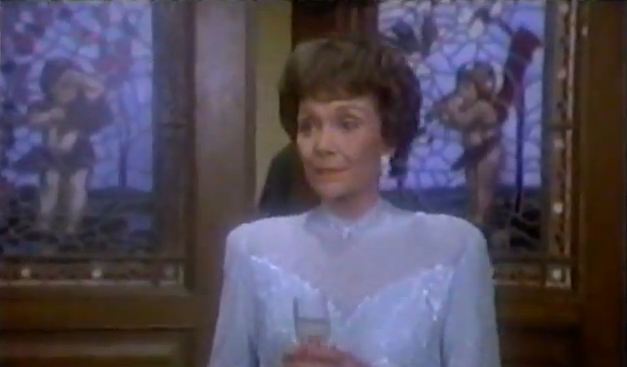
"Falcon Crest" may not have had the brand name recognition of "Dallas" or "Dynasty," nor did it have the niche cult following of "Knots Landing," but it was a well-produced, well-acted, fun series that created vivid, larger-than-life characters who were a pleasure to spend time with week after week.  It might have had some weak years, especially towards the end of its 9 season run when new writers and producers were brought aboard who had no understanding or appreciation of the material, but it was an undisputed hit while it was on the air during the 1980s.  There was enough style and substance to "Falcon Crest" to warrant its inclusion in the "Pioneers of Television" documentary.  I believe one reason why the series may not have been as well-remembered as the other prime time soaps is because it was the only one that did not generate a reunion movie years after it went off the air.  Rather than reflecting a lack of popular interest, I believe the lack of a reunion movie was ultimately due to two factors.  One, "Falcon Crest" had the most bloodthirsty season ending cliffhangers.  Unlike the other prime time soaps, which teased a fiery finale each season, but didn't have the guts to actually kill off its major characters, "Falcon Crest" proved to be the most merciless to its protagonists.  In the course of its run, major characters such as Chase, Maggie, Melissa, Terry, among others, all met their maker.  That left fewer characters to bring back for a reunion.  More importantly, "Falcon Crest" gave its audience a satisfying sense of closure in its final episode on May 17, 1990.  With most of its surviving characters given a happy ending, the show closed with an internal monologue given by Angela Channing, as she recalled the characters and events of "Falcon Crest" across 9 seasons, that proved to be a fitting summation of the entire series.  "Falcon Crest" left no loose ends.

Sunday, January 13, 2013

Isolation and Solitude in "Zero Dark Thirty"


I just returned from seeing "Zero Dark Thirty" (2012) in the theaters.  I was amazed at how crowded the movie theater was for a Sunday morning screening.  Clearly, this movie has become an "event," especially in Washington, DC.  I don't know if I have anything particularly original to add to the ongoing dialogue about the movie, but I agree it is an injustice that Kathryn Bigelow was snubbed by not receiving a Best Director Oscar nomination for this film.  (Especially since the movie received nominations in most other major categories.)  Bigelow directs this movie in such an assured, confident manner that she never has to over-dramatize the events being depicted.  As such, the movie has a low-key, laid-back quality that was awe-inspiring and which gave it credibility.  Throughout the movie there are moments and events that another director would have over-played and wrung out every ounce of unnecessary pathos.  But Bigelow avoids this and so the movie has a very clear-minded, almost detached perspective that was intelligent and refreshing.  I do not have first-hand knowledge as to whether the events depicted in the movie are accurate, but Bigelow has an amazing attention to detail that lends credibility to her endeavor.  Screenwriter Mark Boal also does an amazing job spinning this tale with dozens of characters without the audience getting confused or losing their place in the story.  By the time the movie reaches its inevitable conclusion at that infamous compound in Pakistan, you are on the edge of your seat even though you know the outcome of the story.


With regards to the vitriol that both Bigelow and the movie have endured concerning the treatment of torture in the story, I do believe that Bigelow was sincere and correct when she stated in interviews that she wants to leave the audience enough room to draw their own conclusions on the topic.  The movie does not, as Naomi Wolf suggested, glorify or condone torture.  (I realize that this is something open to debate and I am fine with people disagreeing with me so long as the comments and discussion, if any, remain civil.)  Torture is portrayed in the movie as ugly and unpleasant as one has imagined it to be.  If Bigelow made this movie and did not include those scenes, she would have been criticized for having white-washed the subject matter.  I think it is admirable that Bigelow assumed the audience was intelligent enough to interpret the movie without heavy-handedly beating them over the head with a scene that explicitly stated to them, in case they didn't realize it, that torture is unpleasant and horrifying and potentially dehumanizes all who are involved with it.  In my personal opinion, I also do not believe that Bigelow's depiction of torture in these scenes explicitly, or implicitly, state that these techniques directly led to the discovery of Bin Laden in Pakistan.  In those scenes, some useful information is obtained, but I believe the movie makes a point of underscoring how what came out of this endeavor was also not 100% effective.  The movie makes it clear that the discovery of Bin Laden's hideout came about from other methods of intelligence gathering.  So for Naomi Wolf and others like her to suggest that the movie is meant to justify, or serve as an apology, for the use of torture is way off base.  Additionally, for Wolf to draw analogies between Kathryn Bigelow and Leni Riefenstahl is irresponsible and also shows Wolf's limited knowledge and understanding of history.  Riefenstahl's films utilized brilliantly composed and edited images in a conscious effort to glorify the abhorrent National Socialist Party of Germany.  Bigelow's film has no such purpose in-mind and I would argue that her movie remains largely apolitical.


I have wondered for awhile if the criticism that has been mounted against "Zero Dark Thirty" would have been as strong or vitriolic if it were directed by a man.  (I hesitate to say that because the last thing I would want to do is to say something that might be condescending to Kathryn Bigelow.)  I have felt at times that the liberal-leaning critics of the movie are particularly outraged because a woman directed the movie.  Perhaps they operated under the expectation and assumption that a woman would make a movie that explicitly, and unequivocally, stated that torture is bad and that would be clearly sympathetic to a liberal viewpoint by portraying the CIA and the U.S. military personnel in an unquestioningly negative light.  The fact that Bigelow defied that party line and attempted to give the CIA and the U.S. military their due may have been seen by the liberal intelligentsia as a "betrayal," and that may explain why they have come out in full force against Bigelow and the movie.  One reason I have gotten this impression is because Naomi Wolf's article/open letter in The Guardian begins with her reminding Bigelow that "many young women in film were inspired as they watched you become the first woman ever to win an Oscar for directing" before she launches into her attack upon Bigelow for making "Zero Dark Thirty" by rhetorically asking her "(w)hat led to this amoral compromising of your film-making?".  (For the record, I am middle-of-the-road when it comes to politics, so I am no Fox News-type Neo-Con by any stretch of the imagination.)  I have a feeling that if Martin Scorsese had directed the movie, the scenes of torture would have been noted by critics, and there might have been a spirited debate about it in scholarly journals, but I don't think it would have risen to the level of controversy that it has.  This double-standard that I believe Bigelow may have been subjected to could help to explain why she was snubbed by the Oscars.  At the very least, whether or not gender had anything to do with her Oscar snub (and I acknowledge that it's entirely possible that my theory is incorrect and that gender was not a factor in this situation), I do believe that Bigelow angered liberals because her movie did not conform to the expectation that Hollywood filmmakers always express a clearly left-leaning viewpoint.  The fact that actors David Clennon (who?), Ed Asner, and Martin Sheen have all come out condemning the movie also suggests the extent to which the movie defied the expectations of even those who are from the entertainment industry.


I also feel that Bigelow could have been snubbed in the Best Director category because she comes across as a very humble individual in all of her interviews promoting the film.  In an interview with the New York Times, Bigelow was eager to highlight the contributions her crew members made to the movie, rather than simply touting herself.  It was refreshing to see a major filmmaker acknowledge the collaborative nature of the medium, rather than hog the spotlight.  However, it's possible that this may have undermined Bigelow's chances for a nomination because it may have allowed Oscar voters to take her immense contribution to the movie for granted.  In this respect, I disagree with critics who feel that the Maya character played by Jessica Chastain in the movie is supposed to be an extension of Bigelow's own personality.  As portrayed by Chastain, Maya remains a cold, at times off-putting cipher throughout the movie.  Maya is clearly intelligent and has determination, traits which Bigelow conveys in all of her interviews, but you never sense a warm or humane quality from Maya.  (In contrast, Bigelow conveys an inherent decency and humanity in all of her interviews which makes it clear why she is an effective leader on a film set.)  Maya is quick to contradict and chastise her superiors and her colleagues, eager to have her contributions recognized by everyone, and does not appear to possess an ounce of humility or empathy.  Diplomacy is clearly not her strong suit.


Casting Jessica Chastain was an unlikely risk that ultimately paid off.  Chastain has a high-pitched, at times squeaky, voice that normally does not convey gravitas, presence or authority.  Her co-star Jennifer Ehle, who has a supporting role as one of Maya's colleagues, possesses much more warmth and wit than does Chastain.  The earthy Ehle would have been a much more expected and conventional choice to play Maya instead of Chastain, as she would have evoked audience sympathy from the get-go.  But by casting the unsympathetic Chastain, I think Bigelow is expressing how the kind of person who would have devoted a decade of her life to the hunt for Bin Laden would also have to be an unconventional individual who thinks outside the box and is unconcerned with the niceties of life.  The scene where Maya briefs the Navy SEALs on the mission normally wouldn't work because Chastain's high-pitched voice does not make her come across as a natural leader, but Chastain nevertheless sells the scene by conveying Maya's unapologetic arrogance and determination that she is absolutely correct in her analysis and assessment of the situation.


At times, "Zero Dark Thirty" reminded me a great deal of "The Silence of the Lambs" (1991).  Both films involve talented young women working for a federal law enforcement/intelligence agency who are on the hunt for an elusive criminal in hiding.  In the case of "Lambs," Jodie Foster's Clarice Starling is on the hunt for the serial killer Buffalo Bill.  Unlike Maya, however, Foster's Clarice is a much more accessible, understandable character.  Clarice has moments of warmth and wit, remains exceedingly humble, is diplomatic at all times to her colleagues and superiors, and is simply a much more mature and self-aware character.  At the end of "The Silence of the Lambs," you get a feeling that Clarice is at the start of both a potentially brilliant career and hopefully fulfilling life.  In contrast, because Maya appears to have no life and no friends, she has nothing to look forward to once her mission has been accomplished.  Which is why the final shot, a close-up of Maya crying in the back of a C-130 flying her back to the United States from Pakistan, is so haunting.  Earlier, when the SEALs returned from the compound, hugged and patted one another on the back, and congratulated each other for a job well done, she was unable to share in that moment with them because her inherent nature prevented her from building a rapport with her colleagues.  In some respects, she is as isolated as Ethan Edwards (John Wayne) at the end of John Ford's "The Searchers" (1956).  Both characters spend a decade in a relentless, obsessive search for an individual whose whereabouts are unknown.  When the search is over, both characters find that their anti-social, almost narcissistic, nature prevents them from enjoying the fruits of their labor.  For Maya, there is no deep insight or revelation to be gleaned from this experience, now that Bin Laden is dead, because she has no one else to share the moment with in the world. 

Saturday, January 12, 2013

"The Cristina Raines Song"


There's a song that all my friends know I'm obsessed with.  I have sung and taught it to a wide scope of people in Washington, DC including military officers and personnel, attorneys, accountants, defense contractors, lobbyists, even cab drivers from Pakistan.  The funny thing is, it's a fairly obscure song that only a small handful of people would remember.  It's called "Could it Be Love" and it was written and composed by the esteemed Holly Dunn and Stewart Harris.  The song was performed by Cristina Raines three separate times during the second season of the prime time soap "Flamingo Road."  To the best of my research, the song has never been performed or recorded elsewhere.  My friends and I refer to the song not by its name, but as "The Cristina Raines Song."  The cab driver from Pakistan, to whom I taught the song, has told me that he has taught the song to some of his other fares and to the other cab drivers working at the same cab company.  A friend of mine teases me mercilessly because I like to sing it frequently since it puts me in a good mood.  You can see a performance of the song at 12:02 here.  The lyrics go like this:

If I've known you for such a long time.
And if the thought of lovin' you never crossed my mind.
Something's changing deep down inside.
I seem to be lookin' at you in a different light.

Could it be the firelight, dancin' around you?
Could it be the moonlight, shinin' above?
Isn't it a fine sight, you lyin' beside me?
Oh could this be magic, could it be love?

All I know is what I need.
Baby your kisses put a spell on me.
I'm so happy, so satisfied.
To look and see you lyin' by my side.

Could it be the firelight, dancin' around you?
Could it be the moonlight, shinin' above?
Isn't it a fine sight, you lyin' beside me?
Oh could this be magic, could it be love?

Oh could this be magic, or could it be love?


Lane Ballou (played by Cristina Raines) performed the song in the second season of "Flamingo Road" while working at the roadhouse owned and operated by Lute-Mae Sanders (Stella Stevens).  Lane arrived in Truro, Florida more than a year earlier while performing in a traveling carnival that came through town.  She is what I often refer to as one of the many "Lorimar outsiders":  a naive character whose arrival in a new and treacherous environment in the first episode of a Lorimar-produced prime time soap kicks off the start of the series.  ("Dallas" had Pamela Barnes marrying Bobby Ewing and moving onto Southfork.  "Knots Landing" had Gary and Valene Ewing moving into the Seaview Circle cul-de-sac.  "Falcon Crest" had Chase and Maggie Gioberti, and their children Cole and Vickie, moving into the Tuscany Valley.)  In the opening episode of "Flamingo Road," Lane tells Coyne, the proprietor of the carnival, "I'm tired of draggin' from town to town, I'm tired of eating greasy food in crummy cafes, and I'm tired of being leered at by country hayseeds.  I'm real tired of runnin' Coyne."  Lane decides to stay in Truro and make a life for herself.  She starts out with a waitressing job at the local diner and soon falls in love with handsome Fielding Carlyle (Mark Harmon) deputy sheriff of Truro.  Field falls deeply in love with Lane but, unbeknownst to her, Field is bequeathed to marry snooty Constance Weldon (Morgan Fairchild), the richest girl in town.  Titus Semple (Howard Duff), the evil sheriff of Truro, hates Lane on sight.  Titus has political ambitions for Field to someday get elected to the state Senate, and marrying Lane (an orphaned, hash-slinging waitress who came into town via the traveling carnival) doesn't fit his plans.  Titus wants Field to marry the shallow Constance.  In an effort to scare her into leaving Truro, Titus has Lane fired from her job at the diner and railroaded into prison on a 30-day sentence for bogus solicitation charges.  When she gets out of jail, she heads to Lute-Mae's to ask for a job as a singer in her saloon.  It's at Lute-Mae's that Lane makes the heart-breaking discovery that Field didn't wait for her while she was in jail and has gone ahead and married Constance.


When Field learns that Lane is back in Truro, he tries to reconcile with her and tells her that he loves her.  Lane responds by bitterly telling him "It doesn't matter anymore."  Lane eventually establishes a close relationship with successful local businessman Sam Curtis (John Beck), a hard-playing, hard-partying bachelor who starts to think about settling down when he falls deeply in love with Lane.  Throughout the first season of "Flamingo Road," it's clear that Sam is crazy about Lane and wants to marry her, but she is distracted because she is still in love with Field.  Eventually, Field and Lane embark on an affair that enrages Constance, who swears vengeance, and which breaks Sam's heart.  The first season ends with a violent argument between Field and Constance at the top of the staircase at Lute-Mae's where Constance refuses to grant Field a divorce.  Field grabs Constance, shakes her, and lets go, causing Constance to fall from the second floor bannister to the floor below.


When the second season opens, Field learns that Constance has been paralyzed by the fall.  Sam tells Lane that she has no future left in Truro and she may as well leave because whatever potential relationship she would have had with Field is ruined because he can't leave Constance now, or else risk a political scandal that would cost him his seat in the state Senate.  Sam is still bitter at Lane for breaking up with him and taking up with Field.  Eventually, Field and Lane break up for good.  When Field tries to reassure Lane that he still loves her, she tearfully reiterates what she told him the year before when he said he still loved her: "It doesn't matter anymore."  Lane decides to stay in Truro and build a life for herself that has nothing to do with Field.  Lane and Sam begin rebuilding their friendship and Lane starts working more and more on her music.


It is during this time of transition in Lane's life that the song "Could it Be Love" is introduced on "Flamingo Road."  The song premiered in the episode titled "The Intruder" on November 24, 1981.  The scene where it is introduced focuses on Sam and Lute-Mae talking while watching Lane perform it on the piano in the background of the scene.  Even though it seems like an incidental musical number, the song has thematic significance for Lane's character and the show.  The lyrics to "Could it Be Love" reflects how Lane has finally let go of hoping that she will ever be with Field.  She knows that a future with Field would be a dead-end and is finally ready to consider other opportunities staring her in the face.  The opening verse ("If I've known you for such a long time.  And if the thought of lovin' you never crossed my mind.  But something's changin' deep down inside.  I seem to be lookin' at you in a different light.") symbolizes how Lane has finally stopped taking Sam for granted.  She realizes he is a good man with much to love and appreciate, and she finds herself genuinely falling in love with him, not just using him as someone to keep her company while she is on the rebound from Field.  The second verse ("All I know is what I need.  Baby your kisses put a spell on me.  I'm so happy, so satisfied.  To look and see you lyin' by my side.") reflects how Lane has finally stopped looking for the unattainable with the spineless and wishy-washy Field to find true happiness.  She comes to deeply appreciate what the readily accessible, solid, and stable Sam has to offer her.  In the chorus ("Could it be the firelight, dancin' around you?  Could it be the moonlight, shinin' above?  Isn't it a fine sight, you lyin' beside me?  Oh could this be magic, could it be love?"), Lane is asking herself what it is about Sam that makes her feel so special.  As such, she is also rhetorically asking herself why she didn't recognize and appreciate all of Sam's wonderful qualities sooner.  The song reflects that Lane is on the verge of a healthier, mutually respectful, and loving relationship with Sam.


"Could it Be Love" reappears on "Flamingo Road" at least two more times during the second season.  The repeat performances of "Could it Be Love" helps chart the course of Lane and Sam's deepening relationship.  In the episode "The Powers That Be" which aired December 15, 1981, Lane is seen performing a country-rock version of the song in a recording studio where she is making a demo record.  She has developed more self-confidence about her singing talent and is looking to see what career opportunities lay ahead for her.  Earlier in that episode, Lane has a key scene where she runs into Field for the first time since they broke up five episodes earlier.  She later tells Sam that, when she ran into Field by chance, she realized she wasn't in love with him anymore.  She explains how, when she used to see Field, her heart used to leap for joy.  This time, when she saw Field again, she expected the feelings to return, but they didn't.  Field had become just another face in the crowd to her.  As a result, when we see Lane singing "Could it Be Love" in the recording studio later on in the same episode, her performance seems even more heartfelt and joyous than before.  She has realized that Field is completely out of her system and so the lyrics resonant even more deeply with her.


Throughout this time, Lane's relationship with Sam grows deeper and more serious.  When Lane sings "Could it Be Love" a final time in the episode "Strange Bedfellows" on January 12, 1982, she is performing it at Elmo Tyson's (Peter Donat) campaign fundraiser to run against Titus for sheriff of Truro.  Two episodes later, Sam asks Lane to marry him and, two episodes after that, Sam marries Lane in a lavish wedding attended by the elite in Truro.  Sam buys Lane a lavish house on Flamingo Road next door to where Field and Constance live with Constance's parents.  When the series is cancelled abruptly by NBC at the end of that season, Lane and Sam are expecting a baby and are among the few characters in Truro whose lives are happy and not in peril like the others.  The outsider who was shunned by the establishment when she arrived in Truro has established her own home and power base in that town.

Songwriter Stewart Harris

I've always liked "Could it Be Love" from the first time I heard it performed on "Flamingo Road."  It was that rare song that was catchy and also had depth.  For many reasons, its lyrics resonated with me.  Because I was so intrigued and obsessed with this song, I started researching the background of it.  It took a long time to find out anything about it because I don't think it ever received a songwriting credit in the end titles of the "Flamingo Road" episodes it appeared in.  I first tried to figure out what the actual title of the song was.  I researched the ASCAP and BMI databases for any songs that might be called "Could it Be" or "Could it Be the Firelight" or "Could it Be Love."  Finally, I found a biography for the songwriter Stewart Harris that indicated he had written songs that were used on "Flamingo Road."  I started researching Mr. Harris's songs and found that he had written a song called "Could it Be Love" with Holly Dunn.  I learned in my research that Mr. Harris is a very esteemed Nashville-based songwriter whose compositions have been recorded by Waylon Jennings, Randy Travis, Mickey Gilley, Reba McIntire, Tammy Wynette, Loretta Lynn, Levon Helm, Conway Twitty, Travis Tritt, among many others.  I also learned that Holly Dunn, as a two-time Grammy nominated solo artist, recorded many popular country albums in the 1980s and 1990s and is now a successful oil painter based in Texas.  Some of her hit records include "Daddy's Hands," "Two Too Many," "Only When I Love," and "You Really Had Me Going."  I found Ms. Dunn's official website and emailed her to ask about the song.  To my everlasting gratitude, she shared her memories about the background and origins of composing "Could it Be Love."  (Her detailed biography and discography can be found here.)  

Songwriter Holly Dunn

Ms. Dunn recalled that "As a paid songwriter in Nashville, you are given a weekly salary to write songs for the publishing company that you work for.  In this case it was April Blackwood which became CBS Songs Inc., which became EMI Music Group several years later.  Stewart and I were under contract to write songs for April Blackwood, and they in turn, were trying to get our songs recorded by the current Country Music recording artists of that era.  I don't recall any special circumstances surrounding the writing of this song...Wish I could give you come juicy story, but we were two hungry songwriters hoping to write something that someone would want to record!  Later on, we both wrote huge hits, but at the time we wrote this song, we were young and new to the business and just trying to earn our keep!  Having our song picked up and used on a TV series was HUGE to us back then!" 

Original lyric sheet for "Could it Be Love" sent by Holly Dunn

Ms. Dunn also graciously sent me a PDF of the lyric sheet from her personal archives for "Could it Be Love."  When I had transcribed the lyrics to the song in my original email to her, based on how Cristina Raines had performed it, Ms. Dunn "noticed that the lyrics you were quoting weren't right, so I am attaching the original lyric sheet that we had on file at our publishing company.  I can't have you out there quoting wrong lyrics!  Ha!  I seem to recall that the lyrics that were used on "Flamingo Road" weren't correct and that really upset us...Thanks for taking me down memory lane with this one!"  When I examined the lyric sheet, I noticed immediately that the opening verse had been changed for "Flamingo Road."  Originally, Harris and Dunn had kicked off the song with the lyric "Baby I've known you for such a long time..." instead of "If I've known you for such a long time."  I noted how the music director on "Flamingo Road" had Cristina Raines begin the song with lyrics that were in a conditional tense.  By having Lane start off the song with the word "If," it reflects Lane's insecurity about her relationship with Sam.  It shows how, after having originally left Sam for Field, Lane is uncertain whether Sam wants her back.  


The other major change I noticed was that Harris and Dunn had composed a bridge to the song that was not used at all on "Flamingo Road."  The bridge reads:

I believe true love has found me
Since you opened up my eyes
So wrap your lovin' arms around me
And hold me tonight.

After that, the song is supposed to conclude with a reprise of the chorus.  I asked Ms. Dunn if she remembered what the bridge melody was supposed to be.  She wrote that "The 'bridge' melody is different than the verses and chorus, but after 30 years, I couldn't tell you what it is supposed to sound like... You can just pretend it isn't there or make something up!"  It was interesting to learn that there were additional lyrics to the song that I was not aware of before.  I wonder why the music director on "Flamingo Road" chose not to use it, as the lyrics "I believe true love has found me, since you opened up my eyes" remain consistent with Lane's deepened love and appreciation for Sam.  The additional lyrics "So wrap your lovin' arms around me, and hold me tonight" also reflect how Lane is sincerely committed to staying with Sam.  There is no chance she would ever return to Field.


"Could it Be Love" ranks as the best musical performance Cristina Raines gave on "Flamingo Road."  Raines debuted as a singer years earlier in Robert Altman's "Nashville" (1975) performing Gary Busey's composition "Since You've Gone."  Raines did not have a musical background when Altman asked her to sing in "Nashville."  However, as indicated in the book "The Nashville Chronicles," (which covers the making of that film) she diligently rehearsed the song for weeks before she went before the cameras.  Probably because it was her musical debut, Raines has admitted in interviews that she still does not like to watch herself sing in "Nashville."  When you watch Raines' performance of "Since You've Gone" in "Nashville," you sense a slight tentativeness and uncertainty to her performance.  Nevertheless, this does not prevent her from turning in a good musical performance in the end.  The result is a song that fans of "Nashville" consider to be one of the best in the movie.  Cristina Raines got another opportunity to hone her vocal abilities when she was cast as saloon singer Lane Ballou on "Flamingo Road."  Raines was probably the most credible of all the "Lorimar chanteuses."  Unlike Audrey Landers's Afton Cooper on "Dallas," Lisa Hartman's Ciji Dunne and Cathy Geary on "Knots Landing," and Apollonia Kotero as Apollonia on "Falcon Crest," Lane's vocal talent isn't lauded or overpraised by the other characters on "Flamingo Road" the way Afton, Ciji/Cathy, and Apollonia were overrated as singers by the other characters on their respective shows.  And, unlike the others, Lane never had a wealthy male benefactor using his influence to propel her singing career forward.  (In fact, Lane pays for the demo recording of "Could it Be Love" out of her own savings and refuses Lute-Mae's suggestion that Sam use his connections and influence to help Lane's career.)  Lane's original motive for singing at Lute-Mae's was nothing more grand than to have a home and earn a living.  Because "Flamingo Road" isn't trying to sell the audience on the notion that Lane is a brilliant singer, this allows Cristina Raines the luxury of quietly honing Lane's musical abilities.  As a result, we see Raines (and Lane's) talents refine and develop over the course of the series.  


During the first season of "Flamingo Road," Raines competently performed standards on the show like Crystal Gayle's "Don't it Make my Brown Eyes Blue," Dusty Springfield's "The Look of Love," Loretta Lynn's "Blue Kentucky Girl," and Frank Sinatra's "Imagination."  By the second season, Raines had proven herself to where the producers purchased the original composition "Could it Be Love" for her to perform on the show.  At the risk of overstating it, Raines does a great job with the song.  With her energetic and joyous performance, she effectively conveys the sense of discovery and awe that is inherent in the song.  All the nervous uncertainty of her "Nashville" performance years earlier is completely gone.  Just as Lane has put aside her insecurities, Raines has developed enough self-confidence in her musical abilities that she's able to sell that song and wring every ounce of nuance from it.  I only wish that a recording of Raines' performance of "Could it Be Love" was available on Amazon.com.  Does anyone out there know what became of the recording masters for "The Cristina Raines Song"?  If so, leave me a message or comment here.  Considering everything that has now become commercially accessible, there's no reason why a song of this quality and pedigree should remain unavailable to the public. 

Tuesday, January 8, 2013

Characters to Root for in "Dressed to Kill"


Brian De Palma's work as a director is not often discussed these days, which is surprising considering how revered and important he was during the 1970s and 1980s.  I think this is because many of his films were entertaining exercises in style over substance.  You were often dazzled by his story construction and visual imagery, but rarely were you touched by the characters in his films.  For someone who purported to take after Alfred Hitchcock, De Palma rarely had any genuine insight into his characters the way Hitchcock did.  For De Palma, his characters were often plot devices to move the story along.  This is not meant as a condemnation, because I have enjoyed many of his films, but it does explain why his work is not as revered as Hitchcock or other major directors of his generation.  You are rarely touched by any of his films.  However, there is one De Palma film that I do think rises to the level of deserving greater acclaim and that's 1980's "Dressed to Kill."  I think what distinguishes this film from others is that De Palma seems to actually care about his protagonists for a change.  In "Dressed to Kill," he creates a trio of characters that the audience identifies with, and genuinely cares about, to the degree that their deaths and/or survival in the movie really matters for a change.


As has already been noted, "Dressed to Kill" takes on the structure of Alfred Hitchcock's "Psycho" in that we begin the movie with the story focused on one blonde woman (Janet Leigh in the Hitchcock movie, Angie Dickinson in the De Palma movie) as she throws caution to the wind and embarks on a series of risky endeavors on the last day of her life that indirectly lead to her premature and violent death at the hands of what appears to be a vicious, violent woman in an enclosed, claustrophobic and otherwise ordinary setting (a shower in "Psycho," an elevator in "Dressed to Kill").  At that point, another blonde (Vera Miles in "Psycho," Nancy Allen in "Dressed to Kill") takes over as the new, heretofore unexpected protagonist who collaborates with a man who had a close relationship with the deceased woman (John Gavin, playing Janet Leigh's lover in "Psycho," Keith Gordon, playing Angie Dickinson's computer geek son in "Dressed to Kill") to solve the mystery and nab the killer.  The killer in each movie turns out to be a man suffering from a split personality disorder that causes them to dress as a woman when they commit their violent crimes (Anthony Perkins as Norman Bates in "Psycho," Michael Caine as the repressed psychiatrist in "Dressed to Kill.")  Even though there are some superficial similarities, "Dressed to Kill" has enough intrigue and nuances to it that it is able to stand on its own as a worthy companion piece to "Psycho," instead of another cheap knock off.


One of the reasons I like "Dressed to Kill" is because Angie Dickinson gives one of her best performances as the sexually repressed upper middle-class housewife Kate Miller.  Dickinson courageously opens the movie with both a nude shower scene (a dream sequence) as well as a racy scene in bed where Kate is making love to her husband.  Later, Dickinson has another racy love scene in the back of a taxi cab with a handsome stranger she has encountered in a museum.  Dickinson gives a brave performance throughout these sequences by conveying the loneliness and longing for affection that Kate experiences in her stifling marriage.  Because De Palma directs these love scenes by lingering on Dickinson's expressive face--which convey her feelings of passion, surprise and delight--these scenes do not come across as tasteless or exploitative.  Instead, they come across as a sincere and sensitive expression of a woman's longing for romantic, emotional, and sexual fulfillment.  The normally feisty and bawdy Dickinson suppresses her typically exuberant screen image to create a confused and sympathetic character that the audience feels compassion for.  Kate is a kind and decent person who is clearly a good wife and mother, but is still attractive and vibrant enough to yearn for love and passion in her life.  Dickinson has a good rapport with Keith Gordon, playing Kate's nerdy son Peter.  The scene where Kate and Peter discuss his latest computer invention at home, while arguing over whether he will accompany her to the museum that day, has an authentic sound to it that makes it completely believable that they are mother and son.  Because Dickinson makes a strong impression as to the quality of person Kate is in a short amount of screen time, it is devastating when she is brutally killed in the elevator.


However, Kate's departure from the film allows for the introduction of another fascinating blonde woman in the movie, streetwise high-class prostitute Liz Blake (Nancy Allen).  As individuals, Kate and Liz are polar opposites.  Unlike Kate's sexually repressed comfortable, suburban middle-class housewife existence, Liz makes her living selling her sexuality.  She is completely at ease with that aspect of her life and does not have the insecurities as to her sexual self-worth the way Kate did.  Liz is an ambitious, proactive woman who lives in a classy Manhattan loft, invests money in art and the stock market, and who likely will move on to another line of work once she decides what she wants to do next with her life.  Liz transcends the stereotypical "hooker with a heart of gold" in that she retains her tough exterior, but still demonstrates evidence of being a decent human being.  The only scene where Kate and Liz meet is in the elevator after Kate has been viciously attacked and is bleeding to death, and when Liz is about to board.  Kate silently reaches out to Liz, begging her to help.  Liz, in shock and horror, reaches out to Kate to try and help her until she notices the killer standing nearby, whereupon she snatches the razor from the ground after the killer has dropped it.  Liz was helpless to do anything to save Kate, but her innate decency allows her to have the courage to reach out to another human being in danger.  This is in contrast to Liz's cowardly middle-aged client from out of town, who ran off in horror the moment he saw the bleeding and wounded Kate.  (Ironically, Liz's attempt to help Kate causes her life to be endangered, as her continued presence at the elevator allows the killer to become aware of her.)  Despite the seedy underbelly of society that Liz has seen in her line of work, she's still a good person.


In some respects, when Kate desperately reaches out to Liz in the elevator, she is metaphorically handing over the care and responsibility of her teenage son Peter to Liz.  From the moment of his mother's death, Peter rises to the occasion by mounting an effective and unconventional investigation to bring the perpetrator to justice.  He proves to be a young man of strength and character that his mother would be proud of.  Peter might be presented in the movie as a nerdy computer-whiz, but Keith Gordon portrays him with sympathy and respect.  There's nothing weird, socially inept or off-putting about his character.  When Peter saves Liz from the killer on the subway, he finds an unlikely ally and surrogate mother/sister in the streetwise hooker.  The Peter/Liz scenes are some of the best moments in "Dressed to Kill."  As he did with Angie Dickinson, Keith Gordon has a wonderful rapport with Nancy Allen that you can believe that these beautiful women are delighted to spend time with him.  In turn, Nancy Allen shows a different side to Liz's personality with her friendship and concern for Peter.  Liz still has a tough edge, but demonstrates a responsible, maternal side that suggests she would make a good mother someday.  The scene where Liz tries to comfort Peter when he expresses how much he misses his mother Kate is quite touching.  You root for Peter and Liz to successfully unmask the killer and survive "Dressed to Kill."


In contrast to the Vera Miles/John Gavin characters in "Psycho," Liz and Peter actually have depth and personality.  Miles and Gavin did fine work in "Psycho," but it's clear in that earlier film that Hitchcock had no interest in who Lila Crane and Sam Loomis were as individuals.  Lila and Sam were there to move the plot along, whereas Liz and Peter look like people whose lives, and friendship, will continue long after "Dressed to Kill" ends.  Because his main protagonists are not mere plot devices, "Dressed to Kill" is perhaps Brian De Palma's masterpiece.  For once, he actually seems interested in his protagonists and cares about what happens to them.  He allows them moments of humor, warmth, and sympathy that help to make them engaging characters.  As a result, Kate's death scene never has the cold, clinical quality that is evident in the brilliantly staged, but impersonal, scenes of violence from other De Palma movies.  It's an emotionally shattering experience after everything the audience has shared with Kate.  And, as mentioned before, you enjoy spending time with Liz and Peter so that the finale, with Liz imperiled with the killer nearby, is incredibly suspenseful.  Kate, Liz, and Peter are all vibrant, interesting people who would be fascinating to watch in other kinds of stories, not just the horror-suspense narrative that De Palma has devised for this film. 

Saturday, January 5, 2013

The Hidden Supporting Cast of "Speed 2"


One of my favorite "bad" movies is "Speed 2: Cruise Control" (1997).  Back in the summer of 1997, I was looking forward to seeing the movie for genuine reasons because I had enjoyed the original "Speed" (1994) immensely and also because two of my favorite actresses, Lois Chiles and Colleen Camp, were featured in the supporting cast.  I even had an unexpected phone conversation with Colleen Camp a few months before the movie premiered.  A friend of mine from college, Dave King (God rest his soul), was temping at Tom Rothman's office at 20th Century-Fox one day when Colleen Camp called the office.  Dave, ever the person to seize the moment, told Ms. Camp all about how I was a big fan of hers and he convinced her to let me interview her for an article about her career.  The next time I spoke with Dave on the phone, he gave me Colleen Camp's phone number to call.  I phoned her to introduce myself and was greeted with a very enthusiastic and fast-talking individual.  I asked her about "Speed 2" and she energetically told me that Jan De Bont was a "phenomenal" director and that she had "a nice, medium-sized part."  I asked her about Lois Chiles's role in the movie and Ms. Camp told me that Chiles had a good part playing the mother of a deaf girl and that she learned sign-language for the role.  (I never got to interview Colleen Camp because she seemed to have a very busy schedule.)  So I had reason to expect the movie would be good.


I remember being shocked, when I saw "Speed 2" on opening night, at how confused and incoherent the movie was at times.  It didn't seem at all like a worthy sequel to what was a very exciting movie.  The jerky camerawork and choppy editing made the movie hard to watch at times.  I was surprised at how slowly-paced the movie was, and how annoying the normally likeable Sandra Bullock was.  She and Jason Patric had no chemistry together.  I was glad that Lois Chiles had a decent amount of screen time, but I kept straining my eyes to find Colleen Camp in the movie.  I could hear her voice in the background throughout the movie, especially during very busy and crowded scenes with characters running around in a panic, but she was nowhere to be found, as the aforementioned clumsy editing and camerawork made it difficult to follow what was going on in the movie.  I wondered at the time, "Had Colleen Camp done something to cause the director to edit her out of the movie?"  (Impossible!)  The other thing I remember from my first viewing of "Speed 2" was the joke my brother made when Colleen Camp and Lois Chiles's names appeared on the same title card during the main title sequence at the end of the movie.  He said, "Wow, putting their names together seems apropos!"  Nevertheless, through the years, I have grown to enjoy "Speed 2," especially when it airs on AMC or FX cable in an extended version that reinserts additional scenes, not included in the theatrical version, back into the story.  I realized that the reason why the movie was so badly received at the time was that the audience expected that it would be an appropriate sequel to an action blockbuster.  As I have watched "Speed 2" on numerous occasions since then, I realized that, buried beneath its Joel Silver action framework, beats the heart of an Irwin Allen-style ensemble disaster movie, bursting to break out.


In subsequent viewings, I began to notice a cast of supporting characters with potentially complex and nuanced relationships that were buried beneath the awkward action hero posturing of Jason Patric and the atypical whining of Sandra Bullock.  There was a large ensemble of characters who made up the passengers and crew members of the cruise ship that the movie was set aboard who looked like they had stumbled in from "The Poseidon Adventure" (1972) and "The Towering Inferno" (1974).  What made "The Poseidon Adventure" work as a movie, that other disaster movies aspired to, was the fact that it was ultimately a character-driven piece where the tension and bickering among the passengers fighting to get out of that capsized ocean liner ultimately made the movie memorable.  At the very least, it was much more memorable than its soulless remake "Poseidon" (2006), which didn't bother to develop its characters at all.  You grew to care about the people in "The Poseidon Adventure" because there were recognizable traits in each of them, as broadly portrayed as they were, that made it easy for audiences to identify with them.  I would argue that there are moments in "Speed 2" that suggest the original intent of the movie was to recreate that sort of lively ensemble cast that distinguished the original "Poseidon" from other similar genre movies.


In "Speed 2," you've got Lois Chiles, Francis Guinan and Christine Firkins playing an upper-middle class family with tensions brewing underneath because of the deaf daughter's need to establish an identity for herself despite her uptight father's persistent disapproval.  You've got Colleen Camp and Michael Hagerty playing a good natured, overweight married couple who are vocal advocates of an unconventional diet plan called "Fat Busters."  You've got Connie Ray and Patrika Darbo as a pair of sisters from the South on vacation together.  You've got Charles Parks and Susan Barnes as a bitter, middle-aged married couple.  You've got Kimmy Robertson and Tamia playing hapless members of the ship's crew trying to keep the passengers calm.  And you've got Enrique Murciano and Jessica Diz as a newlywed couple on their honeymoon.  What's interesting is that none of these characters exist as plot devices in the main storyline involving Jason Patric or Sandra Bullock's efforts to defeat villain Willem Dafoe's plan to sabotage the cruise ship for his own nefarious purposes.  Usually, in action blockbusters like these, cut from the "Die Hard" mode, there is only enough room for characters that play a role in resolving the main crisis at-hand.  The fact that the movie features all of these supporting characters lends credence to the notion that part of the intent of the movie was to recreate the sort of "Grand Hotel" type movie that had been popular decades before.  If you look at "Speed 2" as an action blockbuster movie, it is an utter failure.  If you look at it, as I have suggested, as an attempt at an Irwin Allen-style ensemble disaster movie, you might find more to enjoy.


What appears to undermine the movie is the fact that director Jan De Bont can't seem to decide which of these two filmmaking genres he's trying to accomplish here.  The movie never works as an exciting action blockbuster because the premise of the cruise ship being hijacked and going out of control just does not lend itself to the sort of lightening, breathless pace of the original "Speed."  Nevertheless, De Bont continues to try to squeeze this square peg into a round hole by emphasizing that aspect of the movie over everything else.  As a result, the movie focuses far too much time on the Jason Patric and Sandra Bullock characters.  As mentioned before, Patric simply does not have the screen presence to be an effective action hero, Bullock is not nearly as charming or integral to the storyline as she was in the original "Speed," and neither of them have any convincing chemistry with each other.  You spend the entire movie rue-ing the fact that Keanu Reeves (understandably) refused to do this sequel.


Because the film spends so much time with Jason Patric and Sandra Bullock, it never completely takes advantage of recreating the sort of Irwin Allen/"Grand Hotel" disaster ensemble movie of the 1970s.  As a result, the supporting cast of passengers and crew members never get a chance to have enough screen-time to recreate the sort of chemistry that the original "Poseidon Adventure" ensemble had.  That's the reason why it is not easy to recognize the interrelationships of the passengers the first time you see the movie.  It's only when you see it again on cable, especially in the longer TV version, that you realize who is related to who.  (The net effect is like watching a Robert Altman movie, where in subsequent viewings more and more nuances become apparent.)  The only supporting cast members who get any decent screen-time are the deaf girl Drew and her parents.  Christine Firkins brings dignity and intelligence to the role of Drew.  I liked how, when Drew is separated from her family, and her parents are panicking, she is depicted as resourceful, calm, and poised.  Lois Chiles and Francis Guinan also do good work playing Drew's parents, Celeste and Rupert. With minimal amounts of screentime, Chiles and Guinan are still able to create a married couple who are disconnected from each other due to probable ennui and complacency.

 
There's a scene early in the movie where all the characters are above deck dancing to a band.  While the foreground of the scene involves Bullock exchanging dialogue with Dafoe and Patric, you see Rupert and Celeste in the background sitting at the bar.  Rupert is wearing a suit and tie, Celeste is wearing an attractive dress.  They both look like they are out for a night of dinner and dancing in Manhattan rather than on a cruise in the Bahamas.  What's notable are the little nuances Guinan and Chiles give to Rupert and Celeste in this scene to establish their relationship.   Rupert is busy reading his newspaper at the bar, while Celeste takes a sip from her drink.  Neither of them are talking with each other.  Because both actors stayed "in character" with their choices in this scene, even when the focus was on other characters, they establish in short-hand that something is wrong with that marriage.


I also like the silent moments of sadness and discomfort when Celeste witnesses Rupert's continual disapproval of their daughter Drew.  Chiles does a good job depicting Celeste's awkwardness as she witnesses the disconnect between her husband and daughter.  The first time I saw the movie, I never understood why Rupert and Celeste didn't go after Drew after she ran away from them before dinner because of their argument over the dress she was wearing.  It just seemed like a plot device by the screenwriters to create a potential crisis later on in the movie by separating Drew from her parents--and it probably was.  However, because the actors have invested as much as they can into their characters, I now interpret the scene as an indication that this is simply the latest in another series of arguments between father and daughter.  Rupert and Celeste appear unconcerned when Drew runs away from them because they've probably been through it before with her.  Because Chiles, Guinan and Firkins are committed to their roles, they look like a real family together.


Since the premise of "Speed 2" was such a non-starter, director De Bont should have tried to focus more attention on the supporting cast.  He might have at least taken advantage of the cast he had assembled and allowed them to attempt to create the sort of "Poseidon Adventure" ensemble chemistry that endeared audiences to the personalities of that earlier movie.  Rather than giving all the action and heroism to the bland Jason Patric, or focused so much attention on the inexplicably whiney Sandra Bullock, De Bont could have spread the heroism around equally to the other characters, allowing them to have moments to distinguish themselves and shine.  I would have liked it if Colleen Camp or Patrika Darbo got to become the Shelley Winters of "Speed 2," sacrificing her life for the good of her fellow passengers.  Or if Tamia got to become the Carol Lynley of "Speed 2," frightened and vulnerable and touching, rather than just taking up space on-screen doing nothing.  Or if Francis Guinan and Charles Parks argued with each other the way Gene Hackman and Ernest Borgnine debated the proper course of action, with Michael Hagerty (standing in for Red Buttons) trying to make peace between them.  Or if Lois Chiles and Susan Barnes were allowed chances to be as earthy, feisty, and sardonic as Stella Stevens was in the original "Poseidon."  As contrived as all of that might sound, it would have made a better "Speed 2" than what Jan De Bont ultimately turned in.