Showing posts with label John Ford. Show all posts

Saturday, June 15, 2013

Sue Lyon Demonstrates Courage and Integrity as one of John Ford's "7 Women"


I've always considered Sue Lyon, best known as the star of Stanley Kubrick's controversial adaptation of Vladimir Nabokov's novel "Lolita" (1962) as one of the most underrated actresses of the 1960s.  She's usually lumped in with the sort of blonde ingenues that Sandra Dee paved the way for throughout the decade, but she's ultimately much more than that.  Sue Lyon had much more charisma and screen presence than Sandra Dee, was much less childlike than Yvette Mimieux, was much less whiny than Connie Stevens, and was much more talented and intelligent than the bland, vapid and vacuously stupid Carol Lynley.  Even though Sue Lyon and Carol Lynley are continually tied to one another for having similarly-spelled surnames that ensures they will almost always be side-by-side in the index of movie reference books, and because they often competed for the same film roles, Lynley was nowhere as interesting an actress as Sue Lyon.


In fact, Lyon's only true peer in this category is the actress famously known for having turned down the role of Lolita, the gifted and equally underrated Tuesday Weld.  However, Lyon strikes a contrast with even Weld in that she's much less malevolent, nihilistic and destructive on-screen than Weld often was in her film roles.  Weld was brilliant and talented and was able to bring charm and depth to characters that were narcissistic, damaging, and shallow by-design.  Weld could indeed play characters who were marked with sympathy and decency, but that wasn't her forte.  In contrast, even though Sue Lyon's perceived screen image was, at times, that of a troubled "bad" girl (and she was effective during the times she actually played that sort of role on screen), in fact Lyon's strong suit as an actress was her ability to find the intelligence and, yes, unexpected aspects of decency and maturity in her characters that most people tend to overlook when discussing her characters.


A good example of this quality is demonstrated at the end of "Lolita" when Humbert Humbert, played by James Mason, has found Lolita after she has disappeared for several years.  He urges Lyon's Lolita to abandon her hard-of-hearing and hapless husband Dick, played by a likeable Gary Cockrill, and run away with him, only to have Lolita refuse to do so because, as she explains to Humbert, "I've ruined too many things in my life.  I can't do that to him.  He needs me."  As such, the audience realizes the one thing that Humbert hadn't expected and hadn't counted on--that Lolita might have actually learned from her mistakes and has developed the ability to care about somebody other than herself.  Sue Lyon is impressive and touching in that scene, and pulls off that moment better than any of her blonde contemporaries, even the brilliant Tuesday Weld, would have because she demonstrates a quality of humility that they are incapable of.  Lyon's range as an actress was much more than the young "nymphets" that the public perceived her to be.  One of the best examples in Sue Lyon's career that demonstrated her ability to convincingly play characters that had courage and integrity was her role as missionary Emma Clark in John Ford's unusual, yet extremely satisfying, final film "7 Women" (1966).


Set in rural China in 1935, "7 Women" concerns itself with the women who operate a Christian missionary post as Mongol invaders terrorize the surrounding territories.  Agatha Andrews (Margaret Leighton) is the severe, repressed head of the mission.  Miss Argent (Mildred Dunnock) is her seemingly timid assistant.  Charles Pether (Eddie Albert) is the foolish teacher at the missionary who waited until he was middle-aged before he finally married his long time sweetheart Florrie (Betty Field), who is now pregnant with their child.  Emma Clark (Sue Lyon) is a young volunteer from a family of missionaries who Miss Argent secretly pines away for.  The complacent life of these missionaries is turned upside down throughout the course of "7 Women" by a series of extraordinary developments.  Dr. D.R. Cartwright (Anne Bancroft)--an unconventional, assertive physician who wears pants, smokes, drinks and does not subscribe to religion--arrives to serve as the missionary's physician.  From the moment she enters the scene, Cartwright and Andrews clash over their different viewpoints on how the mission should be run.  Andrews is perturbed that young Emma immediately takes a liking to Dr. Cartwright and looks up to this genuinely inspiring individual.


Eventually, the missionaries are joined by refugees from a British mission who fled in terror after they were attacked by ruthless Mongol bandit invader Tunga Khan (Mike Mazurki) and his men.  The refugees include Miss Binns (Flora Robson), the thoughtful head of the British mission; Mrs. Russell (Anna Lee), Binns' assistant; Miss Ling (Jane Chang), a Chinese member of the mission staff; as well as dozens of Chinese refugees.  Not long after they arrive does Dr. Cartwright realize that the refugees have brought with them a strain of Cholera.  Cartwright, Binns, and Emma work overtime in an effort to inoculate the inhabitants of the mission, with Emma falling ill to the disease.  Andrews becomes alarmed over Emma's condition, until Cartwright successfully treats her.  As the mission starts to regain a sense of calmness, Charles Pether notices fire and gunfire off in the distance and goes off to investigate, as the Chinese Army flees the area.  When Pether's car returns and the car horn is honked, the gate is opened and Mongol invaders led by Tunga Khan take over the mission.  The women learn that Charles had been killed by the Mongols while trying to protect a young girl who was being assaulted by them.


The women are rounded up and put into a shed as the Mongols pillage the mission.  When the Chinese refugees are lined up and killed before a firing squad, Emma rushes out of the shed in an unsuccessful effort to save their lives.  Florrie goes into labor and all the women, except for a prudish Andrews, assist Dr. Cartwright in helping her give birth to a baby boy.  Cartwright strikes a bargain with Tunga Khan to become his concubine in exchange for food and medical supplies for the women.  Eventually, with Emma's encouragement, Cartwright is able to negotiate the freedom for all the other women, except herself.  Emma protests leaving Cartwright behind, which causes Cartwright to scold and urge her to leave with the others.  As the women leave the missionary, Emma vows that she'll never forget Cartwright as long as she lives.  Back at the missionary, Cartwright pours two drinks spiked with poison and serves one to Tunga Khan, who keels over dead after drinking it.  Cartwright bitterly and triumphantly announces "So long, ya bastard!" as she drinks from the second cup as well.


A quirky and offbeat adventure drama atypical of director John Ford, "7 Women" is an underrated movie deserving of its cult status from movie buffs.  It's energetically acted by a talented cast led by a brilliant Anne Bancroft (who deserved an Oscar nomination for her work in this film), has an engaging and thought-provoking screenplay by Janet Green and John McCormick, and lively direction by the legendary Ford.  I don't consider "7 Women" a late career hiccup by Ford at all and admire his willingness to get outside his comfort zone to direct a movie considerably different from what he is known for.  (In contrast to Howard Hawks, who simply served up "Rio Bravo" ad-nauseum at the end of his career by making the similar "El Dorado" in 1967 and "Rio Lobo" in 1970.)  As I understand it, Sue Lyon was a casting choice urged upon Ford by MGM, with whom Lyon was under contract, as Ford had originally been considering Carol Lynley to play Emma.  Ford agreed to the casting of Lyon in order to help ensure that MGM agreed to his other casting choices.  Despite Ford biographer Joseph McBride's assertions that "Lyon's acting skills were limited" and that her "line readings were often clumsy, despite the extra rehearsal time the director devoted to her," I think Lyon gives a good performance as the naive Emma.  At the very least, Lyon brings a lot more energy, charisma and commitment to the role than Carol Lynley, who would have probably dragged out and extended the running time of "7 Women" with her typically slow, distracted, somnambulistic line readings.


I think the reason I like Lyon in "7 Women" is because it's the first time in a movie where Lyon's character is not sexually objectified by the director.  Lyon had great parts, and did terrific work, for directors Stanley Kubrick in "Lolita" and for John Huston in "The Night of the Iguana" (1964), but there's no doubt that both directors emphasized her good looks and playful personalities in both films in a way that exploited her to a certain extent.  Despite the fact that Agatha Andrews (Margaret Leighton) clearly has a romantic attraction to Emma in the storyline, director Ford doesn't linger upon that aspect of the movie more than he needs to.  As such, Ford respects Lyon's sense of modesty in ways that Kubrick and Huston didn't and this allows Lyon an opportunity to create a morally unambiguous character marked with strong traces of courage and integrity.  In Lyon's hands, Emma comes across as a bright, if slightly naive, young woman, filled with caring and concern for those around her.  Emma has a good relationship with the Chinese children that she helps to educate, and tries to comfort Florrie, whenever she becomes hysterical, that things will turn out all right.  Unlike most roles offered to young 1960s starlets, Emma is an individual marked with strength, maturity and character, and Ford plays fair with her by presenting her character in a respectful manner.


I like how Emma does not blindly follow Andrews, even though she starts out in the story respecting the older missionary, and finds admirable qualities in Dr. Cartwright that allow her to broaden her perspective on the world.  When Andrews expresses dismay at Emma's admiration in Cartwright, and announces that she plans to have her replaced at the earliest possible opportunity, Emma defends Cartwright and refutes Andrews' assertion that she is morally and spiritually bankrupt by declaring "No...Dr. Cartwright has come here to look after the sick, to take care of Mrs. Pether.  She just can't be a bad woman.  She's different."  When Andrews continues attacking Cartwright and declares her to be evil, Emma again defends the doctor by saying "Evil?  I can't believe it."  Andrews tries to guilt-trip Emma by implying that her admiration of Cartwright is a betrayal of the time and effort Andrews has spent trying to mentor her and that it is an indication that she has lost her faith.  Even though we see how Andrews has put Emma on the spot, Emma insists "Oh no!  I...No, I haven't lost my faith.  I didn't mean that.  I haven't."  Despite Andrews' manipulation, we eventually see in the course of the story that Emma does not blindly follow misguided leaders, and is an independent thinker who is smart enough to make her own judgments as to who or what is good in the world.  Because she's someone who is able to make up her own mind as to what is important to her, Emma is a character with a bright future ahead of her, someone who will be an even more effective missionary than the uptight and close-minded Andrews.

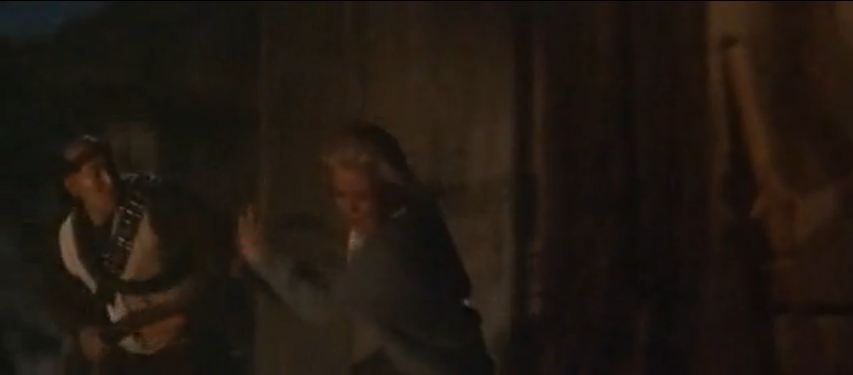
As a result of Cartwright's earthy presence at the mission, Emma stops wearing her hair in the severe bun that Andrews insists of her and allows her hair to be worn in a more natural manner that allows her to express her femininity.  Emma has learned that service to God does not mean she should, concurrently, shun other aspects of being a woman.  Emma continues to demonstrate the courage of her convictions by assisting Cartwright in helping to inoculate the mission population from cholera, even though she herself falls ill to the communicable disease, and by rushing out of the shed, when she realizes the Chinese refugees are being lined up to be slaughtered by the Mongols in a firing squad, in an unsuccessful effort to save their lives.  In both instances, Emma risks her life by putting her safety at risk in order to help the refugees that she has devoted her life to.  She doesn't take them for granted as mere "sheep" the way Andrews does, but as human beings whose welfare she is genuinely concerned about.  After witnessing the slaughter, an emotionally distraught Emma says, "Dr. Cartwright, now I know what Evil really is."  Her naivete wiped clean from her consciousness, Emma now realizes how dangerous her work as a missionary truly is and won't have the sense of entitlement and arrogance that hindered Andrews, who foolishly believed that being an American inherently protected her and the others from the dangers of the outside world.  If Emma chooses to continue her work as a missionary, she will know how to avoid walking into traps the way Andrews has by recognizing how to protect herself and those around her.


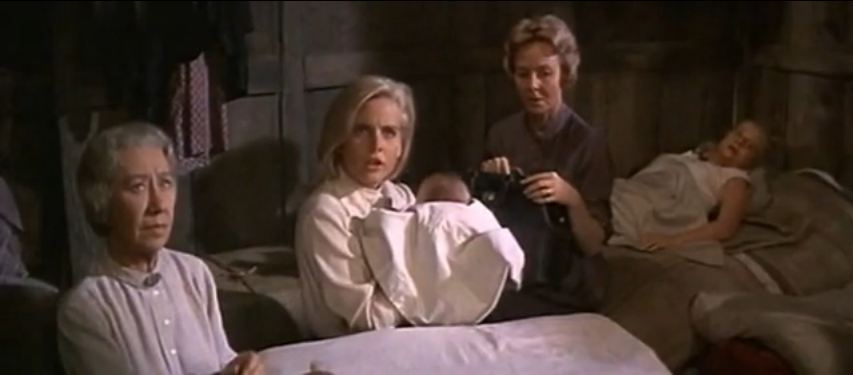
Throughout the remainder of "7 Women," Emma continues to demonstrate her ability to roll up her sleeves to do what needs to be done for the greater good of all.  When Florrie goes into labor, and all the women (except Andrews) rise to the occasion to help her, Emma asks Cartwright what she can do to assist.  Cartwright tells Emma to get Florrie a stick that she can bite on while she is in labor.  Emma immediately grabs a stick, snaps it into smaller pieces by breaking it on her knee, and brings it over to Florrie for her to bite on.  After Florrie's son is born, Emma actively participates in caring for the child and assists in his feeding.  We see how Emma has a maternal maturity about her that belies her youth.  When Andrews expresses disgust for Cartwright's sacrifice in becoming Tunga Khan's concubine, and complains about the baby, Emma finally gets fed up with the whiny Andrews and tells her, "Oh stop it!  Whatever the doctor's doing, she's doing for our good!  You should be thankful!"  In so doing, she has finally put Andrews in her place and begins to shatter her "holier-than-thou" delusions about herself and the world around her.


Despite her youthful naivete, Emma remains a realist who can handle what life has thrown her way.  Emma is the one who helps suggest to Dr. Cartwright that she can use her position as Tunga Khan's concubine to negotiate the women's release.  Cartwright smiles and admires Emma's shrewd pragmatism at recognizing the bargaining position that Cartwright is in and tells her, "You're a good kid, Emma."  However, even Emma couldn't foresee that Cartwright's success at negotiating the women's release would result in Cartwright further sacrificing herself by being left behind to face an uncertain future with Tunga Khan.  Emma asks Cartwright, "What are you?...Why are you staying here?  Why aren't you going to come with us?" only to have Cartwright scold her into leaving by telling her "Beat it!"  As the women are wheeled away in an oxen-drawn cart, Emma looks back at Cartwright and declares with admiration, "Dr. Cartwright...I'll never forget her as long as I live."


Similarly, anyone who has ever seen Sue Lyon's work as an actress isn't likely to ever forget her either.  If she did nothing else as an actress, Lyon's work in Stanley Kubrick's "Lolita" would, and indeed has, cemented her place in film history forever.  However, Lyon followed up her brilliant work for Kubrick with equally fine work for John Huston, in the aforementioned "The Night of the Iguana" and with John Ford in "7 Women."  In a short period of time, Lyon starred in leading roles with three of the finest directors in cinema history in three excellent movies.  As such, even though Sue Lyon's career was much shorter, much less prolific, and marked with probably more bumps in the road than Sandra Dee, Carol Lynley, Yvette Mimieux, and Connie Stevens, I think her career was in the long run much more rewarding because they never reached the heights of achieving brilliance the way Lyon did.  In some respects, Lyon eclipses even Tuesday Weld (who I greatly admire) because her trio of brilliance is more impressive than even the interesting and offbeat films that were the highlights of Weld's idiosyncratic career.


Later in the 1970s, Lyon's career struggled as she made appearances in B-pictures and on television that didn't take full advantage of the earthy intelligence and vitality that she had to offer.  Her last good movie was as the female lead in the bio-pic "Evel Knievel" (1971) with George Hamilton.  But, even within the limited framework offered to her, Lyon's star quality as an actress continued to shine brightly.  She was particularly good in a 1969 "Love American Style" episode entitled "Love and the Bed" where she and Roger Perry play neighbors in an apartment house who argue over ownership of a elegant brass bed being thrown out by another neighbor moving out of the building.  Even though it was a light-weight vignette, Lyon brought insouciant wit and maturity to the skit that allowed it to rank among the better segments of that series.  I also remember her charming performance in the TV movie "But I Don't Want to Get Married!" (1970), as one of the many women attracted to recently widowed, middle-aged Herschel Bernardi.  In casting that was clearly meant to draw parallels with her famous role as Lolita, Lyon's character is very attracted to Bernardi's kindness and maturity as a gentleman.  She tells Bernardi's character, "You're a nice guy.  There aren't too many around.  And I like you.  Aren't those enough reasons?...Listen, I'm a big girl now.  I know what I want."


In contrast to James Mason and Richard Burton before him, Bernardi tells Lyon's character, "I'm a grown man and I know what I can't have."  Defeated, Lyon graciously accepts Bernardi's invitation to buy her a hot chocolate at a nearby drugstore and jokes "All right, I guess a hot chocolate's better than nothing!"  Clearly, Lyon's characters continually mature and progress beyond one's expectations.  I also remember her for her touching performance in an episode of "Fantasy Island" in 1978.  She played a spoiled rich girl who pays Mr. Roarke to recreate the best summer of her life when she was still in high school and spent it with her four girlfriends from school.  Michele Lee, Pamela Franklin, and Hilarie Thompson played her classmates.  In Lyon's most affecting moment, she reveals to the others how she is not as rich as they remember her to be, that she had to get a job and save up money for this fantasy, and that she simply wanted one more chance to relive her youth before ultimately facing reality.


In so doing, Lyon's characters continually demonstrate how they are more self-aware about the realities of their lives than the ones played by other blonde 1960s starlets.  Her comparatively deeper, mature voice, vibrant intelligence, and forthright directness was a refreshing contrast to the frivolity and coyness expressed by her counterparts in their roles.  Lyon faced her share of career struggles while in Hollywood, but there is no other role that demonstrates her qualities of courage and integrity better than her performance as Christian missionary Emma Clark in John Ford's "7 Women."  Ford doesn't objectify her on screen and allows Lyon's assertive qualities as an actress to be fully explored.  Lyon has great chemistry throughout the movie with her formidable co-stars, particularly with Anne Bancroft and Margaret Leighton, and more than holds her own amidst such powerhouse performers.  It's a shame that "7 Women" wasn't a bigger success for all involved so that the public and Hollywood didn't perceive that John Ford was losing his touch as a director and so that Sue Lyon could have had a shot at playing more mature and dignified roles in her career.  Sue Lyon's stardom in Hollywood may have been shorter than it should have been, but her fine work for John Ford in "7 Women" demonstrates the extent to which her star, at its peak, did indeed truly shine bright. 

Sunday, March 31, 2013

Protocol, Cohesion and Sacrifice in "They Were Expendable"


My favorite John Ford movie, and my favorite World War II film, is "They Were Expendable" (1945).  I never tire of seeing it and watch it every Memorial Day weekend.  I've always had an affinity for movies and TV shows set in the U.S. Navy that focus on the Pacific Theatre of the War.  "They Were Expendable" has always stood out as a class act in the genre because of its emphasis on character and nuance.  Even though there is plenty of action, it can't be defined as a pure action film.  The movie has a very relaxed, episodic structure as it follows the men of the United States Navy's 3rd Motor Torpedo Boat Squadron in the early days of the war.  What also strikes me about the movie is that it's not a film that follows our protagonists, and the Allied effort in the war, as they go from strength to strength.  The movie has the courage to demonstrate moments of defeat, disaster, and disappointment as the personnel depicted in the story attempt to push back Japanese advancement in the Pacific.  It has a serious, but not heavy-handed, tone that gives it a sense of gravitas that is not always present in other World War II movies.


Robert Montgomery stars as Lt. John "Brick" Brickley, Commander of Motor Torpedo Boat Squadron Three based in the Cavite province of the Philippines in Manila Bay.  At the start of the film, Brickley and his second in-command Lt., J.G. Rusty Ryan (John Wayne) are frustrated because Navy leadership do not have faith in the efficacy of the torpedo boats.  However, news of the Japanese attack on Pearl Harbor provides Brick and Rusty an opportunity to demonstrate what the boats are truly capable of.  After disappointment that their initial orders are to patrol the bay and standby for messenger duty, the Squadron begins to distinguish themselves when they shoot down three Japanese planes that have attacked the island and destroyed a majority of the base.  During the battle against the Japanese planes, Rusty badly injures his right hand.  Despite this, the squadron is still assigned to messenger duty on the island of Bataan.  While there, Brick orders Rusty to medical treatment at the military hospital on Corregidor when Rusty's injuries develop into blood poisoning in his arm.  As a result Rusty, and the personnel on his boat, must sit it out as Brick and another torpedo boat are assigned to sink a Japanese cruiser that is patrolling Bataan and shelling Allied positions on the island.  While in the hospital, Rusty meets and falls in love with level-headed, no-nonsense Army nurse Lt. Sandy Davyss (Donna Reed).


Rusty eventually recovers and returns to duty as the Torpedo Boat Squadron continues to prove their mettle as they work to thwart Japanese efforts in the Pacific.  Brick and Rusty are given their most important assignment yet when they are ordered to transport General MacArthur, his family, and other key military personnel to Mindanao.  However, Brick receives orders that a majority of his enlisted personnel must stay behind in Bataan and help the Army hold back the Japanese on land.  Rusty phones Sandy to bid farewell before he leaves Bataan, but is unable to finish his phone call when Sandy is ordered off the phone by military personnel who are dismantling the phone lines so that they can move South.  Brick and Rusty successfully bring MacArthur to Mindanao and are eventually assigned to sink a Japanese cruiser on its way to Corregidor.  They succeed in their mission, but both Brick and Rusty's boats end up separated, with Rusty's boat eventually destroyed from Japanese aerial assault.  Meanwhile, Rusty learns that American forces have surrendered at Bataan, and wonders about the fate of both Sandy and the squadron's enlisted personnel who stayed to help the Army fight the Japanese.  By this point, Brick and Rusty have proven to Navy leadership the importance of the torpedo boats and receive orders to head first to Australia and then eventually back to the United States to help train a new squadron of torpedo boat personnel.  As they reluctantly fly out of the last plane leaving the Philippines, they ponder the fate of their squadron as well as all the other American military personnel left behind.


What distinguishes "They Were Expendable" from other World War II movies are the beautifully nuanced moments and characters that director John Ford and screenwriter Frank Wead, a retired Naval aviator, have weaved throughout the film.  People who have never seen "They Were Expendable" might dismiss it as a John Wayne starring vehicle, but Wayne shares equal screen time in the film with Robert Montgomery, who is the film's co-leading character.  The versatile, level-headed Montgomery, who should be remembered by short-sighted movie and TV fans as much more than just Elizabeth Montgomery's father, is terrific as Lt. Brickley.  He strikes a good contrast with the larger-than-life Wayne by demonstrating Brickley's calm, quiet, diplomatic leadership qualities.  Brickley has a maturity about him that is refreshing compared to other characters in war movies.  Rather than being a presumptuous hot-head eager to prove the worth of both himself and his squadron, Brickley quietly accepts disappointing and unchallenging orders rather than be insubordinate and disrespectful of military protocol.


Montgomery is superb in the scene, right after the squadron has shot down three Japanese planes that have attacked the base at Cavite, when he receives word that Admiral Blackwell (Charles Trowbridge) wants to speak to him.  Brickley excitedly goes to see the Admiral, expecting him to issue orders for the torpedo boat squadron to engage a Japanese task force moving into Lingayen Gulf, only to learn that the Admiral wants them to use the boats to deliver messages between Manila and Corregidor.  Rather than overplay the scene, Montgomery subtly demonstrates Brickley's disappointment by first staring intently and reacting in a deadpan manner to the orders, and then blinks his eyes just once to project the extent to which Brickley is crestfallen by the assignment.  In this instance, one gesture says a thousand words.  Brickley calmly listens as the Admiral explains, "That task force will land.  You and I can't stop it...Listen, son you and I are professionals.  If the manager says 'Sacrifice' we lay down a bunt and let somebody else hit the home runs...Our job is to lay down that sacrifice."  Brickley doesn't try to play hero by arguing with the Admiral because Ford and Montgomery, who both served in the Navy during the war, clearly understand that respecting military protocol and maintaining a calm perspective of the larger picture are of paramount importance in these circumstances.


Throughout the movie are sequences of the Torpedo Boat Squadron awaiting orders to engage in combat, rather than depicting scene-after-scene of action.  This gives "They Were Expendable" a relaxed quality that allows Ford an opportunity to develop the relationships of the characters in the movie.  I particularly liked the way Ford demonstrates the different cultures and dynamics of the officer and the enlisted personnel.  Unlike other war movies, which do not make as much of an effort to demonstrate the distinction between officer and enlisted, "They Were Expendable" makes it clear that the two groups co-exist in a separate world apart from one another. The opening sequence at the officer's club, with the officers wearing their choker white uniforms and dancing with beautiful women in an attractive nightclub/restaurant setting is intercut with the scene at a local bar where the enlisted men are celebrating the impending retirement of Doc (Jack Pennick), the squadron's medic.  The polite formality of the social atmosphere in the officer's club is contrasted with the warmer and more exuberant celebration of the enlisted personnel at the bar.  You see how both groups of personnel have their own chain of command and traditions that complement one another in ways that are rarely demonstrated in most movies set in the military (which oft-times focuses mainly on the officers, as they are purportedly considered more "glamorous" by Hollywood).


Ford also dramatizes a degree of competitiveness among the enlisted personnel, demonstrated by the scene when Chief Boatswain Mate Mulcahey (Ward Bond) attempts to share anecdotes concerning his boat crew's combat with the Japanese cruiser patrolling Bataan with Rusty's boat crew.  Rusty's boat crew got left behind as the boat Mulcahey serves on is sent in its place to help sink the Japanese cruiser when Rusty is ordered by Brickley into the hospital because of the worsening injuries on his hand.  Rusty's crew yanks Mulcahey's chain and prevent him from boasting by responding to each of his anecdotes with feigned disinterest, "Pick up any chow?...Oh, I forgot to tell you, Mick, your laundry's drying.  Came out swell...Youse guys was late for breakfast too.  It was wonderful...Yeah, cupcakes with raisins," which only serve to frustrate Mulcahey.  Mulcahey returns the favor later when Rusty's crew, who are now excitedly sharing anecdotes after they return from combat with the Japanese, is interrupted by an annoyed Mulcahey who throws back in their face, "We had cupcakes for breakfast!  With raisins."  We see during these moments how the crew members of each individual boat in the squadron attempt to distinguish themselves from one another in a competitive manner that still allows the entire squadron to remain a cohesive whole.


Ford even takes time to demonstrate the friendly tension between officer and enlisted during the scene, after Brick's squadron successfully transport MacArthur to Mindanao, where junior officer Ensign Gardner (Marshall Thompson) attempts to notify the enlisted that they've been awarded the Silver Star for gallantry by MacArthur.  The enlisted personnel are too busy trying to fix one of the boats, or laughing about how the squadron's black cat stowed away on one of their boats during the operation, to pay the increasingly frustrated Gardner any attention.  This follows-up on an earlier scene in the movie when Gardner is inspecting the kitchen and drinks a ladle of dishwater, thinking that it is soup, only to have Doc shake his head and dismissively mutter under his breath "Ensigns!"  In depicting this friendly competitiveness amongst the officer and enlisted personnel, Ford helps to develop the personalities and relationships amongst these characters with a refreshingly nuanced level of detail.  It demonstrates the extent to which these characters are able to retain their sense of individuality even within the inherent conformity that is required in order to serve in the military.


Ford further underscores the line of demarcation between officer and enlisted personnel during the brief scene where the enlisted are waiting outside as Brick, Rusty, and the other officers are inside strategizing how to sink the Japanese cruiser patrolling Bataan.  It's a brief moment, but it helps to demonstrate how the enlisted are left out of certain aspects of the decision making process in the military and must follow the orders given to them by the officers.  But there is no complaint, frustration, or insubordination among the enlisted as they accept this protocol as part of the reality of their service, the same way Brick must quietly accept disappointing orders issued to him by Admiral Blackwell.  Ford demonstrates, with little vignettes and subtle touches such as these throughout "They Were Expendable," the importance of respecting the chain of command in the military, and how traditions such as these help to develop a sense of cohesion so that the military personnel never becomes distracted or muddled in their efforts to defeat the Japanese.  Even though Ford underscores the distinction between officer and enlisted in "They Were Expendable," what's amazing is how, in the end, the squadron still operates as a cohesive whole despite (or, perhaps, because of) the differences in the classes of military personnel.


But I don't want to give the impression that "They Were Expendable" is a movie that lauds protocol and conformity above all other qualities in its characters.  Ford also goes a long way to demonstrate that a level of passion and spontaneity can also be useful, as exemplified in John Wayne's impatient Rusty.  With Rusty's character, Ford demonstrates how, in specific occasions, the ability to think outside the box helps to ensure that military protocol and conformity never turns into complacency.  Rusty, like Brickley, gets frustrated by the unchallenging, disappointing orders issued by Navy leadership.  At the start of the film, when Admiral Blackwell seems unimpressed by the capabilities of the torpedo boats, we see Rusty at the bar in the officer's club drafting a request to be reassigned to a destroyer, where he feels his talents might be better utilized.  However, Rusty remains a team player and, upon learning of the Japanese attack on Pearl Harbor, tears up the request he is drafting and immediately reports for duty with his squadron.  Rusty is much more vocal in his frustration of Blackwell's orders that the squadron be utilized as a messenger service, but he has enough regard for the chain of command that he does not disrespect those orders.  He never becomes arrogant and presumes to know better than those in command.  Instead, he impetuously kicks a can on the ground in frustration, which inspires Brickley to also take out his frustration by kicking another can nearby.


Rusty's eagerness to be utilized in a substantive manner in the war helps ensure that Brickley never becomes complacent with his squadron.  Brickley respectfully continues to advocate on behalf of his motor torpedo boat squadron so that Admiral Blackwell remains aware of them when he finally has an assignment that is specially suited to their capabilities.  Rusty continually challenges Brickley throughout the movie so that the more senior officer always remains innovative and resourceful in thinking of ways to best utilize the talents of his squadron.  When Admiral Blackwell finally issues orders for the squadron to take the torpedo boats out to sink the Japanese cruiser patrolling Bataan, Brickley responds to this validating moment not with cheers and excitement, but a calm, slight smile as he rhetorically asks Rusty, in the presence of the Admiral, "I think one boat, don't you, Mr. Ryan?" only to have Rusty slyly respond "No, I think two boats, Mr. Brickley" to subtly demonstrate to the Admiral how both men are pleased with these new orders.  John Wayne's work in "They Were Expendable" is comparatively more overt than Robert Montgomery's characterization, but his performance beautifully complements Montgomery's low-key approach throughout the movie.  Ford demonstrates the extent to which Brickley and Rusty remain a brilliant team, and how Brickley's calm and reasoned leadership is beautifully balanced by Rusty's passion and initiative.  They work together to help ensure that Motor Torpedo Boat Squadron Three never becomes too contemplative or too impetuous for its own good.


This balance between maturity and passion is exemplified by the scene at the very end when Rusty and Brickley are about to be flown out of the last plane out of the Philippines.  A guilt-ridden Rusty almost gives up his seat on the plane to friendly Army Air Corps Captain Carter nicknamed "Ohio" (Louis Jean Heydt) whom he met while being treated in the hospital.  Rusty does not want to leave behind the other American military personnel in the Philippines, who are facing a grim fate, but Brickley sternly reminds him that his act of sacrifice would be selfish in the larger picture because it prevents him from returning to the United States to help train new squadrons of torpedo boat personnel to fight the Japanese.  Brickley simply states, "Rusty!  Who are you working for?  Yourself?"  Ford demonstrates, in that short scene, how important it is for military personnel such as Rusty to set aside their own personal feelings and interests and remember that they are merely a cog in a much larger wheel than themselves.  In this instance, true sacrifice is much more than merely laying down one's own life.


The beauty of "They Were Expendable" is that Ford acknowledges the sacrifice of not just people like Brickley and Rusty, but other people who have a major stake in Allied victory as well.  I liked the way Ford incorporated Donna Reed's likeable Army nurse Sandy into the proceedings in a way that was not contrived and remained believable throughout.  Reed's Sandy, like Brickley and Rusty, is a dedicated, no-nonsense professional who is good at her job and keeps her cool throughout the movie.  Donna Reed was only 24 years old when she filmed "They Were Expendable" and her performance reminds one of how comparatively immature most portrayals of women in their early 20s are in movies and television these days.  Reed portrays Sandy with an intelligence and internal strength and calmness throughout the movie that helps the character to remain contemporary almost 68 years later.  When Rusty checks in to the military hospital to have his infected arm treated, she doesn't take any guff from him, and retains a bemused attitude towards this bull in a China shop who has suddenly showed up at her post.  Sandy puts Rusty in his place by telling him, "You better lie down and take it easy.  You've got a temperature of 103...You Navy boys always run about two degrees above normal.  Must be that time you spend at sea."  An incensed Rusty asks Sandy what her rank is and learns that she is a second lieutenant.  Rusty reminds her, "Well, I'm a j.g. so watch your language!"  Sandy remains unflappable and responds with "Oh, I thought you were a motorcycle cop.  Despite your gold braid, you don't tell us.  We tell you.  So lie down."  She orders Rusty to unfasten his pants so that she and the orderly can pull them off from under the covers so he can rest.


During the sequence when Sandy helps the military doctor operate on wounded casualties from Bataan, as enemy aircraft continue to attack from above, Reed plays the scene calmly, without pity or revulsion for her patients' wounds, as Ford gives her awe-inspiring close-ups showing her hair pulled back, wearing a baseball cap and no make-up, while the lights flicker on and off, that help to demonstrate her calmness, courage and professionalism under trying circumstances.  Sandy's sturdy reaction helps to demonstrate how this moment is about taking care of her patients, not about herself.  Rusty witnesses Sandy's selfless dedication to the wounded from afar and begins to fall in love with her as he realizes he has met his match.  However, Rusty still doesn't give her an easy time when she invites him to attend a dance being held for the nurses and the wounded personnel.  Rusty snaps at her, "Listen, sister, I don't dance.  And I can't take time out now to learn!  All I want to do now is get out of here."  Rather than getting emotional or begin bickering with Rusty, Sandy silently turns and walks away, which demonstrates she has no time to waste on Rusty's childish immaturity.  Ford cuts to a shot showing Sandy and the other exhausted nurses smoking and walking down a long corridor towards their quarters to prepare for the dance.  With one silent shot, Ford demonstrates the loneliness, sacrifice and dedication of these nurses which parallels the men who have gone into combat.  To Ford, these nurses are as brave, and contribute as much, as the men.  That's why it is so devastating when "They Were Expendable" ends without any word as to Sandy's ultimate fate.  We surmise she is among the American personnel captured at Bataan and wonder, as Rusty does, what will happen to her.  Ford courageously doesn't give us a traditional happy ending to this appealing romance, allowing our imagination to determine what will happen to Sandy and Rusty.  I've always felt that Sandy survives the war and she and Rusty are eventually reunited and given a chance in postwar peacetime to develop a relationship with each other.  After everything both characters have experienced, they deserve it.


Ford also acknowledges the sacrifice made by the younger enlisted personnel with the character of Willie (William McKeever Riley), the youngest member of the squadron.  Willie is mostly assigned to mess duty but is one of the enlisted men ordered to help the Army fight the Japanese on land in Bataan.  We see Willie at the start of the movie when the enlisted men are celebrating Doc's retirement with a toast.  As most of the men drink a toast to Doc with beers, Ford silently cuts to Willie drinking a glass of milk, a gesture that demonstrates the age disparity between Willie and the other members of the squadron.  When Japanese aircraft attack the base at Manila Bay, Ford cuts to a scene showing Willie peeling potatoes in the squadron's kitchen.  Upon the realization that they are being attacked, the much older men pick Willie up by the shoulders and rush him to safety.  When Brickley acknowledges, after the attack, in front of the younger enlisted personnel that they don't have a monopoly on being scared, Ford cuts to a close-up of a shaken Willie, feeling reassured and validated by his commanding officer that his reaction to the attack is human and to be expected.  When Brickley bids farewell to his enlisted personnel who remain behind at Bataan, he reminds them "You older men, with longer service records, take care of the kids," Ford cuts to a shot of Willie standing proudly amongst his fellow enlisted men.  Right before he shoves off for Mindanao with General MacArthur, Rusty shakes Willie's hand and reminds him to "Be a good kid."  With this character, Ford acknowledges the contribution of young enlisted personnel who have volunteered to serve their country during times of war.  Willie's fate, along with that of Sandy and the older enlisted personnel left on Bataan, is also left unresolved by Ford in order to remind viewers that genuine sacrifice and heroism can come from unexpected sources.


The final group of individuals that Ford takes time to acknowledge throughout the movie are the people of the Philippines who were valuable allies to the United States throughout the War in the Pacific.  A few politically correct film reviewers have incorrectly identified the nightclub singer and the hostess who appear in the officer's club party at the start of the film as purportedly Japanese-Americans.  They opined that this was meant to be Ford's acknowledgement of the patriotism of Japanese-Americans who were unjustly placed in internment camps during World War II, since the nightclub singer openly weeps and begins singing "My Country 'tis of Thee" and the hostess is clearly saddened to hear about the Japanese attack on Pearl Harbor.  However, I don't know how they came to this conclusion because my understanding of the scene is that it's set in the Philippines since the opening title card at the start of the movie places the setting of the location of Brickley's squadron as being based in the Cavite province near Manila Bay.  I believe that Ford was acknowledging the personal stake that Filipinos had in the war rather than underscoring Japanese-American patriotism.  The Japanese-American reading of this scene appears to be wishful thinking on the part of politically correct critics more than anything else. 


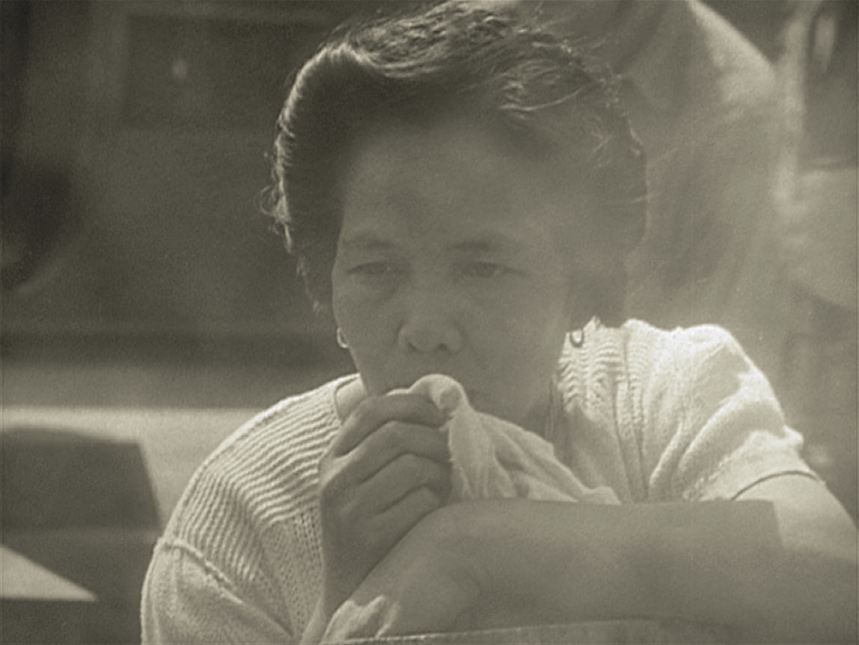
Ford's acknowledgement of the significant contribution of Filipinos to the war effort is underscored by the fact that the nightclub singer is played by Pacita Todtod, a Filipino-American from Northern California who wrote to then-Secretary of the War Henry Stimson and successfully advocated for Filipino-Americans to be allowed to serve in the U.S. military during World War II after they had initially been rejected.  (Todtod also entertained for the USO during the war.)  Ford also includes the character of Steward, Third Class Benny Lecoco (Alex Havier), a Filipino-American, as a member of Brickley's Torpedo Boat Squadron to further underscore the contribution that Filipinos and Filipino-Americans made to the war.  There is also the haunting close-up of the Filipino woman clutching a handkerchief who appears deeply moved and despondent as she bids farewell to the wounded American personnel who are being taken by the torpedo boat crew to seek medical treatment at the end of the sequence when the Japanese planes attack Cavite and Manila Bay.  During the sequence at the hospital on Corregidor when Sandy is helping the doctor operate on wounded personnel as Japanese aircraft continue to attack from above, Ford cuts to close-ups of both wounded American and Filipino military personnel.  All of these nuances, which expresses empathy both for and by Filipinos and Filipino Americans, help to underscore that they were in this fight with the rest of us and, as such, deserve to be acknowledged accordingly.


"They Were Expendable" remains a genuine Hollywood classic because of its ability to transcend being merely a World War II action movie.  It is a character study of individuals rising to the occasion under difficult circumstances, as well as a social history of the different cross sections of society, and of the world at-large, who successfully came together for a common purpose.  John Ford intersperses moments of action, comedy, romance, drama, tragedy, poignancy, sacrifice, friendship, and camaraderie so that the movie never becomes one-dimensional and successfully operates on several different levels simultaneously.  Ford and director of photography Joseph August beautifully photograph "They Were Expendable" in a moody, shaded, noir-tinged black and white that, instead of demonstrating moral ambiguity as such lighting typically does, reflects the tragedy and death the protagonists are continually facing.  John Wayne and Donna Reed are touchingly honest and direct in their romantic scenes with one another so that the Rusty/Sandy subplot never feels contrived, and the scenes of action and epic drama demonstrating the torpedo boats in combat with the Japanese are suspenseful and awe-inspiring.  The film also has one of the most moving and poignant endings ever in a Hollywood war movie.  When Ensigns Gardner and Cross (Cameron Mitchell) finally arrive before the last plane leaves the Philippines, two other officers, Army Major James Morton (Leon Ames) and the aforementioned Army Air Corps Captain nicknamed "Ohio" must forfeit their seats on the plane and stay behind.  When Gardner and Cross learn that no other planes are coming in to take the remaining personnel out of the Philippines, they slowly realize to their horror that their arrival may have sent Major Morton and "Ohio" to certain, eventual death at the hands of the Japanese.  Brickley reminds them that the sacrifice of Morton and "Ohio" is for the greater good because they must all go back to the United States to help train additional torpedo boat personnel so that they can eventually return and help save their colleagues by defeating the Japanese.  When Brickley says to Gardner and Cross, "Look, son, we're going home to do a job.  And that job is to get ready to come back.  Check?" he has come full-circle and has himself become Admiral Blackwell, reminding the personnel under his command of the larger picture that is at stake.  It's at this point you realize the title "They Were Expendable" is not a reflection of helplessness, defeatism or cynicism, but actually demonstrates how nobility, integrity, and hope are the hallmark of individual sacrifice.