A couple of days ago
I blogged about how I don't believe Morgan Fairchild ever got outside the box as an actress. I gave examples of other actresses considered sex symbols who I felt had distinguished themselves at some stage of their careers with top-notch performances. Among them was Tina Louise,
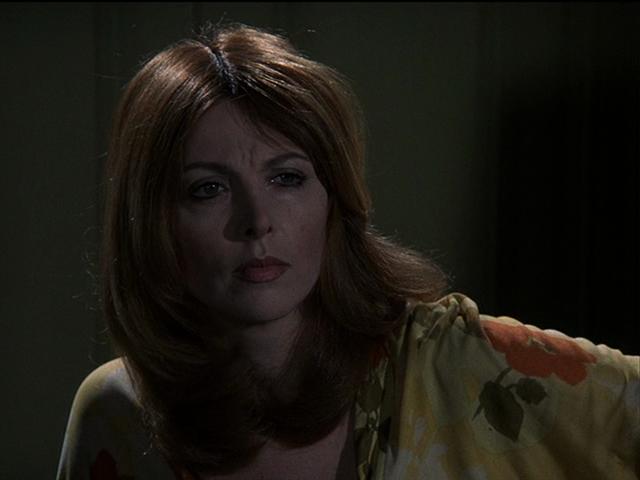
who I have blogged about before and acknowledge is my favorite actress (and also acknowledge I'm not being objective when writing about her). I felt like giving some examples of Ms. Louise's work through the years where I thought she challenged herself to rise beyond what was expected of her and created some interesting and unique characters. Most of her best work as an actress were in the hour-long television dramatic guest appearances she made during her long career. In these guest shots, Ms. Louise had a chance to play roles she normally was not offered in feature films. Elizabeth Ashley once joked in her autobiography that guest-starring on television was the lowest gig imaginable for an actor because you usually just go in, hit your marks, have a couple of laughs, and then sit back and wait for the check to come in the mail. Ashley made the joke self-servingly so that she could assert how she took those assignments more seriously than her peers, but she wasn't the only one who took advantage of such opportunities. In my humble opinion, Tina Louise made guest-starring on television almost an art form. She didn't just play "Tina Louise" in these roles--she brought nuance to each of these performances so that every one came across as a completely different individual from the other.

The first role that comes to mind when I think of Ms. Louise's TV guest appearances was her appearance on the "Kraft Suspense Theatre" episode entitled "The Deep End" which aired on NBC on January 2, 1964. The episode opens at a lake where a blonde, shapely and youthful Lucille Benton (Ellen Burstyn then known as "Ellen McRae") is swimming. Lucille is attacked and drowned by a mysterious scuba diving assailant. Her death leads to an investigation spearheaded by smooth private detective Dan Walsh (Clu Gulager), who is hired by Lucille's twin sister Barbara Sherwood (Burstyn again). Dan's investigation leads him to Lucille's lover, financially troubled building contractor Sam Kimber (Aldo Ray). Ms. Louise played Aldo Ray's cooly efficient, loyal secretary, Angie Powell. Angie is a mysterious, prim and proper religious fanatic and psychopathic killer who believes that the Lucille "corrupted" her boss "Mr. Sam" (her nickname for him) into embezzling from his company and so Angie murdered Lucille as a result. Angie will do everything necessary to eliminate those she believes will taint "Mr. Sam's" soul. But what's interesting about the character is that she's not in love with nor sexually attracted to "Mr. Sam." She simply idolizes him into being something that he is not. When Angie realizes that "Mr. Sam's" accountant Gus Hickman (Whit Bissell) knows about her employer's embezzlement and threatens to expose him, she invites Gus to meet her at a construction sight late at night. During their conversation, the madness of Angie's character slowly emerges. She tells Gus,
"I would've been proud to keep it (the embezzled money) for him if he'd asked me. But he didn't. The more I thought about it, the more I realized that he must've given it to that woman (Lucille). So I went to see her in the night...She tried to lie to me, but it didn't work. She thought that you told me about the cash. She said that you tricked her....I'm going to protect him with all my heart and with all my soul. Do you think that I would let him run off with that immoral woman? Do you think that I would let him run off alone with that money? I'm going to protect him the rest of his life. That woman would be alive today if you hadn't been so sneaky. And you...you'd be alive...tomorrow." With that, Angie puts Gus into a chokehold and strangles him before putting his lifeless body in his car and setting it in motion so it can crash into the construction site, thus covering up her crime. When she realizes that Gus is dead after she has strangled him, Angie has an almost vampire-like close-up as if she has been rejuvenated by her act of murder.

Rather than making flashy gestures, Ms. Louise was very subtle and subdued in playing this complex role. Angie starts out the episode speaking in a very low, clipped, confident voice. As the episode progresses, and her character's mind unravels, Angie's voice drops to almost a child-like innocence, a reflection of how she believes she has good intentions for "Mr. Sam" and is completely unaware of how homicidal she is. You can tell that Ms. Louise is so engaged and committed to this character that she does not color in her trademark beauty mark on the left side of her face and allows the director to stage scenes on the right side of her face (which rarely occurs because, like Claudette Colbert, she is usually photographed from the other side for maximum visual impact). Even though she looks fine in this episode, she's not at all concerned about appearing glamorous and wears very conservative suits and dresses throughout. I also enjoy the contemptuous way Angie refers to Lucille and Barbara, Burstyn's dual characters in this episode, as "that woman." The mildly annoyed tone she references Lucille and Barbara throughout the episode subtly suggests the extent to which she hates and despises both of Burstyn's characters. At the end of the episode, Angie is apprehended and locked in a guarded, empty hospital room where she talks aloud in the direction of the locked door, as if she is speaking directly to "Mr. Sam." It kind of reminded me of the ending of "Psycho." She explains out loud why she must now punish his character as well, even though he is absent from that hospital room, and Ms. Louise's performance is chilling. Angie's childlike feelings of disappointment and hurt towards "Mr. Sam" are sad, because we realize that he was much more corrupt than she ever realized. In her own psychotic way, Angie had genuinely pure intentions, even if they were homicidal and destructive, and the tragic part is that "Mr. Sam" never deserved the level of loyalty she paid to him. It's my all-time favorite performance of Ms. Louise's. You can see that episode
here on YouTube.

A couple of years later, Ms. Louise had a meaty, unglamorous role on the "Desperate Passage" episode of "Bonanza" which aired on NBC on November 5, 1967. She played Mary Burns, a survivor of Paiute Native American attack on a Western town. The Cartwrights discover both her wandering deliriously in the streets, as well as a prisoner locked in the town's jail cell, Josh Tanner (Steve Forrest), who was arrested prior to the Paiute attack for a murder he was alleged to have committed. The only witness who can exonerate him is Mary Burns, but Tanner forces Mary not to say anything to the Cartwrights or run the risk of revealing that they were adulterous lovers. The noble Josh does not want Mary's reputation ruined if it becomes apparent that Josh shot the man he is accused of killing in self-defense because he burst into Mary's hotel bedroom while Josh and Mary were having an intimate moment. Ms. Louise eschews the glamorous expectations people had of her (this was the very first role she did right after the cancellation of "Gilligan's Island") by wearing no makeup and playing Mary in a low-key, frightened and vulnerable manner. Her love scenes with Steve Forrest are touching as both actors underscore the deep love and sense of urgency the characters feel for one another. The episode ends on a bittersweet note, as Josh Tanner and the Cartwrights rescue Mary from being kidnapped form the Paiutes and Mary ends up reunited with her husband instead of the man she truly loves. You can see it on YouTube
here.


She next guest-starred as SIA government agent Anna Martine in an episode of "It Takes a Thief" entitled "Totally by Design" which aired February 20, 1968 on ABC. In the episode, Robert Wagner's Al Mundy is assigned to break into an impenetrable Middle Eastern fortress in order to steal a bank book that could be used to help finance that nation's war against a neighboring country. Ms. Louise's character is assigned to assist him in his efforts to gain entry to the stronghold. We first see her character Anna Martine living in a werehouse across from the guarded fortress. She explains to Al Mundy how she's carefully staked out the fortress and briefs him as to what she has already discerned about it. What I liked about the episode was the assured way in which Ms. Louise played this character. She rarely had chances in her career to play a Howard Hawks-type heroine. In this show, Ms. Louise lowers her voice to a deep register to where she comes across as controlled, confident, and assured. Her Anna Martine comes off as so firm, and no-nonsense that All Mundy even notes at one point
"You shake hands like a man." I particularly like the moment when she explains that her "cover" story for this assignment is as an agricultural research expert. Mundy looks incredulous and asks her if she even knows anything on the subject, to which the non-plussed Anna Martine replies
"I majored in it in college, that's why Noah set it up that way." In Ms. Louise's hands, Anna Martine comes across as witty and attractive as well as being intelligent and capable. She has good chemistry on-screen with Robert Wagner and it's evident the two of them enjoyed working together. If anything, her "It Takes a Thief" performance makes you regret how Ms. Louise never got to be a Bond Girl. She would have been a more ideal Tiffany Case in "Diamonds are Forever" (1971) than Jill St. John.

Ms. Louise soon followed that up with a guest appearance on "Ironside" in the episode "Beware the Wiles of the Stranger," which aired January 22, 1970 on NBC. She played Candy, an accomplice in the robbery of an illegal gambing casino who is assigned to pose as a hitchhiker on the highway to find a patsy who she and her partner can murder and plant evidence on so that they can blame the robbery on the patsy. She is picked up on the side of the road by Mark Sanger (Don Mitchell), the assistant to the show's Chief of Detectives Robert Ironside (Raymond Burr) who is driving north back to San Francisco after visiting family in the Southern California area. Candy's assignment is to make her presence conspicuous at all roadside stops that she and Mark make so that her accomplice Fred (John Ericson) can easily catch up with and find them. Fred plans to kill Mark and leave his body with enough evidence to mislead the mobsters in charge of the illegal gambling casino, who are out to retrieve the money Candy and Fred robbed. A complication in the storyline arises when Candy finds herself attracted to Mark and tries to get him out of the predicament that she has gotten him into. What's interesting about the episode is that, underneath the robbery storyline, is a subtext about an interracial relationship as the African American Mark and the Caucasian, red haired Candy have real chemistry and rapport with each other. Whenever they make a stop, the locals eye them suspiciously as Candy and Mark ignore the glares and simply enjoy each other's company. There's even a scene where Candy and Mark are refused separate rooms at the third motel they've visited that evening. No explanation is given by the proprietor why they've been refused and none is needed. In yet another scene, Mark and Candy are at a coffee shop waiting an inordinate amount of time to be served. The waitresses ignore them and serve the other customers. Candy goes over to counter, picks up the coffee decanter, and serves she and Mark while the others watch, indignant at her boldness. What's refreshing about the episode is that it never gets preachy about race relations and simply allows the story speak for itself. Don Mitchell and Ms. Louise play off one another well. They seem like a natural couple together. Ms. Louise effectively conveys Candy's contrite humility later in the episode after she realizes she likes Mark and regrets getting him involved in her scheme. Unfortunately, the dictates of the crime storyline prevent a satisfactory resolution to the Candy/Mark relationship. The episode ends with Mark receiving in the mail a fancy pair of bell-bottom trousers from Candy to make amends for the trouble she has caused him. There is no final scene between Mark and Candy to indicate where their relationship might go, now that the crisis has been resolved. Even though the "Ironside" episode tread new ground for television in 1970, by clearly depicting a romantic attraction between a black man and a white woman, it still wasn't ready to see its themes through to a proper resolution. That episode is available on Hulu
here.

Ms. Louise gave one of her best performances a few years later in the "Die Before They Wake" episode of "Kojak" that aired on CBS on February 6, 1974. The storyline involved Kojak's investigation into a prostitution/narcotics ring run by sleazy Harris Yulin. When Yulin murders a crusading television reporter who is dedicated to uncovering this racket, Kojak must protect the reporter's young widow (Jess Walton), a former junkie herself who is out to avenge her husband's murder. Ms. Louise played Audrey Norris, a pathetic, strung out heroin addict who helps Yulin recruit girls for his prostitution ring. Ms. Louise plays Audrey as a sad, lonely soul. Early in the episode, she asks Yulin if the two of them are arguing because he doesn't spend time with her anymore. Yulin makes lame excuses about being busy and Ms. Louise awkwardly smiles and attempts to put on a good face knowing full well that he has no longer has any sexual or romantic interest in her. She effectively conveys Audrey's embarrassment at being rejected by her former lover. She's also very good in her two scenes with Telly Savalas's Kojak. In the first scene, Kojak visits her apartment seeking information about her former roommate, who was murdered after acting as an informant to the reporter, while Audrey is high on dope. Ms. Louise plays Audrey as withdrawn and emotionally dead underneath the drug-induced haze in this scene. She effectively conveys how Audrey doesn't care enough about herself to be concerned whether Kojak is going to bust her for using drugs.

Later, at the end of the episode, Ms. Louise and Savalas have a powerful moment where Kojak confronts Audrey concerning the whereabouts of Jess Walton's character. He lays out what a lie her life has become because she has medicated herself from the pain of her empty existence, and how her cohorts will quickly wash their hands of her and let her rot in jail before they even admit they know her. Ms. Louise conveys Audrey's sadness and humiliation in this scene beautifully. It is not simply that Ms. Louise allows herself to look "ugly" by wearing little makeup, and keeping her hair in disarray. She also conveys Audrey's emotional and physical fragility in the way she shakes nervously, hyperventilates, and clings desperately to the lit cigarette in her right hand. Audrey's at the end of her ropes and the only way she can turn her life around is to come clean and provide Kojak the information he needs to put the people who turned her into a junkie away. At the end of the scene, after Audrey has helped Kojak, he kisses her hand and says his trademark "Who loves ya?" Ms. Louise allows Audrey a faint, hopeful smile at the end, an indication that someone has finally broken through to her protective, medicated shell by simply expressing basic human decency to her. That episode is available on Hulu.com
here.
Ms. Louise soon followed that up with another good part on the series "Movin' On" starring Claude Akins and Frank Converse as a pair of independent truckers hauling freight across the country. In the episode "The Cowhands," which aired October 24, 1974 on NBC, Ms. Louise played Helen Trueblood, the ex-wife of rodeo owner/rider Tommy Trueblood (Glenn Corbett). Akins' Sonny is old friends with the Truebloods and offers to help keep the rodeo operational after Tommy has been badly injured after being thrown off a rodeo bronco. Helen owns half the circus with Tommy since the judge granted it to her in their divorce, as well as collects $500 a month in alimony from him, so she has a vested interest in seeing the rodeo prosper. Sonny and Helen, old sweethearts, clash throughout the episode because of her ruthless self-interest. When Helen collects her $500 alimony from the till before the rodeo has paid its financial obligations, she and Sonny argue bitterly about it,
"Now what's mine is mine! Now that $500 is mine, and you can't take that away from me, the court gave it to me!...I don't have any obligations to anybody! Now Tommy Trueblood owes me $500 a month, and he's gonna owe me till the day he dies! And I ain't ever gonna let him forget it, and don't you forget it either!...That is his problem, not mine! Listen, if you don't like it, you know what you can do about it. And if you really want your money, you better pray for a miracle at the box office, 'cause after I collect this month's alimony I'm standin' right here to collect next months!" But it's not all bitterness and bickering between Helen and Sonny. Akins and Ms. Louise have a sweet scene by a roadside after Helen has angered Sonny to such a degree, he and Will (Converse) have left in their rig. She follows him in her car until he finally stops and she recalls their long-ago feelings for one another,
"You remember Cheyenne?...It was when Tommy was still thought of a star. Remember we had a little money then? That was before the first divorce. Did you ever know why...why the divorce?...Tommy thought I was crazy about you, because we danced 51 dances in two nights. Did you ever know that?...And he sat there, and he drank. Did you ever know that? And he was right, I was (crazy about you)."

The "Movin' On" episode is unique because it's a very character, rather than plot, driven storyline. There are no criminals nor villains who need to be captured or defeated in the storyline. This allows Ms. Louise to create a three-dimensional character who is not a plot device for the episode. In her hands, Helen Trueblood comes across as a determined, essentially good-hearted woman who has been disappointed enough in life that she now jealously guards her financial future at the expense of others. At the end of the episode, Helen is reunited with her injured ex-husband, who pulled himself out of the hospital bed to ride in the rodeo after the defection of the star attraction. Ms. Louise and Glenn Corbett have genuine chemistry playing a couple who have been through enough conflicts and reunions in their lifetimes that they understand each other completely. The tenderness in their scenes make them seem like a real married couple, not just a pair of actors pretending to be one. By the early 1970s, Holywood was moving away from glamorous actors in feature film roles. Earthier actors such as Karen Black, Ellen Burstyn, and Susan Anspach dominated the cinema. Ms. Louise admirably dresses down for this performance. She pulls her trademark red hair into a pony tail and wears minimal makeup so that her natural freckles show. She lowers her voice into a deep register to emphasize the maturity and gravitas of her character. Her performance in this episode proves her range was not limited to glamour-girl roles on TV. At the end of the episode, she gives Akins's Sonny the money that her ex-husband's rodeo owes him out of her alimony money. She apologizes and thanks Sonny by hugging him and saying
"Thanks big buddy. Sorry I was so uptight. I get scared." It's a simple moment and a simple line of dialogue, but the affection and contrite humility Ms. Louise conveys in that brief moment speaks volumes. This episode is also on Hulu
here.


The following year, Ms. Louise played Nell Dexter, a determined LAPD police detective, in an episode of "Cannon" that aired November 19, 1975 on CBS. Nell Dexter is the daughter of a veteran police officer who was once Frank Cannon's (William Conrad) partner and training officer. She has followed in her late father's footsteps, but has been relegated into posing as prostitutes while working on the Vice Squad. Nell sees an opportunity to get out of Vice when she is attacked by a john she has picked up who played the Wedding March on a tape recorder right before he brutally assaults her. She notices that there has been a series of brutal attacks and killings of prostitutes by a john who plays the Wedding March and realizes that she is on the trail of a serial killer. When her own police captain (Vic Tayback) refuses to re-assign her to Homicide to investigate the case, she seeks the assistance of Frank Cannon to help catch the killer. At one point, when Cannon appears reluctant about encouraging Nell to investigate the case she reminds him that he was the cop who trained her when she was a rookie and that he once said
"If you can't hack it, all of it, you don't belong. That's what you used to tell me. Well I've hacked it for years. I belong!" Like Anna Martine in "It Takes a Thief," Ms. Louise makes Nell Dexter intelligent and capable. It's possible that she invested a lot into that character because she knew how it felt, as an actress, to be passed over for more substantial assignments and offered roles that relied heavily on her looks and not her abilities. As such, Ms. Louise never short-changes the character and is always conscientious about ensuring that she comes across as a mature police officer. The character is never shown as a sex object trading on her looks the way Angie Dickinson occasionally was relegated to playing on "Police Woman."

When it came time for Ms. Louise to appear on "Fantasy Island," she landed a good part. She played the dual role of Lisa Corday, a woman who comes to Fantasy Island to find out what is the root of the nightmares she has been having for several months where she dreams she is locked in a room in a European castle. Lisa learns from Mr. Roarke that she is the descendent of Elizabeth Bathory, a ruthless Hungarian countess known for slaying young girls and bathing in their blood in order to retain her beauty. The nightmares Lisa is suffering from stem from the fact that Elizabeth's ghost is trying to reincarnate herself in the 20th Century by taking over Lisa's body. Mr. Roarke reveals that he was once Elizabeth's lover centuries ago and vows to help Lisa fight to prevent Elizabeth from taking over her soul and coming back to life. Ms. Louise does a good job in both roles. She makes Lisa a sympathetic and believable protagonist while, at the same time, makes Elizabeth Bathory haughty, ruthless, charming, frightening so that they both come across as separate and distinct personalities. She does not just walk through the episode with an eye towards collecting her paycheck. Ms. Louise appears truly engaged by the storyline, especially during the confrontation Elizabeth has with Mr. Roarke at the end where she tries to convince him to allow her to take over Lisa's body and return to life. She brings some pathos to the evil Elizabeth's plight of having her soul be in a state of limbo for centuries that she comes across as a tragic victim of her own ruthless desire for eternal youth. It's actually one of the scarier episodes of "Fantasy Island."

Ms. Louise still played glamorous roles through the years that might, on the surface, be reminiscent of her "Gilligan's Island" Ginger Grant character, but she usually brought nuance to these later roles that distinguished them from what was expected of her. One example was her role on "Blacke's Magic" on January 29, 1986 on NBC. Ms. Louise played glamorous TV star Lainie Warde, working at Universal on a big-budget special effects epic when the producer of the film is found murdered at the studio. The homicide is investigated by magician/amateur sleuth Alexander Blacke (Hal Linden) and his father Leonard Blacke (Harry Morgan) who are also working on the film. Lainie recognizes that the movie is her last shot at becoming a major movie star. She rejects the skimpy costumes and lascivious sex scenes being forced upon her by the producers as she battles her own drinking problems and insecurities. By the end of the episode, she pulls herself together to help the Blacke's unmask the killer stalking the movie set. Even though Lainie Warde could have been a caricatured parody of Hollywood actresses, Ms. Louise invests some heart and pathos into the character so that she has substance and does not come across as shallow or narcissistic. She genuinely likes Alexander Blacke and appears to regain some self-respect when she helps the Blacke's solve the murder. In the scene where she argues with the director about the trashy love scene that they have scripted for her to appear in, she plays it with intelligence and dignity so that Lainie does not come off sounding whiney. Even when appearing in the sort of roles that are expected of her, Tina Louise still gives them more depth than is required.

In one of her last TV guest appearances before she refocused her priorities and began volunteering in the New York public school system reading to children, Ms. Louise guest-starred on the syndicated action series "L.A. Heat" in the episode "In Harm's Way" which aired May 19, 1999 on TNT. She played Patricia Ludwigson, a ruthless criminal who has been robbing banks and armored cars with her grown son. You'd have to go as far back to "Nightmare in Badham County" (1976) to see Ms. Louise playing such an unsympathetic character. Her Patricia is cold, brutal, scheming. There's very little that redeems her character, but Ms. Louise seems to be having a ball playing this role, whether it's scolding and needling at her son, threatening poor Billy Barty, or going down fighting in a hail of bullets while firing a sawed-off shotgun. If she does nothing further in her acting career, Tina Louise went out auspiciously in a blaze of glory with this role. By now, I think you get an idea of how Tina Louise made the most of the opportunities given to her in TV guest appearances and went for broke whenever she was offered something that might offer a challenge. In contrast to Morgan Fairchild, she often went beyond what was expected of her as an actress so that many of the roles I just described came across as separate and distinct characters. That's why, to me, the title card "Special Guest Star Tina Louise" at the opening of an hour-long dramatic series has always held the promise of something unexpected and surprising, no matter what the script.