Monday, April 22, 2013

Jacqueline Bisset Saves the Day in "Inchon!"


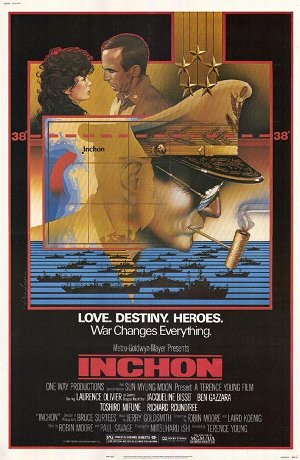
A movie that has always intrigued me, both because of what went on on-screen and off-, was the notorious Korean War epic "Inchon!" (1982) produced by the Reverend Sun Myung Moon's Unification Church.  The stories that went on behind the scenes on that film, as well as the bad reviews it received at the time, created an aura of mystery and intrigue surrounding the movie that makes me surprised that no one has ever attempted to write an in-depth book about it, much less released it on DVD containing all of its versions running different lengths as well as extras detailing the production history of it.  When I finally got to see the movie, years after it bombed at the box office, I was surprised that it didn't quite live up to my expectations of ineptitude as I had imagined.  It was indeed an uneven and bloated production, with an amazingly bizarre performance by Laurence Olivier as General Douglas MacArthur, but it had enough color and spectacle that it was never boring.  I kept expecting to chuckle at embarrassing moments, but I didn't probably because I sensed a level of earnest sincerity behind the whole enterprise that didn't warrant the contempt it had somehow engendered through the years.


What kept me engaged in the movie was the surprisingly touching subplot involving Jacqueline Bisset's character.  Bisset plays Barbara Hallsworth, the estranged wife of Marine Major Frank Hallsworth (Ben Gazzara) who is having an affair with a Korean woman Lim (Karen Kahn).  Barbara is living near the 38th Parallel and running an interior design business from Philadelphia.  The day the Communist North Korean soldiers move past the 38th parallel into South Korea, she is busy shopping for furniture for her clients when she learns of the Communists' advancement into the South.  She and her chauffeur escape in their Ford Woody station wagon as they proceed South to the American Embassy in Seoul, but he is killed by a North Korean plane firing from overhead.  As Barbara continues her journey by herself, she encounters an elderly Korean man who entrusts his five orphaned granddaughters with Barbara.  At first frustrated and annoyed with the responsibility of caring for these children that have been thrust upon her, Barbara eventually bonds with these Korean girls as they help bring a sense of purpose to her life that had been absent before.


Barbara and the girls encounter various dangers throughout their journey, including narrowly escaping a collapsing bridge that had been blown up by the South Koreans so that the Communists, who had been shelling and advancing upon the bridge, can't take possession of it.  Barbara also shoots a North Korean soldier between the eyes when he tries to confiscate her station wagon.  Along the way, they pick up a young Korean woman Mila (Lydia Lei) who was planning to get married, and has been separated from her fiancee, when the Communists began their advancement.  Barbara, Mila and the girls eventually arrive at a Mission run by the U.N. where they briefly take refuge and then move on to Pusan where Barbara is reunited with her husband.  After U.S. Troops are able to drive out the North Korean forces, Barbara bids a sad farewell to the five Korean girls as she and Frank reconcile.


Years ago, before I moved East for law school, I had the opportunity to interview Jacqueline Bisset for a book I was working on regarding 1960s-era actresses.  Bisset was one of the most intelligent people I ever met in my life, let alone one of the most intelligent actresses I encountered while conducting interviews for this book project.  She was as friendly and down-to-earth as her reputation indicated, with a refreshing sense of humor and humility about herself.  Even though she had high standards with regards to what she considered a good film, she was also a realist.  She knew it was difficult to have any sort of success as an actress in as competitive an industry as Hollywood, and realized that, despite best efforts, sometimes every actor ends up in a film that isn't very good.  There was no sense of entitlement about herself that I sometimes encountered with other actresses.  Despite her frustrations at the limited opportunities for mature actresses in Hollywood, I sensed that she knew she was fortunate to still be working.  She was one of the smartest actresses I ever met with regards to understanding the business end of Hollywood.  I learned a lot from her about maintaining a decorum of maturity and professionalism that I try to apply to my own life and career.


What was refreshing about her was that she didn't trash the Irwin Allen disaster movie "When Time Ran Out..." (1980) or "Inchon!" when I asked her about them.  She knew that they had been badly received, but acknowledged that she enjoyed making them and that everyone involved did their best.  She explained that she agreed to make "Inchon!" when the director, Terence Young, met with her personally after she had originally turned the script down.  He urged her to reconsider.  Bisset didn't like the overall script, but liked the subplot that had been devised for her character Barbara and agreed to do the film on that basis.  She said she enjoyed working in South Korea and loved working with Lydia Lei and the five Korean girls who played the orphans in her vignette.  At the time I spoke with her, she said she hadn't seen "Inchon!" but welcomed the opportunity to watch it someday because she was curious at how it turned out.  Bisset shared a funny anecdote about a woman approaching her not long after the release telling her that she loved "Inchon!"  Bisset was startled because she had heard nothing but bad things about it, and then found out that the woman was referring to the lavish premiere party the producers threw for it at the Cannes Film Festival, not the film itself.  She explained at the end of the interview that she has no regrets about "Inchon!" or "When Time Ran Out..." or other films she made that may not have turned out as well as she had hoped because she always found something good about the experience of every film she worked on.  I admired how she didn't take a bad movie in her career as somehow being a personal reflection upon herself, which other actresses self-indulgently do.


And there's no reason for Bisset to be embarrassed because she does good work in "Inchon!" and does indeed have the best subplot in the movie.  Barbara's storyline is one of the few that seems to have a clear objective and purpose in comparison to the other muddled narratives in the movie.  When we first encounter Barbara in the story, she's kind of haughty, self-centered and aristocratic.  She's haggling over the prices of antique Korean furniture with an antique dealer when she suddenly learns that the North Koreans have crossed the 38th Parallel, causing her to flee immediately.  She's only concerned for her own hide and doesn't seem overly upset when her driver is killed.  When she encounters the elderly Korean grandfather, as she is trying to cross a crowded bridge, who asks her to take his five granddaughters to safety, she selfishly refuses to help them until they climb into her car against her permission.  So her initial involvement with the Korean girls was hardly out of the goodness of her heart.  She even goes so far as to yell at them, when they climb into her station wagon, "Hey, what the Hell do you think you're doing?!  Come on, get out of there!  Quick!  Sir, get these little bastards out of here!"  Even after they climb into her car, she tells them they have to get out once they're safely across the other side of the bridge.

 
Eventually, however, Barbara's innate decency emerges as she and the Korean girls and, later, the young Korean woman Mila bond over the course of their journey.  Some of the best action sequences in the movie are the ones involving Barbara and the children, including the sequence on the bridge when the South Koreans blow it up.  The station wagon containing Barbara and the children teeters precariously over the edge until a group of South Korean soldiers help pull it to safety.  Later, when they encounter the Communist soldier who attempts to confiscate their vehicle, Barbara calmly shoots him between the eyes and floors the accelerator until they've escaped the Communists.  By the time the car has broken down, and Barbara is trying vainly to get it started up again, we see her holding her right hand up, with her fingers crossed for good luck, as the Korean children hold up their hands, with their fingers crossed as well, in a collective act of praying for good luck that the engine of the car will eventually turn over.  The gesture indicates Barbara's gradually softening feelings towards the children and also about her own lessening sense of entitlement.


When one of her husband's enlisted colleagues, Sergeant Henderson (Richard Roundtree) encounters Barbara and helps fix the engine of her car, he addresses her as "Mrs. Hallsworth."  Barbara appears indignant at his mock-formailty and asks him "What's this 'Mrs. Hallsworth' bit?"  Henderson explains, "You know, officer's wife, rich Philadelphia lady," and Barbara responds, "Right now, I'm just a woman with five kids, stuck in the middle of a war."  Henderson realizes that Barbara's experiences with the children have begun to change her from a selfish and entitled person, to someone with considerably more substance.  He jokes, "You're a bit dusty, quite a bit warmer, I must say motherhood quite becomes you."  Barbara is further humbled when she learns from Henderson that her husband Frank, who she assumed didn't care about her, has been busy trying to locate her since the fighting started.  As she gets into the car, she tells Henderson that she plans to "head south, all the way to Pusan.  It'll be safer for the kids.  And if that sounds noble, it isn't.  Maybe I just want Frank to know that I don't need him."  After what she has encountered, Barbara realizes that, at that moment, survival, and the safety of the children, is more important than being concerned about the future of her troubled marriage.


One of the (intentionally) funniest scenes in "Inchon!" has Barbara driving the car as the Korean girls yell and fight amongst themselves for crackers from a care package that Henderson has given them so they can eat.  She yells at them to settle down saying, "Oh, OK, you guys!  Keep it down or you'll have to walk all the way!  You hear!"  As she looks in the rearview mirror, she sees one of the youngest children mimicking her harsh, scolding nature.  Barbara honks the horn to tell her to cut it out and everyone gets silent in the car.  Barbara tries hard to suppress her smile as she bursts into laughter because the little girl has imitated her quite succinctly.  They all laugh together as Barbara grabs one of the crackers and begins to truly feel at-ease with these children.  Bisset and the Korean children have great chemistry together in this scene, and it's easy to see that she sincerely enjoyed working with them.


Throughout "Inchon!" we see how Barbara starts becoming genuinely concerned for their well-being and the well-being of the other refugees.  At one point, Barbara stops the car when she notices the bodies of American and South Korean soldiers strewn along the roadside.  She urges the oldest girl to engage the other children in games so that they aren't traumatized by the horrors surrounding them.  As she goes to help Mila, the young Korean refugee who was supposed to get married that day, tend to the wounded soldiers, she seems concerned about the bruises on Mila's face and asks where they came from.  As Mila tears up her wedding dress to make bandages to help the wounded American soldiers, she faints from exhaustion, and a concerned Barbara drags the girl to her car so that she can join them on their journey South to Seoul.  After Barbara and the girls arrive at the U.N. Mission, she originally intends to make the remainder of her trip alone, but realizes that she can't easily part company with Mila and the children just yet and brings them along with her to Pusan where she reunites with her husband.  When Barbara arrives in Pusan, and is greeted by a Turkish General (Gabriele Ferzetti), who asks "And whose, may I ask, are these young children?," Barbara proudly proclaims, "Mine." 


That night, Barbara has a scene where she tucks the children, who are sleeping side-by-side in an extremely wide bed, in at night.  She tells them, "Now, everyone, fast asleep!  Or I'll be back, and you'll see!"  As she walks out of the room, the girls start to laugh and Barbara jokingly scolds them "Now you all, don't you imitate me when my back's turned!"  It could have been a really corny scene, but Bisset and the Korean children pull it off thanks to the genuine warmth emanating from them that allows it to be a touching, rather than cloying, moment.  Because Barbara has changed so much, her reunion right after this with her husband Frank turns out to be less acrimonious than we would have expected it to be given his adultery and her lingering animosity towards him.  They argue, but Bisset and Ben Gazzara do a good job demonstrating how much they still love each other.  Even though they hash it out over the reasons he started having the affair with the Korean woman, Lim, and her boredom and frustration being an officer's wife, at the end of the scene Barbara has enough perspective to say "Look, Frank.  Tomorrow you're going to be off, wherever it is.  You've got problems of your own.  Let's leave ours for the moment.  And, later, when you come back, you tell me the way you want it and that's the way it'll be."  Barbara realizes that, with the war brewing around them, right now isn't the time to go over a litany of each other's shortcomings as spouses and that they can deal with it later when they have the luxury of considering their future.


At the end of the movie, after the American and South Korean forces have driven out the North Korean forces, Barbara and Mila bid farewell to the Korean children at an orphanage in Seoul.  As the bell rings for the children to attend class, the youngest of the children runs up to Barbara and hands her a drawing that the girls of made of Barbara, the five children, and their car, with a crayon scrawl saying "We Love You Babira."  Barbara brushes back tears as she tells Mila, "I don't have yellow hair."  After nearly 2 and a half hours of haphazardly staged epic battle sequences, and political posturing, the movie elicits some genuinely touching emotions with this quiet little moment.  Some people have scoffed that the drawing is awful and hilarious, but there's a simple sincerity to the moment that would have come across more clearly had it been contained in a much better movie.  In isolation from the rest of "Inchon!," however, the gesture works fine because of the heart that Jacqueline Bisset, Lydia Lei and the Korean children (who, unfortunately, are unbilled in the credits) invests in it.  If more of the movie was built around the Barbara storyline or, at the very least, had the same care and attention paid to it, perhaps it might not have been as critically reviled upon release.  The only thing that makes me slightly unsatisfied by the ending is that I'm a bit surprised that, after everything they've gone through, Barbara and her husband Frank don't adopt the children, rather than leaving them at the orphanage before returning to the United States.  However, since the rest of the movie has a lot of problems, I guess it would be unfair to quibble about a minor issue in what was, otherwise, the best storyline that "Inchon!" had going for it. 

Sunday, April 21, 2013

Raquel Welch and Faye Dunaway steal the show from "The Three Muskteeers"


My first exposure to Alexandre Dumas' "The Three Musketeers" occurred in the late 1970s when I received a Moby Illustrated Classics version of the book with my McDonald's Happy Meal.  Even though this may not have been a purist's manner of being introduced to the story, it was still a wonderfully engaging way to introduce me to the love of reading at an early age.  The Illustrated Classics version of the story was quite well-done, as I recall, and I kept it for many years.  Every so often, I would take it out to read and get pulled into the story all over again.  What stood out for me from the Illustrated Classics version of the book was the depiction of villainous Milady de Winter, Cardinal Richielieu's beautiful and treacherous spy.  I was fascinated that someone who was illustrated as so lovely in the book could also be so heartless and cruel.  She was, without a doubt, my favorite character in the story.  I was so engaged with her character, I was actually saddened when she was captured, put on trial by the Musketeers, and beheaded for her multiple crimes.  It was one of the first times I recall rooting for the bad guy in a story.


However, I also recall that I had absolutely no interest in the heroine of the story, Constance Bonacieux, Queen Anne of France's seamstress and confidate, and D'Artagnan's love interest.  Constance, unlike Milady, came across as bland and flat in the story, with little of interest or color to recommend her.  I usually regarded her as a minor character, rather than one of the two principal female characters of the story, because I always forgot about her.  Which is why I am always amazed by the fact that Constance happens to be my favorite character in Richard Lester's wonderful pair of movies based on Dumas' novel, "The Three Musketeers" (1973) and "The Four Musketeers" (1975).  To everyone's everlasting gratitude, Lester reimagined Constance as a feisty, klutzy, endearing and sexy character and gave Raquel Welch the best role of her entire career.  In a classic example of an inspired actress bringing something to the role that wasn't there originally, Welch brought Constance to life in ways that none of the actresses who have played her in other versions of the "Musketeers" saga have ever been able to do.  Paired with an equally inspired Faye Dunaway, perfectly cast as my favorite character in the novel, Milady de Winter, both Welch and Dunaway disprove the adage that women in action/adventure films are usually lightweight and expendable presences.  In so doing, they steal the show from their impressive male co-stars.  Both movies may have had the word "Musketeers" in the title, but it's Welch and Dunaway's show all the way. 


The concept of the beautiful woman who is also a comedic klutz wasn't new by the time Welch starred in the "Musketeers" films.  Sharon Tate had played one in the Matt Helm spy comedy "The Wrecking Crew" (1969), for instance, but her performance always struck me as mannered, contrived, and self-conscious, not helped by her line delivery throughout that movie, which always sounded forced and unsteady.  She wasn't as funny in that movie as her constituents have alleged.  In contrast, Raquel Welch brought a relaxed quality to the manner in which she played Constance in a comically klutzy manner that remains consistently delightful.  Unlike Sharon Tate in "The Wrecking Crew," Welch was funny because she was creating a flesh and blood character, with distinctly human traits and mannerisms that included being a klutz, as opposed to just going through the motions of being clumsy.  Constance is indeed klutzy throughout the movie, but the reason it seems fresh, and why the audience never gets annoyed, is because Constance never becomes self-pitying or apologetic about making a mess of the situation.  She takes it all in stride and has enough self-confidence to recognize that she has qualities of loyalty and bravery that redeem her character in spite of the mess she often makes of a situation. 


Constance is also one of the most endearing characters Welch had played in her career up until this time.  Prior to the "Musketeers" films, Welch had a successful run of films playing sexy characters who sometimes lacked warmth.  This had more to do with the roles she played than any inherent quality in Welch because, as she has proven in recent years, there was an earthy and humorous quality to Welch that had been untapped until the "Musketeers" films.  For the first time, Welch was as likeable as she was beautiful.  Welch is particularly funny in her scenes with Spike Milligan, who plays her selfish, slovenly older husband.  There is a tolerant affection that Welch instills in Constance with regards to her relationship with her husband that isn't evident in the book or in other film adaptations of this story.  The non-judgmental quality that Welch brings to Constance humanizes the character greatly.  One of her best moments in the film is when Constance reunites the Queen (Geraldine Chaplin) with her lover the Duke of Buckingham (Simon Ward) inside of a laundry.  As the two Nobles declare their secret love for one another, Richard Lester gives Welch an illuminating close-up showing how touched Constance is by the feelings these two have for one another, and helps to underscore the basis for the trust that the Queen has bestowed upon Constance.  Moments like these in "The Three Musketeers" demonstrated Welch's keen ability to play empathetic characters concerned about the welfare of others which, except for "Kansas City Bomber" (1972), she had not had the opportunity to play often up to that point in her career.


Another quality I like about Welch's performance is the way she appears unaware of her own beauty and attractiveness throughout the "Musketeer" films.  The lack of vanity that Welch instills in Constance strikes a notable contrast with Faye Dunaway's playfully scheming and treacherous Milady de Winter.  Milady knows her effect on the male species and thrives on her awareness that her looks and charm are able to bring ruin to foolish men.  Dunaway effectively modulates her expressive voice throughout the "Musketeer" films to veer between light and frothy, and cold and cunning with great ease.  I like the scene in "The Three Musketeers" where she is seducing the Duke of Buckingham so that she can steal the diamonds from the necklace that Queen Anne had entrusted him with.  Dunaway sits at the edge of the bed, swinging her legs and twirling up her toes, as the Duke undresses her.  She pretends to be a compliant and submissive sex object to the Duke, while knowing full well that she's the one in control of the situation because she has him under her spell.  Just as I reacted to the character when I read my Classics Illustrated version of "The Three Musketeers" that I got with my McDonald's Happy Meal, Dunaway makes Milady in this film version a villainess we happen to like very much by bringing some identifiable human qualities to the character. 


Dunaway created such an effective antagonist that it's a pleasure, at the end of "The Three Musketeers" to see Welch and Dunaway square off in a cat fight as Constance and Milady battle each other for possession of the Queen's diamonds.  Such a scene could be tasteless and campy, but Richard Lester stages it as a bawdy, raucous fight that never fails to rouse a delighted audience.  Dunaway demonstrates Milady's deadly determination throughout the sequence, even pulling out a sharp jeweled comb from her hair as a weapon to threaten the scrappy Constance.  Welch, meanwhile, shows Constance's courageous qualities during this fight sequence, never batting an eyelash when she gets the skirt of her dress caught in the closed doorway, immediately picking herself up from the marble floor after Milady repeatedly throws her to the ground, and fighting off her ruthless antagonist with knives, lit candles, and whatever else is at her disposal.

 
At one point, when Constance throws a bushel of grapes in Milady's face, Dunaway shows what a good sport she is by taking the hit in stride and fighting on as if nothing happened.  When Michael York's D'Artagnan crashes through a window, slides across a table, bumps into Dunaway's Milady from behind, and knocks the diamonds into the hands of Welch's Constance, you feel like applauding because the rousing sequence has been capped off by a comedy gesture that you normally would not associate with dramatic actors of this calibre.  Dunaway reacts with an appropriately outraged and indignant expression that, actually, makes Milady even more endearing and allows you to anticipate the revenge she will cook up against D'Artagnan and Constance in the sequel.  What makes the sequence work is the fact that neither Welch nor Dunaway ever lose their ladylike dignity in this fight sequence.  They demonstrate their characters' mettle without ever looking silly doing it.


Welch and Dunaway continue to be delightful presences in the sequel "The Four Musketeers," with Constance kidnapped by the Count de Rochefort (Christopher Lee) and Milady embarking on an affair with D'Artagnan that quickly turns dangerous.  Unfortunately, because the film follows the storyline of the novel, both Constance and Milady die violent deaths, with Constance strangled by Milady, and Milady beheaded by the executioner hired by the Musketeers.  I always found this dark turn of events unsettling, particularly because I had grown to like both of their character so much.  Every time I watch the "Musketeers" movies, I always dread the ending because I know that these exciting and vibrant women will meet fatal ends.  Years later, director Richard Lester reunited much of the cast for a sequel entitled "The Return of the Musketeers" (1989) that was competent, but lacked the charm of the initial two films, due in no small part to the absence of Welch and Dunaway.  When you watch "The Return of the Musketeers," you realize the extent to which these two actresses brought humor, class and playful exuberance to the original "Musketeers" films.  I would love to see Welch and Dunaway reunited for another film that casts them as strong-willed rivals on opposite ends of a conflict.  I have no doubt that they would still create magic together.  In the meantime, the fine work of director Richard Lester, and of actresses Raquel Welch and Faye Dunaway, in "The Three Musketeers" and "The Four Musketeers" allow both of these films to rise above the cliches of the action-adventure genre by giving us a pair of substantive women for the audience to enjoy.  In so doing, they help set a standard that other action films should aspire to, but rarely achieve. 

Saturday, April 20, 2013

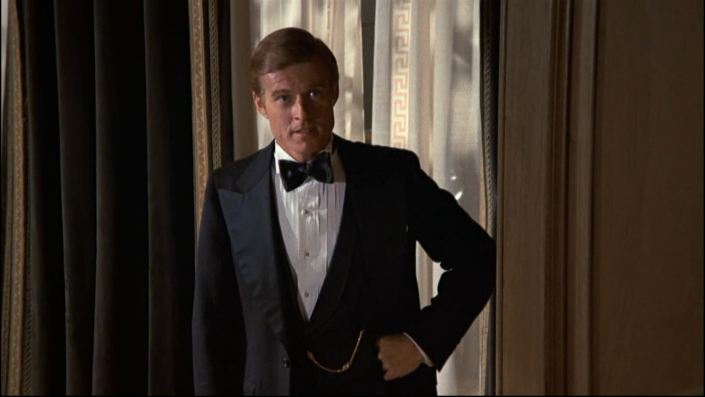
The Pros & Cons of Robert Redford's version of "The Great Gatsby" (1974)


With the imminent release of Baz Luhrmann's 3-D version of F. Scott Fitzgerald's prohibition-era drama "The Great Gatsby," it seems appropriate to take another look at what was, up until now, the most famous movie version of the book, 1974's "The Great Gatsby" starring Robert Redford and Mia Farrow.  I saw the movie in my high school English class when we read the novel and distinctly remember how the class laughed throughout the film.  Because the movie slavishly recreated the novel without any appropriate sense of perspective or interpretation, the scenes Fitzgerald had created in his book came across to everyone in my class as campy and mannered.  The odd thing was, the movie seemed campy, but it lacked any heart or passion to it.  Director Jack Clayton created a visually beautiful film, but its beauty is undermined by a cold detachment that never allows you to become fully engaged with its potentially rich characters and situations.  I think that's the reason why the movie seemed campy and laughable to our class--we never grew to care about the characters the way we are supposed to and, as a result, we are left with little else but to chuckle at the seemingly strange actions and declarations by the characters because the movie never quite captures the subtle nuances that enriched the novel.  (For instance, the movie excludes the character of "Owl Eyes," the bespectacled party-goer at Gatsby's house impressed by the books in the library who, touchingly, proves his friendship to Gatsby by attending his funeral.  The character is nowhere to be found during the movie and his absence is particularly felt during the funeral scene.)  It's the perfect example of a Cliff's Notes movie version of a classic novel--hitting all the key plot points of a novel without ever fully capturing its essence.


I think the casting of the film is at the heart of the problems with this version of "The Great Gatsby."  Robert Redford is dashing and handsome as Gatsby, demonstrating his charm and charisma, but he seems too refined to convince us that he came from the poor, working class background that he was supposed to have come from.  Gatsby is supposed to be a self-made man who puts on a good act of being a sophisticated host, but whose rough, modest edges can still be discerned by perceptive eyes.  Redford comes across as someone who was to the manner born, from the same aristocratic world as Tom and Daisy, and never fully convinces us that there was a level of struggle and desperation to get where he is.  Moreover, there is never that air of mystery attached to Redford's performance that people continually attribute to Gatsby's character.  You never sense what it is about Gatsby that makes Nick Carraway (Sam Waterston) so intrigued with his neighbor as to tail him throughout the novel.  Redford looks good, as ever, but plays Gatsby with an air of detachment that never truly brings the character to life.  Even though Redford's acting is perfectly competent in "The Great Gatsby," I think James Caan, Steve McQueen, Warren Beatty, or Jack Nicholson would have been more interesting in the role.


Similarly, Mia Farrow is also miscast as Gatsby's object of unrequited love, Daisy.  I like Mia Farrow and respect her work as an actress with an offbeat, otherworldly quality exemplified by her fine work in Roman Polanski's "Rosemary's Baby" (1968).  But Daisy should have been a character filled with charm, good-humor, and thoughtless narcissism for Gatsby to have pined away for her all these years.  Farrow instills Daisy with a nervous, neurotic hysteria that makes us wonder what Gatsby ever saw in her.  The scene when Farrow hysterically cries out in panic when she sees George Wilson (Scott Wilson) arrive at her house to question her husband about who drove the car that hit his wife epitomizes why she was all wrong for this role.  It gives Daisy a sense of uncertainty that is at odds with the rest of her character.  I always felt that Daisy was so blithe to causing Myrtle's death, and secure in Gatsby's promise that he would take the blame for it, that she would never lose her cool like that.  Tuesday Weld, who I understand it was on the short list of candidates to play the role, would have been the perfect Daisy for Gatsby to have been obsessed about through the years.  Weld was always perfect at playing charmingly malevolent characters, too wrapped up in self-absorption to care about anyone but themselves.  She had already perfected this type of character years earlier playing Thalia Menninger on "The Many Loves of Dobie Gillis" (1959-60) TV series during its first season.  In that series, Dobie (Dwayne Hickman) spends every waking hour thinking of ways to become rich and successful to win Thalia's heart, only to have Thalia continually set the goal higher and higher for him to reach.  And, yet, we always understood why Dobie would break his back to please Thalia.  Her charm continually outweighed whatever drawbacks that straining to please her would entail.  We needed somebody like that playing Daisy to make us understand the nature of Gatsby's obsession for her.


1970s icons Bruce Dern and Karen Black are also awkwardly cast as Tom Buchanan and Myrtle Wilson.  In contrast to Redford, who seems too refined to play Gatsby, Bruce Dern never seems refined and aristocratic enough to play Tom.  You wonder why the status-conscious Daisy would think that marrying Dern's Tom was more socially acceptable than marrying Redford's handsome and charismatic, if poor, Gatsby.  Tom is supposed to be an arrogant, racist who graduated from Yale, yet Dern makes him look like an alum from the local junior college.  The casting of Tom also suffers from virtue of the fact that Dern can't help but come off creepy and psychotic in almost every role he plays.  When George Wilson shows up at Tom's house at the end of the film to find out who owned the car that ran down his wife, Myrtle, Dern has such a brutal quality about himself that you wonder why Tom didn't just beat George up and kick him out of his house without having to implicate Gatsby in his wife's death.


The less said about Karen Black's Myrtle Wilson, the better.  Myrtle is supposed to be a character desperate to escape her stifling existence with her husband George at his modest service station.  When I read the book, I found her sympathetic and tragic and felt sorry for her and her husband.  In Karen Black's hands, Myrtle comes across as simply vulgar and pathetic.  The scene early in the film at the small party Tom and Myrtle throw in their apartment in which they rendezvous where Myrtle shares with Nick her memories of how she met Tom should have been poignant, because it expresses Myrtle's hopes and dreams, but Black comes across so swarthy and sweaty in the scene that Myrtle seems self-indulgent and delusional.  Later in the film, when George has Myrtle locked upstairs at the service station, while Tom is filling up his car with gasoline, Myrtle smashes her hand through the window to try and alert Tom to her confinement.  This is a scene that was not in the book and was clearly created for the movie.  What does Black do, with Myrtle's hands and finger bleeding from putting them through the window?  She shoves it in her mouth and sucks on it.  Whoever thought that was a good idea for a scene should have had their heads examined.


Which leaves us with the two actors in "The Great Gatsby" who I think were well-cast in their roles.  As I have blogged about before, Lois Chiles has the right air of cool detachment and self-possession in the role of pro-golfer Jordan Baker.  Chiles brings an assured, low-key quality to Jordan that makes her the most interesting and appealing woman in the story.  Unlike Farrow or Black's misinterpretation of their respective roles, which are so shrill and overt that you never wonder what's going on inside of them because it's all spelled out for you, Chiles makes Jordan charming, mysterious, and even sympathetic.  By design, she's a shallow character, but Chiles plays Jordan as if she's aware of these shortcomings and has simply chosen not to do anything to improve herself.  Even though she associates with Tom and Daisy, she's not as cruel or thoughtless as either of them and I always sensed that the attraction of Chiles' Jordan to Waterston's Nick was genuine.  In this interpretation of the story, I always got the feeling that Jordan was drawn to Nick's inherent decency because it contrasted with her own selfish shortcomings as well as the shortcomings of the people she typically associated with.  Chiles and Waterston have a natural chemistry in the movie that makes it a shame they have not worked together again.  Chiles' Jordan is such a good sport that she isn't even offended when Nick breaks up with her at the end of the movie because of her continued association with Tom and Daisy, and the fact that she's too much like them for him to ever fully be in love with her.  I always felt that, in that scene, Jordan accepts Nick's judgement of her without any resentment or disappointment because she ultimately knows he's right.


Similarly, Waterston does a fine job with Nick Carraway, bringing depth to what could have been a difficult role.  Nick is the narrator of the story and the characters that the audience identifies most with in the novel.  Waterston brings the right quality of naivete, sense of awe, and compassion to Nick that the character never becomes a mere storytelling device.  He brings a clean-cut quality to Nick that demonstrates the purity of his soul.  Waterston's Nick has an essential decency about him that allows the audience to continue to be engaged in the story even as we realize that almost everyone around him are awful people.  More importantly, Waterston effectively projects the quietly mounting air of disgust that Nick feels for his cousin Daisy and her husband Tom.  We see how Nick has gone from being impressed by the opulence and splendor of the people around him to being disillusioned and disgusted by their moral corruption looming underneath the pristine surface.  I also like the subtle ways that Waterston plays Nick as someone who was subconsciously attracted to Gatsby and, as such, bestows upon Gatsby the kind of caring, reverence and respect that his cousin Daisy did not.  When Nick and Gatsby's father, Mr. Gatz (Roberts Blossom), are riding out at the end of the film to attend Gatsby's funeral and Gatsby's father asks Nick if he was friends with his son, Waterston projects a telling air of sadness when he tells the father "We were close friends" that suggests his feelings for Gatsby ran deeper than he is willing to admit to himself.  I'm not suggesting that Nick, or Waterston's interpretation of him, was meant to suggest, as some reviewers have indicated, that he was gay, because I think Nick was genuinely attracted to, and enamored of, Jordan.  But I think a conservative reading of the character suggests that the character was probably, at the very least, bisexual and that he was drawn to both Jordan and Gatsby--Jordan for her self-confidence and independence, and Gatsby for his romantic sense of longing.  I think Nick admired Jordan and wanted to be as confident as she was, and I also believe he was touched by how deeply Gatsby remained in love with Daisy all these years that he eventually grew to care about him as a result.  Waterston's performance provides subtle hints that lend support, but doesn't conclusively prove, such interpretations of the character so that Nick remains intriguingly enigmatic as ever.  In fact, in Waterston's skillful hands, Nick becomes a much more interesting character than Redford ever is as Gatsby.


Even though the 1974 version of "The Great Gatsby" remains flawed and uneven, I still like it and find much to appreciate about it.  Like its titular character, it tries hard to please and impress with its lavishness and visual opulence even though, like Gatsby, it is sometimes lacking in substance and purpose.  Despite its flaws in terms of Jack Clayton's direction and the miscasting of many key roles, it still has good performances by Sam Waterston and Lois Chiles, as well as beautiful photography, handsome production design, and stunning locations in Newport, Rhode Island.  The potential was there to make a great film, if only the filmmakers had not compromised by emphasizing style over substance in some essential choices they made.  Nevertheless, its story of unrequited love, empty emotions and thoughtless materialism still has relevance and impact today.  It's a flawed film, but one that is tough to dislike in spite of its missed potential because it has its heart in the right place.  Even though some of the actors and performances are wrong, when I watch it now, I still care about the characters and feel sadness for Gatsby that his dream of happiness with Daisy remains an unfulfilled illusion, and disgusted with Daisy at how her narcissism has thoughtlessly destroyed the lives of the people around her.  F. Scott Fitzgerald's original characters still have power and impact in the 1974 version of "The Great Gatsby" even when they're interpreted incorrectly.  It will be interesting to see how Baz Luhrmann's new 3-D version stacks up against the 1974 version in the long run. 

Thursday, April 18, 2013

William Holden Gave His All Even "When Time Ran Out..."


I recently came across an interesting segment of "The Tonight Show" starring Johnny Carson from 1980 with Carson interviewing William Holden while he's on the show to promote his latest film "When Time Ran Out..." (1980), a terrible Irwin Allen-produced disaster film about tourists on a Pacific island fleeing in terror from an erupting volcano.  With shoddy special effects, mostly indifferent performances (especially by Paul Newman), slow pacing, and bad writing, "When Time Ran Out..." is the sort of film that makes people cynical about Hollywood filmmaking since it was produced as part of a deal Irwin Allen made with Warner Brothers to make a series of disaster movies that included "The Swarm" (1978), "Beyond the Poseidon Adventure" (1979) and countless made-for-TV movies.  My understanding is that Paul Newman and William Holden only appeared in the movie to fulfill their contractual obligation to do another disaster epic for Irwin Allen after making "The Towering Inferno" (1974) for him.  By the time "When Time Ran Out..." was made, the genre had run its course and Warner Brothers had become impatient with Allen to such a degree that they purportedly cut the budget of the movie in mid-production, thus explaining the threadbare production values and special effects.  I've read that Holden didn't like the film at all, particularly as he got billing below Paul Newman, as well as the fact that leading lady Jacqueline Bisset doesn't end up with his character at the end, but with Newman's.  I also recall reading in Bob Thomas' biography of William Holden that he drank heavily throughout the production of "When Time Ran Out..." and that that alarmed the filmmakers since the film entailed difficult stunts and locations.  As such, it was apparent that this was hardly one of Holden's proudest accomplishments as an actor.


Which is why I marveled at how charming and enthusiastic Holden was while being interviewed by Johnny Carson about the film.  After discussing his interest in African conservation and wildlife, and sharing an anecdote about making "Sunset Blvd" (1950), Holden finally gets around to discussing "When Time Ran Out..."  He describes his character and the storyline of the movie with great ease, and even goes so far as to say "It's quite exciting with a marvelous cast...good company and it's an exciting show" which I imagine must have taken a level of intestinal fortitude for Holden to say because anyone who has ever seen "When Time Ran Out..." knows that it's hardly an "exciting" movie.  Holden even jokes, when Johnny Carson points out that Mount Saint Helens had just erupted in real life, that "Irwin Allen plays long shots.  He makes this picture a year in-advance and then the day before the picture comes out Mount Saint Helens blows up.  You see, it's working...He made a picture, 'Poseidon Adventure' and I think it was the Queen Elizabeth turned over in the bay of Hong Kong.  And then we made 'Towering Inferno' and they were very obliging, the skyscraper in San Paulo, Brazil burned down."  Carson then jokes "You're not accusing anyone are you?" and Holden slyly responds "No, no..." as the two chuckle amongst themselves.  Nevertheless, I admired Holden's humility and professionalism to not denigrate the movie publicly the way so many movie stars and celebrities are apt to do these days.  Some people might say that he was being a hypocrite for not expressing his true feelings about the film, but I disagree.  Holden knew that he agreed to make "When Time Ran Out..." and that he took the money for it, and he was hardly a struggling actor trying to pay his bills at the time.  It would have been much more hypocritical, in my opinion, if he made the movie, got paid for it, and trashed it at the time of the release when the studio was still hoping to recoup its expenditures from it.  Years later, upon reflection, he would have been allowed to express his true feelings after the success or failure of the movie had already been determined by the marketplace.


Unfortunately, Holden never had that chance to be candid about "When Time Ran Out..." because he unexpectedly died a year and a half later from an accidental head injury sustained at his home in Los Angeles.  As such, "When Time Ran Out..." ended up being the penultimate performance of a talented and charismatic actor who graced some of the finest movies Hollywood has ever made.  I've always liked William Holden for his charm and warmth on-screen.  Like James Stewart, he had the courage to play unsympathetic characters that went against his natural screen image.  He was never afraid to show the sleazy and corruptible side to his characters, but we still cared about them because his innate charm still came through.  I also liked him for the fact that he grew up in South Pasadena, California--not far from where I grew up--and that knowledge gave me hope that talent and initiative might someday get me out of the San Gabriel Valley (and it has).  Nevertheless, Holden needn't make any excuses for "When Time Ran Out..." because, even though it's a terrible movie, Holden still gives it his all.  While no one in the film could be accused of giving their best performances in it, Holden still does fine work, and has about three or four scenes that allow him to demonstrate what he was capable of as an actor.  That's more than can be said for top-billed star Paul Newman, who sleepwalks his way through the movie, barely able to contain his obvious contempt for the material.


There's a scene at the beginning of the movie, where the jet carrying Holden and Jacqueline Bisset is about to land on the tropical Pacific island where Holden's character, a hotel magnate named Shelby Gilmore, has built his latest resort hotel.  He is there to inspect it while accompanied by his public relations manager, Kay Kirby, played by Bisset.  In the backstory of the movie, Holden's character is deeply in love with Bisset, but she is still in love with oil wildcatter Paul Newman, who she met and was romantically involved with while on an earlier visit to the island.  The pilot tells them that they are making their "final approach" to the island, which inspires Holden to make his "final approach" with Bisset.  He takes out a ringbox and asks her to marry him.  She tells him she can't and that he knows it is because she's still in love with Paul Newman's character.  Holden responds, "But he's not the marrying kind."  Bisset chuckles and tries to change the subject and make light of the situation by commenting that the same can't be said about Holden's much-married, and much-divorced, character.  Bisset muses aloud whether she would be his fifth, sixth or even seventh wife if she were to marry him.  Holden looks at Bisset intently and simply says "The last."  It's a simple line of dialogue, but Holden proved that he still possessed enough romantic sex appeal in this scene so that he delivers it with the requisite amount of love and sincerity.  Because of the fine work between Bisset, a real trouper and sincere professional if there ever was one, and Holden in this scene, you sense how Kay Kirby has affected Shelby Gilmore in ways that his earlier wives had not, and that he sincerely knows that she is the love of his life.  Even though the years of drinking have caused Holden to look much older than he was at the time, Holden still has enough presence to give Paul Newman's character a run for his money while competing for Bisset's hand in marriage.


Later in the film, Holden's character confronts his hotel general manager and business partner, Bob Spangler, played by James Franciscus.  Holden tells Franciscus that he has concerns about the safety of the tourists on the island due to alarming reports about the volcano's stability.  Holden angrily tells him, "Bob, I'm in the partner business.  I can't be in 64 resorts at the same time.  I have to rely on what my partner's tell me.  Up to a point.  And if I come to feel they're lying, I call in the cards."  Franciscus' character bluffs and calls his geologist, who tells him that the volcano is unstable and can erupt any moment and that they better evacuate the island immediately.  The smug and sleazy Franciscus hands the phone over to Holden, in an act of defiance to challenge Holden's authority over him.  Holden takes the phone, looks at Franciscus intently and responds "As I said before, I trust my partners.  Up to a point."  Holden then hangs up the phone and walks out.  Holden's character realizes that Franciscus is bluffing him, and that taking the call would be pointless because he already knows what the truth is.  You can tell that he's not going to waste another minute on Franciscus.  Holden establishes his character as a tough, no-nonsense businessman who doesn't suffer fools gladly.  Even though the role was hardly up to his standards as an actor, Holden still brings a sense of authority and gravitas to establish that Shelby Gilmore is a man who won't tolerate Franciscus' foolishness any longer.


Probably Holden's most touching moments in the film are with Veronica Hamel, who plays Nikki Spangler, the wife of James Franciscus' character.  In the storyline, we learn that Nikki is the goddaughter of Holden's character, and that he loves her deeply as if she were his own child.  We also learn that Franciscus' character only married Nikki in order to get to Holden's character to convince him to build a resort on that island.  When Holden and Hamel's character are reunited at the beginning of the film, and he tells her that he just saw her mother recently and that she's becoming almost as beautiful as she is, there's a warmth and familiarity emanating between the two actors which convinces you that they really are like family.  Later in the film, after the volcano has erupted, and Paul Newman's character has proposed evacuating the resort and moving everyone to higher ground on the other side of the island, Holden's character goes to Nikki's suite.  She had fallen off her horse and sprained her ankle when the volcano erupted and is resting.  Holden urgently tells her to get dressed and that they're leaving for the other side of the island.  When Hamel's character learns that her husband doesn't want anyone to evacuate the resort, she tells Holden that if her husband feels that way, he must be right and that they are safe at the resort.


Holden tells her, "I don't care what he says.  You're my responsibility and I'm taking you with me."  Hamel's character responds, "Shelby, you know my place is with him.  Right or wrong."  Holden tries to reason with Hamel, telling her, "We'll argue about that later.  Now, are you coming or do I have to carry you?"  When Hamel again refuses to leave, Holden grabs Hamel and bluntly tells her "Don't you understand?  He only married you so he could get to me!"  Hamel tearfully tells him she doesn't believe him and that "I'm not going to go with you!" as she wrests herself away from him.  Holden becomes frustrated that he can't make Hamel see the truth, and that he's lost her forever.  Before he walks out the door, Holden turns around, looks intently at Hamel, and quietly says with gravitas and sadness, "Goodbye Nikki."  Flush with anger from arguing with her, Holden's character calms down and regains his composure as he realizes that this is the last time he will ever see her again.  Holden and Hamel's performances bring a surprising level of poignancy to this subplot that make it one of the better scenes in the movie. 


Throughout "When Time Ran Out...", William Holden rises above the cliched and hackneyed storyline of the movie to make Shelby Gilmore a sympathetic and intelligent character, with strength and resolve.  His presence never becomes campy or foolish in the course of the story.  Despite his wealth and power, he remains a heroic and admirable character, one who is concerned about the safety of others rather than his own personal comfort and security.  At the end of the film, after the rag-tag group of survivors have witnessed the destruction of the resort by the volcano, Holden has a quiet moment listening to Burgess Meredith's character grieve for his wife.  Holden listens with compassion and sympathy, but we realize that he is also grieving at that moment for his goddaughter, Nikki.  Holden is subtle in that scene and allows those expressive eyes and his handsome face to convey his feelings of sadness to the audience.  In contrast, Paul Newman makes absolutely no effort to bring any feeling or depth to his character.  It's clear that Newman is on autopilot throughout "When Time Ran Out..." and, if it's true that Holden was annoyed that Newman got top-billing and won the girl in the end, I can't honestly blame him considering how he still delivered the goods despite the bad script he had to contend with, and his own personal issues at the time.  Holden's fine performance brings to "When Time Ran Out..." a few nicely acted little vignettes that stand out from the rest of the movie surrounding it.  Time may have sadly run out in William Holden's life when he made this film, but his talent, screen presence, and professionalism continue to live on.

Tuesday, April 16, 2013

Scarlett O'Hara's Complex Relationship with the Slaves in "Gone with the Wind"

 
"Gone with the Wind" (1939) remains a controversial movie to this day due to its depictions of slavery in the South leading up to, during, and after the Civil War.  This is understandable on many levels because slavery remains a blot on the history of our great nation.  Any film that purports to depict that time period and subject matter is bound to tread dangerous territory.  I personally think it's a great film, with vivid and exciting characters, but I can understand why the movie might rub some people the wrong way.  I am not a proponent of political correctness in the least, but as an American of Chinese descent I acknowledge how there are depictions of Asians in cinema that offend me, like Wayne Wang's "The Joy Luck Club" (1993), so I am the last person to ever suggest that African Americans, or anyone else for that matter, shouldn't be offended by the movie.  The interesting thing is, "Gone with the Wind" has an innate appeal that allows it to transcend notions of political correctness so that its fans encompass a wide spectrum of individuals from different nationalities, religions, and ethnic backgrounds.  I have found that people you'd least expect to like "Gone with the Wind" happen to worship and enjoy the movie wholeheartedly.  I think one reason why its appeal remains so widespread is because its depictions of slavery, and of the slaves, is more complex and nuanced than is typically acknowledged by politically correct interpreters of the film.  As such, people are able to enjoy "Gone with the Wind," and appreciate the characters and themes of the story, without having to embrace or condone the institution of slavery.


One aspect of the movie that remains complex is Scarlett O'Hara's (Vivien Leigh) personal interaction and relationship with the slaves who work for her.  Unlike the other Southern slave owners in the movie, Scarlett is the only one who has any sort of substantial dealings with the slaves.  While there is a definite mistress-servant dynamic with regards to how Scarlett deals with Mammy (Hattie McDaniel), Pork (Oscar Polk), Prissy (Butterfly McQueen), and Big Sam (Everett Brown) in the film, there's also much more to it than that.  There is a directness and candor with regards to Scarlett's relationship with the slaves that is distinct and separate from her relationship with everyone else in the film.  In contrast, her sisters Suellen (Evelyn Keyes) and Carreen (Ann Rutherford) don't have nearly as complex and nuanced a relationship with the slaves as Scarlett does, and they grew up in the same house as she did.  Throughout "Gone with the Wind," Scarlett is in a perpetual state of subterfuge and manipulation with the way she interacts with Ashley Wilkes (Leslie Howard), Melanie Wilkes (Olivia De Havilland), and even Rhett Butler (Clark Gable) because she's trying to fool them into believing she's a better person than she is so that she can get what she wants and needs from them.  But Scarlett isn't like that when she's with the slaves.  One could validly opine that it's because she's the mistress, they're the slave/servant, and they have to put up with her no matter what her eccentricities are, and follow her directives accordingly.  But I think it's deeper than that.  Scarlett is cognizant of the fact that the slaves know what kind of person she really is underneath all of her airs and, as such, she can't easily manipulate them like she does the others.  She can relax around them and admit her fears, vulnerabilities and concerns in ways that she can't around the other Southerners in the story.


Most people point towards Scarlett's relationship with Mammy to demonstrate the complexity of the movie's depiction of the slaves, and there is much evidence in the movie to support this contention.  Despite Mammy's status in the first half of "Gone with the Wind" as a slave (and, thus, possession) in the O'Hara household, in many ways she is also one of the most formidable characters in the story.  Like Rhett, she's one of the few characters in the story who isn't frightened or intimidated by Scarlett in the least, and remains blunt and honest throughout the story whenever she feels Scarlett is making a mistake.  More than Ellen O'Hara, Mammy is the true mother-figure in Scarlett's life.  When Scarlett puts on airs about Ashley Wilkes liking a girl who has a healthy appetite, so that she can avoid having to eat before the Twelve Oaks Barbecue, Mammy slyly reminds her that Ashley hasn't expressed any interest in wanting to marry Scarlett.  As such, Mammy reminds Scarlett of how she's pinning all of her hopes on a man who only gives her crumbs in-return for the unearned adoration she bestows upon him.

 
Mammy is also the one who tells Scarlett that she's making a mistake to go to Atlanta to stay with Melanie, after Scarlett's first husband Charles Hamilton (Rand Brooks)--Melanie's brother--has died.  As Mammy wisely opines "Savannah would be better for ya.  You'd just get in trouble in Atlanta...You know what trouble I's talkin' 'bout.  I's talking 'bout Mr. Ashley Wilkes.  He'll be comin' to Atlanta when he gets his leave, and you sittin' there waitin' for him, just like a spider.  He belongs to Miss Melanie."  Mammy knows that Ashley doesn't love Scarlett, and that her presence in Atlanta will only stir up trouble and land Scarlett in hot water.  Mammy doesn't want to see Scarlett hurt everyone around her, including herself.  Mammy is also there when Ashley returns from the war and Scarlett impulsively starts to run out to greet him, just as Melanie is running towards Ashley.  Mammy grabs Scarlett and sagely reminds her that he's Melanie's husband now.  Throughout "Gone with the Wind," Scarlett tries to hide how deeply her feelings are for Ashley in front of almost everyone, but she is honest about her feelings in Mammy's presence.  Mammy's knowledge and understanding of Scarlett's unrequited love for Ashley enables her to try and help Scarlett to avoid embarrassment and scandal from inadvertently revealing her feelings for him at inopportune moments.  In many ways, Mammy represents the conscience that Scarlett has, but chooses to ignore throughout the movie.


One aspect of "Gone with the Wind" that continues to trouble people is Scarlett's interaction with Prissy, particularly during the scene in Atlanta when Melanie has gone into labor with no doctor around to help.  As you will recall, the Yankees are due to arrive any moment, and Prissy finally admits that she lied about knowing how to help give birth to babies.  The scene where Scarlett slaps Prissy out of anger and frustration remains disturbing decades later because it is the one scene in the movie that doesn't try to soft-pedal the dominance that slave owners had over their slaves during that time.  Scarlett was out of line in hitting Prissy, and there's no way to rationalize or justify her actions at that moment.  The only thing that redeems Scarlett is the fact that she doesn't leave Prissy behind when Rhett shows up at Aunt Pitty's house to help them all escape from Atlanta before the Yankees arrive.  Rhett informs Scarlett that there's been fighting around Tara all day, and that it would be crazy to trek through there with Prissy, Melanie and her baby.  He rhetorically asks if Scarlett intends to leave them behind.  An impatient Scarlett tells Rhett that she intends to make sure that they all get back to Tara safely, including Prissy.  Scarlett exclaims, "They're going with me and I'm going home and you can't stop me!"  One might conjecture that Scarlett doesn't want to lose a slave who she could put to use once they're back at Tara, but given how frightened Scarlett is at that moment concerning the Yankees' impending arrival, she could have easily abandoned Prissy in order to expedite a faster and easier escape.  But she doesn't because, for better or worse, Prissy is part of the team and, like military personnel, Scarlett seems to feel a duty to ensure that no one who is part of her group is left behind.


Scarlett also has a rather complex and nuanced relationship with the men who work at Tara: Pork, the family's valet, and Big Sam, the field foreman.  When Pork informs Scarlett that Jonas Wilkerson has become a carpetbagger and that his friends intend to raise the taxes on Tara, Scarlett says aloud that she will ask Ashley what to do about it.  Pork reminds her that Ashley doesn't have the tax money and Scarlett responds, "Well, I can ask him if I want to, can't I?"  Scarlett's reaction is interesting because she doesn't respond to Pork in a manner that would indicate that it's none of his business that she's consulting Ashley about the taxes, which is how one might normally expect a mistress of the household to address one of her servants.  Instead, Scarlett gets defensive about it, almost as if she feels she has to justify to Pork her reasons for wanting to reach out to Ashley on this issue.  Later, after Gerald O'Hara has died, Scarlett gives Pork her father's pocket watch as a memento.  Pork tells Scarlett that she should sell it to get the money to pay the taxes on Tara.  Scarlett tells Pork, "You take it, it's for you.  Pa'd want you to have it...You think I'd sell Pa's watch?  And don't cry.  I can stand everybody's tears but yours."  In so doing, Scarlett recognizes the role that Pork has played in her family's household for presumably decades.  The fact that she acknowledges that she can handle everyone's tears over her father's death, except Pork's, suggests to me that she knows she has to remain strong for the others in the household she regards as weaker and needing more support.  Scarlett's admission that Pork's tears would unnerve her suggests that she regards Pork as someone who can be strong, just as she is.  If he cracks under pressure, it might be too much for Scarlett to handle and would allow her to give in to her fears that she won't be able to surmount this latest challenge.  Scarlett relies on Pork to stay strong for her sake.  As such, Scarlett leans on the slaves for emotional support more than is usually acknowledged in the movie.


Similarly, Scarlett's scenes with Big Sam also reflect the certain level of comfort and ease she feels around him.  When the Yankees are initially bombing Atlanta, and the residents are fleeing the city in fear, Scarlett is rushing to Aunt Pitty's house after she has gotten fed up with volunteering at the hospital.  She's fleeing through the streets when she runs into Big Sam and the other field hands from Tara, who are being sent by the Confederacy to help dig ditches.  Scarlett seems genuinely happy to see Big Sam and the other slaves from Tara, calls out each of their names, and tells them "Goodbye Big Sam, goodbye boys.  If any of you get sick or hurt, let me know."  Scarlett expresses a level of concern for the slaves that we never see from the other slave owners.  Later, when Scarlett is riding her buggy through shanty-town and is attacked, and Big Sam comes to her rescue, she again seems genuinely happy and grateful to see him.  As she rushes away on her buggy wagon, she stops when she realizes that Big Sam is the one who fought off her attackers.  She appears relieved to see him and stops the buggy so that the two of them can escape the seedy shanty-town milieu together.  If Scarlett was as callous as people expect her to be about her slaves and servants, she would've just left Big Sam behind after he fought off her attackers (just as she would've, but didn't, leave Prissy behind when the Yankees were closing in on Atlanta).  Back at Frank Kennedy's house, as Kennedy gives Big Sam money and instructs him to head straight to Tara to avoid being arrested for this altercation, Vivien Leigh's voice registers a moment of vulnerability and sincerity when she says "Goodbye Sam, and thank you" while Scarlett is busy crying in order to generate sympathy from Frank for being attacked.  At that moment, she's trying to manipulate her husband Frank to feel sorry for her, but she drops her facade long enough to express gratitude to Big Sam for coming to her rescue.


I think the fact that Scarlett doesn't take the slaves for granted is the reason why they all continue working for her long after the Civil War has ended.  Unlike the Wilkes', whose slaves never came back after Twelve Oaks was burned down by the Yankees and after the war has ended, the slaves remain a part of Scarlett's household for decades to come as she works hard to help everyone around her rebuild their lives in post-war Atlanta.  Mammy, Pork, Prissy, and Big Sam could have taken other jobs, but they chose to continue working for Scarlett.  One could opine that the reason for this is because of their uncertainty of forging new lives for themselves as emancipated slaves in the post-Civil War South, and that would certainly be a valid point to make.  But I think a more valid reason is because Scarlett, in her own way, has demonstrated to them that she values their presence in her life and doesn't take them for granted the way the other slave owners may have treated their servants.  At one point, when Scarlett and Ashley argue over the use of convicts as workers at their lumber mill, he sanctimoniously declares that he "will not make money out of the enforced labor and misery of others." Scarlett reminds Ashley that "You weren't particular about owning slaves."  Ashley tries to rationalize things and says that he would have freed his father's slaves after he had passed away if the Civil War hadn't happened, and claims that he treated his slaves better than the convicts are being treated.  However, we never see Ashley throughout the course of "Gone with the Wind" have any meaningful interaction with his slaves, or anyone else in the movie for that matter.  Ashley can espouse high-minded ideals of freeing the slaves because, as with everything else in his life, he thinks of his slaves in terms of romanticized abstractions, not as flesh and blood individuals.  Scarlett remains a taskmaster with her servants to the end, but she watches their back just as much as they watch out for hers.

 
I think the moment that sums up Scarlett's relationship with her slaves is the scene, right after the intermission, when Gerald O'Hara (Thomas Mitchell) complains to Scarlett about how tough she has been with the slaves as they pick cotton in the fields.  Gerald O'Hara makes the cringe-worthy statement, "I've been talking to Prissy and Mammy and I don't like the way you are treating them.  You must be firm with inferiors, but you must be gentle with them."  Scarlett responds, "Yes, Pa, I know.  But I'm not asking them to do anything I'm not doing myself."  Despite Scarlett's apparent affirmation of Gerald O'Hara's statement, I think her response actually suggests that she doesn't necessarily think of Prissy, Mammy, Pork, or Big Sam as "inferiors" at all.  Despite the class differences between their characters, Scarlett is holding them to the same standards that she is holding herself to.  If Scarlett indeed felt that they were "inferiors," as her father suggested, she would assume that they were too helpless and ineffectual to assist in her efforts to rebuild their lives after the war.  Gerald O'Hara appears to regard the slaves almost as if they were children to be coddled, whereas Scarlett treats them in a straightforward manner like the adults that they are.  Scarlett might lose her cool, and scold or get mad at them, but she never mocks or condescends to them.  While I wouldn't go so far as to suggest that Scarlett thinks of them as her equals (and, to be honest, she doesn't think of anyone else in the movie, except maybe Rhett, as her equal) she also doesn't take them for granted for the reasons I've already underscored.


To be clear, my intent is not to romanticize slavery or "Gone with the Wind's" depiction of it at all.  As stated at the outset, slavery remains a blot on the history of the United States and cannot be rationalized.  However, I believe that it's because of the subtle nuances in the depiction of the slaves, and Scarlett O'Hara's interaction with them, in "Gone with the Wind" that many viewers are able to come to terms with aspects of the movie that are genuinely troubling to them.  As with any great work of art--and I do consider "Gone with the Wind a great work of art--it's the controversial aspects attached to it that allows it to maintain intrigue and relevancy through the decades.  Scarlett O'Hara's relationship with the slaves--as well as the brilliant performances of Hattie McDaniel, Butterfly McQueen, Oscar Polk, and Everett Brown that brought warmth, humor, and humanity to characters that could have been completely one-dimensional stereotypes--provides a level of balance so that contemporary viewers are able to appreciate the scope and depth of Margaret Mitchell's timeless story that producer David O. Selznick brought vividly to life over 73 years ago.