Sunday, April 7, 2013

Barbara Stanwyck Brings Out the Best in David Manners as "The Miracle Woman"


Yesterday, I spent a great afternoon at the National Gallery of Art in Washington, DC attending a triple feature of Universal horror films as part of the "Universal at 100" traveling exhibit of movie screenings to commemorate the studio's centenary.  It was wonderful to see "The Mummy" (1932), "Murders in the Rue Morgue" (1932) and "The Black Cat" (1934) on the big screen, and to see the audience receive the movies so warmly.  I've seen them many times before, but this time I paid attention to the performances in both "The Mummy" and "The Black Cat" by pretty-boy, matinee-idol leading man David Manners as the hero in both stories.  Manners, who also starred as Jonathan Harker in "Dracula" (1931) opposite Bela Lugosi, is usually derided by horror movie fans for the bland, stilted performances he gave in these films.  As such, he is often considered by many as a "bad actor" when, in fact, he was simply fitting the minimal requirements of such roles.  I love Universal horror movies and think they're great, but more often than not they were plot-driven films that paid less attention to character and nuance than to atmosphere and suspense.  This is not a put-down at all of Universal horrors, just an acknowledgement of what they were.  In fact, it was at this screening of "The Black Cat" that I realized just how great Bela Lugosi is in that film.  I'll probably blog about Lugosi's work in that film another time, because today my focus is on David Manners and probably the movie that demonstrated what he was truly capable of, when he wasn't defending heroines from monsters at Universal, was Frank Capra's satirical drama "The Miracle Woman" (1931) opposite a brilliant Barbara Stanwyck.


In "The Miracle Woman," Stanwyck plays Florence Fallon, the disillusioned daughter of an elderly minister fired by his Church's congregation, who has chosen a much younger man to replace him.  When she is delivering her father's final sermon, she stops in mid-sentence and announces that her father died in her arms out of a broken heart before he finished composing it.  She chastises the congregation for their betrayal of her father and their own personal hypocrisy as they flee in fear and shame.  Florence's angry outburst is witnessed by charlatan and con man Bob Hornsby (Sam Hardy) who convinces Florence that she can get even with the kind of people who betrayed her father by using her knowledge of the Bible to turn a profit by becoming an evangelist who performs fake miracles for gullible followers who blindly donate their money to Florence.  Hornsby tells her "Religion's like everything else.  It's great if you can sell it, no good if you give it away."  Florence becomes "Sister Fallon" who hosts epic, staged sermons for large crowds, with actors interspersed throughout the audience to demonstrate the "miracles" that "Sister Fallon" is capable of performing.


As "Sister Fallon's" popularity grows and extends into radio, John Carson (David Manners) a blind composer, Harvard graduate, and former WWI aviator who lost his sight while fighting in the war, is composing his suicide note and about to throw himself out his apartment window.  John has received the latest rejection letter from a music publisher over the compositions he has submitted and, in despair, is ready to end his life when he hears Sister Fallon's sermon broadcast from a neighbor's radio.  He listens to "Sister Fallon's" sermon about how God can easily forgive sinners, but would have a harder time forgiving quitters, and has a sudden change-of-heart about his situation.  His will to live restored, John asks his kind neighbor Mrs. Higgins (Beryl Mercer) to take him to see "Sister Fallon's" sermon in-person.  "Sister Fallon" preaches from inside a cage of lions, and asks for a volunteer to join her.  When one of Hornsby's paid actors fails to raise his hand because he's too drunk to pick up on his cue, "Sister Fallon" welcomes John to the stage, who joins her inside the cage of lions.  "Sister Fallon," thinking that John is one of Hornsby's actors, tells John in front of her entire flock that God will cure his blindness and restore his sight if he has enough faith.


One night, after a performance, John waits patiently outside the stage door in order to speak to "Sister Fallon."  Florence, tired of being "Sister Fallon" and being isolated from regular folk, recognizes John from the other night and offers to give him a lift home.  John welcomes Florence into his apartment as they become better acquainted and enjoy each others company.  John, a natural ventriloquist, takes out his dummy Al in order to communicate with Florence about how her radio sermon prevented him from jumping out the window and saved his life.  Through "Al," John admits to Florence that he would like to work for "Sister Fallon" and Florence offers him a job of composing hymns for her sermons.  Florence regularly visits John at his home as he begins composing for her and the two fall deeply in love.  Meanwhile, Hornsby, who is also enamored of Florence, blackmails her into going with him on a tour of Palestine, which is actually meant to be a romantic trip to Monte Carlo for just the two of them, by telling her that he has embezzled the donations and murdered their meddling sales manager, and has arranged to blame her for both crimes if she does not acquiesce.  Florence attempts to bid farewell to John before she leaves with Hornsby, but breaks down and admits how she is a liar, a hypocrite and a phony preacher and that the "miracles" she has performed at the tabernacle in front of the audience are all fake.  John tells Florence he loves her and that she's not the fake she believes she is because her sermons have indeed helped many people, including himself.  John urges Florence to tell him what it is that she's running away from only to have Hornsby show up and take her away.


John wakes up Mrs. Higgins and asks her to come with him to the tabernacle late at night.  Mrs. Higgins vividly describes the surroundings of Florence's dressing room, so that John can return the next evening when Florence is preparing for her final sermon so that he knows every part of the room and pretend to have regained his sight the next time he encounters Florence.  John hopes to restore Florence's faith so that she will believe that she has indeed performed a miracle and restored his sight, and decide not to run away with Hornsby.  John tells Mrs. Higgins that he plans to leave town soon afterwards so that Florence will never learn that he is still blind.  When John returns the next night for "Sister Fallon's" final farewell sermon, he tries to make her believe that he can now see, but Florence soon realizes that he is pretending.  Nevertheless, she is so moved by John's deep love for her that she intends to tell her congregation the truth about herself.  Hornsby, believing John has regained his sight, punches John and knocks him out.  Hornsby tries to shut off the lights to the tabernacle, as Florence is about to repent and confess before the audience, and accidentally starts a raging fire.  The fire causes the audience to panic but Florence's urges them to sing "Onward Christian Soldiers" as they calm down and exit the tabernacle safely.  John awakens in time to rescue Florence from the stage as firefighters and ambulances arrive.  The congregation kneel down and pray as John and Florence are rushed to the hospital.  Many months later Hornsby, who somehow survived the fire, is walking down a New York City street with a prize fighter he is promoting when he spots Florence, now working with the Salvation Army.  At that moment, Florence receives a telegram from John, telling her that doctors have told him his sight might be restored but that, either way, he loves her and wants to marry her.  As Hornsby cynically remarks "And she gave up a million bucks for that.  The poor sap!" Florence marches with the other Salvation Army volunteers, singing "Glory Glory Hallelujah," with tears of joy streaming down her face as her faith is God fully restored.


A tough and touching study of evangelical hypocrisy and genuine faith, "The Miracle Woman" is an unheralded early masterpiece by director Frank Capra.  Capra condemns those who would cynically take advantage of religious faith while, at the same time, provides affirmation for belief in such faith.  Stanwyck gives a vivid, multi-dimensional performance as the evangelist who has lost her faith after her father is betrayed by his congregation, only to have the blind John remind her that the basic principals underlying such tenets still have validity despite the hypocrisy and corruption that might sully it.  She's absolutely brilliant in the opening scene where she starts reading her father's farewell sermon to his ungrateful congregation, only to unleash a torrent of outrage against them for their personal hypocrisy and betrayal of her father.  "My father is dead!  He died in my arms five minutes ago before he could finish his message to you!  Well I'm going to finish it for him!...You're the head deacon of this church Mr. Simpson and I want you to listen to what I have to say!  Because it's your clique that started all this trouble!  Leave if you like!  My father preached to empty hearts.  I don't mind talking to empty pews!  My father is dead and you killed him!  You crucified him just as surely as he (Jesus) was crucified!  He died of disappointment, from heartbreak, of ingratitude!  He gave his life to serve you and when he was old and worn you threw him out!  You all came to this church in automobiles, he always had to walk!  He didn't even leave enough money, after 20 years of service to you, to buy a burial in a decent cemetery!"


When Mr. Simpson (Charles Middleton), the deacon, sanctimoniously attempts to calm Florence down from the pews and tells her to remember she's speaking in the House of God, she angrily retorts, "What God?  Whose God?  Yours?  This isn't the House of God!  This is a meeting place for hypocrites!...Well go on and get out!  You've been running this church, but I'm gonna run it for the next hour!  I'm gonna preach the sermon that my father should've preached!  The bible say the laborer is worthy of his hire, but you wouldn't pay your pastor what you'd pay your chauffeurs!  I worked for you too, without pay!  I served you by helping him!  And you've got to listen to me!  I don't have to make any notes, either, I was brought up on the Bible and I know it by heart!  I'm going to take my text this morning from Chapter 23 of the Gospel of Matthew.  And I say unto you as Christ said to the scribes and pharisees, 'Woe unto you hypocrites for ye devour a widow's home and for a pretense make long prayers!'"


As the congregation calls her crazy and flees in fear and shame, Florence continues driving them out with her righteous tirade, "Who among you is poor in spirit?!  Who among you mourns?!  Which of you is merciful and humble?!  Some of you have listened to my father for 20 years and you can't remember one word he said to you!  But you will remember this:  You subscribe to temperance and I can tell you the names of your bootleggers!  You pretend to be decent and I know which of you are cheating wives and husbands!  Shall I call out your names?!  What are you running away from?!  Are you afraid of the truth?!  Is that why you committed against my father?!  You are thieves, killers, adulterers, blasphemers and liars six days a week!  And on the seventh day you are hypocrites!  Go on!  Get out all of you!  Get out so I can open these windows and let some fresh air into this church!"  We realize watching "The Miracle Woman" that, even though Florence's faith is shaken as a result of the unscrupulous actions by those around her, her underlying belief in God and scripture remain strong.  That's why Florence's words still have power and sincerity, even when she has knowingly hooked up with Hornsby in order to fleece her followers, because she knows and understands their underlying intent.  Florence is as effective as she is as an evangelical preacher because, even though she is disillusioned, she ultimately believes in what she is saying.


When John, who is about to throw himself out the window after having his latest musical compositions rejected by publishers, leans out his window and hears Florence's sermon from a nearby radio, the words resonate with him because there is still truth to what she is saying, even though he is unaware that she is doing it for mercenary reasons.  The handsome, almost beautiful-looking David Manners has an illuminating close-up that demonstrates John's spiritual rebirth as he listens to Florence's powerful sermon and his despair turns to hope and happiness, "The trouble with most people is they're quitters.  They're yellow.  The moment they're put to any sort of test, they cave in.  The difference between a man and a jellyfish is the fact that a man has backbone.  What did God give him a backbone for?  To stand up on his feet!  That's what real men do!  Beethoven wrote his greatest symphony when he was deaf!  Oscar Wilde wrote his greatest poem in jail!  And Milton, a blind man, gave us 'Paradise Lost.'  It's easy to forgive sinners, but it's hard to forgive quitters!"  Florence's sermon inspires John so that, despite his blindness, he's going to continue living his life to the fullest and will continue composing music and sending them to publishers because he now realizes that nothing worthwhile is done without a level of struggle.


The beauty of the sequence, and of the movie as a whole, is that Capra demonstrates the notion that, even if the intent of self-annointed interpreters of the Bible are less than pure or altruistic, it should not ultimately disillusion one from finding their own truth with its message.  Capra doesn't take the easy way out by implying, because of the hypocrisy in organized religion, that one should outright dismiss faith in their lives.  Florence may have fleeced her congregation and associated herself with Hornsby from outrage over how her father was treated by his hypocritical congregation, but we see through her interaction with John that she still has a strong understanding as to what the Bible is saying.  This is reflected in her willingness to come clean to both John and her followers, and why she joins the Salvation Army at the end of the film.  Stanwyck's scenes with David Manners in the movie are very special and romantic in a sincere and genuine way.  We see how Florence and John bring out the best in each other: Florence, in making John believe that his life is worth living despite his blindness; and John, in making Florence believe that there are still good and genuine people who are sincerely seeking spiritual guidance so that they can conduct their lives in an honorable manner, and are not hiding behind the Bible for corrupt or hypocritical reasons.


Even when John learns from Florence that she's a phony, he does not become disillusioned, as one might have expected from him, because he feels that Florence, as "Sister Fallon," has done tremendous good for people by giving them faith and hope in their lives.  He recognizes the sincerity behind Florence's sermons.  Concurrently, when Florence realizes that John is trying to pretend that a miracle has taken place and his sight has been restored, so that she won't leave her congregation, she feels a miracle has indeed taken place.  Florence realizes that John has selflessly learned much from her sermons and that he loves her enough that he planned to leave town, so she would never learn that he is still blind, to ensure that she won't abandon her congregation and leave with Hornsby.  John's love helps to cleanse Florence's soul, after she's been corrupted by Hornsby, so that she's ready to share her life with him while continuing to serve God.  At the end of the movie, as Florence is about to confess to her congregation, she humbly tells them, "If you only knew, those roses you threw at me tonight might have been stones.  During the past few months, many of you have come up here to confess your sins and tell how you've been saved.  Tonight, I'm gonna tell you how I've sinned and how I was saved.  I've wandered far away from God.  And now I'm coming home."  Stanwyck's humility is touching as she attempts to repent for her corruption and treachery due to her association with Hornsby.  Thankfully, Capra redeems Florence, and doesn't punish her any further, by allowing her to survive the fire at the end so that she can carry on her work for God and marry John.


David Manners' warm and sympathetic performance makes John someone worth loving.  Unlike his smug, stilted and entitled characterizations in the Universal horror films, which always made us root for Dracula and The Mummy to triumph against him, Manners brings humility and vulnerability to John so that the audience cares very much about him.  Manners' handsomeness and physical beauty, which seemed to lack a human dimension in his Universal horrors, are used by Capra to help demonstrate the purity of John's soul.  John's blindness makes Manners come across so vulnerable that we are happy to see how Florence's sermon and love for John help him to regain his strength and confidence.  We root for David Manners to end up with the powerhouse Barbara Stanwyck at the end, and his quiet strength in the movie provides a good match to Stanwyck's passion and emotion.  I particularly liked the way Manners handles the scenes with the ventriloquist dummy Al, as he expresses his feelings for Florence.  Because of Manners' warmth and sincerity in this role, the scene comes across as a touching, rather than creepy, expression of John's shyness and deepening feelings for Florence.  Working opposite the earthy Stanwyck gives Manners an assertive edge that we rarely associate from him in his more famous horror movie roles.  Watching his fine performance in "The Miracle Woman," it is easier to understand why Manners was such a popular Hollywood leading man in the early 1930s and one can see that he should have been considered for roles such as Ashley Wilkes in "Gone with the Wind" instead of Leslie Howard.  It's too bad that Manners didn't stick around Hollywood longer before abandoning his film acting career in 1936 to become a writer, because "The Miracle Woman" demonstrates the genuine promise he had as a leading man--demonstrating courage, strength, and humility--rather than being considered just another pretty male starlet.

Saturday, April 6, 2013

Pamela Hensley Brightens a Potentially Dim "Double Exposure"


Early 1980s slasher movies are not normally known for providing good parts for actresses over 30, much less two actresses over 30.  A rare exception to the case is the little-known Crown International release "Double Exposure" (1982) which featured Joanna Pettet and Pamela Hensley in the leading female roles.  Veteran actor Michael Callan stars as Adrian Wilde, a swinging bachelor and fashion photographer who lives in a fancy RV and suffers from horrible nightmares that he is murdering women.  He confides in his psychiatrist Dr. Curtis (Seymour Cassel) and his disabled stuntman brother B.J. (James Stacy) about these dreams as he pursues a romance with attractive young widow Mindy Jordache (Joanna Pettet).  Meanwhile, LAPD homicide detectives Sergeants Buckhold (David Young) and Fontain (Pamela Hensley) are investigating a series of murders of women across the Southland, all of whom turn out to be the same women Adrian has dreamed about murdering.


As Adrian begins to fear the worst about himself, and senses the police are closing in on him, he takes Mindy out on a camping trip near the beach in his RV.  While taking a walk in the canyons near the beach at night, Mindy is stabbed in the stomach by an unseen assailant.  Back at the RV, Adrian is knocked unconscious by his brother B.J., who has shown up out of nowhere.  Adrian awakens to find himself tied to the front bumper of his Mercedes only to learn that B.J., who still harbors resentment against their promiscuous mother, is the one who has been perpetrating the murders by patterning them after Adrian's dreams.  As B.J. is about to kill Adrian, a wounded Mindy shows up in the nick of time and stabs B.J. in the neck just as Fontain and Buckhold arrive on the scene.


A surprisingly ambitious entry in the early 1980s slasher genre, "Double Exposure" benefits from the fine performances of its veteran cast, who are mostly comprised of prolific TV performers from the 1960s, 1970s and 1980s.  Lead actor Michael Callan does a solid job as the tortured and charming Adrian, projecting the right balance of warmth and intensity to allow the audience to wonder whether he really is the killer until the last moment.  He is aided every step of the way by his leading ladies Joanna Pettet and Pamela Hensley, who both take a break from making episodic guest appearances on television by starring in this independently made slasher film.  Both Pettet and Hensley respond to their better-written-than-usual parts by delivering good performances that help to elevate this movie above others in the genre.


Joanna Pettet's Mindy is a sympathetic, believable character throughout the context of the story.  After meeting Adrian in an elevator, only to have him follow her to her car in the parking garage, Mindy gives in to his persistent attention by agreeing to a date that evening.  The two connect with each other right away and begin to fall in love.  However, Mindy starts feeling insecure about the relationship and wonders what Adrian is up to when he is out all night.  The remarkable thing about Mindy is that she comes across in the film as a real human being who is unaware of the danger she is in by virtue of falling in love with Adrian.  Mindy never becomes a fool for not knowing what is going on because the script takes great pains to demonstrate the extent to which Adrian has shielded Mindy from the darker aspects of his life.  Pettet and Michael Callan have genuine chemistry that brings credibility to Adrian and Mindy's romance.  Perhaps her most notable moment in the movie is her nude love scene with Callan.  Director William Byron Hillman stages the scene in a sensitive manner so that it comes across as an intimate moment involving two adults expressing their genuine regard for one another.  It never degenerates into something tasteless or exploitative.  Mindy also demonstrates a surprising sense of resolve at the end of the film when she arises out of nowhere and kills B.J. just as he is about to kill Adrian. We realize that her love for Adrian is so sincere that she is willing to kill in order to protect him.  As such, Mindy comes across as a unique and novel "final girl" in the slasher movie genre.


Pamela Hensley was a sophisticated brunette with wit and intelligence whose career suffered by virtue of the fact that she was born a decade too late to ever be hired by Howard Hawks.  As a result, Hensley built her career as a Unversal contract player in the 1970s and early 1980s, guest-starring on many Universal shows, appearing in countless Universal miniseries and TV movies, and had regular/recurring roles on the final season of 'Marcus Welby, M.D." (1975-76) as James Brolin's wife and, more memorably, on "Buck Rogers in the 25th Century" (1979-80) as the delightfully villainous Princess Ardala.  When her Universal contract ended, Hensley started working for producer Aaron Spelling as the female lead on the series "Matt Houston" (1982-85) before marrying producer E. Duke Vincent, a Spelling associate, and retiring from acting.  Hensley always gave solid performances, whether it was at Universal or for Spelling, that elevated many of the light-weight television productions she appeared in.  But "Double Exposure" was unique in that it allowed her to play the sort of gutsy and gritty role that Hensley's earthy personality was naturally suited for.


In "Double Exposure," Hensley's Sergeant Fontain is a dedicated police officer determined to help capture the serial killer stalking women in Los Angeles.  We see Fontain throughout the movie on stakeouts,  meticulously investigating crime scenes, interrogating witnesses and suspects, and taking brow beatings from her sexist Chief of Detectives (Cleavon Little) who has no faith in Fontain because of her gender.  Unlike Angie Dickinson on "Police Woman," Fontain is a detective who we see doing real police work and is not assigned duties based purely on her looks or attractiveness.  Hensley brings credibility to Fontain with a direct, forthright and intelligent attitude that never degenerates into being overly "cute."  Fontain has wit and can hold her own against her colleagues and uncooperative witnesses, yet still has compassion and heart for the victims whose deaths she is investigating.  She's dedicated to solving the case to help ensure the streets of Los Angeles are safe from the killer and never portrays Fontain as someone who is determined to solve the case out of a sense of self-interest in proving her worth as a police detective.  She already knows what she brings to the table.


Hensley is particularly good in the opening scene when she learns that a male colleague disguised as a woman has been murdered by the serial killer.  Hensley fights hard to hold back the tears and then angrily hits her lap with her fists, yelling aloud in frustration "Damn you!  Why didn't you turn around?!"  In the hands of a lesser actor, it might have been a cheesy scene but Hensley makes it a touching and affecting moment.  If there is a drawback to the Fontain character, it's that she does not play as vital a role in the finale as we would have expected given the build up for her.  Nevertheless, this does not inordinately hurt the film since love interest Mindy ends up becoming the refreshing and unlikely person who dispatches the killer at the end.  Even though "Double Exposure" has its share of flaws, the fact that the script takes the time to provide the game cast surprisingly nuanced roles that they can sink their teeth into allows it to be a novel entry in a usually unambitious and imitative genre. 

Friday, April 5, 2013

Bette Davis: A Great American On- and Off-Screen in "Hollywood Canteen"

 
Today marks Bette Davis' 105th birthday.  Growing up in the 1970s and 1980s, I first became acquainted with Davis' work from her appearances in horror thrillers she made later in her career.  It was when I started watching the classics she made during the 1930s and 1940s, that I grew to truly appreciate her as one of the great stars of the classic era of Hollywood.  Unlike other people, who tended to focus on her more overt roles where she played aggressive and unsympathetic characters, I actually preferred the movies--such as "The Old Maid" (1939), "All This, and Heaven Too" (1940) and "Now, Voyager" (1942)--where she played more subtle and low-key roles, the kind of women who would sacrifice themselves for the people they loved.  After reading several biographies of Davis, and hearing plenty of stories about her, I go against the grain and feel that those roles, which allowed her to demonstrate warmth and vulnerability, probably reflect who Davis was as a human being rather than the "b-tchy" roles she seems to be more identified with.  No doubt she was a larger-than-life personality who didn't suffer fools gladly, but I also always sensed that she was a woman who indeed had heart. 


One reason why I tend to see Davis in a sympathetic light, compared to others who prefer to see her as a diva, is because of her admirable work during World War II in helping to organize and run the Hollywood Canteen.  For the uninitiated, the Canteen was a club in Los Angeles, located in Hollywood at 1451 Cahuenga Boulevard, that provided food, dancing and entertainment free of charge to military personnel from all the Allied nations.  Movie stars, as well as entertainment industry personnel who worked behind the scenes, volunteered their time at the Canteen every night after work.  Stars not only provided entertainment on-stage, they also waited on, prepared meals, cleaned up, and danced with the service members.  Davis, along with fellow Warner Brothers contract star John Garfield, founded and organized the Canteen and operated as its President from the time it opened its doors on October 3, 1942 until it closed three years later on November 22, 1945.  As such, it's understandable why Bette Davis indicated in interviews that her participation with the Canteen was one of the proudest accomplishments of her life.


Davis' involvement with the Canteen was amazing for several reasons.  She was able to operate and volunteer at the Canteen at night while filming many of her classic movies at Warner Brothers during the day.  She did not get paid for her efforts, and was instrumental in ensuring that many studios, guilds and unions donated their resources to the club.  Most importantly, Davis did it out of a selfless interest in ensuring that military personnel passing through Southern California on their way to being deployed would have a place to relax and enjoy themselves and feel appreciated for their duty and sacrifice to their country.  There are still celebrities who entertain for the troops today, but I can't help but get the feeling that some (but not all of them) do it because it provides a good photo op.  In contrast, I feel the stars of the classic era of Hollywood were more sincere in helping the troops--whether by volunteering at either the Hollywood or the Stage Door Canteen, or entertaining overseas, or going on war bond tours to help raise money to fight the war--because they all came from either rural or modest backgrounds and still remember what it was like to be a regular person before becoming a star.


Ironically, even though we idealize the stars of the classic era of Hollywood as being larger-than-life, I think many of them still had enough of a connection to their roots that they felt they were the same as everyone else in the country who had a stake in Allied victory over the Axis nations.  That's why stars like James Stewart, Robert Montgomery, Tyrone Power, Henry Fonda, Glenn Ford, Douglas Fairbanks Jr., William Holden, Robert Stack, and Clark Gable served in the military during the war, and why many of the remaining stars on the home front made significant contributions to support the war effort.  It's one thing to fly in, do a show for service members for a few hours or a few days, and then fly back out.  It's another thing entirely to volunteer several nights a week after work on a regular basis for at least three years to cook, serve food, dance with, and spend time socializing with service members up close.  Davis and the stars of the classic era of Hollywood distinguish themselves from many current stars because of the personalized touch they put into contributing to the war effort.


As a result of the success of the real-life Hollywood Canteen, Warner Brothers, Bette Davis' own studio, decided to make a film based on it.  Davis and John Garfield played themselves in the film and many stars under contract to Warner Brothers made cameo appearances throughout.  As a film "Hollywood Canteen" (1944) is a rather underrated musical comedy, written and directed by Delmer Daves, that tells the story of Army corporal Slim Green (Robert Hutton) who was wounded while serving in the South Pacific and is currently on leave in Hollywood, California with his buddy, Sergeant Nolan (Dane Clark).  Slim wants to see movie stars while he is on leave and is told that he should head over to the Hollywood Canteen for food and entertainment.  Slim's favorite movie star is Joan Leslie (playing herself) and asks Jack Carson while visiting the Canteen what it was like to work with Leslie.  When Bette Davis, John Garfield, and Jane Wyman all learn about Slim's infatuation with Joan Leslie, they call Joan Leslie away from the party she is hosting to come immediately to the Canteen where they stage an introduction between Slim and Leslie.  Slim is overwhelmed at meeting his idol and even gets to kiss her.  When he tells his buddy Sergeant Nolan all about meeting Joan Leslie and the other stars, a disbelieving Nolan insists that Slim bring him to the Canteen the next night.  Nolan is as overwhelmed as Slim was the night before, flirting with Ida Lupino and Alexis Smith and dancing with Joan Crawford.  Nolan even meets and falls in love with a junior hostess (Janis Paige) who works during the day as a guide at Warner Brothers studios.


The next night, Slim returns with Nolan and becomes the millionth man to visit the Canteen.  As a result, he is given a free hotel room, free car, the opportunity to visit any studio in town, and the opportunity to have a date with any movie star of his choice.  Slim, naturally, chooses Joan Leslie as his date and the two begin to get to know each other and is even invited by Joan Leslie to come home and have dinner with her family.  On his final night in Los Angeles, before being deployed again, Slim gives an inspiring, heartlfelt speech at the Canteen acknowledging the contributions of service members from all nations and different races in contributing to the Allied war effort.  Slim waits for Joan Leslie to arrive to take him to the train station, but her car has run out of gas.  Slim leaves her a note thanking her for her kindness and that, even if this was just meant to be a publicity stunt, it doesn't matter to him because she helped bring him more happiness than he ever expects to experience again.  At Union Station, just as Slim and Nolan's train is about to leave, Joan Leslie arrives at the last minute, after hitching a ride, to kiss Slim, bid him farewell, and assure him that their friendship will continue after he returns from the war.


A whimsical, idealistic comedy that would likely be scoffed at by cynical, younger viewers, "Hollywood Canteen" works by virtue of the genuine sincerity that characterizes the whole enterprise.  Even though there are some critics who label the movie as a self-satisfied piece of Hollywood propaganda, I don't agree because the stars playing themselves in the movie come across as sincere and humbled about spending time with military personnel who are about to be deployed in service to their country, knowing that there is a strong likelihood that they may not return safely.  As such, there is a bittersweet, melancholy air that hangs over "Hollywood Canteen" as we grow to care about Slim and Nolan and the other military personnel we meet throughout the movie who we hope will survive the war.  Robert Hutton is touching as the naive, open-hearted Slim Green.  Hutton's performance avoids being cloying or overly sentimental because of the humility that he instills in the character.  Slim never comes across smug or entitled about his good fortune in encountering all his favorite stars at the Canteen, and feels that his experiences merely reflect the experiences of all the other military personnel in attendance.


In the amazing and touching speech that Bette Davis asks Slim to make before all the military personnel in attendance before he deploys again, Slim says "Fellas, I guess any of you who were here last night and saw how I was lucky enough to be number one million were kind of ashamed of me.  All I said was 'Golly.'  I know I let you down.  That's why I wanted to come back here before I shove off tonight.  I happen to be number one million, but I just represent every fella who's ever come here.  Gosh, I might have been a soldier, a flier, or a sailor of the British commonwealth of nations.  Or a Chinese air cadet here to learn to fly.  I might have been one of our good friends from Russia.  Or one of our own colored boys.  I might have come from the Philippines across the Pacific.  Or down under from New Zealand or Australia.  Or maybe been a free Frenchman.  I might have been one of the boys from South America, or from our next door neighbor Mexico.  Or escaped from Norway or the Netherlands or Denmark or Greece or Poland or Czechoslovakia or any of the countries.  I might have been wearing kilts like a Scotsman, but believe me if I was you could see my knees shaking right now.  So I was all you fellas rolled up into one when they made this short leave in Hollywood into some kind of paradise for me.  We've seen people we've dreamed of up close.  And we found them all as real as they are famous.  They wait on us, they wash our dishes.  Gosh, they come up here every night to make us laugh or even choke up a little.  But whatever they do they make us forget for a while where we've been, or where we're going.  Still, I think we'll remember longest that most of us arrived here lonely.  But after coming to the Canteen, we weren't lonely anymore.  So, Miss Davis, when I just said 'Golly' last night, I was feeling as grateful as all the boys are.  Except that we can't put it into words.  So instead of saying 'Thanks' we just say 'Golly' and never forget."  Davis humbly responds "You've given us something we'll never forget.  And wherever you go, our hearts go with you."

 
The scene is notable because, rarely in other movies made during the era, will you get such a direct acknowledgement of the contributions made by African Americans and other ethnic groups to the Allied war effort.  Throughout "Hollywood Canteen," you see service members of different races and nationalities socializing and interacting with one another.  However, it should be noted (unless we get too idealistic) that African Americans are still seen dancing only with other African Americans, and Caucasians are still seen dancing only with Caucasians, etc.  This reminds us that the history of progress throughout society is always characterized with stipulations.  In my opinion, director Delmer Daves was attempting to dramatize a moderate image of racial equality in the movie to the best of his ability.  Nevertheless, he deserves some kudos for being as cutting-edge and revolutionary as possible at the time considering how notions of equality and integration were still decades away from becoming fully accepted.  It's because of scenes such as these that the movie ages better than one might expect, and reflects Bette Davis' expressed intention for the real-life Canteen to include African Americans as well as Caucasians among the military personnel who visited because they were risking their lives to defend their country as much as anyone else.  And where else are we going to see such great leading ladies from the classic era of Hollywood all featured in one movie?  In addition to Davis, you've got Barbara Stanwyck, Joan Crawford, Ida Lupino, and Jane Wyman all making appearances (though not all at the same time).
 

I am not sure how Bette Davis felt about the movie version of "Hollywood Canteen," but I have no doubt the feisty and tenacious Davis worked hard to ensure that any movie based on the club she organized and ran honored the efforts of the volunteers, and the service members who visited it, in an appropriate manner.  As odd as it may sound, Bette Davis playing "Bette Davis" in the movie "Hollywood Canteen" is one of my favorite Davis performances.  Like Joan Leslie, who also gives a good performance playing "herself" in the movie, Davis has a substantial role in "Hollywood Canteen" and does not merely play a cameo.  As expected, Davis comes across as a confident, larger-than-life grande dame who is also warm, sympathetic, and kind.  Davis projects a disarming, sincere sweetness in the movie that she is not given enough credit for.  What strikes me about Davis' performance in the movie is that, even though we sense her immense pride in the Canteen, we also sense her genuine humility about it.  In "Hollywood Canteen," Davis never comes across as self-satisfied about her accomplishment, and behaves throughout the movie in a way that demonstrates that she always remembered that the purpose of the club was to honor the service members who visited, and not about honoring herself.  I am fully aware of Davis' reputation for feuding with co-stars, directors, and studio heads, but I sincerely believe that, in this particular instance in her life, Davis humbly set aside her personal concerns to do something for the greater good.  As such, her acting performance in this movie, ranks alongside her work in "The Old Maid," "All This, and Heaven Too" and "Now, Voyager" as among the most subtle and sympathetic performances throughout her career.  More importantly, Hollywood Canteen, the real-life service members club as well as the movie based on it, offers compelling evidence demonstrating the extent to which Bette Davis was both a great actress and a great American.

Tuesday, April 2, 2013

John Kerr and Anne Francis redeem "The Crowded Sky"


Actor John Kerr passed away last month from congestive heart failure.  He was a sensitive actor who started out on Broadway in the 1950s and found success in movies such as "Tea and Sympathy" (1956) and "South Pacific" (1958) and tons of television all the way through the late 1970s.  He became an attorney in real life in the mid-1960s and eventually quit acting to practice law.  Kerr was always a likeable, appealing presence on-screen, with an "everyman" quality as an actor that made it easy to relate to his characters.  He never came across as elitist or entitled in his performances, and was always a very underrated actor throughout his career.  I met him several times at autograph shows and he was a very kind man, even gave me his business card and encouraged me to call him if I ever needed some advice about law school.  I never followed-up with him on that, but I remember being impressed at his generosity of spirit.  That's why I was saddened to hear of his passing.  Of all the movies he made, I would say that my favorite performance of his was in the early airline disaster epic "The Crowded Sky" (1960).


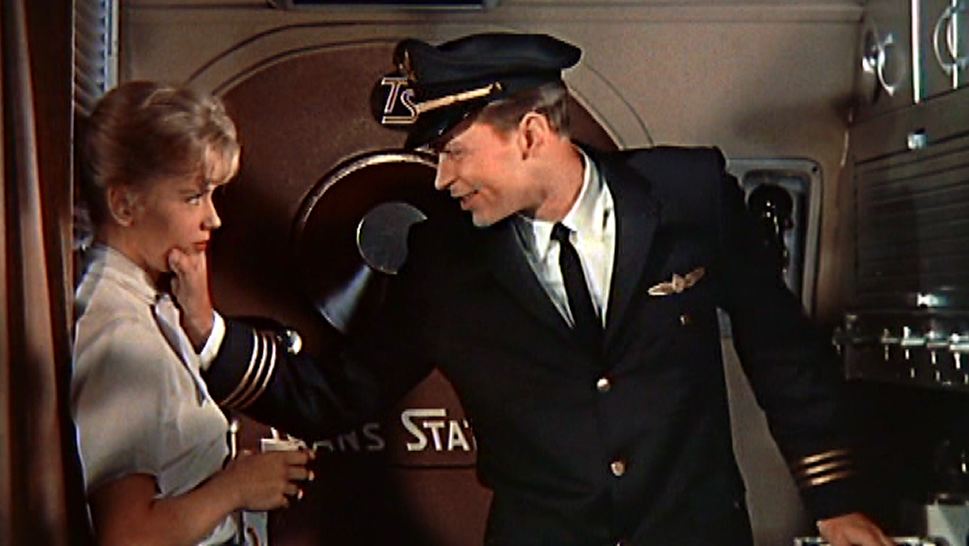
In "The Crowded Sky," Kerr plays moody airline co-pilot Mike Rule, who dabbles in being a commercial artist since his real passion is painting.  Mike is the son of brilliant Noah Rule (Brandon Beach), a famous and eccentric painter who married five wives and burned all but four of his paintings.  We learn during the course of the movie that Mike received word, while serving in Korea, that his father had died.  In the present day, Mike is co-piloting a commercial airliner from Washington, DC to Los Angeles that is on a collision course with a Navy jet flying from the opposite direction.  Throughout "The Crowded Sky," there are flashback scenes involving the passengers and crew members of both Trans States Airline Flight 17 and the Navy jet as they ponder the mistakes of their lives.  The other flashback subplots include scenes involving the troubled marriage of Navy Commander Dale Heath (Efrem Zimbalist, Jr.) and his adulterous wife Cheryl (Rhonda Fleming); as well as an extended vignette concerning airline Captain Dick Barnett's (Dana Andrews) inability to relate to his teenage son;  However, it is the subplot involving the deepening love and relationship between John Kerr's Mike Rule and witty flight attendant Kitty Foster (Anne Francis) that always engages me every time I see this movie.


In the Mike/Kitty flashback, we learn that Mike's animosity towards Captain Barnett stems from Barnett's refusal to allow Mike to make captain himself due to Barnett's jealousy of Mike's ability to relate to Barnett's troubled young son in ways Barnett never could.  When Mike learns at a poker game that Barnett has spitefully denied his promotion, he punches Barnett out and then sets out to get drunk.  He awakens the next morning in the bedroom of attractive flight attendant Kitty Foster (Francis) who brought him home to sleep off his inebriation after she met him at a bar the night before.  Kitty and Mike become attracted to each other over breakfast and he offers to fly her around the country to see his father's remaining paintings.  However, Mike makes it clear to Kitty that he has no interest in ever getting married or having a family.  Mike, in turn, learns that Kitty was once a very promiscuous girl and had a child out of wedlock that she gave up for adoption.  Kitty admits that she never takes the first kiss anymore in order to avoid falling in love and getting entangled in romantic complications.


While visiting the home of Mrs. Mitchell (Frieda Inescourt) a Texas oil millionairess who owns one of Noah's paintings, he notices another, newer and unfamiliar painting nearby that features his father's characteristic style.  He learns that the painting is a recent work of his father, that he is still alive, and that Mrs. Mitchell was his father's second wife.  Mike's mother approached Mrs. Mitchell to help pay for Noah's commitment to an asylum after he had become a hopeless catatonic.  Mrs. Mitchell explains that she and Mike's mother decided it best to make Mike believe that his father had died rather than allow him to know the history of insanity in his family.  Mike visits his father in the asylum and admits how much he loves and misses him, but the catatonic man does not respond.  Mike is clearly shaken at seeing his father by the time he brings Kitty home.  The two admit they have fallen in love and begin a relationship that continues to prosper, despite Mike's continued refusal to ask Kitty to marry him, as the story returns to the present-day aboard the flight.  When the airliner is hit by the Navy jet, Mike, Barnett and Kitty work valiantly to keep the passengers calm and help bring the plane down safely.  After years of declaring that he will never get married or have children, Mike finally proposes to Kitty and declares his desire to have a family with her.


I am not attempting to build a case that "The Crowded Sky" is a particularly good film.  There are some cheesy, dare-I-say-it "campy" moments throughout the movie that prevent one from taking it too seriously as a fine piece of drama.  However, it remains an entertaining, engaging story with a very appealing cast.  John Kerr and Anne Francis stand out from the rest of the ensemble by giving their characters a bit more depth than the others.  They are committed to their roles to enough of a degree that Mike and Kitty become a sympathetic couple that you root for to end up together.  I particularly like the way director Joseph Pevney stages the "meet cute" flashback sequence where a hung-over Mike wakes up in Kitty's bedroom after she met him the night before in a bar.  As Mike looks up and sees his painting of Kitty staring down at him from the wall, he wonders aloud how he could have painted her if he had never met her until now.  Kitty cheekily replies, "I have an elegant theory about that.  You saw me somewhere.  Who knows where, it may have been some airport.  And then one day when you were painting, you just popped me out of your subconscious cortex."  Anne Francis' smart, insolent delivery helps to sell that contrived bit of writing so that the audience accepts the fact that: 1) Mike painted Kitty without ever meeting her before; 2) Kitty discovers Mike's painting of her in a gallery; 3) Kitty just happens to meet Mike by chance in a bar; and 4) Mike turns out to be a pilot working for the same airline as Kitty.  It's a cheesy scenario that normally would not be believable, but Francis' conviction makes it work.


Kitty then makes breakfast for Mike as the two continue their "meet cute" flashback sequence.  Kitty asks whether Mike's father Noah really had five wives, and Mike identifies his mother as wife #5.  Mike becomes attracted to Kitty and makes her a compelling offer, "I can pick up the phone, borrow a Cessna, show you the life work of Noah Rule and have you tucked in bed by midnight Saturday...Let's get one thing clear first.  $10,000 bucks in the bank and I quit flying.  I take five years to find out if I'm an artist as well as a painter.  I intend to stay unmarried, without child, unattached.  Now do I still pick up the phone and borrow the cessna?"  Kitty smiles and responds, "Let's get one thing clear first...You and I didn't indulge last night.  And we won't.  I'm an ex-tramp.  And I know myself.  One kiss and I blast off.  Past the point of no return.  So I just make it a point never to take that first kiss.  Now do you still pick up that phone and borrow the Cessna?"  Mike smiles as he starts dialing the number to make arrangements to borrow his friend's plane.  John Kerr and Anne Francis have an appealing and natural chemistry in this scene that I never tire of watching.  Right away, they seem completely at ease with one another that you are eager to see how their relationship develops.


I particularly like the way Anne Francis underscores how supportive and empathetic Kitty is of Mike when he realizes that his father is alive.  Francis demonstrates Kitty's depth and sensitivity, while Kerr projects a refreshing sense of vulnerability in Mike, throughout the sequence at the asylum when Mike is reunited with his father.  Kitty and Mike both appear to have made a deep, serious connection with each other by the time Mike brings her home after their cross-country, whirlwind tour of visiting each of his father's paintings.  Kitty appears deeply moved by what she has experienced and admits that "I think I could kiss (you) and not blast off beyond the point of no return" because she has fallen in love with Mike in a sincere and mature manner.  Unlike all of her previous relationships, Kitty genuinely cares about what happens to Mike, as opposed to selfishly falling in love with someone so that they can make her feel special.  When Mike kisses Kitty, it's a very touching and sweet moment, particularly when he tells her, "Go on in and lock your door...Maybe that kiss didn't blast you off, but me I..."  We see that Mike's resolve against ever making a commitment and having a family is beginning to weaken as he has finally found the right person for himself.  Kerr is effective at demonstrating how Mike has started to mature and put aside his selfish goals so that he can allow himself to fall in love with this special woman who has suddenly entered his life.  By this point, Mike and Kitty's cute rapport has evolved into a relationship characterized by caring and compassion. 


For much of the remainder of "The Crowded Sky," the Mike/Kitty subplot takes a backseat as the airline disaster storyline takes center stage.  Kerr and Francis continue to have significant screen time, but their characters are mostly focused on tending to their passengers and bringing the plane down safely.  Kerr and Francis do a good job at demonstrating how Mike and Kitty are dedicated, courageous professionals who are able to put aside their personal concerns to help their passengers face this disaster.  Kerr's low-key demeanor as an actor is used to good advantage as he effectively portrays Mike's calm, steely reserve while he helps Dana Andrews' Barnett bring Flight 17 down safely.  Francis is particularly good in the scene where she instructs the passengers to prepare for a crash landing, "Just the same I'm gonna ask you to do a few things to project yourself.  First and quick now, I want you to fasten your seatbelts as tight as you can.  Push your seat buttons and raise your seats up straight.  False teeth out.  Put them in your purses and your seat pockets.  We won't tell a soul that you wear them."  Francis projects leadership, confidence, and even a tension-breaking sense of humor during this sequence that demonstrates Kitty's ability to stay calm and strong in order to help the passengers keep up their courage throughout their ordeal.  We realize, as Mike already does, that Kitty is a special person who can handle any challenges and who he would be fortunate to spend the rest of his life with.


Which is why we're pleased, in the final scene of "The Crowded Sky," when Mike finally proposes to Kitty.  As they look at a cigarette billboard Mike has painted featuring a kitten playing with a ball of yarn (which Kitty sardonically describes as being "sentimental enough to make Santa Claus toss his cookies"), Mike finally tells Kitty, "Either way, flying or painting, I want to marry you.  Yeah, I want to wade knee deep into disposable diapers!  I want to name the first boy Noah.  Now where do you want to honeymoon?"  Kitty excitedly responds, "What difference does it make?  We'll never leave our hotel room!"  As Kitty hugs Mike, Anne Francis is given the last line of the movie in a stream of consciousness voice-over, "If there's a God of the game of love and kisses:  Gracias.  Merci.  And thank you."  What's wonderful about this scene is that John Kerr and Anne Francis play it sincerely without a degree of irony.  These days, because we have become a society who overindulges in cynicism and irony, there's not a current actor or actress in existence who wouldn't try to play this scene from a campy perspective.  The dialogue is so broad that it naturally lends itself to a humorous interpretation.  But Kerr and Francis never condescend to the scene, or to their characters, so that it's actually touching that Mike and Kitty will finally be together after all the personal and professional hardships they've endured.  "The Crowded Sky" might be considered a camp classic by some, but John Kerr and Anne Francis rise above the material to make Mike and Kitty's love story something rather special to watch.