Wednesday, July 17, 2013

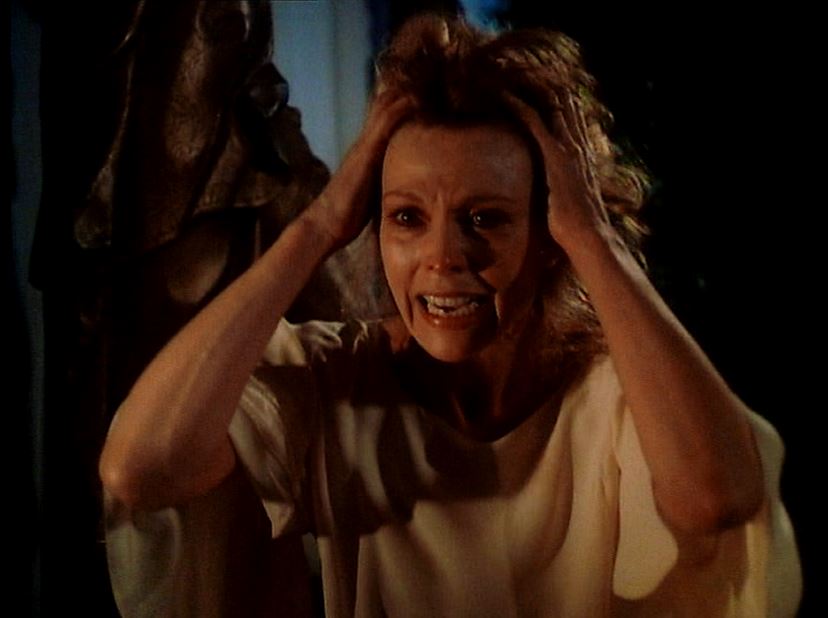
Cristina Raines and Yaphet Kotto are "Prisoners" on "Alfred Hitchcock Presents"


In the mid-1980s, one of my favorite hours of television was the back-to-back half-hour anthologies that NBC offered for the 1985-86 season.  On Sunday at 8:00 PM, we were treated to an episode of "Amazing Stories," a fantasy, horror, and science fiction anthology series produced by Steven Spielberg, and at 8:30 PM right afterwards was "Alfred Hitchcock Presents," a revival of the classic 1950s/1960s anthology series that remade many episodes of the original series, using colorized versions of the original episode's intros and closings featuring Hitchcock himself, but made with their own unexpected twists and unique spin to them.  Both shows were produced by Universal and received great publicity and attention that season.  However, given the level of attention they received, neither show was a ratings hit and "Amazing Stories" was ultimately cancelled after two seasons.


"Alfred Hitchcock Presents" only lasted one season on NBC and later continued on the USA Network in increasingly inferior episodes that were produced in Canada.  It's a shame, because for that one season, when they were paired side-by-side, both shows provided a stimulating, imaginative, and exciting modern-day twist on the sort of anthology storytelling that hadn't been tried by network television for quite some time.  I loved them both, but I think I preferred the darkly suspenseful and witty storytelling of the "Alfred Hitchcock Presents" half of the hour.  There were some very good episodes produced that season on NBC, but my favorite segment was the one entitled "Prisoners" starring Yaphet Kotto and Cristina Raines, which aired December 8, 1985.


In the episode, Cristina Raines plays Julie Nordstrom, an upper middle class housewife whose husband Glen is continually absent on business trips.  Julie's only friend is her white dove named Mr. Chips as she spends her days watching game shows on television and caring for her home.  Her sheltered existence is turned upside down when her home is invaded by escaped convict Jack Royce (Yaphet Kotto) who at first terrorizes Julie and orders her to cook for him.  As Jack enjoys the luxuries of Julie's house, the two become acquainted and find that they actually have much in common with one another.  They both enjoy the same game shows and they both realize they are lonely individuals who each felt stifled, isolated, and imprisoned in their own confined existence.


When Jack says that he plans to escape to Jamaica, Julie announces that she intends to accompany him as his "hostage" for a week so that she can finally travel without her husband.  Julie starts packing her luggage when the phone starts to ring.  Jack becomes alarmed that someone might be alerted to the house if Julie doesn't answer the phone and act like everything is OK.  At gunpoint he forces Julie to pick up the receiver and tell the caller that everything is normal at the house and that her husband Glen is expected back home at 10:00 PM.  Jack later apologizes for having been rough with Julie.  He asks her if she still wants to go with him and Julie declines.


The festive mood broken, Jack leaves the house as night falls, only to find himself confronted by a SWAT team who have surrounded them.  As Julie watches helplessly, Jack turns to her and says "People weren't meant to be prisoners, Princess" and pulls his gun on the officers.  He is shot down in a hail of bullets.  As the SWAT team members surround Jack's body, one of them muses aloud, "I can't believe she got him to fall for that trick...Mrs. Nordstrom's deaf...She can't communicate except by reading lips.  She can't talk on the telephone."  Later, with her bags packed, Julie releases her dove Mr. Chips from his cage and leaves her imprisoning home forever. 


A poignant and insightful episode, the "Prisoners" segment of the new "Alfred Hitchcock Presents" is a remake of the January 15, 1956 segment of the original series entitled "You Got to Have Luck."  John Cassavetes played the escaped convict in that episode, with Marisa Pavan playing the hearing impaired housewife held hostage.  Even though the original episode is a good segment on its own terms, it has nowhere near the depth and nuance of the "Prisoners" remake starring Kotto and Raines.  Kotto brings a swaggering, bull-in-the-China-shop quality to Jack that masks his sensitivity and vulnerability.  Even though Jack is undoubtedly a dangerous criminal, he also has an honesty and directness to him that allows Julie to eventually see through his tough exterior and grow fond of him.  He helps encourage Julie to break out of her shell by pointing out how the refined and pristine household that her husband Glen has established for her to maintain has become its own prison-like environment.


I particularly like the scene where Jack enjoys the living room and notices how all the furniture are covered by protective plastic and that the nuts are all stale because Julie and Glen have never had guests over in the entire time they've lived there.  Julie reveals that it's not easy making friends in such a private and rarefied neighborhood, because everyone keeps to themselves, and that they've moved four times in seven years.  Jack responds, "Oh, I know what you mean.  My father moved me about when I was a kid.  And I hated moving.  And sometimes I think that if it weren't for all that moving around I might not have been a criminal."  An incensed Julie chastises Jack and asks him, "Am I supposed to feel sorry for you?!...Who do you think you are?!  I mean you come in here waving your gun and scaring me to death!  Don't you expect me to feel sorry for you and your 'deprived' childhood!  I won't do it!  I mean there are other people who have problems.  They don't have guns!  And they don't go to prison!...I've got problems too and I don't have a gun!  I don't go out terrorizing people in their own home!...And I don't particularly like the plastic on the sofas either!"


In so doing, Julie gets Jack to see the hypocrisy of his statement, which causes him to apologize for playing "victim" to her when he has been victimizing her at gunpoint all afternoon.  Concurrently, Jack gets Julie to see the irony of how her husband Glen has created an imprisoning atmosphere for her by covering the furniture with plastic and making her feel unwelcome to spend time in her own living room.  As Julie admits to Jack, "I just never come in here...I consider it Glen's room."  Jack encourages Julie to free herself from the confines of her existence by reminding her, "This is your living room, too" and proceeds to cut open the plastic covering the furniture.  A shocked Julie says "You're crazy."  Jack corrects her, "You're crazy.  This is your living room.  And you're afraid to come in it!" 


Jack and Julie become more at-ease around one another when they realize that they are both game show fans who watch "The Price is Right" and "Wheel of Fortune" every day.  As Jack starts to understand Julie better, he apologizes and tells her, "I'm sorry about your sofa and all.  As soon as the sun goes down, I'm out of here.  I'm out of here and you'll still be afraid of going into your living room!  I mean, you're just as much a prisoner in this house as I was yesterday!  Only I blew that top.  I'm never going back."  Jack's words resonate with Julie as she takes out a knife while Jack sleeps and starts cutting open the plastic protective covering on the furniture. 

 
As the day progresses, Julie continues to break out of her shell in Jack's presence.  They begin cutting open all the furniture, not just the plastic, and start tossing the feathers and stuffing inside into the air.  At one point Jack opines, "You know something?  This place is disgusting!"  Julie laughs and responds, "I think it looks lived in!"  We further understand the extent of Julie's sense of confinement when she refuses to be the Iron while playing Monopoly with Jack because, as she puts it, "I'm gonna be the Top Hat this time.  I think the Iron is a symbol of oppression."  We realize that Glen had long stopped seeing Julie as a genuine partner long ago and began to see her more as a servant and as one of his belongings.  Even though Jack may have initially terrorized her, his entry into her life became Julie's wake-up call to take proactive measures to do something about her life.


What makes the episode work is the effortless chemistry between Yaphet Kotto and Cristina Raines, both of whom started their careers appearing in offbeat feature films in the 1970s.  Kotto continually brings out the warmth and humanity of Jack, while Raines effectively demonstrates Julie's stifling repression and suppressed sense of childlike enthusiasm.  Raines has the more difficult role to play, as she has to maintain an air of mystery in order to conceal the knowledge of Julie's hearing impairment from the audience until the very end.  As such, the role allows Raines to play to her strengths as an actress as she has always been effective at playing roles that combined earthy intelligence with an intriguing air of mystery as well.  Because of the fine performances of Kotto and Raines, you really grow to care for these two individuals throughout this episode, and it packs more depth and nuance within its 30 minute running time than most 2 hour feature films. 


Later, in the episode, after Jack grabs Julie when the phone is ringing, and forces to to answer it, there is a genuine sense of loss as Jack's violent gesture breaks the mood and causes the bond established between these two individuals to be severed.  I remember feeling sad at the first viewing of this episode over 28 years ago upon realizing that their friendship has no chance of continuing.  You realize that Jack and Julie have no future together on the run, even though Julie asks Jack "Are you sure you have to go?" when he announces that it's time for him to depart.  As Jack tenderly kisses Julie before leaving, you sense that this unlikely pair of individuals have fallen in love with each other in the short time they've been together.  Even though Jack dies in a hail of gunfire at the end, his death was not in vain, as he ultimately helps to give Julie the courage to leave her own prison forever.  The final scene, of Julie opening up her patio doors, releasing her fellow "cellmate" Mr. Chips from his cage, and walking out into the night with her luggage, has a quiet poetic quality that has been lost from current network TV shows, which now tend to emphasize the obvious and overt.  The scene is haunting because Julie has finally left her confining existence now that she has the courage to face an uncertain future.  It's because of episodes such as these--which combined elements of suspense, dark humor and unexpected poignancy--that the 1980s NBC remake of "Alfred Hitchcock Presents" proved to be such a worthy companion piece to the original series. 

Sunday, July 14, 2013

A Gaggle of '60s Starlets Make Fools of Themselves Fighting Over "Friendships, Secrets and Lies"


There are some movies that you want to like, because an actor you always enjoy stars in it, but you ultimately conclude that you don't like it at all for a variety of reasons.  The NBC-TV movie "Friendships, Secrets and Lies" (1979) is one such movie.  For years, I used to rationalize that I liked it because it gave Tina Louise, whose work in movies and television I've usually enjoyed, a particularly meaty role.  However, in hindsight, and with maturity and objectivity, I now realize that it's a very bad movie containing badly written characters and proffering themes that I personally don't agree with.  It's a shame, because the movie contains a provocative and potentially interesting premise and has a cast of committed and talented actresses who appear to be engaged by the ostensibly substantial roles offered to them in the script, but are ultimately undermined by the unfocused agenda of its muddled filmmakers.


In the small college town of Arconia, the skeletal remains of a baby are found at the bottom of an air shaft at the old Kappa Beta Chi sorority house.  An examination of the bones suggest that the remains have been there for at least 20 years.  The only time when the air shaft was ever open was for repairs to remove dry rot during one summer in 1956 when six sorority sisters were living there over the summer term.  As authorities investigate the bones as part of a potential homicide investigation, eager beaver local newspaper reporter Jessie Dunn (Sondra Locke) prints a newspaper article listing the names of the six women who stayed there that summer, all of whom still live in Arconia.  The former sorority sisters reunite as they find themselves at the center of a police investigation as well as the abortion debate.


The women include local newspaper editor Martha Plowden (Cathryn Damon), whose husband Frank has left her for a younger woman Layne (Cathie Shirriff); happily married B.J. (Loretta Swit) who is busy raising a large family and has just learned that she's expecting another baby; widowed Joan Holmes (Tina Louise) who got by on her looks while in school and has just learned that her late poet husband may have had an affair while they were all in school with promiscuous Sandy McIntosh (Paula Prentiss) a blithe divorcee and single mother who now teaches ballet; never-married dress shop owner Mary Alice Friday (Shelley Fabares), who has been hiding the fact that she's a lesbian from her other sorority sisters; and beauty salon owner Edyth (Stella Stevens), who is being beaten and abused by her drunken husband Miley.


At the time the movie was made, the movie was heavily promoted by NBC that it was written, produced and directed by women, featured an all-female cast, and had an almost all female crew.  It was a film obviously made with sincere intentions in order to allow women more opportunities in film and television to play substantial roles, both in front of and behind the cameras.  But "Friendships, Secrets and Lies" is continually undermined by an overly earnest and general air of mediocrity that runs rampant throughout.  The main problem with the movie lies with the terrible direction by Marlena Laird and Ann Zane Shanks, which results in a movie featuring uneven performances, poor editing, and awkward camerawork and blocking.  There are a couple of scenes in the movie where shots are cobbled together from different takes and different angles of the same scene where the tone of performances between the different shots don't match up.  As such, in a couple of scenes, as you cut from one angle to another, the facial expressions and the tone of the actresses' voices between two different shots are so contradictory, and at such odds with one another, that it feels like the character's mood has changed in a split second.


Years ago, I interviewed Stella Stevens about her 1960s film career and we talked about "Friendships, Secrets and Lies."  She explained that the reason why two directors are credited with the movie is because one didn't work out and the actors ended up directing each others' performances.  When the original director was replaced, the actors vowed to ignore the new director and continue directing each other.  Unfortunately, without a strong director at the helm, "Friendships, Secrets and Lies" was destined to fail.  Stevens revealed that the producer of the movie later confided in her that, if the director was a man, she would have replaced him right away.  As Stevens recalled, "We just wanted to prove that women could direct, but the producer let that director work longer than she would have before firing her, when she should've just treated her like a man.  But she didn't.  And that's what's wrong: they treat women like women and men like men.  They should treat people like people."


In my humble opinion, "Friendships, Secrets and Lies" suffers because of the manner in which the producer treated the initial director differently on the basis of her gender, rather than ensuring that the best qualified person was hired to direct the movie.  In so doing, the personnel in charge of the movie undermined their intended goal of helping to broaden the opportunities for women in filmmaking by not holding the first director accountable to do good work.  (One wonders why the more experienced Karen Arthur, Randa Haines, Lee Grant, or Gwen Arner weren't hired to direct this film.)  Without a strong director at the helm, many of the performances are all over the map.  I generally like Stella Stevens, Paula Prentiss, and Tina Louise, but they aren't allowed to play to their strengths throughout this film.  Stevens' character Edyth requires her to be timid and victimized, in contrast to her usually spirited and feisty personality.  Stevens is a talented actress who does indeed have the ability to play roles outside her expected range, but she isn't given enough guidance from the director to allow her to fully explore the character without coming across as mannered, awkward, and whiny at times.  Stevens is also undermined by one of the most ridiculous scenes in the movie.  In order to maintain the pointless and stupid "all-female cast" gimmick, which only brings an air of artificiality to the proceedings, in the scene where Edyth is being physically abused by her drunken husband Miley, we see Stevens facing the camera, as if confronting her husband, stagger off camera so that we hear her being physically assaulted by her never-seen husband, and then have her pushed back into camera range bruised and abused.  The scene plays as awkwardly as it reads.


Paula Prentiss is usually funny and quick-witted, but her role as Sandy is callous, presumptuous, and mean-spirited.  The central premise concerning the discovery of the skeleton of a dead baby ought to evoke a level of compassion out of most individuals, whether you're pro-life or pro-choice, but Prentiss' Sandy loses our compassion and respect when she proves herself to be insensitive concerning the circumstances surrounding the skeleton.  As Tina Louise's character Joan expresses sadness at hearing about the skeleton, Sandy dismisses her feelings by derisively telling her "Joan, don't get maudlin."  When Joan makes the case that it's a tragic occurrence, Sandy continues expressing cynicism and nihilism by wise-cracking "So's Shakespeare."  Upon learning that Sandy may have seduced both Joan and Martha's husbands while in college, something that she doesn't feel particularly sorry about even though this has clearly hurt both Martha and Joan, you realize that she doesn't have feelings for anyone but herself.  When Sandy is unfairly accused later in the film of having aborted the baby, which causes her young daughter (Kim Richards) to run away, the sympathy that her character ought to elicit simply does not come through.  It's hard to feel sorry for a character who lacks a conscience and doesn't have any compassion for other people.  Paula Prentiss, an actress ideal for portraying sparkling whimsy instead of biting sarcasm, is miscast as Sandy.  Sandy is an ugly, mean-spirited individual that only an actress as skillful at playing narcissistic nihilism as Tuesday Weld could have pulled off.


Tina Louise is given a more substantial role than usual in this film, but ends up overacting in most of her scenes.  I have blogged before that her best moments as an actress are the quiet, low-key moments where she underplays and wrings out the nuance in even the most unlikely material.  That isn't the case in "Friendships, Secrets and Lies."  I almost feel that Louise is so eager to overcome her "Gilligan's Island" typecasting and demonstrate what she is capable of that she's like a horse that's out of its gate before its ready to hit the track.  There's a level of enthusiasm that Louise brings to the material that you can't fault her for, but she doesn't know when to reign it in at times.  The result is that, given a relatively good part for a change, she ends up going out of her mind as an actress in ways we've never seen before.


In one scene, Louise's character Joan confronts Prentiss's character Sandy at her dance studio with evidence that Sandy had an affair with Joan's husband while they were still in college.  Louise glares like a Madwoman throughout this sequence, her eyes blazing with excited, maniacal energy, especially when she spits in Paula Prentiss' face.  In another scene, when most of the women are at Edyth's beauty salon while a pro-choice/pro-life demonstration is taking place outside in the streets, Louise walks around the salon absent-mindedly giggling to herself, sipping booze from a glass, and running a comb through her hair.  In his review of the film, the New York Times' television critic John J. O'Connor recalls this moment as "one of several ludicrous scenes.  As a distraught Tina Louise staggers about a beauty shop in what looks like Ophelia's mad scene, a friend sweetly asks 'Are you sure you're all right?'  Miss Louise starts smashing everyone in sight with her outsized pocketbook and Stella Stevens stands by with a black eye from her wife-beating husband, while Cathryn Damon clutches her head in disbelief.  Miss Damon's plight is understandable."


In yet another scene, as Tina Louise's character is burning her husband's papers in the fireplace, she tells her teenage daughter all about her regrets in life, how she used to try and get by on just her looks, and urges her daughter to "think like a man.  Work like a man.  I never did my studies.  I never learned how to work.  I can't even discipline myself to stay on a stupid diet!  I only learned how to flirt, and how to be 'Pretty Joan.'  'Isn't Joan the prettiest girl in town?!  Isn't Joan the lady?!'  That's what they used to say about me!  And I counted on that, I counted on that to get me by.  It got me by all right.  (She cackles maniacally.)  It got me right by life!"  All of these scenes should have been Louise's tour-de-force as an actress but, even though her heart is in the right place, she undermines herself by not pulling back and finding the humanity in Joan in order to demonstrate genuine feeling instead of being broadly mannered.  These scenes come off more like acting sessions with Strasberg at the Actors Studio rather than genuine moments out of the life of a believable individual.


Fortunately, the rest of the cast does better with the weak material.  Cathryn Damon is touching and sincere as the ostensibly sensible level-headed Martha.  Damon does a good job at demonstrating the years of regret that her character has from spending her life putting her ex-husband's needs before her own.  What I like about Damon's performance is that she is able to make Martha a sympathetic and understandable character, even as the script makes it clear that she allowed herself to be victimized by her husband because of the bad choices she has made.  Shelley Fabares is also good as the closeted lesbian Mary Alice.  Fabares doesn't allow the character to slip into any stereotypes so that Mary Alice remains a generally believable individual throughout the movie.  Sondra Locke is a bit annoying at times as the eager-beaver newspaper reporter Jessie Dunn, but this is more due to the one-dimensional script that allows the self-serving Jessie to be insensitive to how her reporting is tearing apart the lives of the sorority sisters than anything to do with Locke's performance, which is generally good throughout the movie.


Best of all is "M*A*S*H" star Loretta Swit as BJ, the only truly happy and content sorority sister from Kappa Beta Chi.  Swit gives a terrific performance as the one sorority sister who is a genuine friend to all the others, who are too weak, self-centered, malicious, or manipulative to really think of anyone but themselves.  What I find a bit ironic, and which demonstrates the muddled intention of the filmmakers, is that the BJ character is the one person in the whole film who is against abortion and has a pro-life perspective.  However, BJ is not denigrated for having this perspective and so her position is given its due.  She is portrayed as a non-judgmental individual who is against abortion, but has compassion for whichever sorority sister had the baby.  The filmmakers play fair with BJ by making her a grounded individual who is happy with her own marriage and family life as a mother and homemaker, and she isn't demonized by them even though she is clearly at odds with their apparent pro-choice agenda.  Nevertheless, the filmmakers ultimately undermine themselves by making most of the other characters, who share their pro-choice perspective--such as Sandy Jessie, and Mary Alice--unsympathetic, smug, and timid individuals.  (For the record, I am not advocating for either a pro-life or pro-choice perspective because the purpose of this blog is to remain as apolitical as possible.)  Anyone who has ever watched "Friendships, Secrets and Lies" can sense that the filmmakers themselves are vehemently pro-choice.  The fact that they aren't even able to have the characters that voice their perspective come across effectively demonstrates the extent of their bad filmmaking.


What I ultimately don't like about "Friendships, Secrets and Lies" is how it presumes that the pro-choice/pro-life debate is the only, only issue of importance to women.  While I acknowledge that the ongoing debate between pro-choice and pro-life is indeed a very important issue concerning women (and I also acknowledge that the film's central storyline naturally preordains that the movie focuses primarily on this issue) at no point in "Friendships, Secrets and Lies" do the women express interest in equal opportunities regarding employment or pay, geopolitical or economic concerns, civil rights for people of color and other ethnicities, or other issues of substance affecting the world in 1979.  In that sense, I actually consider "Friendships, Secrets and Lies" a movie that condescends to women by not allowing them to consider a broader perspective on the world they live in.  Moreover, except for Loretta Swit's happily married BJ, almost all the women in this story are victims.  Martha is a victim of her philandering ex-husband Frank, Edyth is a victim of her physically abusive husband Miley, Joan is a victim of being objectified because of her fading good looks, Mary Alice is a victim of having to hide her lesbianism from everyone in town, and Sandy is victimized by her own promiscuous past and by pro-life protestors who assume that the baby was hers.  Most of the characters are so one-dimensional that it's not hard to figure out who was the sorority sister who had the baby.  The mystery aspect of the movie never really works because the characters are so transparent.  In so doing, I actually feel that the filmmakers responsible for "Friendships, Secrets and Lies" have actually undermined women by limiting their portrayal to the sorts of traditional, confining gender stereotypes that many have long sought to overcome.  This film never takes a broader perspective that recognizes the ever-widening interests and concerns of women in the last several decades.  The unfortunate irony is that, despite the intentions of its filmmakers, "Friendships, Secrets and Lies," both on-screen and off, reinforces the narrow stereotypes that have at times hindered women throughout history, rather than offering new perspectives and opportunities for them.

Saturday, June 22, 2013

Anita Ekberg Made Everyone Want to Live "La Dolce Vita"


When I was in college, I wanted to move to Italy after graduation.  That never happened, and it's just as well, because my desire was purely influenced by the glamorous image of Italy that had been instilled in me by director Federico Fellini's masterpieces "La Dolce Vita" (1960) and "8 1/2" (1963).  While I have no doubt experiencing Italy in-person would be a great experience because of the history and culture and people of that great country, I worry that it might not live up to the expectations set by those great films.  "La Dolce Vita," in particular, made mid-century, post-war Roman debauchery and decadence appear to be exciting and larger-than-life and not seedy or sleazy at all.  The movie romanticizes the very elements of the culture that it is simultaneously satirizing and critiquing.  One reason why "La Dolce Vita" was such a glamorous and enticing movie experience was the contribution of blonde Swedish bombshell Anita Ekberg, who appeared in a 30 minute sequence early on in the movie as Hollywood starlet and sex symbol, Sylvia Rank, who has arrived in Italy to make a movie and is herself completely entranced by the sensual atmosphere Rome has to offer.  Ekberg's sequence is just one vignette out of many in this great film, but she leaves such a lasting impression that you imagine that her role is much longer than it actually is in the movie.


Throughout Ekberg's scenes in "La Dolce Vita," she dramatizes the experiences of countless Hollywood-based actresses, both before and after her, who left the States and arrived in Italy to make movies because of a variety of factors, including a lack of good roles in Hollywood (or a lack of ANY kind of acting work in the States in films, TV, or theater) or for personal reasons.  These actresses include Linda Darnell, Tina Louise, Jayne Mansfield, Raquel Welch, Carroll Baker, Pamela Tiffin, Mimsy Farmer, Barbara Bouchet, and Ekberg herself.  The enthusiastic response that Ekberg's character, Sylvia Rank, receives by the Italian media and movie industry was likely similar to what these actresses experienced when their planes touched down in Rome.  We never really see Sylvia Rank at work in "La Dolce Vita," but Fellini avoids succumbing to movie star stereotypes by making her a generally likeable individual.  While I wouldn't call Sylvia a deep or substantial person, Fellini at least plays fair with her by avoiding making her a difficult, petulant, or insensitive diva.


I think the reason why people are so responsive to the Sylvia character is because she is so passionate and full of life and has the ability to enjoy both the glamorous milieu of her profession, as well as the little things in life.  Sylvia seems genuinely excited at noticing the chickens on the side of the rural road while riding in a car from the airport ("Oh, Edna, look at all the chickens!"); she energetically climbs the stairs up St. Peter's Dome like a tourist completely unaware of the exhausted reporters and photographers that she leaves in her wake, never complaining about the physical exertion and even commenting, "This is the right way to lose weight!  I must remember to tell Marilyn!"; she does a provocative and joyful dance at the Baths of Caracalla nightclub with Marcello (Marcello Mastroianni) and other patrons in attendance; when she and Marcello flee the nightclub after she has argued with her leading man and boyfriend Robert (Lex Barker) she notices the dogs howling at the moon and playfully imitates their nocturnal greetings; she walks barefoot through the streets of Rome in the middle of the night and plays with a little kitten that she places atop of her head; and, in perhaps the most famous scene in the movie, she wades while fully-dressed in the Trevi Fountain just before dawn and invites Marcello to join her.  Sylvia is not an uptight individual concerned about what others think of her and I think it's this genuine quality to her personality that people have always responded to with her character.


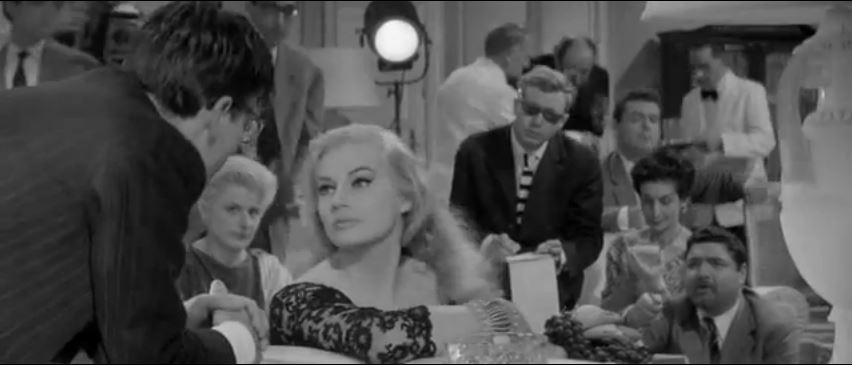
But that doesn't mean Sylvia isn't a shrewd professional who knows how to make the most of the media attention showered upon her and maximize this level of interest.  At the airport, when she emerges from the plane, Sylvia knows how to make a grand entrance, looking stunning in a dark dress, even re-enacting her emergence from the plane at the request of the photographers with her cape flowing, while blowing kisses to the cameras, and taking a taste of the enormous pizza the movie producer has brought so that the photographers catch a shot of her sampling, in the words of a radio journalist reporting from the scene "a typical Italian product, which is as colourful and joyful as our country."  Ekberg has virtually no dialogue throughout this sequence, but she does a great job at demonstrating the extent to which her character Sylvia knows how to make the maximum visual impact upon a captivated audience.  I particularly like the scene where Sylvia holds court in her hotel room while conducting a press conference for the reporters who have breathlessly gathered to document every word or gesture she makes.  Ekberg is very good at parodying the sort of clever quips and phrases that movie stars say at press conferences in order to make good copy and remain in the headlines.  Some people have commented that Sylvia's quotes are reflective of a vacuous, brainless movie star, but I disagree.  I think Sylvia knows that whatever she says will be reported on a wide-spread basis, and has learned from experience what she needs to say in order to remains as provocative, mysterious and intriguing to the public as possible.


When asked by the radio reporter whether she loves Italian cuisine, knowing that her words will be picked up by the Italian public, Sylvia enthusiastically makes sure to tell them, "Oh, I adore it!  Especially spaghetti and cannelloni!"  When asked if she sleeps in pajamas or nightgowns, Sylvia leans forward, plucks a grape from the fruit basket placed on the table in front of her and coyly responds, "Neither...I sleep only in two drops of French perfume."  When asked what she likes the most in life, Sylvia slips on a pair of shades and tells the reporters, with an air of mystery and sensuality, "I like lots of things.  But there are three things I like most.  Love, love and love."  As the reporters applaud her answer, Sylvia takes a self-satisfied drag on her cigarette, knowing full well that she's got these journalists eating out of the palm of her hand.  When a reporter asks Sylvia, as she playfully tries on a wig in front of a mirror with all the reporters observing her, why she works in pictures, with the wig and shades still on, she playfully thrusts her bosom forward in the direction of a capturing camera and tells the crowd, "Because they discovered I've got great talent!"  Clearly, Sylvia doesn't take herself overly seriously as an actress or as an individual, but she still enjoys a self-possessed quality because she has figured out how to successfully play the game as a celebrity.


I think another reason why people like Sylvia's character is because she doesn't have an overly pathetic or tragic quality to her personality that other movie star characterizations are tainted with.  Her personality is simply too strong to ever allow that to happen to her.  The only downside to her life is her clearly unhappy relationship with her leading man Robert, who is perpetually drunk, insults her in front of the others at the nightclub, and slaps her in front of the reporters and photographers when she returns to the hotel in the morning after staying out all night with Marcello.  But I don't get the impression that Sylvia is the type who would put up with Robert for very long.  She responds to Robert's insults at the nightclub by fleeing with Marcello and stays out all night with him.  When Robert cruelly slaps her in front of the reporters, Sylvia doesn't quietly respond to the abuse.  As she walks away from him, into the hotel, she emotionally cries out "You shouldn't do things like that!  Particularly in front of people!"  When Robert scolds her and tells her to go to bed, Sylvia again retorts, "I haven't done anything Robert!"  Because Sylvia isn't willing to just suffer in silence, doesn't feel any sense of shame about herself, and talks back to him, I sense that she'll eventually come to her senses and dump this sleazeball when she's had enough of him.  I think her bad relationship with Robert will be one of the life lessons that will allow Sylvia to develop survival instincts so that she can handle any challenge, personal or professional, that her life or career will throw in her way.


There's a very basic, animalistic quality to Sylvia that inspires her to be a very physical and expressive individual, particularly at the sequence at the nightclub where she dances with Marcello, her actor friend Frankie (Alain Dijon), as well as the other club patrons.  (This quality is probably the reason why Sylvia was so responsive to the chickens, the howling dogs, and the little kitten she found on the streets--she identifies to a certain degree with their earthy and primal nature.)  At first, as Marcello dances with her and showers compliments upon her, Sylvia is completely lost in her thoughts and in the mood of the romantic, music and setting of the club.  Her expressions of contentedness show the extent to which she is completely at ease with her environment.  Then, with Frankie's encouragement and with the audience clapping along, Sylvia makes provocative, playful, sensual moves on the dance floor that may have seemed risque in 1960, but now appear wonderfully classy compared to what passes for dancing in 2013.  At one point, Sylvia kicks off her high heel shoes from her feet, and into the air, and attempts to catch them as they land.  As Frankie lifts her on his shoulders, Sylvia balances upon him with her arms lifted up, as if she's riding the wave on a surfboard.  When Frankie does hand stands on the dance floor, Sylvia seductively crooks her finger for Frankie to gravitate towards her so that she can playfully move her arms back and forth, in a pulley motion, while tugging at his dangling legs and feet.


When the band starts playing rock and roll music, by doing a cover of Little Richard's "Ready Teddy," a barefoot Sylvia commandingly leads the entire club patrons in a musical march through the outdoor establishment, "Come on, everybody, just follow me!"  As Sylvia passes an older, staid gentleman in a tuxedo standing at the sidelines watching her dance, she flounces the train of her dress in his face as she playfully invites him to join her by telling him, "Come on, young man!"  When they return to the dance floor, Frankie lifts Sylvia horizontally above his head as he starts spinning her around 360 degrees.  What's amazing about Ekberg throughout this sequence is the way she makes Sylvia's uninhibited dance moves completely classy and elegant.  She is extremely sensual, but she never comes across as tasteless or crass in this sequence.  I think this is because of the joyful quality that Ekberg brings to Sylvia's character in this scene.  Sylvia is very sexy, but she's not performing a striptease in an objectified manner to try and arouse any of the male bystanders at the nightclub.  Sylvia is expressing her passion for living and inviting the patrons of the club to experience what she's enjoying along with her, rather than enjoying it at her expense.  Sylvia's dancing still seems classy because neither Fellini, nor the other characters in the story, are ogling her throughout this sequence in a blatantly exploitative way.


Sylvia's uninhibited quality is exemplified by the famous scene where Sylvia wades in the Trevi Fountain still fully dressed in her glamorous evening gown.  As I pointed out before, she's able to enjoy the little things in life, which is why she takes such pleasure in wading in a public fountain that most people who live and work in Rome have seen and probably take for granted in their daily existence.  For such a glamorous individual, Sylvia doesn't seem the least bit concerned with getting her hair or makeup damp, or with potentially ruining her dress by getting it soaked.  The famous close-up of Sylvia, with her eyes closed and head thrown backwards, enjoying the rush of the flowing waters of the fountain, has such impact because we sense how much Sylvia wants to freeze this moment in time forever.  It's the one moment of genuine peace and solitude in the hustle and bustle of Sylvia's movie star existence.  When she invites Marcello to join her in the water, it's not so much because she's sexually attracted to him and inviting him in to seduce her, but because she wants him to also experience the sense of contentedness that she feels at that moment.  In fact, the movie makes it clear that neither Sylvia nor Marcello make much of a huge emotional impact on each other's lives in the course of the movie.  Eventually, Sylvia's vignette in "La Dolce Vita" ends and the film moves on to examine other aspects of Marcello's life, with Sylvia left behind.  As such, we realize that these two glamorous and romantic individuals merely experienced a fleeting moment that can't be captured again, which is exemplified by how the waters of the fountain stop flowing the moment Marcello is about to kiss Sylvia.  In "La Dolce Vita," nothing lasts forever.


Even though Anita Ekberg's role in "La Dolce Vita" is relatively short in the context of the movie's overall 3-hour running time, you never feel cheated because Fellini created such a memorable character for Ekberg to make the most of.  If Sylvia returned and reappeared later in the movie, I think that might have taken away some of the mystery and intrigue to the character because she already had a full and satisfying story arc.  We don't need to learn more about her because Fellini and Ekberg did such a great job at allowing us to understand the essence of this woman.  "La Dolce Vita" was, without a doubt, the high point of Anita Ekberg's offbeat and lengthy movie careerAs I've blogged about before, she started out in Hollywood in the 1950s, playing mostly decorative roles in movies.  She developed a reputation in America as another stoic, blonde sex kitten in the wake of Marilyn Monroe.  Some people considered her a bit cold in her Hollywood movies, but I think some films like "Back from Eternity" (1956) demonstrated how Ekberg was capable of creating a sympathetic and nuanced character.  "La Dolce Vita" surprised her naysayers by demonstrating how Ekberg was capable of breaking out of this "ice queen" mold and giving a raucous, witty, full blooded, and passionate performance.  Ekberg abandons the low-key, subdued manner that she usually delivered her dialogue in her Hollywood movies and demonstrates her husky, full-throated speaking voice for probably the first time on-screen.  That she's able to give Sylvia quiet moments of vulnerability and humanity shows how Ekberg was indeed someone who had her own special quality as an actress.


As I understand it, Ekberg has suffered some challenges in the last few years after her home was burglarized and later destroyed in a fire, broke her hip in a fall, and has faced financial difficulties as a result of these setbacks.  I am saddened to hear that Ekberg's golden years have not been as peaceful as one would have hoped, but I have a feeling that she'll continue to survive and thrive because these challenges appear to be the result of bad luck as opposed to anything self-destructive.  Because of her association with "La Dolce Vita" and Fellini (she ultimately made a total of four films with him), Ekberg has been the subject of some well-deserved tributes that demonstrate the extent to which she is a survivor who is still able to command interest and attention.  I hope she'll someday write her memoirs so we can read her insights into her intriguing life and career.  I think the reason why Sylvia in "La Dolce Vita" has such vitality and warmth, and never comes across as a victim (even with her bad relationship with her lover Robert), is because Anita Ekberg instilled the character with a lot of her own heart and personal resilience.  Ekberg could obviously identify with aspects of Sylvia's life that she knew how to ensure that the character remained a human being and didn't just become a gross caricature.  There were lots of blonde bombshell sex symbols from the 1950s and 1960s who have come and gone, but Anita Ekberg is still here. 

Sunday, June 16, 2013

Jayne Mansfield Makes "The Wayward Bus" a Worthwhile Journey


I've always liked Jayne Mansfield ever since I discovered her while I was in college by watching her in director Frank Tashlin's "The Girl Can't Help It" (1956) and "Will Success Spoil Rock Hunter?" (1957).  Moreover, I always liked her better than Marilyn Monroe, who I've never particularly cared for.  I guess it has to do with the fact that Mansfield is continually regarded as a poor-man's Monroe that I always end up rooting for her no matter how bad her movies became later in her career.  Mansfield had a larger-than-life quality on-screen that people have dismissed as a caricature, but I think at her best she managed to instill her characters with warmth and likeability, and brought a sense of humanity, which helped to undercut that sexpot image.  No doubt Mansfield's best work in comedy was in the Tashlin films, but her best overall work as an actress was her dramatic role in the underrated "The Wayward Bus" (1957), made at the height of her popularity right after she was signed by 20th Century-Fox.  Also featuring an equally impressive and underrated Joan Collins, playing an atypically unglamorous role, "The Wayward Bus" gives Mansfield a thoughtful, fully-realized character that allows her to demonstrate her untapped potential as a straight dramatic actress.


In "The Wayward Bus," which was based on John Steinbeck's novel, Rick Jason and Joan Collins star as working class couple Johnny and Alice Chicoy.  Johnny drives a beat up bus he nicknames "Sweetheart" and Alice operates a restaurant/bus stop at a rural California crossroads called Rebel Corners that caters to customers who are passing through by bus.  On a storm-ridden day, Johnny is transporting a motley assortment of passengers from Rebel Corners to San Juan, Mexico including Ernest Horton (Dan Dailey), a middle-aged traveling salesman; nasty, vile and evil businessman Elliot Pritchard (Larry Keating), his uptight wife Bernice (Kathryn Givney) and their rebellious teenage daughter Mildred (Dolores Michaels); Norma (Betty Lou Keim), a starstruck girl who used to work in Alice's restaurant but who quit after being verbally abused by Alice; Ed Carson (Dee Pollack), Johnny's young assistant; Mr. Van Brunt (Will Wright), a cantankerous old man who insists on reaching San Juan no later than 3:00 PM that day; and beautiful, blonde Camille Oakes (Jayne Mansfield), a stripper on her way to a hired gig in San Juan.
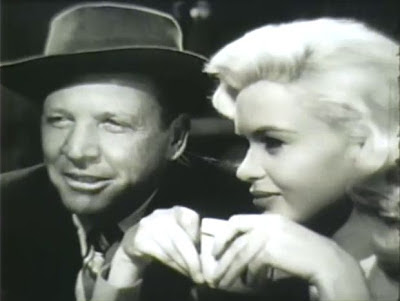

Before they depart, Johnny and Alice get into an argument, which causes her to drown her sorrows in alcohol after Johnny leaves.  Ernest and Camille become better acquainted during the trip and start to fall in love with each other.  Mildred seizes upon the opportunity to flirt with Johnny whenever she has an opportunity.  Malicious Elliot Pritchard discovers Camille's true identity and shares the information with Ernest, which causes him to call off their engagement.  The bus and its passengers survive a landslide, endure crossing a rickety bridge that spans across raging river rapids, and emerge from a near crash after the bus' brakes fail, causing the vehicle to spin out of control.  When Johnny goes off to look for a tractor at a nearby farm to help tow the bus out of a ditch, Mildred follows along and seduces him.  When they return, they find that Alice has arrived in order to make amends with Johnny after hitching a ride with a highway patrol helicopter.


Realizing that Johnny has cheated on her with Mildred, Alice refuses to speak with him on the final leg of the trip to San Juan.  Heartbroken because Ernest cannot accept that she is a stripper, Camille urges Alice not to be a fool and to make up with Johnny before it is too late.  When the bus arrives at San Juan, we learn that elderly Mr. Van Brunt was eager to arrive by 3:00 PM because he was trying to arrive in time for his wedding at the Justice of the Peace.  Ernest realizes that he loves Camille no matter what she does for a living and asks her to marry him again.  And Johnny chases after a bus to Reno that he believes Alice has boarded, until he realizes that Alice, who has taken Camille's advice, is actually sitting behind him in the bus, waiting for Johnny to turn it around so they can return home to Rebel Corners.


People accustomed to the presumed image of Jayne Mansfield as a vacuous sexpot are always pleasantly surprised by her intelligent and thoughtful performance in "The Wayward Bus."  Mansfield lowers the pitch of her voice and restrains her usual mannerisms in order to make Camille a sympathetic and down-to-earth individual.  The result is undoubtedly Mansfield's finest work as an actress.  In her hands, Camille is a woman who has seen it all and has learned how to protect herself from being used and hurt by men.  She has a healthy skepticism against getting taken advantage of, but has managed to not become as cynical as she could be.  Camille is a smart and perceptive woman, but her heart is still open to falling in love when the right man enters the picture.


When Camille first meets Ernest at Alice's restaurant at Rebel Corners, he offers to open the door and carry her luggage for her as she is about to enter the establishment by saying "I wish you'd let me handle those things for you."  Camille smartly brushes him off by telling him "Thanks, can't afford a tip."  Camille clearly doesn't want anyone to act like a "gentleman" with her so that she doesn't have to owe them anything later.  When Elliot Pritchard tries to make conversation with her at the diner, and mentions that he believes he recognizes her from somewhere else, Camille smartly dismisses his inquiry by telling him, "I don't think so.  I've been living in Chicago...I used to do things around a dental clinic."  When Pritchard asks if she worked as a receptionist, Camille puts an end to the conversation by telling him, "No, no more like saying 'Spit out, please!'"  Camille has dealt with enough wolves in her lifetime that she knows how to handle jokesters like Pritchard.


However, Camille's experience with sleazy men like Pritchard in her lifetime has conditioned her to expect all members of the male species to be as unscrupulous as he is.  As such, she initially fails to recognize that Ernest is actually not cut from the same cloth as Pritchard and that he is a genuinely kind human being.  When Ernest pulls up a seat next to Camille at the diner and attempts to start a conversation by telling her, "Well, Miss Oakes, you and I are strangers at the moment.  Perfect strangers meeting at this desert crossways, right?...You'd be surprised how unlike strangers strangers can be when they aren't strangers anymore.  Right?...You and I have got a long way to go today, so who knows what might happen?"  Camille maintains a bemused smile at Ernest's introduction and responds by telling him, "Mr. Horton, everybody knows what might happen.  So for the fifty miles, let's see if we can't just stay acquaintances, hmm?  Think we could?"  What I like about the way Mansfield plays this scene is her heightened sense of awareness as to herself and how men perceive her to be based on her looks.  Camille is not oblivious about herself and the men in her environment the way one might expect from her.


There's a certain poignancy to Camille's wizened view of the world, particularly in the scene when Camille is on the telephone in the diner making a phone call to the client who has hired her to perform a strip tease act for friends in San Juan.  "Hi, Mr. Stanton?  This is Camille Oakes...How do you do?  I hate to bother you at your office but my bus doesn't get in 'til 2:00...Oh swell.  I'll be looking for you then at the bus station....Hmmm?...Well, if your friends want music and colored lights and that stuff that's entirely up to them...What magazine?...Which number?...No, I didn't...Humph, I'm glad you thought so...That?  That was strictly a frame-up!  (sigh)  Yeah, see you later."  Mansfield is very good in this scene, which is shot in one long and continuous and unbroken take, bringing the right sense of wariness, authenticity and concern to the phone conversation.


As she looks at her surroundings throughout the conversation, to ensure that no one is overhearing her, we see how Camille is uncomfortable with people knowing about her true profession and the lengths she goes to hide it from others so as not to be treated differently by society.  This is emphasized by how she goes over to the magazine rack after the phone call to find the issue of the tabloid scandal sheet that features a story about her, and how she tries to hide the magazine at the back of the rack.  It suggests the extent to which Camille still has hopes that she may meet the right guy so that she can quit being a stripper and have the sort of family and home life she clearly yearns for.  Even though she doesn't realize it yet, Camille has indeed met the right guy in Dan Dailey's middle-aged, jokey, but ultimately sincere Ernest.


On board the bus, Camille sits with Norma, the star-struck girl who quit working for Alice moments earlier.  Norma is impressed with Camille's sense of sophistication and asks her for advice about what she should do once she arrives in Hollywood in order to pursue stardom.  Mansfield is very endearing and sympathetic in the scenes between Camille and Norma, as the wizened and worldly lady takes a liking to this younger girl and mentors her.  When Norma expresses how she believes Camille can help her land a job at a drive-in restaurant in Los Angeles, in order to earn a living before she gets discovered, Camille pointedly tells her, "The things I could help you with wouldn't do you any good at a drive-in, honey...Well, I tell you.  There are two ways of getting discovered, honey, coming and going.  You better figure on both."  Even though I sense Camille wouldn't want Norma to find out she's a stripper, you get the impression in this scene that she'll do what she can to try and help Norma find a foothold in Los Angeles once she arrives.  Camille might be skeptical and world-weary, but she hasn't become hardened to the extent that she won't help others if she can.


Ernest witnesses this exchange between Camille and Norma, and senses Camille inherent warmth and decency, and attempts to initiate another conversation with her.  When Norma learns that Camille has never been married and asks why, Camille explains, "The right guys had the wrong ideas."  Ernest interjects by asking Camille, "How about if the right guy had the right idea?"  Ernest eventually softens Camille's resistance to him with self-deprecating humor, as he jokingly demonstrates the products and knick-knacks in his suitcase that he sells, which allows her to see a more genuine and playful side to him.  When Ernest gives Norma a compact as a free gift, Camille later compliments Ernest on his selfless generosity, "You know, it was real nice of you givin' the kid that compact."  Ernest responds, "Well, I am nice."  Camille laughs, "And smart, too, I suppose."  Ernest says, "If I was smart, I'd be settled down and married instead of peddlin' stuff around like this.  Hey, how about that?  Married, you and me, huh?"  Camille opines, "It's original, no question about it."  Ernest continues to joke, "Simple as A-B-C."  Camille pointedly responds, "S-E-X you mean.  Look, you're a salesman.  So am I.  We both know what the score is.  It's even.  So why don't we call it that and quit.  OK?"


After Camille tries to put an end to their bantering, an act of God suddenly occurs that changes the course of both the movie and Camille and Ernest's relationship.  As Johnny drives through a canyon road, the bus is suddenly caught in the middle of a landslide caused by the torrential rains.  As the rocks and dirt race downhill towards the bus, Ernest instinctively covers Camille in order to protect her.  This causes broken glass from flying debris to cut the side of Ernest's face.  When Camille realizes that Ernest has been injured while trying to protect her, she immediately becomes concerned about his well-being and softens her stance against him as she tends to his wounds.  I like how the filmmakers depict Camille as someone calm and resilient during the landslide, but who is quick to tend to Ernest's needs once the danger is over.  When the trip has resumed, Camille is now sitting next to Ernest and the two are genuinely falling in love with each other.  Mansfield and Dan Dailey have natural chemistry in these scenes as Ernest asks Camille if she's in love with anybody.  She tells him no, and he asks "You feel like being or not?...Would it be fantastic if we...I mean you and I sorta possibly could wind up...?"


Camille interrupts Ernest and asks him "Quite honestly, why do you like me?"  Ernest jokes, "Oh, because you're thrifty, you're a good cook, and because you hand-stitch marvelously...Honestly, because you are probably the most physically attractive girl I've ever spoken too...And, on the other hand, I'm a man who never spoke to Ava Gardner!...You sure had me pegged for a fresh guy on the make this morning, didn't you?...And you know something, you are absolutely right...If you scratch the surface just a little, you'll find out I'm really not just a fresh guy.  I have depth, honest, I think I have...Want to scratch the surface a little?"  Because Ernest is candid with Camille that his original intentions about chatting with her were less-than-honorable, and how he's reevaluated his intentions with her, she allows herself to fall in love with Ernest and cuddles up with him on the bus.  An amazed Ernest says aloud with wonder, "Oh, boy.  Nice.  I haven't felt this good in years."  A vulnerable Camille says with equal amazement, "For me, it's been years too!"


Later, after Johnny has accidentally driven the bus into a ditch, Camille and Ernest take a walk and she reveals that she grew up in Salinas, California.  When Camille tells Ernest that he really doesn't know anything about her, Ernest reassures her, "I don't have to know anymore about you.  Everything I said I meant."  As such, Camille allows herself to believe that she's finally found the right guy and that she will get married and leave her days as a stripper behind.  As Camille excitedly tells Norma, "You know, he's never even asked me one single thing about myself...Remember when he said 'Why shouldn't we get married?'  Just kidding?  Well, he said it again!  For serious!  For really and truly!  He's got a little apartment, Spanish type, and he's gonna buy me the latest timing electric stove!  All you do is set it and when the steaks' done it plays 'Tenderly'!"  Mansfield is very touching in this scene, as we see the modest dreams and aspirations that Camille has for her own life.  Since Camille doesn't seem to believe that she's entitled to be happy, we are glad for her that her hopes appear to be on the verge of fruition.


However, Camille's happiness is short-lived after Pritchard, who found the tabloid magazine article which discusses Camille's scrape with a scandalous situation and realizes that he had met her before while she was performing, maliciously tells Ernest the truth about Camille being a stripper.  Mansfield does a great job in the scene when Ernest returns to the bus and looks for the magazine and realizes the truth about Camille.  Mansfield effectively underplays the hurt feelings Camille is experiencing at being rejected by Ernest.  It's a scene with little dialogue, with Camille fighting hard to hold back the tears, and Mansfield makes the most of the moment by bringing genuine feeling and pathos to demonstrate Camille's hurt and disappointment.  Anyone who casually dismisses Mansfield as someone incapable of portraying a sincere and believable human being should watch how effectively she handles this moment.


Later, on the bus, when Ernest attempts to re-initiate a conversation with her by lighting her cigarette, Camille bitterly tells him, "Did I ever tell you I was a school teacher?...I wasn't trying to hide anything from you  I was gonna break it to you gradually.  What do you want me to do, wear a sign on my back?"  When Ernest says he'd still like to see her when they get to Los Angeles, Camille scoffs and says "For old times sake?  OK, might just give you a buzz some time.  Who knows?"  At that, Camille gets up and takes a seat at the back of the bus with Alice Chicoy, who is angry at her husband Johnny when she arrives by helicopter and discovers that he has had an adulterous interlude with passenger Mildred Pritchard.  Even though Camille is heartbroken over being rejected by Ernest, she still has enough compassion for others to try and give Alice advice on how to handle Johnny's betrayal of her.


In probably the best scene in the whole movie, with Fox glamor girls Collins and Mansfield acting opposite one another, Camille explains to Alice, "Mind if I sit here?...None of my business but mind if I tell you what I did to a guy I was in love with once?  Broke a chair over his head after I caught him kissin' some dame at a party."  Alice opines, "Bet he never tried that again."  Camille continues, "Don't know.  Never saw him after that.  But he's married.  Happily married...and I make a living.  Believe me, breaking a chair over a guy's head can sure work miracles.  The kind of miracles that louse up your whole life."  In trying to help Alice realize that she shouldn't throw what she has with Johnny away so quickly, Camille allows us to see how she has made mistakes in her own relationships and how it has led to where she is now with her life.  As such, the character takes responsibility for who she has become and doesn't play victim by blaming her circumstances on others.  She has a maturity and honesty about herself that allows her to be a sympathetic figure in the course of the story.


By the time the bus reaches San Juan, most of the storylines are tied up in a satisfying manner.  Camille meets her client and learns that her striptease performance is actually for the next night and that the client assumed she was also a prostitute who would be willing to spend the night with him.  The wise Camille responds by telling her client, "I see.  So you thought we might get together for a little 'talk,' hmm?...I do my act tonight or I take the first bus back to LA...you'd better start looking around for another gal for tomorrow night, Mr. Stanton, and for tonight too!"  Meanwhile, Pritchard smugly attempts to justify telling Ernest that Camille is a stripper by rationalizing that he's saved Ernest from making a bad mistake in marrying Camille.  Ernest comes to his senses and tells Pritchard that Camille is "nice, kind, even-tempered, sweet.  About the most attractive person I ever spoke to.  And you know something?  Physical attraction is a very important thing!"


In so doing, Ernest subtly tells off Pritchard by reminding the cruel, entitled, and elitist snob that Camille possesses all of the positive qualities that Pritchard's uptight, cruel, unappealing, and racist wife does not.  My only dissatisfaction with "The Wayward Bus" is how the screenplay does not sufficiently punish Mr. Pritchard, his wife, and their daughter for insulting and causing hurt to the other passengers on the bus.  The Pritchards are the true villains of "The Wayward Bus," an evil upper middle-class family who has no understanding, compassion or regard for others.  Mr. Pritchard is particularly loathsome when he is incredulous at Ernest's concern over what will eventually happen to Camille.  It's obvious that someone like Mr. Pritchard only views Camille as a commodity to be exploited and not as a genuine human being.  Some reviewers gave good notices to Dolores Michaels as the irresponsible Mildred, but I find her character as obvious, despicable, and annoying as her father.  As such, I don't really have any sympathy or compassion for her character because she doesn't realize how the consequences of her actions have hurt other people.  The only sense of justice for the Pritchards is that Ernest has reminded Mr. Pritchard that he's trapped in an unhappy marriage and family life, with the miserably uptight Mrs. Pritchard, whereas Ernest still has a chance at true happiness if he can do right by Camille and patch things up with her before it is too late.


And Ernest does right by Camille in the nick of time.  As Camille is about to storm off after quitting her job, Ernest rushes up and tells her "Camille can I speak to you for a moment?  It's really important...It's about our electric stove."  Camille stops in her tracks, becomes happy and elated, and turns to Ernest with a sense of wonder and excitement as she realizes that he is again proposing marriage to her.  She accepts his proposal by asking him, "Electric stove, for our new apartment?" as Ernest takes her luggage and the two walk off to a bright future together.  Jayne Mansfield and Dan Dailey do wonderful work together in "The Wayward Bus" that allows the slowly emerging love story between Camille and Ernest to touch our hearts as something genuinely sincere and special.  We see how these two lonely people are slowly able to drop their facades and reveal who they are underneath the surface, and we are happy for them that they have found one another.


Jayne Mansfield's performance in "The Wayward Bus" effectively demonstrates how she was indeed capable of playing real human beings with feeling and depth.  By eliminating the breathy, breathless dialogue delivery she was known for in other films--and by carrying herself in a dignified manner by using a deeper, more resonant speaking voice--Mansfield gives a great performance in "The Wayward Bus" that should silence any of her naysayers.  We realize how she didn't need to be a cartoon caricature of a sexy woman, as she eventually became in her later, inferior films.  "The Wayward Bus" ranks with "The Girl Can't Help It" and "Will Success Spoil Rock Hunter?" as the best movies that Mansfield ever made, the ones that showed she had something special that was all her own and that she wasn't just a Marilyn Monroe parody.  However, "The Wayward Bus" eclipses those movies because it's the one time on-screen that Jayne Mansfield lives up to her hype as a screen goddess and sex symbol.  With a more low-key makeup and hairstyle and wardrobe, Mansfield is truly beautiful and sexy in this movie in a way that she would never be again.  In addition to highlighting her acting abilities, "The Wayward Bus" allows contemporary audiences to appreciate her natural good looks and sex appeal in a way that never seems cartoonish.  By properly and appropriately balancing both glamor and authenticity, Jayne Mansfield gives the best performance of her career and makes "The Wayward Bus" a worthwhile screen journey.