
When I was in college, I wanted to move to Italy after graduation. That never happened, and it's just as well, because my desire was purely influenced by the glamorous image of Italy that had been instilled in me by director Federico Fellini's masterpieces "La Dolce Vita" (1960) and "8 1/2" (1963). While I have no doubt experiencing Italy in-person would be a great experience because of the history and culture and people of that great country, I worry that it might not live up to the expectations set by those great films. "La Dolce Vita," in particular, made mid-century, post-war Roman debauchery and decadence appear to be exciting and larger-than-life and not seedy or sleazy at all. The movie romanticizes the very elements of the culture that it is simultaneously satirizing and critiquing. One reason why "La Dolce Vita" was such a glamorous and enticing movie experience was the contribution of blonde Swedish bombshell Anita Ekberg, who appeared in a 30 minute sequence early on in the movie as Hollywood starlet and sex symbol, Sylvia Rank, who has arrived in Italy to make a movie and is herself completely entranced by the sensual atmosphere Rome has to offer. Ekberg's sequence is just one vignette out of many in this great film, but she leaves such a lasting impression that you imagine that her role is much longer than it actually is in the movie.

Throughout Ekberg's scenes in "La Dolce Vita," she dramatizes the experiences of countless Hollywood-based actresses, both before and after her, who left the States and arrived in Italy to make movies because of a variety of factors, including a lack of good roles in Hollywood (or a lack of ANY kind of acting work in the States in films, TV, or theater) or for personal reasons. These actresses include Linda Darnell, Tina Louise, Jayne Mansfield, Raquel Welch, Carroll Baker, Pamela Tiffin, Mimsy Farmer, Barbara Bouchet, and Ekberg herself. The enthusiastic response that Ekberg's character, Sylvia Rank, receives by the Italian media and movie industry was likely similar to what these actresses experienced when their planes touched down in Rome. We never really see Sylvia Rank at work in "La Dolce Vita," but Fellini avoids succumbing to movie star stereotypes by making her a generally likeable individual. While I wouldn't call Sylvia a deep or substantial person, Fellini at least plays fair with her by avoiding making her a difficult, petulant, or insensitive diva.

I think the reason why people are so responsive to the Sylvia character is because she is so passionate and full of life and has the ability to enjoy both the glamorous milieu of her profession, as well as the little things in life. Sylvia seems genuinely excited at noticing the chickens on the side of the rural road while riding in a car from the airport ("Oh, Edna, look at all the chickens!"); she energetically climbs the stairs up St. Peter's Dome like a tourist completely unaware of the exhausted reporters and photographers that she leaves in her wake, never complaining about the physical exertion and even commenting, "This is the right way to lose weight! I must remember to tell Marilyn!"; she does a provocative and joyful dance at the Baths of Caracalla nightclub with Marcello (Marcello Mastroianni) and other patrons in attendance; when she and Marcello flee the nightclub after she has argued with her leading man and boyfriend Robert (Lex Barker) she notices the dogs howling at the moon and playfully imitates their nocturnal greetings; she walks barefoot through the streets of Rome in the middle of the night and plays with a little kitten that she places atop of her head; and, in perhaps the most famous scene in the movie, she wades while fully-dressed in the Trevi Fountain just before dawn and invites Marcello to join her. Sylvia is not an uptight individual concerned about what others think of her and I think it's this genuine quality to her personality that people have always responded to with her character.

But that doesn't mean Sylvia isn't a shrewd professional who knows how to make the most of the media attention showered upon her and maximize this level of interest. At the airport, when she emerges from the plane, Sylvia knows how to make a grand entrance, looking stunning in a dark dress, even re-enacting her emergence from the plane at the request of the photographers with her cape flowing, while blowing kisses to the cameras, and taking a taste of the enormous pizza the movie producer has brought so that the photographers catch a shot of her sampling, in the words of a radio journalist reporting from the scene "a typical Italian product, which is as colourful and joyful as our country." Ekberg has virtually no dialogue throughout this sequence, but she does a great job at demonstrating the extent to which her character Sylvia knows how to make the maximum visual impact upon a captivated audience. I particularly like the scene where Sylvia holds court in her hotel room while conducting a press conference for the reporters who have breathlessly gathered to document every word or gesture she makes. Ekberg is very good at parodying the sort of clever quips and phrases that movie stars say at press conferences in order to make good copy and remain in the headlines. Some people have commented that Sylvia's quotes are reflective of a vacuous, brainless movie star, but I disagree. I think Sylvia knows that whatever she says will be reported on a wide-spread basis, and has learned from experience what she needs to say in order to remains as provocative, mysterious and intriguing to the public as possible.
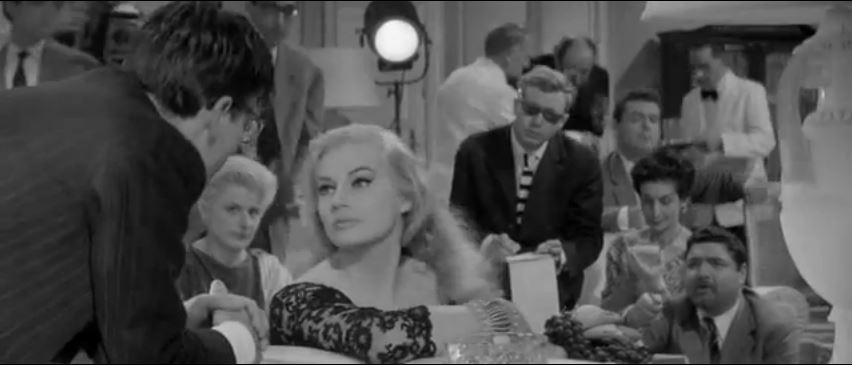


When asked by the radio reporter whether she loves Italian cuisine, knowing that her words will be picked up by the Italian public, Sylvia enthusiastically makes sure to tell them, "Oh, I adore it! Especially spaghetti and cannelloni!" When asked if she sleeps in pajamas or nightgowns, Sylvia leans forward, plucks a grape from the fruit basket placed on the table in front of her and coyly responds, "Neither...I sleep only in two drops of French perfume." When asked what she likes the most in life, Sylvia slips on a pair of shades and tells the reporters, with an air of mystery and sensuality, "I like lots of things. But there are three things I like most. Love, love and love." As the reporters applaud her answer, Sylvia takes a self-satisfied drag on her cigarette, knowing full well that she's got these journalists eating out of the palm of her hand. When a reporter asks Sylvia, as she playfully tries on a wig in front of a mirror with all the reporters observing her, why she works in pictures, with the wig and shades still on, she playfully thrusts her bosom forward in the direction of a capturing camera and tells the crowd, "Because they discovered I've got great talent!" Clearly, Sylvia doesn't take herself overly seriously as an actress or as an individual, but she still enjoys a self-possessed quality because she has figured out how to successfully play the game as a celebrity.

I think another reason why people like Sylvia's character is because she doesn't have an overly pathetic or tragic quality to her personality that other movie star characterizations are tainted with. Her personality is simply too strong to ever allow that to happen to her. The only downside to her life is her clearly unhappy relationship with her leading man Robert, who is perpetually drunk, insults her in front of the others at the nightclub, and slaps her in front of the reporters and photographers when she returns to the hotel in the morning after staying out all night with Marcello. But I don't get the impression that Sylvia is the type who would put up with Robert for very long. She responds to Robert's insults at the nightclub by fleeing with Marcello and stays out all night with him. When Robert cruelly slaps her in front of the reporters, Sylvia doesn't quietly respond to the abuse. As she walks away from him, into the hotel, she emotionally cries out "You shouldn't do things like that! Particularly in front of people!" When Robert scolds her and tells her to go to bed, Sylvia again retorts, "I haven't done anything Robert!" Because Sylvia isn't willing to just suffer in silence, doesn't feel any sense of shame about herself, and talks back to him, I sense that she'll eventually come to her senses and dump this sleazeball when she's had enough of him. I think her bad relationship with Robert will be one of the life lessons that will allow Sylvia to develop survival instincts so that she can handle any challenge, personal or professional, that her life or career will throw in her way.


There's a very basic, animalistic quality to Sylvia that inspires her to be a very physical and expressive individual, particularly at the sequence at the nightclub where she dances with Marcello, her actor friend Frankie (Alain Dijon), as well as the other club patrons. (This quality is probably the reason why Sylvia was so responsive to the chickens, the howling dogs, and the little kitten she found on the streets--she identifies to a certain degree with their earthy and primal nature.) At first, as Marcello dances with her and showers compliments upon her, Sylvia is completely lost in her thoughts and in the mood of the romantic, music and setting of the club. Her expressions of contentedness show the extent to which she is completely at ease with her environment. Then, with Frankie's encouragement and with the audience clapping along, Sylvia makes provocative, playful, sensual moves on the dance floor that may have seemed risque in 1960, but now appear wonderfully classy compared to what passes for dancing in 2013. At one point, Sylvia kicks off her high heel shoes from her feet, and into the air, and attempts to catch them as they land. As Frankie lifts her on his shoulders, Sylvia balances upon him with her arms lifted up, as if she's riding the wave on a surfboard. When Frankie does hand stands on the dance floor, Sylvia seductively crooks her finger for Frankie to gravitate towards her so that she can playfully move her arms back and forth, in a pulley motion, while tugging at his dangling legs and feet.


When the band starts playing rock and roll music, by doing a cover of Little Richard's "Ready Teddy," a barefoot Sylvia commandingly leads the entire club patrons in a musical march through the outdoor establishment, "Come on, everybody, just follow me!" As Sylvia passes an older, staid gentleman in a tuxedo standing at the sidelines watching her dance, she flounces the train of her dress in his face as she playfully invites him to join her by telling him, "Come on, young man!" When they return to the dance floor, Frankie lifts Sylvia horizontally above his head as he starts spinning her around 360 degrees. What's amazing about Ekberg throughout this sequence is the way she makes Sylvia's uninhibited dance moves completely classy and elegant. She is extremely sensual, but she never comes across as tasteless or crass in this sequence. I think this is because of the joyful quality that Ekberg brings to Sylvia's character in this scene. Sylvia is very sexy, but she's not performing a striptease in an objectified manner to try and arouse any of the male bystanders at the nightclub. Sylvia is expressing her passion for living and inviting the patrons of the club to experience what she's enjoying along with her, rather than enjoying it at her expense. Sylvia's dancing still seems classy because neither Fellini, nor the other characters in the story, are ogling her throughout this sequence in a blatantly exploitative way.


Sylvia's uninhibited quality is exemplified by the famous scene where Sylvia wades in the Trevi Fountain still fully dressed in her glamorous evening gown. As I pointed out before, she's able to enjoy the little things in life, which is why she takes such pleasure in wading in a public fountain that most people who live and work in Rome have seen and probably take for granted in their daily existence. For such a glamorous individual, Sylvia doesn't seem the least bit concerned with getting her hair or makeup damp, or with potentially ruining her dress by getting it soaked. The famous close-up of Sylvia, with her eyes closed and head thrown backwards, enjoying the rush of the flowing waters of the fountain, has such impact because we sense how much Sylvia wants to freeze this moment in time forever. It's the one moment of genuine peace and solitude in the hustle and bustle of Sylvia's movie star existence. When she invites Marcello to join her in the water, it's not so much because she's sexually attracted to him and inviting him in to seduce her, but because she wants him to also experience the sense of contentedness that she feels at that moment. In fact, the movie makes it clear that neither Sylvia nor Marcello make much of a huge emotional impact on each other's lives in the course of the movie. Eventually, Sylvia's vignette in "La Dolce Vita" ends and the film moves on to examine other aspects of Marcello's life, with Sylvia left behind. As such, we realize that these two glamorous and romantic individuals merely experienced a fleeting moment that can't be captured again, which is exemplified by how the waters of the fountain stop flowing the moment Marcello is about to kiss Sylvia. In "La Dolce Vita," nothing lasts forever.

Even though Anita Ekberg's role in "La Dolce Vita" is relatively short in the context of the movie's overall 3-hour running time, you never feel cheated because Fellini created such a memorable character for Ekberg to make the most of. If Sylvia returned and reappeared later in the movie, I think that might have taken away some of the mystery and intrigue to the character because she already had a full and satisfying story arc. We don't need to learn more about her because Fellini and Ekberg did such a great job at allowing us to understand the essence of this woman. "La Dolce Vita" was, without a doubt, the high point of Anita Ekberg's offbeat and lengthy movie career. As I've blogged about before, she started out in Hollywood in the 1950s, playing mostly decorative roles in movies. She developed a reputation in America as another stoic, blonde sex kitten in the wake of Marilyn Monroe. Some people considered her a bit cold in her Hollywood movies, but I think some films like "Back from Eternity" (1956) demonstrated how Ekberg was capable of creating a sympathetic and nuanced character. "La Dolce Vita" surprised her naysayers by demonstrating how Ekberg was capable of breaking out of this "ice queen" mold and giving a raucous, witty, full blooded, and passionate performance. Ekberg abandons the low-key, subdued manner that she usually delivered her dialogue in her Hollywood movies and demonstrates her husky, full-throated speaking voice for probably the first time on-screen. That she's able to give Sylvia quiet moments of vulnerability and humanity shows how Ekberg was indeed someone who had her own special quality as an actress.

As I understand it, Ekberg has suffered some challenges in the last few years after her home was burglarized and later destroyed in a fire, broke her hip in a fall, and has faced financial difficulties as a result of these setbacks. I am saddened to hear that Ekberg's golden years have not been as peaceful as one would have hoped, but I have a feeling that she'll continue to survive and thrive because these challenges appear to be the result of bad luck as opposed to anything self-destructive. Because of her association with "La Dolce Vita" and Fellini (she ultimately made a total of four films with him), Ekberg has been the subject of some well-deserved tributes that demonstrate the extent to which she is a survivor who is still able to command interest and attention. I hope she'll someday write her memoirs so we can read her insights into her intriguing life and career. I think the reason why Sylvia in "La Dolce Vita" has such vitality and warmth, and never comes across as a victim (even with her bad relationship with her lover Robert), is because Anita Ekberg instilled the character with a lot of her own heart and personal resilience. Ekberg could obviously identify with aspects of Sylvia's life that she knew how to ensure that the character remained a human being and didn't just become a gross caricature. There were lots of blonde bombshell sex symbols from the 1950s and 1960s who have come and gone, but Anita Ekberg is still here.


