Showing posts with label When Time Ran Out. Show all posts

Monday, April 22, 2013

Jacqueline Bisset Saves the Day in "Inchon!"


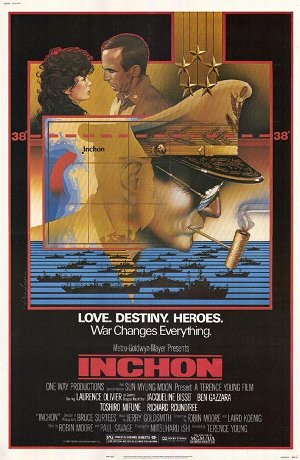
A movie that has always intrigued me, both because of what went on on-screen and off-, was the notorious Korean War epic "Inchon!" (1982) produced by the Reverend Sun Myung Moon's Unification Church.  The stories that went on behind the scenes on that film, as well as the bad reviews it received at the time, created an aura of mystery and intrigue surrounding the movie that makes me surprised that no one has ever attempted to write an in-depth book about it, much less released it on DVD containing all of its versions running different lengths as well as extras detailing the production history of it.  When I finally got to see the movie, years after it bombed at the box office, I was surprised that it didn't quite live up to my expectations of ineptitude as I had imagined.  It was indeed an uneven and bloated production, with an amazingly bizarre performance by Laurence Olivier as General Douglas MacArthur, but it had enough color and spectacle that it was never boring.  I kept expecting to chuckle at embarrassing moments, but I didn't probably because I sensed a level of earnest sincerity behind the whole enterprise that didn't warrant the contempt it had somehow engendered through the years.


What kept me engaged in the movie was the surprisingly touching subplot involving Jacqueline Bisset's character.  Bisset plays Barbara Hallsworth, the estranged wife of Marine Major Frank Hallsworth (Ben Gazzara) who is having an affair with a Korean woman Lim (Karen Kahn).  Barbara is living near the 38th Parallel and running an interior design business from Philadelphia.  The day the Communist North Korean soldiers move past the 38th parallel into South Korea, she is busy shopping for furniture for her clients when she learns of the Communists' advancement into the South.  She and her chauffeur escape in their Ford Woody station wagon as they proceed South to the American Embassy in Seoul, but he is killed by a North Korean plane firing from overhead.  As Barbara continues her journey by herself, she encounters an elderly Korean man who entrusts his five orphaned granddaughters with Barbara.  At first frustrated and annoyed with the responsibility of caring for these children that have been thrust upon her, Barbara eventually bonds with these Korean girls as they help bring a sense of purpose to her life that had been absent before.


Barbara and the girls encounter various dangers throughout their journey, including narrowly escaping a collapsing bridge that had been blown up by the South Koreans so that the Communists, who had been shelling and advancing upon the bridge, can't take possession of it.  Barbara also shoots a North Korean soldier between the eyes when he tries to confiscate her station wagon.  Along the way, they pick up a young Korean woman Mila (Lydia Lei) who was planning to get married, and has been separated from her fiancee, when the Communists began their advancement.  Barbara, Mila and the girls eventually arrive at a Mission run by the U.N. where they briefly take refuge and then move on to Pusan where Barbara is reunited with her husband.  After U.S. Troops are able to drive out the North Korean forces, Barbara bids a sad farewell to the five Korean girls as she and Frank reconcile.


Years ago, before I moved East for law school, I had the opportunity to interview Jacqueline Bisset for a book I was working on regarding 1960s-era actresses.  Bisset was one of the most intelligent people I ever met in my life, let alone one of the most intelligent actresses I encountered while conducting interviews for this book project.  She was as friendly and down-to-earth as her reputation indicated, with a refreshing sense of humor and humility about herself.  Even though she had high standards with regards to what she considered a good film, she was also a realist.  She knew it was difficult to have any sort of success as an actress in as competitive an industry as Hollywood, and realized that, despite best efforts, sometimes every actor ends up in a film that isn't very good.  There was no sense of entitlement about herself that I sometimes encountered with other actresses.  Despite her frustrations at the limited opportunities for mature actresses in Hollywood, I sensed that she knew she was fortunate to still be working.  She was one of the smartest actresses I ever met with regards to understanding the business end of Hollywood.  I learned a lot from her about maintaining a decorum of maturity and professionalism that I try to apply to my own life and career.


What was refreshing about her was that she didn't trash the Irwin Allen disaster movie "When Time Ran Out..." (1980) or "Inchon!" when I asked her about them.  She knew that they had been badly received, but acknowledged that she enjoyed making them and that everyone involved did their best.  She explained that she agreed to make "Inchon!" when the director, Terence Young, met with her personally after she had originally turned the script down.  He urged her to reconsider.  Bisset didn't like the overall script, but liked the subplot that had been devised for her character Barbara and agreed to do the film on that basis.  She said she enjoyed working in South Korea and loved working with Lydia Lei and the five Korean girls who played the orphans in her vignette.  At the time I spoke with her, she said she hadn't seen "Inchon!" but welcomed the opportunity to watch it someday because she was curious at how it turned out.  Bisset shared a funny anecdote about a woman approaching her not long after the release telling her that she loved "Inchon!"  Bisset was startled because she had heard nothing but bad things about it, and then found out that the woman was referring to the lavish premiere party the producers threw for it at the Cannes Film Festival, not the film itself.  She explained at the end of the interview that she has no regrets about "Inchon!" or "When Time Ran Out..." or other films she made that may not have turned out as well as she had hoped because she always found something good about the experience of every film she worked on.  I admired how she didn't take a bad movie in her career as somehow being a personal reflection upon herself, which other actresses self-indulgently do.


And there's no reason for Bisset to be embarrassed because she does good work in "Inchon!" and does indeed have the best subplot in the movie.  Barbara's storyline is one of the few that seems to have a clear objective and purpose in comparison to the other muddled narratives in the movie.  When we first encounter Barbara in the story, she's kind of haughty, self-centered and aristocratic.  She's haggling over the prices of antique Korean furniture with an antique dealer when she suddenly learns that the North Koreans have crossed the 38th Parallel, causing her to flee immediately.  She's only concerned for her own hide and doesn't seem overly upset when her driver is killed.  When she encounters the elderly Korean grandfather, as she is trying to cross a crowded bridge, who asks her to take his five granddaughters to safety, she selfishly refuses to help them until they climb into her car against her permission.  So her initial involvement with the Korean girls was hardly out of the goodness of her heart.  She even goes so far as to yell at them, when they climb into her station wagon, "Hey, what the Hell do you think you're doing?!  Come on, get out of there!  Quick!  Sir, get these little bastards out of here!"  Even after they climb into her car, she tells them they have to get out once they're safely across the other side of the bridge.

 
Eventually, however, Barbara's innate decency emerges as she and the Korean girls and, later, the young Korean woman Mila bond over the course of their journey.  Some of the best action sequences in the movie are the ones involving Barbara and the children, including the sequence on the bridge when the South Koreans blow it up.  The station wagon containing Barbara and the children teeters precariously over the edge until a group of South Korean soldiers help pull it to safety.  Later, when they encounter the Communist soldier who attempts to confiscate their vehicle, Barbara calmly shoots him between the eyes and floors the accelerator until they've escaped the Communists.  By the time the car has broken down, and Barbara is trying vainly to get it started up again, we see her holding her right hand up, with her fingers crossed for good luck, as the Korean children hold up their hands, with their fingers crossed as well, in a collective act of praying for good luck that the engine of the car will eventually turn over.  The gesture indicates Barbara's gradually softening feelings towards the children and also about her own lessening sense of entitlement.


When one of her husband's enlisted colleagues, Sergeant Henderson (Richard Roundtree) encounters Barbara and helps fix the engine of her car, he addresses her as "Mrs. Hallsworth."  Barbara appears indignant at his mock-formailty and asks him "What's this 'Mrs. Hallsworth' bit?"  Henderson explains, "You know, officer's wife, rich Philadelphia lady," and Barbara responds, "Right now, I'm just a woman with five kids, stuck in the middle of a war."  Henderson realizes that Barbara's experiences with the children have begun to change her from a selfish and entitled person, to someone with considerably more substance.  He jokes, "You're a bit dusty, quite a bit warmer, I must say motherhood quite becomes you."  Barbara is further humbled when she learns from Henderson that her husband Frank, who she assumed didn't care about her, has been busy trying to locate her since the fighting started.  As she gets into the car, she tells Henderson that she plans to "head south, all the way to Pusan.  It'll be safer for the kids.  And if that sounds noble, it isn't.  Maybe I just want Frank to know that I don't need him."  After what she has encountered, Barbara realizes that, at that moment, survival, and the safety of the children, is more important than being concerned about the future of her troubled marriage.


One of the (intentionally) funniest scenes in "Inchon!" has Barbara driving the car as the Korean girls yell and fight amongst themselves for crackers from a care package that Henderson has given them so they can eat.  She yells at them to settle down saying, "Oh, OK, you guys!  Keep it down or you'll have to walk all the way!  You hear!"  As she looks in the rearview mirror, she sees one of the youngest children mimicking her harsh, scolding nature.  Barbara honks the horn to tell her to cut it out and everyone gets silent in the car.  Barbara tries hard to suppress her smile as she bursts into laughter because the little girl has imitated her quite succinctly.  They all laugh together as Barbara grabs one of the crackers and begins to truly feel at-ease with these children.  Bisset and the Korean children have great chemistry together in this scene, and it's easy to see that she sincerely enjoyed working with them.


Throughout "Inchon!" we see how Barbara starts becoming genuinely concerned for their well-being and the well-being of the other refugees.  At one point, Barbara stops the car when she notices the bodies of American and South Korean soldiers strewn along the roadside.  She urges the oldest girl to engage the other children in games so that they aren't traumatized by the horrors surrounding them.  As she goes to help Mila, the young Korean refugee who was supposed to get married that day, tend to the wounded soldiers, she seems concerned about the bruises on Mila's face and asks where they came from.  As Mila tears up her wedding dress to make bandages to help the wounded American soldiers, she faints from exhaustion, and a concerned Barbara drags the girl to her car so that she can join them on their journey South to Seoul.  After Barbara and the girls arrive at the U.N. Mission, she originally intends to make the remainder of her trip alone, but realizes that she can't easily part company with Mila and the children just yet and brings them along with her to Pusan where she reunites with her husband.  When Barbara arrives in Pusan, and is greeted by a Turkish General (Gabriele Ferzetti), who asks "And whose, may I ask, are these young children?," Barbara proudly proclaims, "Mine." 


That night, Barbara has a scene where she tucks the children, who are sleeping side-by-side in an extremely wide bed, in at night.  She tells them, "Now, everyone, fast asleep!  Or I'll be back, and you'll see!"  As she walks out of the room, the girls start to laugh and Barbara jokingly scolds them "Now you all, don't you imitate me when my back's turned!"  It could have been a really corny scene, but Bisset and the Korean children pull it off thanks to the genuine warmth emanating from them that allows it to be a touching, rather than cloying, moment.  Because Barbara has changed so much, her reunion right after this with her husband Frank turns out to be less acrimonious than we would have expected it to be given his adultery and her lingering animosity towards him.  They argue, but Bisset and Ben Gazzara do a good job demonstrating how much they still love each other.  Even though they hash it out over the reasons he started having the affair with the Korean woman, Lim, and her boredom and frustration being an officer's wife, at the end of the scene Barbara has enough perspective to say "Look, Frank.  Tomorrow you're going to be off, wherever it is.  You've got problems of your own.  Let's leave ours for the moment.  And, later, when you come back, you tell me the way you want it and that's the way it'll be."  Barbara realizes that, with the war brewing around them, right now isn't the time to go over a litany of each other's shortcomings as spouses and that they can deal with it later when they have the luxury of considering their future.


At the end of the movie, after the American and South Korean forces have driven out the North Korean forces, Barbara and Mila bid farewell to the Korean children at an orphanage in Seoul.  As the bell rings for the children to attend class, the youngest of the children runs up to Barbara and hands her a drawing that the girls of made of Barbara, the five children, and their car, with a crayon scrawl saying "We Love You Babira."  Barbara brushes back tears as she tells Mila, "I don't have yellow hair."  After nearly 2 and a half hours of haphazardly staged epic battle sequences, and political posturing, the movie elicits some genuinely touching emotions with this quiet little moment.  Some people have scoffed that the drawing is awful and hilarious, but there's a simple sincerity to the moment that would have come across more clearly had it been contained in a much better movie.  In isolation from the rest of "Inchon!," however, the gesture works fine because of the heart that Jacqueline Bisset, Lydia Lei and the Korean children (who, unfortunately, are unbilled in the credits) invests in it.  If more of the movie was built around the Barbara storyline or, at the very least, had the same care and attention paid to it, perhaps it might not have been as critically reviled upon release.  The only thing that makes me slightly unsatisfied by the ending is that I'm a bit surprised that, after everything they've gone through, Barbara and her husband Frank don't adopt the children, rather than leaving them at the orphanage before returning to the United States.  However, since the rest of the movie has a lot of problems, I guess it would be unfair to quibble about a minor issue in what was, otherwise, the best storyline that "Inchon!" had going for it. 

Thursday, April 18, 2013

William Holden Gave His All Even "When Time Ran Out..."


I recently came across an interesting segment of "The Tonight Show" starring Johnny Carson from 1980 with Carson interviewing William Holden while he's on the show to promote his latest film "When Time Ran Out..." (1980), a terrible Irwin Allen-produced disaster film about tourists on a Pacific island fleeing in terror from an erupting volcano.  With shoddy special effects, mostly indifferent performances (especially by Paul Newman), slow pacing, and bad writing, "When Time Ran Out..." is the sort of film that makes people cynical about Hollywood filmmaking since it was produced as part of a deal Irwin Allen made with Warner Brothers to make a series of disaster movies that included "The Swarm" (1978), "Beyond the Poseidon Adventure" (1979) and countless made-for-TV movies.  My understanding is that Paul Newman and William Holden only appeared in the movie to fulfill their contractual obligation to do another disaster epic for Irwin Allen after making "The Towering Inferno" (1974) for him.  By the time "When Time Ran Out..." was made, the genre had run its course and Warner Brothers had become impatient with Allen to such a degree that they purportedly cut the budget of the movie in mid-production, thus explaining the threadbare production values and special effects.  I've read that Holden didn't like the film at all, particularly as he got billing below Paul Newman, as well as the fact that leading lady Jacqueline Bisset doesn't end up with his character at the end, but with Newman's.  I also recall reading in Bob Thomas' biography of William Holden that he drank heavily throughout the production of "When Time Ran Out..." and that that alarmed the filmmakers since the film entailed difficult stunts and locations.  As such, it was apparent that this was hardly one of Holden's proudest accomplishments as an actor.


Which is why I marveled at how charming and enthusiastic Holden was while being interviewed by Johnny Carson about the film.  After discussing his interest in African conservation and wildlife, and sharing an anecdote about making "Sunset Blvd" (1950), Holden finally gets around to discussing "When Time Ran Out..."  He describes his character and the storyline of the movie with great ease, and even goes so far as to say "It's quite exciting with a marvelous cast...good company and it's an exciting show" which I imagine must have taken a level of intestinal fortitude for Holden to say because anyone who has ever seen "When Time Ran Out..." knows that it's hardly an "exciting" movie.  Holden even jokes, when Johnny Carson points out that Mount Saint Helens had just erupted in real life, that "Irwin Allen plays long shots.  He makes this picture a year in-advance and then the day before the picture comes out Mount Saint Helens blows up.  You see, it's working...He made a picture, 'Poseidon Adventure' and I think it was the Queen Elizabeth turned over in the bay of Hong Kong.  And then we made 'Towering Inferno' and they were very obliging, the skyscraper in San Paulo, Brazil burned down."  Carson then jokes "You're not accusing anyone are you?" and Holden slyly responds "No, no..." as the two chuckle amongst themselves.  Nevertheless, I admired Holden's humility and professionalism to not denigrate the movie publicly the way so many movie stars and celebrities are apt to do these days.  Some people might say that he was being a hypocrite for not expressing his true feelings about the film, but I disagree.  Holden knew that he agreed to make "When Time Ran Out..." and that he took the money for it, and he was hardly a struggling actor trying to pay his bills at the time.  It would have been much more hypocritical, in my opinion, if he made the movie, got paid for it, and trashed it at the time of the release when the studio was still hoping to recoup its expenditures from it.  Years later, upon reflection, he would have been allowed to express his true feelings after the success or failure of the movie had already been determined by the marketplace.


Unfortunately, Holden never had that chance to be candid about "When Time Ran Out..." because he unexpectedly died a year and a half later from an accidental head injury sustained at his home in Los Angeles.  As such, "When Time Ran Out..." ended up being the penultimate performance of a talented and charismatic actor who graced some of the finest movies Hollywood has ever made.  I've always liked William Holden for his charm and warmth on-screen.  Like James Stewart, he had the courage to play unsympathetic characters that went against his natural screen image.  He was never afraid to show the sleazy and corruptible side to his characters, but we still cared about them because his innate charm still came through.  I also liked him for the fact that he grew up in South Pasadena, California--not far from where I grew up--and that knowledge gave me hope that talent and initiative might someday get me out of the San Gabriel Valley (and it has).  Nevertheless, Holden needn't make any excuses for "When Time Ran Out..." because, even though it's a terrible movie, Holden still gives it his all.  While no one in the film could be accused of giving their best performances in it, Holden still does fine work, and has about three or four scenes that allow him to demonstrate what he was capable of as an actor.  That's more than can be said for top-billed star Paul Newman, who sleepwalks his way through the movie, barely able to contain his obvious contempt for the material.


There's a scene at the beginning of the movie, where the jet carrying Holden and Jacqueline Bisset is about to land on the tropical Pacific island where Holden's character, a hotel magnate named Shelby Gilmore, has built his latest resort hotel.  He is there to inspect it while accompanied by his public relations manager, Kay Kirby, played by Bisset.  In the backstory of the movie, Holden's character is deeply in love with Bisset, but she is still in love with oil wildcatter Paul Newman, who she met and was romantically involved with while on an earlier visit to the island.  The pilot tells them that they are making their "final approach" to the island, which inspires Holden to make his "final approach" with Bisset.  He takes out a ringbox and asks her to marry him.  She tells him she can't and that he knows it is because she's still in love with Paul Newman's character.  Holden responds, "But he's not the marrying kind."  Bisset chuckles and tries to change the subject and make light of the situation by commenting that the same can't be said about Holden's much-married, and much-divorced, character.  Bisset muses aloud whether she would be his fifth, sixth or even seventh wife if she were to marry him.  Holden looks at Bisset intently and simply says "The last."  It's a simple line of dialogue, but Holden proved that he still possessed enough romantic sex appeal in this scene so that he delivers it with the requisite amount of love and sincerity.  Because of the fine work between Bisset, a real trouper and sincere professional if there ever was one, and Holden in this scene, you sense how Kay Kirby has affected Shelby Gilmore in ways that his earlier wives had not, and that he sincerely knows that she is the love of his life.  Even though the years of drinking have caused Holden to look much older than he was at the time, Holden still has enough presence to give Paul Newman's character a run for his money while competing for Bisset's hand in marriage.


Later in the film, Holden's character confronts his hotel general manager and business partner, Bob Spangler, played by James Franciscus.  Holden tells Franciscus that he has concerns about the safety of the tourists on the island due to alarming reports about the volcano's stability.  Holden angrily tells him, "Bob, I'm in the partner business.  I can't be in 64 resorts at the same time.  I have to rely on what my partner's tell me.  Up to a point.  And if I come to feel they're lying, I call in the cards."  Franciscus' character bluffs and calls his geologist, who tells him that the volcano is unstable and can erupt any moment and that they better evacuate the island immediately.  The smug and sleazy Franciscus hands the phone over to Holden, in an act of defiance to challenge Holden's authority over him.  Holden takes the phone, looks at Franciscus intently and responds "As I said before, I trust my partners.  Up to a point."  Holden then hangs up the phone and walks out.  Holden's character realizes that Franciscus is bluffing him, and that taking the call would be pointless because he already knows what the truth is.  You can tell that he's not going to waste another minute on Franciscus.  Holden establishes his character as a tough, no-nonsense businessman who doesn't suffer fools gladly.  Even though the role was hardly up to his standards as an actor, Holden still brings a sense of authority and gravitas to establish that Shelby Gilmore is a man who won't tolerate Franciscus' foolishness any longer.


Probably Holden's most touching moments in the film are with Veronica Hamel, who plays Nikki Spangler, the wife of James Franciscus' character.  In the storyline, we learn that Nikki is the goddaughter of Holden's character, and that he loves her deeply as if she were his own child.  We also learn that Franciscus' character only married Nikki in order to get to Holden's character to convince him to build a resort on that island.  When Holden and Hamel's character are reunited at the beginning of the film, and he tells her that he just saw her mother recently and that she's becoming almost as beautiful as she is, there's a warmth and familiarity emanating between the two actors which convinces you that they really are like family.  Later in the film, after the volcano has erupted, and Paul Newman's character has proposed evacuating the resort and moving everyone to higher ground on the other side of the island, Holden's character goes to Nikki's suite.  She had fallen off her horse and sprained her ankle when the volcano erupted and is resting.  Holden urgently tells her to get dressed and that they're leaving for the other side of the island.  When Hamel's character learns that her husband doesn't want anyone to evacuate the resort, she tells Holden that if her husband feels that way, he must be right and that they are safe at the resort.


Holden tells her, "I don't care what he says.  You're my responsibility and I'm taking you with me."  Hamel's character responds, "Shelby, you know my place is with him.  Right or wrong."  Holden tries to reason with Hamel, telling her, "We'll argue about that later.  Now, are you coming or do I have to carry you?"  When Hamel again refuses to leave, Holden grabs Hamel and bluntly tells her "Don't you understand?  He only married you so he could get to me!"  Hamel tearfully tells him she doesn't believe him and that "I'm not going to go with you!" as she wrests herself away from him.  Holden becomes frustrated that he can't make Hamel see the truth, and that he's lost her forever.  Before he walks out the door, Holden turns around, looks intently at Hamel, and quietly says with gravitas and sadness, "Goodbye Nikki."  Flush with anger from arguing with her, Holden's character calms down and regains his composure as he realizes that this is the last time he will ever see her again.  Holden and Hamel's performances bring a surprising level of poignancy to this subplot that make it one of the better scenes in the movie. 


Throughout "When Time Ran Out...", William Holden rises above the cliched and hackneyed storyline of the movie to make Shelby Gilmore a sympathetic and intelligent character, with strength and resolve.  His presence never becomes campy or foolish in the course of the story.  Despite his wealth and power, he remains a heroic and admirable character, one who is concerned about the safety of others rather than his own personal comfort and security.  At the end of the film, after the rag-tag group of survivors have witnessed the destruction of the resort by the volcano, Holden has a quiet moment listening to Burgess Meredith's character grieve for his wife.  Holden listens with compassion and sympathy, but we realize that he is also grieving at that moment for his goddaughter, Nikki.  Holden is subtle in that scene and allows those expressive eyes and his handsome face to convey his feelings of sadness to the audience.  In contrast, Paul Newman makes absolutely no effort to bring any feeling or depth to his character.  It's clear that Newman is on autopilot throughout "When Time Ran Out..." and, if it's true that Holden was annoyed that Newman got top-billing and won the girl in the end, I can't honestly blame him considering how he still delivered the goods despite the bad script he had to contend with, and his own personal issues at the time.  Holden's fine performance brings to "When Time Ran Out..." a few nicely acted little vignettes that stand out from the rest of the movie surrounding it.  Time may have sadly run out in William Holden's life when he made this film, but his talent, screen presence, and professionalism continue to live on.