
This week, the new "Dallas" on TNT killed Larry Hagman's iconic JR Ewing character off the series as a result of Hagman's death due to complications of throat cancer treatment back in November. In the next, upcoming episode of "Dallas," the series will pay tribute to JR and to Hagman with an episode concerning JR's funeral. My understanding is that the remainder of the series will focus on JR Ewing's legacy and how it affects his family. All of this reminds me of what happened back in 1981 on the original "Dallas" series on CBS when actor Jim Davis, who played patriarch Jock Ewing, died of multiple myeloma. The producers dealt with Davis' death by sending Jock off-screen to South America for several episodes where Jock was wildcatting oil. They didn't actually kill off Jock on the series until the January 8, 1982 episode titled "The Search," which involved JR, Bobby and Ray on a desperate search for Jock after a helicopter he was riding in crashes into a South American lake. In the aftermath of that development, the theme for the remainder of the original "Dallas" changed and became a story about a family attempting to live under the legacy set for them by their now-lost patriarch. I imagine that the remainder of the new TNT "Dallas" will follow a similar path as the new generation of Ewings react to the legacy that JR has left for them. What's interesting about Jim Davis' death, and the death of the Jock Ewing character on the original "Dallas," is how it affected not just one television series, but two, during the 1982-83 television season. During that season both "Dallas," and its sister spin-off series "Knots Landing," engineered storylines whose lynchpin was largely tied to Jock Ewing's final will and testament, and its affect upon his immediate family and the people surrounding them.

In the appropriately titled episode "Jock's Will" that aired just over 30 years ago on October 29, 1982, Ewing family attorney Harve Smithfield (George O. Petrie), lays out the terms of Jock's will. Jock leaves Southfork, any income to be derived from it, as well as $50 million of community property holdings to Miss Ellie. Jock also set up a trust fund for his four sons JR, Gary (Ted Shackelford), Ray (Steve Kanaly), and Bobby (Patrick Duffy) where he leaves each of them $10 million. Granddaughter Lucy Ewing (Charlene Tilton) receives $5 million. However, Gary's share of this trust fund is limited to the use of the interest alone for four years. As JR cruelly jokes, "I guess Daddy was trying to help you, Gary, to keep you from squandering your capital on one of your weaker weekends...Sorry Mama." Jock also sets up a trust fund for all of his grandchildren to receive an equal portion on their 21st birthday divisible by the number of grandchildren at that time.

As for Ewing Oil, Harve reads from a codicil to the will that was written by Jock while he was still in South America witnessed by his best friend Punk Anderson (Morgan Woodward). In the codicil, Jock admits that he agonized over who he should leave the controlling interest in Ewing Oil. Because neither Gary nor Ray ever showed any inclination or aptitude for business, Jock's choice of successor is narrowed to Bobby and JR. Even though Jock admits that he always hoped JR and Bobby would someday run Ewing Oil as a team, Jock realizes that Ewing Oil can have only one man at the helm. Jock determines that that man has got to be the one that wants it the most. Jock orders an independent audit of Ewing Oil's assets so that Bobby and JR each get a 50% share. After one year, Punk Anderson (who Jock names as the Administrator of his estate) will conduct a second independent audit of the company. Whichever son manages to create the greatest gain for his half-share of Ewing Oil will win 51% of the stock of the entire company and can run it anyway he sees fit. The loser in the contest will get 19% of the stock. The remaining 30% will be divided equally among Ray, Gary, and Miss Ellie, to ensure that they will never be without the profits from the company he created, which must never be owned by anyone other than an Ewing. If either Bobby or JR dies during the year, the remaining son will take over the shares and run the company. And, with that, Jock sets the course for the lives of his family members over the next 30 years and also shapes the storylines of both "Dallas" and "Knots Landing" for that season, and all subsequent seasons to follow.

Throughout the 1982-83 season of "Dallas," a majority of the storylines on the series centered on Bobby and JR's battle for control of Ewing Oil. Bobby becomes so ruthless in his determination to beat JR that his wife Pamela (Victoria Principal) separates from him and starts dating millionaire playboy Mark Graison (John Beck). Meanwhile, JR uses every dirty trick in the book to help increase his assets. Earlier that season, before Jock's will was read, JR was briefly kicked out of Ewing Oil for helping to perpetuate Cliff Barnes' (Ken Kercheval) suicide attempt. As a result, Bobby, JR, Miss Ellie and Lucy voted him out of the company. In the meantime, JR is hired by naive oil heiress Holly Harwood (Lois Chiles) to help her run her late father's company, Harwood Oil. In lieu of a salary, JR insists on 25% ownership of Harwood Oil, a decision Holly will soon regret when she realizes that he is using her company's assets and influence as a tool to help give him a competitive edge over Bobby.

Ray aligns himself with Bobby to help him win the company. Meanwhile his wife Donna (Susan Howard) becomes involved with helping to run a new Texas Energy Commission. The new Commission was formed when it was discovered that Walt Driscoll (Ben Piazza) the head of the previous oversight agency, the Office of Land Management, was illegally granting JR a variance allowing him to pump more oil than regulations allowed. JR needed the additional crude oil to supply gasoline to his low-cost service stations which was part of his strategy to beat Bobby. Donna worked to rescind the variance, which hindered JR's efforts, but which also gratified the other independent oil companies, including Barnes-Wentworth Oil, run by JR's arch enemy Cliff Barnes. Cliff and the other independents were afraid that the competition from JR's low-cost gas stations would put the other companies out of business. Cliff, and his mother Rebecca (Priscilla Pointer) became determined to stop JR's efforts at all costs. Rebecca is even killed when her private plane collides with another on the runway, while she is on her way to Houston on Cliff's behalf, to convince the owner of a refinery (that JR desperately needed for his gas stations) to sell to Cliff instead. Meanwhile, Miss Ellie goes to court to try and break Jock's will so that she can sell Ewing Oil, but eventually drops the suit when she finds herself unable to declare in court that Jock was not of sound mind and body when he drew up the will. The stress from the Ewing Oil battle brings her closer to Clayton Farlow (Howard Keel) who will eventually become her second husband.
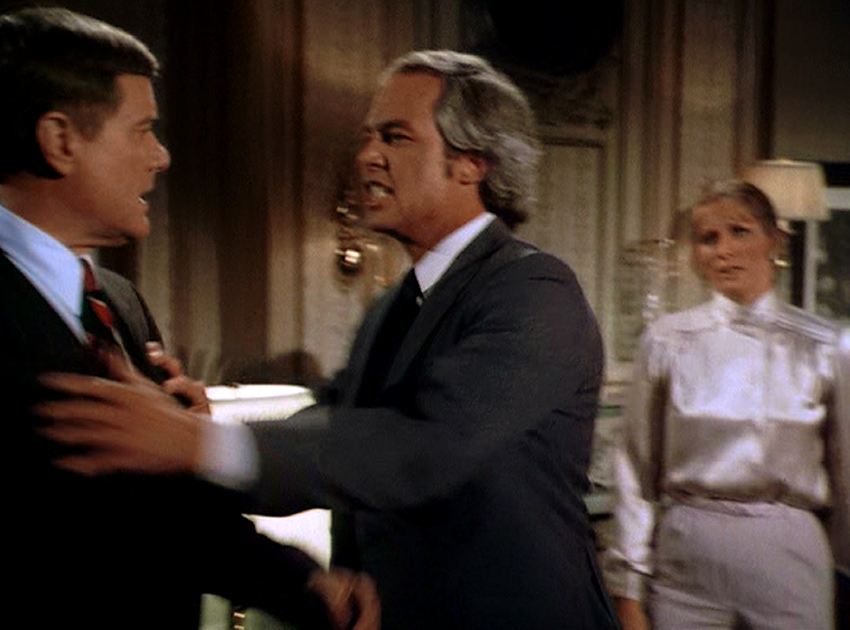

Rebecca's death brings her manipulative daughter Katharine (Morgan Brittany) back to Dallas. Katharine, in love with Bobby, conspires with JR to ensure that Bobby and Pam divorce for good. Cliff's girlfriend Afton Cooper (Audrey Landers) attempts to warn Pam about Katharine's true intentions, to no avail. Throughout the season, Afton urges Cliff to stop obsessing about JR and to not interfere in the battle for Ewing Oil, as she fears his obsession will eat him up and destroy their relationship. Holly Harwood, desperate to get JR out of her company after he gets her involved with an illegal deal selling crude oil to Cuba, starts dropping hints with Sue Ellen that she is having an affair with JR. Holly believes that, if Sue Ellen thinks JR is having an affair with her, she will insist that JR cut all ties with Holly if he wants to save their marriage and retain custody of their son John Ross. When Bobby and Ray learn that JR is trying to sell oil to Cuba, they sabotage Walt Driscoll's efforts to help negotiate the deal on JR's behalf by arranging to have him arrested. When Driscoll calls JR to help bail him out, JR leaves him to rot in jail. Meanwhile, Holly sets Sue Ellen up to catch her and JR in bed. The shock of seeing her husband back to his philandering ways drives Sue Ellen back to the bottle.


After an argument with JR, Sue Ellen attempts to flee Southfork in his car. Lucy's boyfriend, and Ray's cousin, Mickey Trotter (Timothy Patrick Murphy), a troubled-but-reformed youth from Kansas, jumps into the car to stop Sue Ellen. They are side-swiped on the road by a vehicle driven by Walt Driscoll, who believed JR was driving the car and was seeking revenge on JR for ruining his life. Mickey is paralyzed by the accident from the neck-down. Meanwhile, Katharine attempts to get into Bobby's good graces by allowing him to use an experimental drill bit developed by Wentworth Tool & Die in order to help him drill for oil in ice and snow-covered Canada. Cliff opposes this, but Pamela casts the deciding vote in Bobby's favor, but not before telling him that she's filing for divorce. When Ray learns that Walt Driscoll, who committed suicide because of his shame over causing Mickey's paralysis, ran Sue Ellen and Mickey off the road to get revenge against JR, he confronts his half-brother at Southfork about it. The fighting between the two accidentally starts a fire that quickly engulfs Southfork and traps JR, Ray, Sue Ellen and John Ross inside.


This is only a thumbnail overview of the season, but it demonstrates how all the characters, and storylines, on "Dallas" that season were tied to JR and Bobby's battle for Ewing Oil because of the terms set by Jock's will. Both Bobby and JR fight vigorously to win the contest because they believe they must live up to the expectations set for them by Jock and this determination has terrible consequences for all involved. What I thought made this season of "Dallas" so beautifully constructed was how every member of the ensemble, even the most unlikely individual, would have their lives adversely affected by the contest between the Ewing brothers. Even a character like Mickey Trotter, whose storyline appeared to be disconnected with the corporate aspect of the series, ends up as collateral damage. What's interesting is how the battle for Ewing Oil brought out the worst in most of the characters on "Dallas" that season. JR was worse than ever; Bobby realized he could be as ruthless as JR and that he wasn't any better than him (just more sanctimonious); Pam became whiny and sniveling as she witnessed her husband's moral disintegration; Sue Ellen became condescending again as she blindly followed JR's lead; Ray and Bobby thoughtlessly put the hapless Walt Driscoll in jail; Holly Harwood seduced JR so that Sue Ellen could catch them in bed, only to have it drive Sue Ellen back to the bottle; Cliff became even more insufferable than ever in his efforts to interfere with JR and Bobby's business dealings, and so on and so on. The only characters who don't lose their moral compass are Donna, who remained conscientious with her work on the Texas Energy Commission; Miss Ellie, who was dismayed at how the contest was tearing her family apart; Clayton, who remained as strong-willed and supportive of the others as ever; and Lucy, who showed genuine concern and caring for Mickey after he had been paralyzed in the car crash caused by Sue Ellen and Walt Driscoll.

Over on "Knots Landing," Jock's will would also have significant ramifications that would shape its 1982-83 season and alter the course of that series forever. When Gary inherits the $10 million in the trust fund set up for Jock, he uses the interests on it to invest in his neighbors' business ventures. Richard Avery (John Pleshette), an overly ambitious, but emotionally insecure, attorney who suffered a nervous breakdown the season before, opens a new French restaurant that season rather than return to practicing law. Gary gives him money to invest in the business, unaware that his manipulative lover Abby Cunningham (Donna Mills) has drawn up the terms of the gift more as a loan with strings attached to it. She forces Richard to sign a note that hands over the restaurant to her if he does not make his monthly payments. Meanwhile, Gary also invests his money to help produce a record album for a young rock singer he has befriended, Ciji Dunne (Lisa Hartman). Gary goes into business with his other neighbor Kenny Ward (James Houghton) to open their own independent record label, with Ciji as their first artist. This does not sit well with Kenny's wife Ginger (Kim Lankford), who had been trying to get Kenny to help promote her fledgling singing career and resents Kenny and Gary's enthusiasm for Ciji.

Reminding Richard that Gary's money is invested in the restaurant, Abby manipulates him into allowing his restaurant to be used as a cabaret venue to help promote Ciji's singing career. Richard resents Ciji's presence at his restaurant, particularly since she has struck up a close friendship with his wife Laura (Constance McCashin). Ciji becomes romantically involved with a two-bit hustler named Chip Roberts (Michael Sabatino) who becomes her self-annointed manager. Chip is freeloading by living with Gary's estranged wife Val (Joan Van Ark) and her mother Lilimae (Julie Harris), who he has been manipulating because she is enamored of him. Chip's presence in the "Knots Landing" cul-de-sac upsets the life of Karen Fairgate (Michele Lee) whose young daughter Diana (Claudia Lonow) falls hopelessly in love with this shifty character. Only Karen's new husband Mack MacKenzie (Kevin Dobson) senses from the beginning the potential danger of Chip. Behind everyone's back, Gary and Abby sell Ciji's record contract to established music mogul Jeff Munson (Jon Cyper), a move that leaves Kenny out in the cold and which causes Ginger to angrily confront Gary, telling him that nothing in the three or four years she's known Gary would have prepared her for his betrayal of her husband. When Gary tries to explain his position to Kenny, the usually mild mannered record producer responds with a tirade that succinctly demonstrates how Gary is no better than his brothers back in Texas: "Gary you dangled a dream right in front of my face and then you snatched it away!...No misunderstanding man. You cut me out pure and simple. Why don't you live with it? You know, at first I thought maybe this was Abby's doing. I know how her mind works. I thought maybe she put you up to it. But then I remembered who you really are, some of the things you've done. I realized I should've expected this from you all along!...Hey, you got Sid Fairgate involved in selling stolen auto parts, and now he's dead. He gave you a break, you betrayed his trust in you. Val stands by you but, no, you run out on her. Well, now you're just doing the same thing to me. You're damn right it isn't (fair)...You had your chance, Gary, but you blew it, so don't come around here with any phony excuses. You know it's time somebody told you the truth about yourself...No, no, you're the one caught up in himself. You don't realize what you do to other people. You're a weak, spoiled coward who never stands up for anyone or anything. You take the easy way out and you don't care who you step on to do it. Well, congratulations, Gary, you finally learned to be a true Ewing!"

Meanwhile, Chip leaks pages of a manuscript Val has written based on the breakup of her marriage, due to Gary's affair with Abby that started the previous season, in order to impress a public relations executive he is trying to land a position with. The publication of the manuscript in a tabloid drives recovering alcoholic Gary to drink again, which is exacerbated when he learns of the severe terms Abby has placed on Richard for the money he invested in his restaurant. Gary goes on a bender, with Ciji the only person conscientiously looking out for his well-being. Meanwhile, Ciji learns she's pregnant with Chip's baby, as well as the fact that he is a wanted criminal named Tony Fenice. She fires Chip as her manager and warns him to stay away from her and her baby or else she'll tell the whole world his true identity. Meanwhile, because of a casual comment made by a spiteful Chip, Richard starts to believe that his wife Laura and Ciji might be having a lesbian relationship. As Richard's mental state deteriorates, so does his marriage to Laura as he begins to lash out at her and Ciji for the failure of their marriage.


As Ciji's album nears completion, the entire cul-de-sac are at odds with one another over Ciji. Because Ciji has befriended Gary while he is dealing with his alcoholism, Abby warns her to stay away from him. The night of Ciji's album launch party, both Ciji and Gary are missing. Ginger is put on stage by Jeff Munson to entertain the audience in Ciji's absence. Gary wakes up the next morning on the beach, just yards from Ciji's body, which has washed ashore. Mack's ex-girlfriend police detective Janet Baines (Joanna Pettet) arrests Gary for Ciji's murder. Val confesses to killing Ciji because she had an argument with her earlier the night she died where she struck Ciji and knocked her to the ground. She's later released due to lack of evidence. At the end of the season, Gary sits in jail accused of murder; Richard leaves Laura in the middle of the night because he realizes their marriage is irreparable; Kenny and Ginger accept a job offer from Jeff Munson and decide to move to Nashville; and Karen learns that Diana has left town with Chip, moments after learning that he's a wanted criminal named Tony Fenice.

Even though Jock's will had less of an influence on "Knots Landing" than it did on "Dallas," it still had significant ramifications on the residents of Seaview Circle. Gary's newfound wealth, and his initially well-meaning efforts to share it with his neighbors, moved the characters of "Knots Landing" to a more upscale income level than they were previously accustomed to. It created conflicts because they proved to be unprepared for the negative effects of it. Abby, who had previously been a manipulative neighborhood trouble-maker, begins her climb as a ruthless, unethical business mogul this season. Because of the lack of proper oversight on Gary's behalf, Abby is allowed to run rampant that season controlling Gary's finances, which has adverse affects on Richard's restaurant and Kenny's efforts to produce Ciji's album. Even though Richard would have opened his restaurant anyway, because of his wife Laura and his best friend Karen's investment in it, it is Gary's financial involvement with the restaurant that leads to Ciji's employment there as a singer, and to Ciji's friendship with Laura. Insecure Richard feels so threatened by Ciji's presence that he actually throws her out of his house when he finds his wife in an innocent embrace with her. Richard's restaurant and marriage suffer as a consequence of Gary's investment in his establishment.

Also, if not for Gary's discovery of Ciji, introducing her to Kenny, and pledge to financially subsidize an independent record label, Kenny would not have quit his job at the record company to try and be his own boss. The money and attention lavish on Ciji lead to Ginger's open resentment of her, and her marriage to Kenny suffered as a result of it. Ginger and Laura, who had been good friends up to that point, even have an argument over Ciji as both women have decidedly different views on her as an individual. Even though Gary's inheritance had nothing to do with Chip's arrival on the scene (since Chip was originally introduced as someone working for the PR company promoting Val's novel) Gary's investment in Richard's restaurant and in his independent record label with Kenny, with Ciji as its sole artist, created a dysfunctional environment of already simmering resentment among the residents of Seaview Circle ripe for Chip to easily take advantage of. Chip planted the seeds of resentment in Richard's mind that his wife was having an affair with Ciji, manipulated Diana Fairgate to his advantage, and repeatedly used Ciji as a scapegoat to cover up his own nefarious deeds. It would be safe to say that none of this would have occurred as extensively as it did if Gary never inherited that money from Jock. Just as it did simultaneously during the concurrent 1982-83 season on "Dallas," Jock's will has serious ramifications on the lives of the residents of the "Knots Landing" Seaview Circle cul-de-sac. Like the Ewings on "Dallas," Gary's inheritance as a result of Jock's will brings out the worst in the neighbors on "Knots Landing."

Because of the storylines inspired by the ramifications of Jock Ewing's will on both "Dallas" and "Knots Landing," the directions of both series were radically altered for the remainder of their run. "Dallas" became a series where the Ewing family wrestled with the consequences of living their lives in the shadow of the standards and legacy that Jock set for them. Countless storylines in subsequent seasons of "Dallas" revolved around JR, or his siblings, working hard to conduct their lives in a manner that they believe Jock would have approved of. JR, in particularly, is driven by a desire to ensure that he can leave his son John Ross with a legacy of running Ewing Oil someday--a theme which heavily influences the new "Dallas" on TNT. Any divergence from Jock's expectations formed the backbone of enormous amounts of conflict on the original show. I think that's why I began to appreciate Howard Keel's Clayton Farlow a great deal on "Dallas." In many ways, as exemplified by JR's contempt for him, Clayton was the "anti-Jock" of "Dallas"--a hard working, successful oil man in his own right, Clayton was humble whereas Jock was egotistical. Clayton had a compassion and humanity about him that all the characters, except JR, responded to. I think the Ewings, subconsciously, were glad to have Clayton in their family even though they missed Jock terribly. Clayton allowed them to relax and blossom as individuals, whereas Jock continually kept them on their toes. I think the Ewings, underneath it all, were frightened of Jock as much as they loved him, particularly JR. Jock had such high expectations of them that, in many ways, he was as despotic a ruler over his family as Angela Channing (Jane Wyman) of "Falcon Crest" was with her family. It's just that Angela was never as idealized by the other characters on her show the way Jock eventually became idealized. (There's even a storyline in the 1989-90 season of "Dallas" which revealed that Jock had saved a Jewish family from perishing in the Holocaust and they named themselves Ewing when they settled in the United States in honor of him. By then, sainthood had clearly been bestowed upon Jock.) I think the different levels of respect accorded to Jock and Clayton underscores how the open-hearted nice guy is never bestowed the same level of respect as the person who withholds his affection and approval.


Meanwhile, even though Jock never appeared on "Knots Landing," Gary's inheritance from his Daddy's will set that series on an upscale climb that pulled it away from the middle-class, suburban milieu that allowed the early seasons of the show to distinguish itself as unique in the prime time soap genre. Gary eventually bought a ranch that he named Westfork and began investing in the Lotus Point resort, the Empire Valley real estate development, the Pacific World Cable TV station, and the Tidal Energy project in an effort to finally make a name for himself and come out from under the shadow of his brothers. Much of Gary's drive and ambition may have been the result of trying to prove to himself that he was worthy of being Jock Ewing's son. It is ironic that Jock's inheritance gives Gary the resources to demonstrate to himself and others what he is capable of. No doubt much of the upscale direction of the series after its early seasons was also due to the presence of William Devane's mercurial Greg Sumner, who joined the series in 1983, but Gary's inheritance was, in many ways, the impetus to it all. As a result of changes made to the series, John Pleshette's Richard Avery, and James Houghton and Kim Lankford's Kenny and Ginger Ward, were phased out of the show as the series made conscious efforts to become more glamorous and larger-than-life. It stopped becoming a show about four married couples living in a cul-de-sac and became another prime-time soap about the rich and the powerful. Even though "Knots Landing" was still overall a good show that had good years ahead of it, for better or worse, "Knots Landing" was never the same again after Gary came into his inheritance.

The thing that I find so unique about the 1982-83 seasons of "Dallas" and "Knots Landing" is how both shows created storylines centered around one central concept or conflict. For "Dallas," it was the battle between Bobby and JR for control of Ewing Oil. For "Knots Landing," it was how the characters of Chip and Ciji became entrenched in the lives of the neighborhood as a result of Gary's inheritance. Usually, on prime time soaps, there are several different storylines going on at once and, often-times, they are not directly related to one another. On "Dallas" and "Knots Landing" that season, we saw how the actions in the storyline of one set of characters could lead to serious consequences for a whole different set of characters on the same show. There's an ominous tone of dread that hangs over both series that season, as the stories and characters took a dark turn for the worse. The writers and producers of both shows should be commended for the intricate manner in which they constructed their storylines during that concurrent season. They both started out with the idea of Jock's will being read, and then each show developed a beautifully plotted and nuanced storyline that grew organically out of that idea. Taking advantage of the already-established relationships and conflicts on both "Dallas" and "Knots Landing," the personnel in-charge of both shows built upon the backstories they had already created to devise stories and situations that challenged its characters and its viewers. It's because of this cohesion that I consider the 1982-83 season for both "Dallas" and "Knots Landing" the best season ever for each series. By the end of that season for both shows, relationships and friendships that were once strong had, in many instances, irreparably splintered. Marriages, family relations and friendships involving the Ewing family on "Dallas" were all at an impasse because of the fight between JR and Bobby for control of Ewing Oil. Meanwhile, the once friendly neighborhood of "Knots Landing" lost its suburban community atmosphere forever that season as neighbor became pitted against neighbor, with Richard, Kenny and Ginger fleeing as a consequence of the turmoil. All of this was the result of Jim Davis' death in real-life and the subsequent death of Jock Ewing on the original "Dallas." Based on the standard set by the death of Jim Davis/Jock Ewing, it's clear that the new "Dallas" on TNT has big shoes to fill as it charts the course for its future without Larry Hagman/JR Ewing at its helm.


