
The first time I ever had any true understanding of what post-production and editing meant on a motion picture was when I saw the TV version of "Halloween II" (1981). Universal syndicated an alternate version of this movie to independent TV stations starting around 1984. I saw it on the local KCOP Channel 13 in Los Angeles on Halloween of that year (it still plays frequently on AMC and can also be found on YouTube). It was startling to see how different both versions of this film were. Detailed descriptions of the differences between both versions can be found here and here. In general, both versions follow the same storyline: Moments after surviving her attack by Michael Myers in the first "Halloween" (1978), Laurie Strode (Jamie Lee Curtis) is rushed to Haddonfield Memorial Hospital where she is under the care of the medical and nursing staff. Meanwhile, Dr. Loomis (Donald Pleasance) continues searching for Michael's whereabouts as the small town grows hysterical upon learning of the murders he has committed earlier in the evening. Unbeknownst to all of them, Michael has followed Laurie to the hospital and begins systematically picking off the personnel and staff at the hospital until only Laurie is left. The movie ends with a fiery confrontation between Michael, Loomis, and Laurie.


It's been documented through the years that producer John Carpenter was dissatisfied with the version of "Halloween II" that director Rick Rosenthal turned in. In an effort to keep up with the vigorous slasher movie competition then in-vogue, which were much more explicitly violent than his original "Halloween" ever was, Carpenter supervised additions and reshoots where he added one murder, pumped up the violence in other scenes, and purportedly cut down on scenes establishing character development. The TV version is purportedly closer to what Rosenthal had intended for this film. One general difference between both versions of this film is that the theatrical cut of "Halloween II" moves fast, has some exciting and scary moments, but leaves you feeling cold. Even though it's a well-made movie, especially compared to other slasher movies in the early 1980s made in the wake of the original "Halloween," it doesn't have the personality and heart of the original movie. The first "Halloween" distinguished itself by creating a trio of teenage girls that the audience enjoys spending time with. In the theatrical cut of "Halloween II," you never get to know the Haddonfield Memorial Hospital staff who are tending to Laurie. As a result, the theatrical cut never quite generates the same level of suspense as the first film because you are never allowed an opportunity to care about these new protagonists.


All of that changes in the alternate TV version. In this cut of the movie, you get to spend considerably more time with the hospital personnel who, in the other version, came across as mere ciphers. This is not to say that they have become fully dimensional characters, but we now get a better sense of who they are so that their deaths and/or survival matters more to us. In this cut of the movie, the additional scenes with head nurse Mrs. Alves (Gloria Gifford) allows her to come across less of a stern task master, and more as a hard-working professional who expects all the nurses under her supervision approach their work with the same level of maturity and high-standards that she brings to her work so that their patients can rest comfortably. This is underscored by the little vignette, added to the end of the scene early in the movie when Laurie is brought to the ER, where Mrs. Alves draws the curtains as Laurie is being undressed and prepped for surgery, and orders the ambulance attendants out of the room. We see how Mrs. Alves remains sensitive to Laurie's privacy and modesty. We also spend more time with nurse Janet (Ana Alicia) so that we get a better sense of her mild hysteria and nervous disposition. Because Janet in the TV version appears to be the only nurse who has any genuine sense of concern or doom about what may happen to them all, based on what Michael Myers has done earlier in the day, she becomes a more vulnerable and sympathetic character than she was in the theatrical version due to her heightened awareness. Cliff Emmich's likeable security guard Mr. Garrett also gets a few extra scenes where he responds to the news reports of the teenagers murdered in the first "Halloween" by speculating that it must have involved youths under the influence of controlled substances. This helps to better establish him as an old-fashioned, no-nonsense, traditional kind of guy.


Tawny Moyer's nurse Jill comes across as the most put-together, most professional of the younger nursing staff in the TV version, as the additional scenes help establish that she is the only one that Mrs. Alves does not scold in the course of the evening because she makes no mistakes. Pamela Susan Shoop's appealing nurse Karen also benefits from the additional scenes. In the TV version, she comes across as less of an irresponsible flake and becomes a more feisty, level-headed, and quirky individual. Ford Rainey's Dr. Mixter, who virtually disappears in the theatrical version until Janet finds him dead in his office, has more scenes that help to establish his concern over whether he tended to Laurie's wounds properly. The added scene where he is trying to reassure himself that he did all that he could in treating Laurie's wounds, and that her scar won't be that noticeable, allows the character a sense of humanity and vulnerability that wasn't there at all in the theatrical cut. And Lance Guest as Jimmy, the sympathetic young ambulance attendant who is established as a potential love interest for Laurie, benefits in the TV version by virtue of the fact that the original, scripted ending of the film is reinserted in order to allow him to survive. In the theatrical version, Jimmy appears to have died from head wounds sustained from slipping on Mrs. Alves's blood on the hospital operating room floor. (More about this later.) That version of the movie ends with the seeming sole survivor Laurie, desolate and alone, in the back of the ambulance as it takes her away. In the TV version, Jimmy reappears in the back of the ambulance with Laurie, his head wrapped in bandage, but otherwise all right. The sight of Jimmy alive brings Laurie to tears, as the TV version ends touchingly on a more upbeat, hopeful note. (This gives the movie's use of "Mr. Sandman" over the end credits an entirely different nuance. Rather than eerily underscoring how, as it does in the theatrical version, Laurie will remain forever haunted by her encounter with Michael Myers, this TV version ending makes the song ironically upbeat, and makes Michael an inadvertent Cupid for Laurie. As sick as it sounds, Michael's violent actions in the previous 24 hours have put virginal, repressed Laurie on the path to finding a prospective love interest. After everything she's been through during that day, the poor girl genuinely deserves a break.) The only person who does not appear to benefit from the additional scenes in the TV version is senior ambulance attendant Bud (Leo Rossi), who comes across as crass and sardonic as he does in the theatrical cut.


The additional TV scenes also help to resolve some glaring plot holes that remain unexplained in the theatrical version. In the TV version, it is established that Laurie's parents, Mr. and Mrs. Strode, were at the Country Club Halloween party with Dr. Mixter, and that they left the party before Janet, who forgot to contact them there before going on her break, was able to reach them. (Janet is shown in the TV version being scolded by an irritated Mrs. Alves over this.) In the theatrical version, the nurses try to reach the Strodes to no avail. It's never explained that one reason why they appear to be missing is because Janet forgets to call them at an opportune time. In the second-half of the theatrical version, the hospital becomes dark and shadowy without explanation, something that I recall a few critics in print reviews complained about. In the TV version, it is established that Michael Myers cut the power to the hospital and that the dark and shadowy lighting that results is due to the emergency generator kicking in. And, as mentioned earlier, the TV version helps shed light on the ultimate fate of Jimmy, who appeared to lose consciousness in his car after sustaining his head injuries from his fall. In the theatrical version, he passes out in his car in Laurie's presence. We never get the impression that his head injuries were enough to kill him, so it is confusing at the end of the movie when the theatrical version never goes back to address what ultimately happened to him.
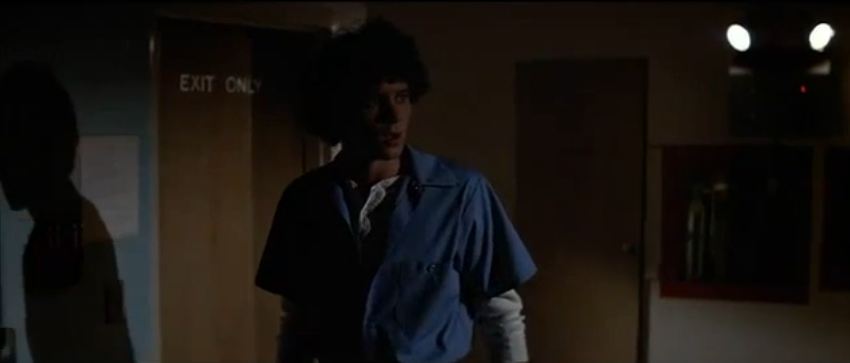

However, even though the TV version helps to resolve the ultimate fate of Jimmy, it also creates its own share of flaws reflected in the fact that his scenes at the end of the film were restructured to create an entirely different impression as to how he was injured. I much prefer the sequence of events in the theatrical version where Jimmy finds Mrs. Alves has bled to death in the hospital operating room, slips on her blood and hits his head on the hard floor, staggers to his car (where Laurie is hiding), tries to start it up to get them to safety, and loses consciousness. The TV version has none of this. Instead, it re-edits and reassembles the scenes and individual shots where Jimmy is seen wandering around the hospital, and slips from Mrs. Alves's blood on the ground, to create the impression that Jimmy is still wandering around looking for Laurie during the final confrontation between Dr. Loomis, Laurie, and Michael Myers, and that he sustained his head injuries from falling backwards because of the explosion Dr. Loomis sets off to kill Michael. It simply seems lame in the TV version that Jimmy doesn't seem to notice the gunfire and shouts of excitement coming from Dr. Loomis and Laurie during their battle with Michael. There was no need to re-edit the sequence of events just to set up Jimmy's reappearance in the ambulance at the end. The set-up for Jimmy's reappearance was done well in the theatrical version and should have remained intact. (I would love to find out what motivated the person at Universal in charge of preparing the TV version of "Halloween II" to make this change.)


I also don't like the fact that the fate of Mrs. Alves, Janet, and Dr. Mixter remain unresolved in the TV version, which gives the impression that they have disappeared from the hospital without explanation. Because of the revisions made to Jimmy's scenes in the last act, the scene where he finds Mrs. Alves strapped to the gurney, the blood drained from her body, is mostly excised from the TV version. (You can see a brief, blink-and-you'll-miss-her shot of Mrs. Alves's lifeless body on the gurney in the quick shot used in the TV version to give the impression that Jimmy was knocked to the ground by the sheer force of the explosion at the end of the film.) Concurrently, the scene where Janet finds Dr. Mixter's lifeless body in his office, and is then killed by Michael, is deleted entirely from the TV version. The net result is that it gives the impression that these characters may have, inexplicably, gone AWOL in the course of the evening. This completely contradicts what's already been established about them earlier in the film as being conscientious medical professionals. The TV version also reassembles the sequence of events in the opening act of the movie. Rather than starting the movie, as in the theatrical version, with a pre-titles sequence highlighting the finale of the first "Halloween," and then launching into the memorable opening credits, the TV version flips this by starting with the opening credits and then segue-ways into the closing scenes from the first film. In so doing, we lose Dr. Loomis's hilariously blunt retort to the neighbor complaining that he had been trick-or-treated to death that night--"You don't know what death is!"--that helps kick off the sequel in high gear.


Another problem with the TV version is that it is indeed too tame for its own good. With its re-dubbed dialogue (covering up any sort of strong language) and its toned-down violence, the TV version plays like a Movie of the Week that is too timid to really cut loose. In addition, the sequence of the introductory scenes in the first half hour of the TV version are assembled in a manner considerably different than the theatrical cut so that its pacing and flow feel awkward in comparison. If this was how Rosenthal's cut of the movie played, then one begins to understand why Carpenter made alterations to the movie in post production. In that sense, I don't mind Carpenter's addition of Alice (Anne Bruner), the teenage girl left alone at home who has an unfortunate encounter with Michael Myers moments after the opening credit sequence in the theatrical version. The scene helps to set the tone of horror and mayhem for the rest of the movie as we now see that Michael is expanding his rampage from the limited circle of characters in the first film to a wider group of individuals. In the TV version, we briefly see Alice at home as Michael watches her from outside, but the sequence goes nowhere and proves pointless as we immediately cut back to the hospital and are left with the impression that nothing dire happened to Alice. The exclusion of Alice's death causes the first act of the TV version to be a bit too loose and meandering for at least a half hour. Whoever was editing "Halloween II" for television should have kept the scene in, but toned down the violence, in order to help set the tone of impending doom for the rest of the movie.


Because the TV version has its shares of considerable flaws, there is no way anyone can consider it an ideal "director's cut" that properly reflects Rick Rosenthal's (or even John Carpenter's) vision. It is unlikely that Rosenthal intended to have the fates of Mrs. Alves, Janet, Dr. Mixter and Jimmy altered to such a drastic degree. It is too bad that the recent Collector's Edition Blu-Ray and DVD of "Halloween II" from Scream Factory did not attempt to create an "Ideal Cut" of the movie that incorporates the best qualities of both the original 1981 theatrical cut and the later 1984 TV version into one film. (Though I give Scream Factory big kudos for including the TV version among its considerable extras.) It would be nice to see a version of "Halloween II" that features all of the character development scenes underscoring the camaraderie among the Haddonfield Memorial Hospital Staff, without the weird alterations to the storyline concerning Jimmy's injuries, and with the requisite R-Rated elements of strong language and violence still intact. (However, I am fine with the notion of deleting the nudity from Pamela Susan Shoop's whirlpool bath death scene. Even though Shoop is a lovely woman, I understand from interviews she has given that she was uncomfortable with the nudity and that that is the only element she regrets about making the movie. The TV version edits the scene in a smooth way where the nudity is implied, but Shoop's modesty is protected. I have no problems keeping that out, but leaving the other R-rated elements in.) Given the continued interest and popularity in the "Halloween" series, especially this film, it is surprising that no one has considered doing the sort of "Ideal Cut" of the movie as I have suggested. If the theatrical cut in 1981 featured both Rosenthal's character development, as well as Carpenter's effectively chilling contributions, I have a feeling that it would have been much better received by critics and openly acknowledged as a worthy follow-up to its classic predecessor.


