Showing posts with label Irwin Allen. Show all posts

Monday, April 29, 2013

A Morally Reprehensible "Tower" of Evil


I saw a movie recently that troubled me deeply and felt compelled to write about it.  It was a brand new disaster epic from South Korea called "The Tower/타워" (2012).  My understanding is that it has shaped up to be a financial success internationally and has even played a few engagements in theaters across the United States.  (It will be released in the U.S. on Blu-Ray and DVD through Inception Media Group on July 2nd.)  The storyline of "The Tower" involves a Christmas Eve celebration taking place at a brand new, luxury skyscraper comprising two identical twin towers that rise 108 stories into the sky in a major South Korean city.  Festivities are in full swing as two helicopters, hired by the owner of the building, spray snow upon the building to heighten the illusion of wintertime.  However, disaster strikes when both helicopters go out of control and crash into the buildings, starting a fast-moving fire that threatens the lives of not only the individuals trapped in the building, but of the surrounding area as well as the structure starts to collapse and implode under the weight of the damage it has sustained.  Who will survive this tragedy?


I was initially very impressed with the precision and scale of "The Tower" and of how well-acted and well-made it was.  I definitely got a clear idea of how an Irwin Allen-type disaster movie might look like today given the advancements in technology since he made "The Poseidon Adventure" (1972) and "The Towering Inferno" (1974).  The movie, on a superficial level, was admittedly suspenseful, exciting and very involving, even though the characterizations were, for the most part, skin-deep and made the individuals in Irwin Allen's movies, particularly "The Poseidon Adventure," appear deep and insightful in-comparison.  Among the cast members, veteran Korean actors Song Jae Ho and Lee Joo Shil are very touching as a doomed elderly couple celebrating Christmas together, Cha In-Pyo has tremendous screen presence as the ruthless and powerful owner of the building (and richly deserves an opportunity to work in Hollywood), and Jeon Guk-hyang was sympathetic as a middle-aged maintenance woman working on Christmas Eve and fighting to survive so that she can see her son again.


Probably my favorite character was Min Young as a young pregnant woman who proves to be surprisingly heroic and resilient under the circumstances.  There is a sequence in the movie where everyone is running for their lives and Min Young's character walks by a scenic elevator and hears a young couple trapped inside and screaming for someone to come and help free them.  She stops, listens, and keeps going.  At first, you assume that she's only concerned for herself and is going to leave them there to die.  Then, minutes later, Min Young unexpectedly returns to the elevator after she has found a sharp spear-like metallic object that she can use to pry the elevator door open so she can save the hapless young couple.  After that, because you don't expect a character in her delicate condition to be concerned for anyone but herself and her unborn child, I was rooting for her to survive because I felt that she had earned it.


However, as it progressed, I started feeling uncomfortable and queasy as the scenes of destruction started to remind me too much of what we all saw on the TV news at New York's World Trade Center on September 11, 2001.  Not only does the disaster in "The Tower" take place at a structure comprised of identical twin skyscrapers, but the catastrophe is caused by two aircraft that had, moments earlier, been circling the towers before they each crash into the structures and burst into flames.  As a result, we are treated to images of hundreds of people running for their lives (including a disturbing image of one young woman screaming in agony and horror and bleeding profusely from the falling glass that has sliced open her scalp); people falling out of windows and plummeting to their deaths a hundred stories below; sequences demonstrating how both structures are threatening to collapse under the weight of the damage they have sustained; scenes suggesting that survivors of the fire might be buried alive as authorities decide whether to detonate explosives to implode the building under controlled circumstances, so that it doesn't cause widespread damage throughout neighboring buildings; sequences showing family members putting up fliers and photographs of their missing loved ones on bulletin boards in the hope that they may be found; and (worst of all) images of people trapped in an enclosed space, screaming for help, being burned alive.  There's a sequence involving a dozen people who are trying to escape the building through an elevator and being trapped on a level where the fire is raging, unable to escape, and are graphically shown being burned to death.  It was at that point that "The Tower" stopped being entertaining.


I'm not a prude or uptight in the least and I do feel that sometimes the public or the media becomes overly sensitive when tragic events occur in the news and cause studios to pull movies from their release schedule (or cause networks to preempt a TV show) because a sequence in that otherwise unrelated film or TV show happens to coincide with a sliver of elements that are unintentionally similar to the events that occurred in that real-life tragedy.  A sliver of elements is one thing, but "The Tower" contains sequence-after-sequence of death and destruction that bear more than a passing resemblance to the events of 9/11.  It's as if the filmmakers played back news footage from that day and wrote the script by emulating as much as they could from those tragic, unforgettable images.  If "The Tower" only contained one or two such elements, it probably would not have bothered me but, as I just outlined to you, there are far too many scenes that appear to be intentionally reminiscent of 9/11 to allow the movie's morally questionable choices (such as the inclusion of slapstick humor and comedy sequences amidst the death and destruction in an effort to break the "tension") as well as general all-around tastelessness (including a musical sequence that has to be seen to be believed involving a light-hearted pop/rap song that's at odds with the death and mutilation that follows and is just as bad as music by the American artists it tries to emulate) for it to go unnoticed.


One could opine that "The Tower" is just a modern-day version of "The Towering Inferno," but when Irwin Allen made that movie in 1974, there was no current event similar to the central premise depicted in that movie for the audience to have an uncomfortable frame of reference.  In addition, Irwin Allen demonstrated a comparative level of restraint by not showing the death and carnage up close as it is depicted in "The Tower."  This was one of the most blood-thirsty commercial films I have seen in a long time, with people suffering and dying spectacularly gruesome deaths with little in the way of compassion, sensitivity or perspective to justify it all.  (The cruel and callous deaths devised for that nice elderly couple in the movie was particularly upsetting to watch.)  I think what bothered me was that I sensed the elements in "The Tower" that reminded me of 9/11 were not merely coincidental, but were included specifically to evoke one's memories of that event.  Unlike Paul Greengrass' "United 93" (2006) or Oliver Stone's "World Trade Center" (2006), which tried to put the events of 9/11 into context, I think director Ji-hoon Kim was consciously and intentionally exploiting imagery reminiscent of 9/11 with no constructive purpose in mind other than pure sensationalism.  He should be deeply ashamed of himself.  At the risk of overstating it, in my opinion, "The Tower" is one of the ugliest, most evil, most morally reprehensible films passing as escapist entertainment that I have seen in quite some time.  Because real people died in almost precisely the same manner as the characters depicted in this movie, it's hard to have enough of an objective perspective to enjoy this movie.  I grew up in the 1970s and love my disaster movies, just not when they exploit and prey on the hurt and suffering of others. 

Thursday, April 25, 2013

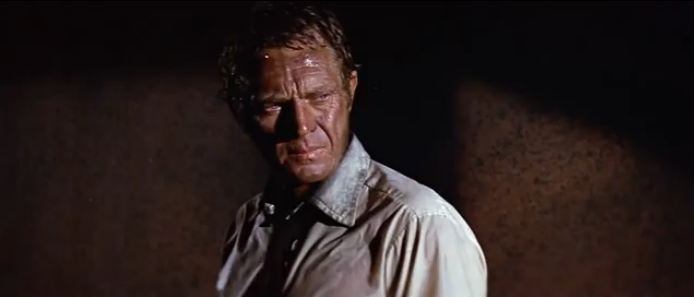
Steve McQueen is a cooler cat than Paul Newman in "The Towering Inferno"


Irwin Allen's "The Towering Inferno" (1974) was hardly my favorite 1970s-era disaster epic.  Bloated and overlong, it featured a cast of mostly wealthy fat-cat characters (except for Jennifer Jones' heroic, yet tragic, Lisolette) who you barely cared whether they would survive.  Next to Jennifer Jones, probably the most sympathetic character in the movie was Steve McQueen's smart, cool-headed San Francisco Fire Department Battalion Chief Michael O'Hallorhan.  From the moment McQueen arrives on the scene, at the 43 minute mark of the movie, you know that there is finally someone who can take command of a situation that has gone dangerously out of control.  This is due in no small part to the commitment that McQueen brings to the role, in contrast to all the other actors who just show up to collect a paycheck.

 
My understanding is that McQueen was originally offered the role that Paul Newman ultimately played in the movie, the architect responsible for designing the 138 story Glass Tower that is the centerpiece of the movie.  However, McQueen was more attracted to the comparatively smaller role of the fire chief who helps resolve the catastrophe with his steely calm and ingenuity, a role originally slated for Ernest Borgnine.  McQueen wanted to play the fire chief because he felt O'Hallorhan was the character who is working to solve the situation, whereas the architect was the character who McQueen felt was, in essence, responsible for the disaster for having designed the building.  McQueen proposed to Allen that he play the fire chief, if the role could be beefed up, and suggested that Allen cast a star of equal magnitude to play the architect instead.

 
Evidently, when Irwin Allen cast Paul Newman as the architect, this tickled McQueen because it allowed him an opportunity to verbally chastise Newman on-screen throughout the movie because of his character having designed such a dangerously tall fire trap.  (Steve McQueen purportedly always felt a sense of professional rivalry with Paul Newman ever since he played a bit part in Newman's 1956 movie "Somebody Up There Likes Me.")  According to press releases, McQueen researched his role by accompanying fire chiefs to the location of a blaze that broke out at the legendary Goldwyn Studios and lent a hand to help put out the flames.  If it were any other movie star, I wouldn't believe that anecdote, but because we're talking about the daredevil Steve McQueen, I'll give the story the benefit of the doubt.  All of this demonstrates to me the level of commitment and enthusiasm that McQueen brought to this role, which is why his performance stands out from all the others in this film.


McQueen's O'Hallorhan makes a spectacular late entrance in "The Towering Inferno," the last of all the main characters to be introduced, pulling up to the scene of the fire in his fiery red fire chief's sedan at such a high speed that he looks like he's dangerously close to spinning out of control.  But O'Hallorhan is such a cool, controlled cat that, just as the sedan looks like it's on the brink of crashing into the barricades, he suddenly brings the car under control within seconds and pulls to a fast stop.  O'Hallorhan cuts a dashing figure as he leaps out of the vehicle wearing black slacks, white short sleeved dress shirt, and black tie.  He quickly dons a firefighter coat over his uniform, with his dress shirt and black tie still showing through, which allows O'Hallorhan to look both enviably dapper and rugged at the same time.

 
Unlike the other characters in "The Towering Inferno," there is no backstory to O'Hallorhan (except that he wears a wedding ring, suggesting that he has a wife and family that he wants to stay alive and go home to) and none is needed.  McQueen's textured performance provides all the details we need to understand the essence of this man.  The moment McQueen's O'Hallorhan meets Paul Newman's blandly named architect Doug Roberts, you can sense the mild contempt O'Hallorhan feels for Roberts for having designed such a tall building.  O'Hallorhan doesn't even shake Roberts' hand when he is introduced to him and, as they ride up the elevator to the 79th floor, he can't help but mutter under his breath "Architects."  When the self-pitying Roberts responds, "Yeah, it's all our fault," O'Hallorhan explains himself, "Now you know there's no sure way for us to fight a fire in anything over the seventh floor.  But you guys keep building them as high as you can."  When Roberts lamely challenges O'Hallorhan by saying "Hey, are you here to take me on or the fire?" O'Hallorhan stares back and doesn't bother responding, knowing full well that he's already made his point.


One reason why O'Hallorhan is such a likeable character is because Paul Newman's Doug Roberts is a self-pitying Henny Penny, spending the entire film ineffectually warning everyone that the sky is falling.  Despite his concerns, he never really does anything effective to warn people of the disaster that could result due to the substandard electrical equipment that he has discovered the building has been wired with, and doesn't do enough to defy the owner of the building James Duncan (William Holden, wearing the worst pair of glasses known to mankind) when he urges Duncan to call for an evacuation of the guests celebrating the opening of the building on the 135th floor Promenade Room.  Roberts warns Duncan about the fire and is overruled, and Roberts meekly accepts this and doesn't do anything further.


In fact, it's not until Roberts informs O'Hallorhan of the party taking place on the top floor that something is finally done to warn the guests.  When O'Hallorhan sagely asks Roberts "Well why didn't you get the them the hell out of there?" Roberts lamely challenges O'Hallorhan with, "Why don't you go upstairs and talk to Duncan?  He ain't exactly listening to me."  O'Hallorhan simply responds with, "I will" and goes up to carry out the job that Roberts wasn't man enough to do.  I like the brief scene in the elevator going up to the Promenade Room where O'Hallorhan thinks for a moment, hesitates, and then reaches up to take off his fire chief helmet and firefighters coat so that his appearance doesn't cause a sudden panic the moment he steps off the elevator.  The subtle choices that McQueen makes in this scene demonstrates the degree to which he was continuously conscientious about doing justice to this role.


I like the manner in which McQueen is always able to get his way in this movie without being overbearing or smug.  He plays O'Hallorhan with a direct firmness that demonstrates his natural leadership abilities.  In the scene in which O'Hallorhan tries to convince William Holden's Duncan that the partygoers should be evacuated, McQueen never raises his voice to get his point across, nor seems annoyed or perturbed when Duncan tries to pull rank on O'Hallorhan by informing him that the Mayor of the city is in attendance and that he can order O'Hallorhan to cease his efforts to ruin the party by calling for an evacuation.  O'Hallorhan calmly tells Duncan, "When there's a fire, I outrank everybody here.  Now one thing we don't want is a panic.  Now I could tell 'em, but you ought to do it.  Just make a nice cool announcement to all your guests and tell 'em the party's being moved down below the fire floor.  Right now."  McQueen is the epitome of authority while delivering that line.  I especially like how McQueen subtly looks down at William Holden's hand when Duncan grabs O'Hallorhan by the arm to try and stop him from making a public announcement about the fire, almost as if to silently say "Did you just touch me?"  McQueen makes it clear in this scene that O'Hallorhan is a politically savvy individual who doesn't suffer fools gladly.


And we're glad that O'Hallorhan knows how to handle any situation because those skills prove to be invaluable in dealing with genuinely life-threatening situations.  When O'Hallorhan and the other firefighters realize that the elevators aren't working and they must rappel down several floors by rope through the elevator shaft, a cowardly firefighter (played by Paul Newman's late son Scott Newman) says "I can't make it.  I'll fall.  I know I'll fall."  O'Hallorhan never loses his cool nor raises his voice at the cowardly firefighter.  He simply says "OK.  Then you better go first.  That way when you fall, you won't take any of us with you."  O"Hallorhan demonstrates that he has no time for self-pity at a time like this, and McQueen delivers the line in a matter-of-fact manner, not with any jokey sense of irony that a contemporary actor might have played it.

 
O'Hallorhan's lack of self-pity is another reason why his character is more sympathetic than Paul Newman's Doug Roberts character.  Not only is Roberts ineffectual at trying to resolve the crisis, but he spends the entire movie feeling sorry for himself, almost as if to absolve himself of the guilt he feels for having designed the building which led to the deaths of so many people.  O'Hallorhan is a man who has, evidently, faced death before and has learned he doesn't have the luxury for self-indulgent self-reflection because he's too busy trying to stop the fire.  But O'Hallorhan also has compassion and human decency as well.  After he and the cowardly firefighter are able to rappel down the elevator shaft, McQueen shoots Scott Newman an approving smile that silently says "You did good, kid" to let us know he still respects him.


Throughout "The Towering Inferno," McQueen brings a lot of subtle touches to the role that help bring depth to the character and to the film.  After the harrowing sequence when O'Hallorhan rescues the women trapped on the dangling scenic elevator that had been blown off its tracks by an explosion, and holds onto a young firefighter by one hand from the roof of the scenic elevator until it is brought to the ground, there's a striking scene showing O'Hallorhan sitting on the ground in the lobby of the Glass Tower, his back to the wall amidst a row of other firefighters also taking a well-earned rest from their duties.  McQueen blankly stares straight ahead, as if O'Hallorhan is lost in his thoughts, until he is called to duty once again.  In one brief shot, McQueen demonstrates the emotional toll that weighs on the conscience of rescue workers in times of disaster.  In so doing, McQueen reminds us that O'Hallorhan is no larger-than-life Superman, but a courageous and talented human being who is simply doing his job.


At the end of "The Towering Inferno," O'Hallorhan is getting ready to leave when he stops and takes a look at the body bags for all the firefighters who lost their lives in the course of the evening.  McQueen looks quietly and calmly, without any sense of self-pity, but with a genuine sense of respect, sadness, and gratitude for their sacrifice, and turns and walks away.  As McQueen's O'Hallorhan exits, Paul Newman's architect sits on the steps outside the building with his girlfriend Faye Dunaway (in one of her most thankless roles) and muses aloud "I don't know.  Maybe they just ought to leave it the way it is.  A kind of shrine to all the bullsh-t in the world."  Newman's line helps underscore the whiney, defeatist attitude that turned me off to his character, Doug Roberts, and which probably turned McQueen off to the role when Irwin Allen originally offered it to him.

 
It's easy to see why McQueen was more interested in playing the fire chief, especially since O'Hallorhan ends the movie by looking down at the seated Roberts and telling him, "You know, we were lucky tonight.  Body count's less than 200.  You know, one of these days, they're gonna kill 10,000 in one of these fire traps.  And I'm gonna keep eating smoke and bringing out bodies until somebody asks us how to build 'em."  A humbled Doug Roberts can only look up to O'Hallorhan from where he is seated and respond with, "OK, I'm asking."  O'Hallorhan smiles and says "You know where to reach me.  So long architect."  O'Hallorhan calmly turns around, gets into the fire chief sedan he arrived in and, unlike almost all the other characters in the movie, leaves the same way he arrived.  As with the rest of their interaction in "The Towering Inferno," Steve McQueen remains in control of the situation over Paul Newman, even after the disaster has been resolved.


I always liked Steve McQueen better than Paul Newman.  There was always a genuine ruggedness about McQueen, both on-screen and off-, that made him more appealing to me than Newman, who always struck me as being entitled and elitist.  The stories I've read concerning McQueen's difficult childhood definitely gave him more grit and gravitas compared to Newman's bourgeois middle class upbringing.  Yes, both McQueen and Newman raced cars and rode motorcycles, but with McQueen it seemed more like a natural extension of his personality, whereas with Newman it always seemed affected, like he was a spoiled rich kid putting on airs.  Steve McQueen was a real man, whereas Newman always remained a pretty boy.  One thing I enjoy about watching "The Towering Inferno" is studying their interaction on-screen together.  They don't have any genuine chemistry, because I get the impression the two men don't particularly care to be acting opposite each other, but that tension and disconnect between them is fascinating and actually works in favor of the movie.  Newman always comes off in the movie as overly self-conscious as to how his character will be regarded because he designed the building, whereas McQueen doesn't give a damn what anyone thinks of him in the course of the story.  Newman's listless sincerity just doesn't seem as impressive next to McQueen's can-do self-assurance.  In so doing, Steve McQueen's fine work in "The Towering Inferno" helps to demonstrates how he was a cooler cat than Paul Newman ever was. 

Thursday, April 18, 2013

William Holden Gave His All Even "When Time Ran Out..."


I recently came across an interesting segment of "The Tonight Show" starring Johnny Carson from 1980 with Carson interviewing William Holden while he's on the show to promote his latest film "When Time Ran Out..." (1980), a terrible Irwin Allen-produced disaster film about tourists on a Pacific island fleeing in terror from an erupting volcano.  With shoddy special effects, mostly indifferent performances (especially by Paul Newman), slow pacing, and bad writing, "When Time Ran Out..." is the sort of film that makes people cynical about Hollywood filmmaking since it was produced as part of a deal Irwin Allen made with Warner Brothers to make a series of disaster movies that included "The Swarm" (1978), "Beyond the Poseidon Adventure" (1979) and countless made-for-TV movies.  My understanding is that Paul Newman and William Holden only appeared in the movie to fulfill their contractual obligation to do another disaster epic for Irwin Allen after making "The Towering Inferno" (1974) for him.  By the time "When Time Ran Out..." was made, the genre had run its course and Warner Brothers had become impatient with Allen to such a degree that they purportedly cut the budget of the movie in mid-production, thus explaining the threadbare production values and special effects.  I've read that Holden didn't like the film at all, particularly as he got billing below Paul Newman, as well as the fact that leading lady Jacqueline Bisset doesn't end up with his character at the end, but with Newman's.  I also recall reading in Bob Thomas' biography of William Holden that he drank heavily throughout the production of "When Time Ran Out..." and that that alarmed the filmmakers since the film entailed difficult stunts and locations.  As such, it was apparent that this was hardly one of Holden's proudest accomplishments as an actor.


Which is why I marveled at how charming and enthusiastic Holden was while being interviewed by Johnny Carson about the film.  After discussing his interest in African conservation and wildlife, and sharing an anecdote about making "Sunset Blvd" (1950), Holden finally gets around to discussing "When Time Ran Out..."  He describes his character and the storyline of the movie with great ease, and even goes so far as to say "It's quite exciting with a marvelous cast...good company and it's an exciting show" which I imagine must have taken a level of intestinal fortitude for Holden to say because anyone who has ever seen "When Time Ran Out..." knows that it's hardly an "exciting" movie.  Holden even jokes, when Johnny Carson points out that Mount Saint Helens had just erupted in real life, that "Irwin Allen plays long shots.  He makes this picture a year in-advance and then the day before the picture comes out Mount Saint Helens blows up.  You see, it's working...He made a picture, 'Poseidon Adventure' and I think it was the Queen Elizabeth turned over in the bay of Hong Kong.  And then we made 'Towering Inferno' and they were very obliging, the skyscraper in San Paulo, Brazil burned down."  Carson then jokes "You're not accusing anyone are you?" and Holden slyly responds "No, no..." as the two chuckle amongst themselves.  Nevertheless, I admired Holden's humility and professionalism to not denigrate the movie publicly the way so many movie stars and celebrities are apt to do these days.  Some people might say that he was being a hypocrite for not expressing his true feelings about the film, but I disagree.  Holden knew that he agreed to make "When Time Ran Out..." and that he took the money for it, and he was hardly a struggling actor trying to pay his bills at the time.  It would have been much more hypocritical, in my opinion, if he made the movie, got paid for it, and trashed it at the time of the release when the studio was still hoping to recoup its expenditures from it.  Years later, upon reflection, he would have been allowed to express his true feelings after the success or failure of the movie had already been determined by the marketplace.


Unfortunately, Holden never had that chance to be candid about "When Time Ran Out..." because he unexpectedly died a year and a half later from an accidental head injury sustained at his home in Los Angeles.  As such, "When Time Ran Out..." ended up being the penultimate performance of a talented and charismatic actor who graced some of the finest movies Hollywood has ever made.  I've always liked William Holden for his charm and warmth on-screen.  Like James Stewart, he had the courage to play unsympathetic characters that went against his natural screen image.  He was never afraid to show the sleazy and corruptible side to his characters, but we still cared about them because his innate charm still came through.  I also liked him for the fact that he grew up in South Pasadena, California--not far from where I grew up--and that knowledge gave me hope that talent and initiative might someday get me out of the San Gabriel Valley (and it has).  Nevertheless, Holden needn't make any excuses for "When Time Ran Out..." because, even though it's a terrible movie, Holden still gives it his all.  While no one in the film could be accused of giving their best performances in it, Holden still does fine work, and has about three or four scenes that allow him to demonstrate what he was capable of as an actor.  That's more than can be said for top-billed star Paul Newman, who sleepwalks his way through the movie, barely able to contain his obvious contempt for the material.


There's a scene at the beginning of the movie, where the jet carrying Holden and Jacqueline Bisset is about to land on the tropical Pacific island where Holden's character, a hotel magnate named Shelby Gilmore, has built his latest resort hotel.  He is there to inspect it while accompanied by his public relations manager, Kay Kirby, played by Bisset.  In the backstory of the movie, Holden's character is deeply in love with Bisset, but she is still in love with oil wildcatter Paul Newman, who she met and was romantically involved with while on an earlier visit to the island.  The pilot tells them that they are making their "final approach" to the island, which inspires Holden to make his "final approach" with Bisset.  He takes out a ringbox and asks her to marry him.  She tells him she can't and that he knows it is because she's still in love with Paul Newman's character.  Holden responds, "But he's not the marrying kind."  Bisset chuckles and tries to change the subject and make light of the situation by commenting that the same can't be said about Holden's much-married, and much-divorced, character.  Bisset muses aloud whether she would be his fifth, sixth or even seventh wife if she were to marry him.  Holden looks at Bisset intently and simply says "The last."  It's a simple line of dialogue, but Holden proved that he still possessed enough romantic sex appeal in this scene so that he delivers it with the requisite amount of love and sincerity.  Because of the fine work between Bisset, a real trouper and sincere professional if there ever was one, and Holden in this scene, you sense how Kay Kirby has affected Shelby Gilmore in ways that his earlier wives had not, and that he sincerely knows that she is the love of his life.  Even though the years of drinking have caused Holden to look much older than he was at the time, Holden still has enough presence to give Paul Newman's character a run for his money while competing for Bisset's hand in marriage.


Later in the film, Holden's character confronts his hotel general manager and business partner, Bob Spangler, played by James Franciscus.  Holden tells Franciscus that he has concerns about the safety of the tourists on the island due to alarming reports about the volcano's stability.  Holden angrily tells him, "Bob, I'm in the partner business.  I can't be in 64 resorts at the same time.  I have to rely on what my partner's tell me.  Up to a point.  And if I come to feel they're lying, I call in the cards."  Franciscus' character bluffs and calls his geologist, who tells him that the volcano is unstable and can erupt any moment and that they better evacuate the island immediately.  The smug and sleazy Franciscus hands the phone over to Holden, in an act of defiance to challenge Holden's authority over him.  Holden takes the phone, looks at Franciscus intently and responds "As I said before, I trust my partners.  Up to a point."  Holden then hangs up the phone and walks out.  Holden's character realizes that Franciscus is bluffing him, and that taking the call would be pointless because he already knows what the truth is.  You can tell that he's not going to waste another minute on Franciscus.  Holden establishes his character as a tough, no-nonsense businessman who doesn't suffer fools gladly.  Even though the role was hardly up to his standards as an actor, Holden still brings a sense of authority and gravitas to establish that Shelby Gilmore is a man who won't tolerate Franciscus' foolishness any longer.


Probably Holden's most touching moments in the film are with Veronica Hamel, who plays Nikki Spangler, the wife of James Franciscus' character.  In the storyline, we learn that Nikki is the goddaughter of Holden's character, and that he loves her deeply as if she were his own child.  We also learn that Franciscus' character only married Nikki in order to get to Holden's character to convince him to build a resort on that island.  When Holden and Hamel's character are reunited at the beginning of the film, and he tells her that he just saw her mother recently and that she's becoming almost as beautiful as she is, there's a warmth and familiarity emanating between the two actors which convinces you that they really are like family.  Later in the film, after the volcano has erupted, and Paul Newman's character has proposed evacuating the resort and moving everyone to higher ground on the other side of the island, Holden's character goes to Nikki's suite.  She had fallen off her horse and sprained her ankle when the volcano erupted and is resting.  Holden urgently tells her to get dressed and that they're leaving for the other side of the island.  When Hamel's character learns that her husband doesn't want anyone to evacuate the resort, she tells Holden that if her husband feels that way, he must be right and that they are safe at the resort.


Holden tells her, "I don't care what he says.  You're my responsibility and I'm taking you with me."  Hamel's character responds, "Shelby, you know my place is with him.  Right or wrong."  Holden tries to reason with Hamel, telling her, "We'll argue about that later.  Now, are you coming or do I have to carry you?"  When Hamel again refuses to leave, Holden grabs Hamel and bluntly tells her "Don't you understand?  He only married you so he could get to me!"  Hamel tearfully tells him she doesn't believe him and that "I'm not going to go with you!" as she wrests herself away from him.  Holden becomes frustrated that he can't make Hamel see the truth, and that he's lost her forever.  Before he walks out the door, Holden turns around, looks intently at Hamel, and quietly says with gravitas and sadness, "Goodbye Nikki."  Flush with anger from arguing with her, Holden's character calms down and regains his composure as he realizes that this is the last time he will ever see her again.  Holden and Hamel's performances bring a surprising level of poignancy to this subplot that make it one of the better scenes in the movie. 


Throughout "When Time Ran Out...", William Holden rises above the cliched and hackneyed storyline of the movie to make Shelby Gilmore a sympathetic and intelligent character, with strength and resolve.  His presence never becomes campy or foolish in the course of the story.  Despite his wealth and power, he remains a heroic and admirable character, one who is concerned about the safety of others rather than his own personal comfort and security.  At the end of the film, after the rag-tag group of survivors have witnessed the destruction of the resort by the volcano, Holden has a quiet moment listening to Burgess Meredith's character grieve for his wife.  Holden listens with compassion and sympathy, but we realize that he is also grieving at that moment for his goddaughter, Nikki.  Holden is subtle in that scene and allows those expressive eyes and his handsome face to convey his feelings of sadness to the audience.  In contrast, Paul Newman makes absolutely no effort to bring any feeling or depth to his character.  It's clear that Newman is on autopilot throughout "When Time Ran Out..." and, if it's true that Holden was annoyed that Newman got top-billing and won the girl in the end, I can't honestly blame him considering how he still delivered the goods despite the bad script he had to contend with, and his own personal issues at the time.  Holden's fine performance brings to "When Time Ran Out..." a few nicely acted little vignettes that stand out from the rest of the movie surrounding it.  Time may have sadly run out in William Holden's life when he made this film, but his talent, screen presence, and professionalism continue to live on.