
It's not unusual when a hit television series inspires a host of imitators containing elements that are similar to the show that preceded it. What is unusual is when the original hit show starts to emulate one of its imitators in both content, story, characterization, and casting. In 1980, NBC introduced the prime time soap "Flamingo Road" in the wake of the success of CBS' "Dallas." "Flamingo Road," like "Dallas" was produced by Lorimar and featured many of the same personnel working both behind the scenes and in front of the cameras. "Flamingo Road" originated from Robert Wilder's 1942 novel of the same name, which detailed political corruption and intrigue in a small Florida town, and later became a short-lived Broadway play in 1946, which only lasted 7 performances. In 1949, Warner Brothers bought the rights to "Flamingo Road" and turned it into a feature film starring Joan Crawford as Lane Bellamy, a tough, cynical carnival dancer who attempts to move up the social ladder in the corrupt Florida hamlet of Bolden City. While the feature film was designed to emulate the Crawford formula of films showing the rags-to-riches story arc of her characters, who are usually from the wrong side of the tracks, the TV version of "Flamingo Road" would take its inspiration from the burgeoning success of prime time soaps in the wake of "Dallas."

In the 1980s NBC TV version of "Flamingo Road," Lane Ballou (now played by Cristina Raines) was still a tough, cynical carnival dancer who decides to make a life for herself in a small Florida town (this time called Truro instead of Bolden City) after she has become burned out from traveling town to town. She started out in the 2-hour pilot movie, and in the first season of the show, as the central character of the entire series. The TV version of Lane still fell in love with deputy sheriff Fielding Carlyle (played in the 1949 movie by Zachary Scott, and in the TV version by Mark Harmon) and, like in the movie version, Field goes ahead and marries his shallow, wealthy blonde fiancee after Lane disappears from town when evil sheriff Titus Semple (Sydney Greenstreet in the feature film, Howard Duff in the TV version), who feels Lane isn't the proper romantic partner for his young protege he is grooming to run for the State Senate, has her arrested and sent to prison for one month on trumped up solicitation charges.

However, the TV version differs from the feature film in that it expands the role of Field's wealthy, shallow, blonde fiancee (and later wife), who is a minor character in the film version named Annabelle Weldon, played by Virginia Huston. In the TV version, she is renamed Constance Weldon, and is played by Morgan Fairchild. Constance and her wealthy family are much more prominent characters in the TV version of "Flamingo Road" in an effort to emulate the wealthy and powerful Ewings of "Dallas." Moreover, the dynamics of the Lane/Field love affair that kicks off the story in the feature film version is given deeper resonance by having their TV counterparts, played by Raines and Harmon, emulate the star-crossed lovers whose relationship also kicked off the story over on "Dallas," Pamela Barnes (Victoria Principal) and Bobby Ewing (Patrick Duffy).

One element that remains the same in both the feature films and TV versions of "Flamingo Road" is Lane's later, more mature and deeper, relationship with a powerful, yet decent, local businessman who she becomes involved with after breaking up with Field. In the feature film version, the character is named Dan Reynolds and played by David Brian. In the TV version, the character is named Sam Curtis and played by John Beck. In the feature film version, the filmmakers quickly establish how Field is a much weaker character than Dan Reynolds and that Lane, who started out loving Field and marrying Dan out of convenience, soon realizes that Dan is the better man for her and her one genuine, true love in life. Field's wife Annabelle is nothing more than a cipher in that version of the story. In the TV version of "Flamingo Road," Lane, Field, Sam Curtis, and Constance form a complex "love square" whose relationships with one another drives much of the storylines in the TV movie pilot and the first season of the show.

In the TV version, it is not made as clear from the beginning that Sam is ultimately the better romantic match for Lane, and so Lane is truly torn between Sam and Field throughout the first season. Meanwhile, Constance becomes a formidable thorn at Field's side as she refuses to stand by quietly while she realizes her husband is in love with another woman. For much of the first season of the show, Lane and Field are the Pam and Bobby of "Flamingo Road" because they are the star-crossed lovers who fight against outside meddling and interference to try to be together, while at the same time each of them have separate romantic partners, Sam and Constance respectively, hovering in the wings whose presence serve to complicate things further. Over the course of the series, however, Lane realizes that Sam is the man she truly loves and is able to regard Field as only a friend, while Field and Constance's marriage of convenience degenerates into a business arrangement marked by bitterness and resentment.


What's odd about the Lane/Field/Sam/Constance love square isn't so much that Lane and Field from the Joan Crawford "Flamingo Road" movie of 1949 were reconfigured to emulate Pam and Bobby on "Dallas" so much as the fact that, over on "Dallas" in the 1983-84 season of that series (which took place a year after "Flamingo Road" had been cancelled by NBC in 1982) another love square scenario was created that directly echoed the earlier one. (The parallels between the characters on both shows were first acknowledged by the insightful and witty commenter "James in London" on the Soapchat.net message boards back in 2006.) By the 1983-84 season of "Dallas," starcrossed lovers Bobby and Pam had had their marriage broken up because of the meddling of Bobby's older brother JR Ewing (Larry Hagman) and Pam's conniving half-sister Katharine (Morgan Brittany), similar to the way Lane and Field were broken up in the "Flamingo Road" pilot when Sheriff Semple, at the urging of Constance and her father Claude Weldon (Kevin McCarthy) has Lane thrown in jail. Her disappearance causes Field to believe she didn't love him, so he goes ahead and marries Constance on the rebound while Lane is in jail. This chain of events foreshadows how Katharine on "Dallas" causes Bobby to believe that Pam doesn't love him anymore and wants a divorce by reading to him a phony letter that her sister purportedly wrote to her divorce attorney expressing how she wants a life separate from Bobby. While Bobby and Pam are apart from one another, they each become romantically involved with other individuals whose presence in the story also serve to muddle the situation and keep the star-crossed lovers from finally being together. Bobby starts dating his former childhood sweetheart Jenna Wade (Priscilla Presley), while Pam is courted by wealthy playboy Mark Graison.


What's ironic about this situation is that Jenna on "Dallas," like Constance on "Flamingo Road," is a character that everyone thought would, and should, have married Bobby from the beginning (just like everyone on "Flamingo Road" naturally assumed Field and Constance were betrothed to marry one another from childhood). The irony is further deepened by the fact that Constance on "Flamingo Road" is played by Morgan Fairchild, the actress who originated the role of Jenna Wade in a one-shot guest star appearance on "Dallas" in 1978. Moreover, the wealthy Mark Graison, who dates and distracts Pam on "Dallas" while she pines for Bobby--the same way Sam Curtis dated and distracted Lane Ballou on "Flamingo Road" while she was pining for Field--is played by John Beck, the same actor who played Sam on "Flamingo Road." (Got all that? Good.) One wonders if the similarities between the Lane/Field/Sam/Constance love square on "Flamingo Road," and the Pam/Bobby/Mark/Jenna one on "Dallas," was simply mere coincidence or by design. In creating a pair of similar love squares on two separate shows sharing similar elements, both "Dallas" and "Flamingo Road" appear to be ironically commenting on one another.


Even though the "Dallas" characters and storylines resonate with me on a much deeper level because it was such an iconic show and was such a large part of my television viewing growing up, I have to admit that there are aspects of the Lane/Field/Sam/Constance storyline on "Flamingo Road" that makes me admire those characters better. Lane on "Flamingo Road" and Pam on "Dallas" both jumpstarted their individual series when they made personal decisions that brought them into new and potentially treacherous territory--Lane leaves Coyne's traveling carnival and decides to live in Truro, Florida, while Pam marries the son of her family's archenemy Jock Ewing (Jim Davis) and moves onto Southfork. They both started their shows as feisty, independent, assertive and earthy women. In fact, Pam's character in the original five-episode miniseries that started the epic "Dallas" saga, was originally intended to be the main character of the show, telling the story of the Ewings from an outsider's perspective. However, by the Fall of 1978 when "Dallas" returned after the original five-episode miniseries, that had debuted earlier that Spring, and became a regular weekly show, Pam had already started to lose elements of her assertiveness and independence.

Even though she kept her job working at the department store, she soon takes to living on Southfork and becoming identified as an Ewing once she is able to find acceptance with most of the Ewing family, except for JR. She starts competing with Sue Ellen (Linda Gray) to establish herself as the lady of the house and, over time, Pam becomes wimpier and wimpier to the point where she no longer resembles the admirable character that she started out as. (Her emotional instability over being unable to bear a child of her own contributes greatly to Pam's deterioration as a force to be reckoned with on this show.) When Victoria Principal left "Dallas" in 1987, after Pam was badly burned and disfigured in a car accident, the producers explained her absence by having Pam run away from the hospital and abandoning her husband and child, due to her irrational concerns over how they would react to seeing her badly disfigured from the accident. The old Pam of the 1978 miniseries would have stood her ground and faced this crisis head-on with her family and loved ones providing moral support by her side. The Pam that she eventually turned into was someone who couldn't face a crisis when the chips were really down.

I acknowledge how it might be unfair to compare Pam's disintegration as a character with Lane Ballou's unwavering strength and integrity as an individual because "Flamingo Road" only lasted two seasons. Nevertheless, Lane never lost that sense of being an outsider, that grittiness and earthy assertiveness even after she marries Sam in Season Two and moves onto Flamingo Road and becomes a neighbor with all the people who tried to drive her out of Truro the year before. (At the very least, there was no suggestion that Lane was losing her sense of resolve as quickly as Pam did within the same amount of time on "Dallas.") When Lane comforts her best friend Lute-Mae Sanders (Stella Stevens), who runs the town roadhouse and brothel, after she has been humiliated by evil Michael Tyrone (David Selby) and has had her dreams shattered that she would marry Michael and eventually rise up in society by moving onto the elite Flamingo Road, Lane reassures her distraught friend, through gritted teeth, "You belong there, same as anyone else in this lousy town!" Lane's reassurance of Lute-Mae underscores the extent to which she still hasn't completely bought into, nor embraced, the rarefied environment that she has suddenly entered into, even though she is happy living on Flamingo Road, especially after she and Sam learned they were expecting a baby. In contrast, on "Dallas," I don't think Pam ever really reasserted her independent, outsider status as a member of a Barnes family unless it was at key moments where Bobby and Pam's marriage was at a crisis, or if she felt she needed to prove something to others. When Pam goes back to work at the department store after marrying Bobby, it's to demonstrate that she won't be a trophy wife like Sue Ellen. In contrast on "Flamingo Road," after Lane marries Sam, she continues singing at Lute Mae's roadhouse. Sam never suggests to her that she should give up her singing career just because she's married, and clearly supports her continuing to work, which strikes a refreshing contrast to how Bobby attempted to discourage Pam from continuing her own career. Lane demonstrates her healthy skepticism and strength of character when she underscore how she's still an outsider, and isn't willing to buy into the status quo, even as things are going well for her life.


Moreover, Pam on "Dallas" might have had moments sparring with JR, but Larry Hagman's confidence in all of those scenes merely underscored how JR was completely in control of the sitaution. Pam always becomes emotional in her confrontations with JR, which is why he almost always wins their sparring matches. On "Flamingo Road," Lane never hesitates to stand up to the people in Truro who want to drive her out of town--particularly Titus Semple, the de-facto JR of "Flamingo Road"--even when doing so potentially puts her in greater danger than Pam ever faced confronting JR on "Dallas." Lane even spits in Titus' face in the pilot episode and later develops a calm, controlled attitude around Titus so that he never gets the impression that he's got the upper hand on her. In one episode of "Flamingo Road" Titus shows up at Lute-Mae's roadhouse to intimidate Lane and begins to tell her a metaphoric story concerning how to handle a misbehaving fox who tried to steal chickens from the hen-house in order to intimidate her. When Titus senses Lane's disinterest in the story, Lane glibly and insolently comments, "I never liked your stories, Titus. They usually get me in trouble." Over the course of "Flamingo Road," Lane's role diminishes due to the fact that her final breakup with Field, coupled with the fact that she's no longer in love with him, means that dramatically, Lane's presence in Truro no longer poses a threat to Titus or anyone else. Nevertheless, Cristina Raines handles her individual scenes in Season Two with the same level of spontaneity and authenticity, and her chemistry with both Mark Harmon and John Beck, respectively, remained flawless. Raines effectively underscored how Lane's love for both Field and Sam had different qualities unique to each man. Her part may have grown smaller, but she still gave nuanced and vivid performances in each of her individual scenes. She never became as overwrought and mannered as Victoria Principal could be at times in her later seasons of "Dallas." This is due to the fact that, respectfully, Cristina Raines was a better, more interesting actress than Victoria Principal ever was. It's not for nothing that Raines' epic 1970s ensemble movie appearance was in Robert Altman's Oscar-nominated and influential "Nashville" (1975), considered one of the finest films of the decade, while Principal's comparable epic 1970s ensemble feature film was the melodramatic and artificial, yet entertaining, "Earthquake" (1974).

Raines was particularly good during Season One demonstrating her feelings of loneliness and sadness while Lane was separated from, and deeply missed, Field. Lane wasn't really at fault for the breakup of her relationship with Field in the pilot episode, because she was railroaded into jail by Titus. She fully intended to reunite with him once she was out of jail, and even courageously returns to Truro after her release, despite knowing that her presence would only provoke more harassment by Titus. We have more sympathy for Lane being separated from Field than we do for Pam being separated from Bobby on "Dallas," because it was Pam's own self-indulgence and stupidity that caused her marriage to Bobby to end. Pam blamed Bobby for the death of her mother Rebecca Wentworth (Priscilla Pointer), who was collateral damage during the contest between JR and Bobby to win Ewing Oil during the 1982-83 season. She allowed herself to be wooed by an aggressive Mark Graison while she was separated from, but still married to, Bobby. And she continually sent out mixed signals to Bobby and Mark which caused both men to be frustrated with her indecision as to who she would ultimately choose to be with. Pam contributed to the dissolution of her relationship with Bobby by not making it clear to herself, and to others, what it was that she really wanted, in contrast to Lane who was much more transparent and straightforward about herself and her actions.


I've always sensed a self-satisfied smugness about Patrick Duffy ever since he left "Dallas" in 1985 to try and pursue what he thought would be a successful movie career, insisted to the producers that they had to kill Bobby off because his ego would not allow him to see someone else play his role, and then returned a year later and caused the whole 1985-86 season to turn out to be a dream. He rarely seemed to realize or acknowledge how his thoughtlessness might have cost actors who were introduced during the dream season their jobs when he decided to return to the series. (I also recall when he appeared on "Donahue" after he returned to "Dallas" and told an audience member that he, frankly, didn't care that he caused trouble over on "Knots Landing" because that show acknowledged Bobby's death and couldn't rewrite its history by dismissing it as a dream. Not that I particularly care about "Knots Landing," either, but Duffy's arrogance and hubris over the whole issue, and how he and the show handled it, was off-putting.) He never seemed to have the sense of professional integrity, strength of character, and conscientiousness that I sense from Mark Harmon, who always gives the impression, especially from his work on "NCIS," as being a good leader and team player both in front of the camera and behind the scenes, qualities that he must have learned from his father, college football player and Heisman trophy winner Tom Harmon, and later on his own when he was a star quarterback for the UCLA Bruins. I can't imagine Harmon ever thoughtlessly doing something on "NCIS," for instance, that might cost people their jobs. I think the contrasting individual qualities that I feel Duffy and Harmon appear to have off-screen were reflected in their own work on-screen in "Dallas" and "Flamingo Road," with Bobby coming across much less sympathetically than he was intended to be, and Field coming across much more admirable than originally conceived.

One might assume that the Sam Curtis character on "Flamingo Road" and Mark Graison on "Dallas" to be mere carbon copies of one another due to the roles they served on their respective shows, and particularly because they were both played by John Beck. However, Sam comes across as far and away the much more sympathetic and admirable character. Unlike Mark Graison, Sam is a self-made businessman, someone whose wealth and success was earned and not inherited. Sam has integrity and self-respect and will go out of his way to protect those that he cares about. Mark Graison might be considered a "nice guy" on his show, but fans of "Dallas" have never warmed up to his character. (My brother even refers to Mark Graison at times as an "ugly muppet.") There's a certain entitled, presumptuous cockiness and arrogance in Mark that the humble Sam Curtis simply does not possess. What also makes me respect Sam Curtis is the fact that he won't settle for mere crumbs or second-best from Lane the way Mark will from Pam. On "Dallas," Mark Graison might complain to Pam that she is still hung up on Bobby and that she should get on with her life, but he does nothing proactive to stand his ground with her. He's willing to go along to get along with Pam, and he doesn't seem to have enough self-respect to walk away from someone who has been stringing him along the way she has. Mark's lack of self-respect and inability to walk away from a woman who doesn't love him enough is probably one reason why "Dallas" fans have never admired him--as to be expected from someone who inherited his wealth, instead of earning it on his own, he's willing to settle for being second-best as long as he gets Pam in the end.

In contrast, Sam on "Flamingo Road" won't accept being a convenient person to fill the empty void in Lane's life while she's on the rebound from Field. He continually challenges Lane to make proactive decisions with her life. In one episode, Constance and Field have been kidnapped for ransom while they are honeymooning. Sam offers to take his helicopter and fly over the large expanse of ocean in the Gulf of Mexico where the authorities believe that they are being held captive on a boat. Lane asks Sam why he's willing to go out of his way to try and rescue Field. Sam explains to Lane that, someday, she is going to have to choose between him and Field, and Sam doesn't want to win Lane by default. I always liked that line. It made me admire Sam much more than Mark, because it demonstrated the extent of Sam's self-respect for himself that he isn't willing to settle for second-best with Lane. Later in Season One, when Field and Lane have reunited, leaving Sam and Constance out in the cold, Sam leaves town for awhile and, when he returns, gives Lane the cold shoulder. Sam even has a one-night stand with Constance, which allows both rejected lovers to vent their frustrations, at being dumped by Lane and Field, with one another. (Mark Graison would never have the guts to do that with Jenna Wade, even if Pam dumped him for Bobby.) Even after Field returns to Constance, Sam maintains a distance from Lane for awhile until their relationship resumes in a natural, healthy manner. When Constance has been injured in a fall, which leaves her paralyzed and ensures that Field cannot leave her or else risk a political scandal, Sam tells Lane that she may as well leave Truro because she now has nothing left to keep her in town. While I like the intelligence and assertiveness of Lane's character, I also admire how Sam holds her to a high standard, doesn't accept any excuses from her, and isn't waiting around pining away for her when she's gone back to Field. Sam respects Lane as an equal and doesn't put her on a pedestal the way Mark Graison does with Pam over on "Dallas." I was never comfortable with the way Mark described how he wanted to show off Pam to all of his jet-setter friends while he was planning his lavish wedding to "debut" her to his associates. It made her seem more like a possession that he has won as opposed to a full-fledged partner who he has earned through love and respect. Whereas Mark Graison just came across as needy where Pam was concerned, Sam was a character who was needed by those around him over on "Flamingo Road."


When Lane and Sam get married in Season Two of "Flamingo Road," it is because Lane has truly grown to love Sam and wants to be with him without reservations. She now regards Field as only a friend and is not in love with him anymore. As such, both Sam and Lane's future looks bright the last time we see them on "Flamingo Road" because they are together for all of the right reasons. They are not marrying each other out of a sense of desperation or obligation. In contrast, when Pam decides to marry Mark over on "Dallas" in the 1983-84 season it's only because she has learned that he is dying of a fatal disease. She had previously admitted to Sue Ellen that she was going to turn down Mark's marriage proposal because she still loved Bobby. Pam decides to play martyr and agrees to marry Mark, and even manipulates Mark's best friend and doctor Jerry Kenderson (Barry Jenner) to hold off telling him about his illness until after they are married, to ensure that Pam will be with Mark no matter what happens after he learns he is dying. As such, Pam demonstrates to extent to which she doesn't regard Mark as an equal partner who deserves to know what is happening to him. She treats him with condescension, disrespect, and pity when she agrees to marry him. In so doing, by announcing her engagement to Mark, she continues sending mixed signals to Bobby as to who she wants to be with, which causes him to decide to get on with his life and propose to Jenna Wade. Unlike Lane and Sam, who were always honest with each other about their feelings, Pam and Bobby continue to contribute to their own separation by failing to take the time to be honest with themselves and with others.


The relationship between Sam and Field on "Flamingo Road" is also much more complex and nuanced than is the comparable Mark and Bobby relationship on "Dallas." On "Flamingo Road," Sam is helping to back Field's candidacy for the State Senate during Season One. As such, Sam has to help strategize and groom Field for his future career in politics and becomes frustrated at times with what he perceives to be Field's passivity and weakness. His professional frustration with Field is further compounded by the fact that the woman he is in love with, Lane, is still in love with Field. Sam has to help the political career of a man who is also his romantic rival in his personal life. Even though there is tension throughout "Flamingo Road" between Sam and Field, in many ways they are similar in that they are essentially decent men and, in certain instances, have common goals in life. In the Season One finale of "Flamingo Road," when most of the characters are trapped at Lute-Mae's roadhouse during a hurricane, Sam and Field put aside their differences when they learn that Lane is being terrorized by mobsters who have come to Truro to take her back with them. Sam and Field conspire to help apprehend the mobsters, who have also taken refuge at Lute-Mae's during the storm, so that they woman they love no longer has to live in fear. Later, in Season Two, Sam and Field team up again to help topple Michael Tyrone's efforts to pass a bill in the state legislature to allow gambling in Truro. By that point, Sam and Field were on the path to becoming genuine friends now that Lane had finally chosen Sam as the one she wanted to be with.


In contrast, Bobby and Mark have no such nuanced relationship with each other on "Dallas." They only dealt with each other occasionally, as when Bobby comes to pick up Christopher from Pam's house for his weekend visits with his son, or when all of them ran into each other at the Oil Baron's Ball. They are only related to one another as being rivals for Pam, and nothing more. It might have been interesting if Mark Graison's business empire was somehow connected to Ewing Oil, but the fact that it isn't demonstrates how Mark is merely a figurehead in his own business empire, whereas Sam Curtis on "Flamingo Road" is a vital, vibrant civic leader in his own community. You sense that Bobby and Mark are mildly annoyed with each other, but nothing else is developed between them that was as interesting as the Field/Sam interactions on "Flamingo Road."


The final component in the love squares on both "Flamingo Road" and "Dallas"--respectively, Constance and Jenna Wade--are generally unsympathetic characters on their individual shows. Constance on "Flamingo Road" is spoiled, entitled, shallow, and petty. She treats Lane with condescension and disrespect, never realizing that she herself comes from a tawdry pedigree, being the biological daughter of the town's brothel owner, Lute-Mae. Constance effectively fills her role as the female antagonist on "Flamingo Road" without ever providing any suggestion that anything else is going on underneath that facade. Even when Field has an affair with Lane while he is married to Constance, I never really think of Constance as being the "wronged woman" as the esteemed James in London on the Soapchat.net message boards has described her as in this scenario. Constance's whining, complaints and urgings to Titus motivated him to railroad Lane into prison and caused Field, on the rebound, to set a wedding date to marry Constance. Constance knew when she was marrying Field that his heart belonged to another woman and that she had caused her rival to be eliminated temporarily. Later, when Field and Lane reunite, Constance conspires with Titus to have the mobsters, who have been searching for Lane, find her in Truro and take her away, knowing full well that the mobsters might kill Lane. Constance sacrifices her humanity and loses our sympathy because she is willing to conspire to commit murder to eliminate her rival.
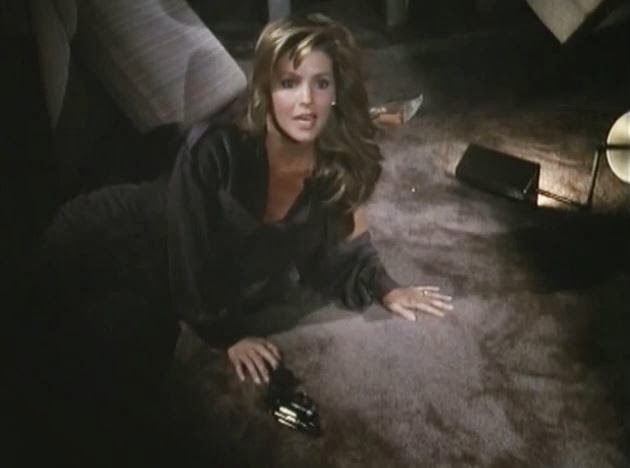

If there is a redeeming quality to Constance, it's that she never comes across as a passive character the way Jenna, as played by Priscilla Presley by that point in the series, does. Jenna motivates the plot on the show by virtue of what she doesn't do. She doesn't come clean to Bobby about who is truly the father of her child, and she continually allows herself to be put-upon and victimized during her time on the series. She allows her ex-husband Renaldo Marchetta (Daniel Pilon) to blackmail her into marrying him again, she allows herself to be set up on trumped up murder charges, and all of these actions culminate in getting herself railroaded into prison. Later, she allows herself to play victim when Bobby decides to remarry Pam and passively pursues Ray Krebbs (Steve Kanaly) by allowing him to visit her frequently while he is breaking up with his wife Donna (Susan Howard). Like Constance on "Flamingo Road," however, the Priscilla Presley version of Jenna also appears to have a sense of entitlement about herself. While dating Bobby, she and Charlie make themselves at home on Southfork, continually helping themselves to the Ewing estate as if they have a divine right to be there. Later, when Jenna is making nice to Ray while he is estranged from Donna, both Jenna and Charlie stake a claim on Ray's residence as if they inherently belong there. Jenna irritates fans of "Dallas" because of how she inserts herself into estranged marriages and relationships and prevents the couples in-question from being able to resolve their differences without interference. She is a passive-aggressive character, whereas Constance, despite her inherent shallowness, at least motivates and drives the storylines on her show by virtue of taking action.


While I'm no fan of Morgan Fairchild, at least she proves to be a good sparring partner. Fairchild and Cristina Raines made the scenes between Constance and Lane crackle with fire and intensity, demonstrating how the antagonism between their characters were brewing close to the surface. Constance continually condescends to Lane throughout the series with an unjustifiably aristocratic air of superiority (which is ironic since we, the audience, knows that Constance was actually the illegitimate daughter of the town prostitute, Lute-Mae, and was later adopted by her own biological father, Claude Weldon without Claude's own wife Eudora knowing her true parentage). In a scene during Season One, Constance shows up at the beauty parlor while the effeminate hairdresser Mr. Eddie is about to wash Lane's hair. Constance insists that Mr. Eddie work on her hair first in order to conform with her busy schedule. In so doing, Constance demonstrates her sense of entitlement towards preferential treatment that she feels "common" people like Lane do not deserve. Lane only gives up her place in the queue not out of any sense of intimidation or inferiority, but in order to ensure that Mr. Eddie doesn't get caught up in Constance's petty class squabbles. Constance again tries to draw a line between the elite and the rest of society when she and her friends attempt to shun and humiliate Lane while she is playing tennis with Sam at their exclusive club. Constance further tries to humiliate her rival on a class-basis by attempting to exclude her from a formal reception that is being held in Field's honor. "Flamingo Road's" leading ladies Lane and Constance are more interesting than Pam and Jenna on "Dallas" simply by virtue of the fact that their show plays up the class distinction between their characters. Lane and Constance would have disliked one another whether or not they were both in love with Field.


In contrast, the Pam and Priscilla-Presley-as-Jenna scenes on "Dallas" are not nearly as interesting because both women are too lady-like to lay their cards on the table as much as we would like. The writers never take advantage of the tension that could have existed between their characters had they emphasized how Jenna started out in life the rich and spoiled daughter of an oilman, and ended up poor in her adulthood; while Pam started out poor and ended up becoming rich when she was older. On "Dallas," Pam and Jenna don't like each other only because they both want Bobby and nothing more. Jenna was actually much more interesting when Fairchild played her briefly in 1978. Fairchild was subtly scheming and manipulative, but brought some surprisingly sympathetic qualities to Jenna that would have made her later incarnation, when she returned in 1983, much more compelling than what Presley made of the character. In the scenes that Principal had with Fairchild in 1978, both actresses gave as good as they got and the scene where Pam confronts Jenna and demands that she admit whether Bobby is the father of Jenna's daughter, was much more engaging and thrilling than any scene Principal and Presley had later on in the series. Fairchild's work as Jenna in her single 1978 appearance on "Dallas" might have been some of her best work as an actress (which, admittedly, isn't saying much in the end).

Even though the Lane/Field/Sam/Constance love square on "Flamingo Road" has more interesting elements at times than the Pam/Bobby/Mark/Jenna love square on "Dallas," it's the latter one that emotionally engages us more by virtue of the fact that we have had the opportunity to become more involved in the "Dallas" love square than the one on "Flamingo Road." "Flamingo Road," unfortunately, only lasted two seasons and produced a 2-hour pilot movie and 38 regular episodes, whereas the "Dallas" love square had at least 5 seasons of backstory built up by that point to hold our attention. Bobby and Pam were the characters we had started out caring about since 1978, which is probably one reason why John Beck as Mark Graison was much more despised in my opinion than when he played Sam Curtis on "Flamingo Road." We despise Mark because he was interfering with the reconciliation of a couple who had been married for at least 5 years by the point he entered into the picture, whereas Sam was not being an interloper on a long-established relationship when he started dating Lane, who had only known Field for a few weeks by that point and hadn't even been married to him. Even though the "Dallas" love square has greater resonance due to its longevity and iconic influence, the concurrent love square on "Flamingo Road" shouldn't be dismissed outright just because it was comparatively abbreviated. Within a shorter period of time, "Flamingo Road" was able to create characters and situations and scenarios in its own love square that compared favorably in terms of intrigue and inspiration as the one that appeared on its more famous progenitor, "Dallas."


