Showing posts with label Buck Taylor. Show all posts

Sunday, August 9, 2015

The Unresolved Love Between Marshal Matt Dillon and Miss Kitty Russell on "Gunsmoke"


In order to understand how television has changed through the years, one would have to consider the on-screen relationship between Marshal Matt Dillon (James Arness) and saloon owner Miss Kitty Russell (Amanda Blake) on the classic Western series "Gunsmoke," which ran on CBS from 1955 to 1975.  When the series began, "Gunsmoke" was a fairly straightforward, intelligently made Western, that ran 30 minutes and was shot in black and white.  As the popularity of the show continued to grow through the years, the show's running time expanded to 60 minutes a week and was eventually filmed in color.  But it wasn't just the appearance of the show that changed, as the format and perspective of the show continued to grow as well.  While Matt Dillon remained the central protagonist, and Dodge City remained the main setting for the series, later episodes would allow other members of the ensemble, or a guest star who either lived in Dodge City or had some tangential relationship with the core cast or locale, to take center stage.  This allowed later seasons of "Gunsmoke" to push the boundaries of the weekly Western format and become more like an anthology series at times.  In so doing, the characters and situations on "Gunsmoke" continued to evolve as the series explored deeper, more psychological and emotional territory than it had at the beginning.  There was always much more than met the eye with this series.


Even though the show continued to evolve, and the characterizations developed more resonance, one aspect of the show that remained enigmatic at times was the nature of the relationship between Matt Dillon and Miss Kitty.  It's been argued that they were lovers the entire time of the series, while others view the relationship more as a platonic friendship.  James Arness and Amanda Blake wisely played their scenes together with restraint and warmth, yet infused with genuine sexual chemistry, so that it worked on multiple levels as both a friendship and a romance.  Arness himself acknowledged in an interview before his death that the series intentionally kept their relationship alternately vague and unresolved because the producers felt that allowing them to have a full-blown on-screen relationship would drastically change the nature of the show.  In its decision to not further develop the Matt/Kitty relationship, I don't think "Gunsmoke" was afraid of allowing the show a level of complexity so much as not wanting to make the show focused solely on them.  I believe the producers of "Gunsmoke" wisely decided to allow it to remain an ensemble piece about the characters that pass through Dodge City and the surrounding environs.
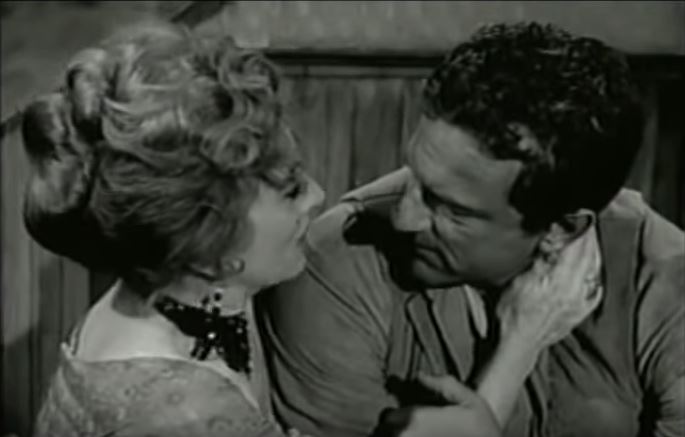

However, if the show was made now, I have no doubt that the Matt/Kitty relationship would be the central thrust and focus of the entire series, at the expense of all the other elements that made it unique and successful.  I think such a tactic would deprive the show of the air of mystery and wonderment that defines the relationship between Matt and Kitty.  As fans of the show, we want to imagine that there is something deeper, more resonant going on underneath the surface that underscores the love and caring the exists between those characters.  At the same time, I think "Gunsmoke" fans also appreciate how Matt and Kitty feel a genuine friendship and respect with one another that they wouldn't want to see ruined if they ended up having a full blown affair that brings with it all the complications that would entail such a relationship.


Through the years, the show gave us little glimpses and hints as to how Matt and Kitty feel for one another, but no other episode addresses it more directly than the epic, exciting three-part segment from 1971, "Gold Train: The Bullet."  In it, Matt Dillon is shot in the back, with the bullet dangerously lodged near his spine.  Doc (Milburn Stone) fears that he does not have the proper training to operate to remove the bullet, so he decides to have Matt transported by train to a surgeon in Denver, while lying face down in the freight car.  Kitty, Festus (Ken Curtis) and Newly (Buck Taylor) also accompany Doc and Matt on their journey.  During the trip. the train is hijacked by a band of outlaws determined to steal the U.S. Army gold shipment that is on board.  The leader of the outlaws is Jack Sinclair (Eric Braeden) whose hand was wounded years earlier by Matt Dillon.  In order to protect Matt from being killed by a vengeful Sinclair, Doc lies to the outlaws that Matt is a patient under his care who has died and that his name is Walters.


A shifty female prisoner being escorted by law enforcement officials back to Denver named Beth Tipton (Katherine Justice) correctly deduces Matt's identity and begins taunting Kitty that she'll reveal the truth to Sinclair if it will ensure that he will take her along with him once he is finished looting the train.  At first, Kitty tries to play dumb and act as though she has nothing to do with the dead Mr. Walters in the freight car.  Beth Tipton sees through Kitty's subterfuge and tells her that, when she saw the level of concern Kitty felt for Matt as he was being loaded onto the freight car, "I could tell that he was your man....They just said his name was Walters.  That's very strange.  When I got on the train, I heard the conductor say his name was Dillon.  Marshal Dillon...If the name isn't Walters, then maybe he isn't dead either."   Amanda Blake's low-key, poker faced reaction to this threat helps underscore Kitty's level of concern and love for Matt.  By not overacting (and overreacting), Blake demonstrates the fear Kitty feels for Matt's safety, as well as her decisiveness in choosing to do what she can to prevent Beth Tipton from informing Sinclair as to his identity and presence on the train.


Later, when Kitty notices Beth chatting with Sinclair, the fiery redhead confronts the unscrupulous woman, in order to learn whether Beth has revealed what she knows, and finally admits her true feelings for Matt and the nature of her relationship with him.  Kitty warns Beth that revealing Matt's identity and whereabouts on the train will cause him to get killed.  Beth glibly replies, "So what?"  An outraged Kitty strikes Beth across the face and says "Don't you try buckin' me, honey.  As tough as you think you are, I'm a lot tougher.  You're right.  He IS my man.  And I'll do anything to keep him alive, even to killing the likes of you."  Again, Blake underplays what could have been a melodramatic moment by having Kitty issue her threat to Beth in a restrained, yet determined, manner.  In so doing, Blake brings a sense of assurance and authority to the character that demonstrates Kitty's ability to hold her own against dangerous adversaries even in times of crisis.


But no other scene in this three-parter underscores Matt and Kitty's relationship better than a quiet, lengthy monologue and soliloquy that she has later on.  Matt has started to lose feeling in his legs due to the bullet, and Kitty tries to convince Doc to operate immediately.  Doc refuses to operate on Matt for fear that his lack of experience with spinal injuries will either cripple or kill Matt.  A resigned and exhausted Kitty goes back inside the freight car, sits next to Matt's unconscious body and reminisces about the day she first met him.  Blake's amazing monologue has always blown me away and I'm surprised it hasn't been acknowledged or written about more often by television fans and critics.


Leaning back against the wall, while looking straight off into the distance, Kitty recalls her arrival in Dodge City: "Seventeen years ago this month.  I'll never forget that first day as long as I live.  It was raining.  And I was cold and hungry and miserable.  When I stepped off that stagecoach, and saw those ugly buildings, all those muddy streets, I hated Dodge City.  I was down to my last forty dollars and it couldn't have taken me much further.  But you couldn't have paid me to stay in Dodge.  I waded over to the cafe and was hurrying through breakfast so I could get back on the stage.  Then a man came in and he sat down across the room from me.  He was the biggest man I have ever seen in my life.  And he also ate the biggest breakfast I've ever seen in my life.  He was so busy polishing off all his eggs and ham and biscuits and he didn't even notice me.  But I noticed him.  I noticed him so much that I decided to stay for awhile.  And stay I did, despite of the fact that I found out that the big man wore a big badge and he didn't think he had any right to get involved in any kind of permanent relationship.  Oh, we REALLY fought some battles about that.  Seems to me that I left three or four times, just swearin' up and down that, under any circumstances, was I gonna see him or his damn badge again.  I always came back.  And, once, he even came to get me.  Now, here we are.  After 17 years, and that's got to be the LONGEST, non-permanent relationship in history.  But I wouldn't change one day of it...not one day."  In response to Kitty's heartfelt remembrance, Matt regains consciousness, struggles to raise his torso while wincing in pain, turns partway towards Kitty, and says (while not looking directly at her), "I noticed that day, Kitty.  I noticed."


James Arness, in the aforementioned interview, indicated that fans frequently wrote to the show's producers complaining that the relationship between Matt and Miss Kitty remained low-key and unresolved.  The fans wanted the producers to finally bring the relationship to fruition, perhaps to even allow them to get married on-screen.  However, I think it's because the show hasn't beat viewers over the head with the romantic aspects of their relationship that Kitty's monologue in the "Gold Train: The Bullet" episode, and Matt's acknowledgement of it, carries such weight and resonance.  We've already seen, in the 17 years leading up to this episode, the warmth and respect that these characters have for one another (while they are involved in story lines that aren't always, directly or indirectly, about their relationship) that we don't need to see or hear about it all the time.  Even if the moments concerning their relationship mentioned by Kitty sometimes took place off-screen, Kitty's monologue still feels believable because we already sensed something was going on between them that her reminiscence simply helps to fill in the gaps as to what we know.  As such, when it came time for "Gunsmoke" to really address Matt and Kitty's love for one another, it never feels forced or artificial, and the result is that it carries tremendous feeling and impact.  The scene, and Kitty's genuine love and concern for Matt throughout this particular three-part episode, would not have worked as well if their relationship was a constant, heavy-handed element in the series.


What makes Kitty's monologue carry even more resonance is our knowledge that Matt and Kitty don't end up together in the long run.  Amanda Blake left the series in 1974 when she decided not to appear in the 20th and final season of "Gunsmoke," and in the reunion movie "Gunsmoke: Return to Dodge" (1987), Matt and Kitty are reunited, but ultimately part for good at the end of that story.  In subsequent "Gunsmoke" reunion movies that feature Matt Dillon (which were made after Blake died in 1989), Kitty is nowhere to be found.  I think stories that involve an unresolved romantic longing between individuals always carry with it more impact than ones that end conventionally.  (Look at "Gone with the Wind" if you doubt what I'm saying.)  Even though I would have liked to have seen Matt and Kitty spend the rest of their lives together, I'm still satisfied knowing that they had a special friendship that lasted through the years, and that they had a positive impact on each other's lives that we were fortunate to have witnessed and experienced.

Sunday, March 9, 2014

"Guest Starring Jess Walton..."


Actress Jess Walton is best known for her successful and continuing 27 year run as Jill Foster Abbott on the CBS daytime soap opera "The Young and the Restless."  However, before she hit her stride in daytime, Walton was already a promising, successful actress starting from the early 1970s when she was under contract to Universal and working under the auspices of Monique James and Eleanor Kilgallen, who ran the studio's New Talent program.  As I've written about before, while interviewing actress Ana Alicia, the purpose of the Universal New Talent program was to discover young actors and actresses, and put them under contract, so that Universal could use them for their films and TV shows and groom them for stardom.  Jess Walton was one of the best and brightest of the Universal contract players of the 1970s.  Beautiful, with slightly unconventional features that only served to give her face depth and character, Walton was a welcome presence as a guest star on many of the major prime time television shows of that decade.


In many ways, she was a slightly younger version of the sort of intense, husky-voiced brunette that actresses like Suzanne Pleshette, the similarly named Jessica Walter, and Elizabeth Ashley exemplified.  However, unlike those actresses, Walton was considerably less mannered, less severe and cold, and less self-indulgent than Pleshette, Walter, and Ashley could be at times.  Walton rarely over-indulged or overacted as an actress.  Universal should have promoted her into feature films throughout her tenure with the studio, but the 1970s being what they were, feature films were made up with leading ladies who were flaky (such as Diane Keaton) or weird (such as Karen Black).  This is not to suggest in any way that Jess Walton was a "conventional" actress.  Walton is a versatile actress capable of being eccentric and edgy in her own right.  However, I think the reason she wasn't allowed a chance to do major feature films in the 1970s had more to do with the fact that she typically brought intelligence, strength, and integrity to her television roles as a young leading lady, qualities that were in short supply for women in feature films during that time.  I believe, had she shown up a few years earlier, director Howard Hawks would have been intrigued with Walton, especially because she always projected maturity and never played "cute" (a quality Hawks hated in actresses) and cast her as one of his assertive, quick-witted heroines. 


One of Walton's earliest TV guest appearances was in the supernatural series "The Sixth Sense."  In the episode "Coffin, Coffin in the Sky," which aired on ABC on September 23, 1972, she played Lily Warren an injured folk/rock singer injured in Mexico, while researching folk songs that she could use for her concerts, being transported back to San Diego in a small commercial aircraft for medical treatment.  Throughout the flight, Lily goes in and out of consciousness, as she hallucinates and has horrible nightmares that the captain is the plane is driving a horse-drawn hearse and visualizes that the passengers on the plane are dead, lying in coffins.  Dr. Michael Rhodes (Gary Collins), a parapsychologist who is a passenger on the flight, attempts to decipher Lily's visions to determine if her visions are a premonition of mechanical issues with the plane that would cause it to crash upon landing.  Walton brings the right air of ethereal mystery to the role.  Given the limited confines of the Lily Warren character, which required her to be strapped to a gurney throughout the episode with an oxygen mask on, the character could have been creepy, but Walton brings sympathetic and human qualities so that her character never comes across as off-putting or needlessly weird.


I also recall her touching performance on "Marcus Welby, M.D." in the episode "Unto the Next Generation," which ABC aired on December 5, 1972.  Walton played Naomi Sobel, a young housewife and mother of an infant who dies from a rare genetic disorder called Tay-Sachs disease.  After their child dies, Naomi and her husband both deal with their grief and also wrestle with their fear of having another child who may also be born with this disorder.  An unusual episode of "Marcus Welby" in that the storyline spans a timeline of what must have been more than a year and a half, rather than like a week in the life of Welby and his patients, "Unto the Next Generation" is notable for its expression of grief over the death of the infant child expressed throughout.  I recall feeling a level of discomfort watching this family wrestle with their loss and with making difficult decisions for their future.  It just seemed surprisingly authentic for a vintage television series from that era.  Walton gave a raw, emotional performance as the sympathetic Naomi.  With subtlety and conviction, she allowed us to see Naomi's grief, vulnerability and strength in a way that felt completely valid and understandable.


While on loan-out from Universal, Jess Walton made several guest appearances on CBS's classic western series "Gunsmoke."  The more memorable appearance was in the January 22, 1973 episode entitled "Patricia."  She played the title character, a woman with nursing experience from Boston, who is riding out West on a stagecoach when a tornado arrives just as she is traveling through Dodge City.  Patricia courageously works along side Doc (Milburn Stone) and Newly (Buck Taylor) to tend to the injured and wounded, earning the affection and respect of Dodge City's residents.  In the process, Patricia and Newly fall in love.  They announce plans to get married and buy a horse ranch.  However, Doc learns that Patricia is dying of leukemia.  Nevertheless, news of her illness is kept from Patricia and the wedding proceeds.  Newly and Patricia are happy for a period of time until she accidentally learns about her illness and her terminal prognosis.


Walton is excellent in the scene where Patricia stumbles upon the telegram that discusses her prognosis.  As she rocks in her chair, after reading the telegram, the camera slowly zooms in on Walton's terrified and grief-stricken face as she recalls, in voice over, the seemingly innocuous advice and suggestions from other individuals, to rest and take it easy.  She now realizes that others knew of her illness before she did as she puts the pieces together.  She runs from the house, wraps her arms around a nearby tree, as she clenches her eyes shut and attempts to compute this information.  She later flees into the hillside, with Newly giving chase.  When he finally catches up with her, she talks about their future together, with the two still not openly acknowledging her illness, and dies peacefully in his arms.  A character-driven episode of "Gunsmoke" that reflected the later years of the series, Walton gave a radiant performance as the sympathetic Patricia.  Walton was able to project the character's innate decency and kindness without the character lapsing into cliches or sentimentality.  I think Walton was able to avoid that by bringing elements of courage, integrity and intelligence to the character.  She's particularly good in the sequence when Patricia learns about her illness.  She hits the right notes of rage, fear, and frustration and knows just how far to take it without being arch or mannered.


One of her best TV guest appearances during this era was in the "Kojak" episode "Die Before They Wake," which aired February 6, 1974 on CBS.  Walton played Cheryl Pope, the much younger wife of crusading TV reporter Daniel Pope (Robert Burr).  Daniel Pope is killed while investigating a criminal organization dealing in drugs and prostitution.  Cheryl, a former addict who was able to overcome her addictions with the love and support of her husband, goes undercover to try and unmask the criminals behind her husband's murder.  In so doing, Cheryl finds herself exposed to the world of narcotics again and must fight against giving into the temptation of dulling her pain with heroin.  Throughout the episode, a concerned Kojak (Telly Savalas) attempts to keep tabs on Cheryl to ensure that her amateur sleuthing does not result in her death.  The "Kojak" episode afforded Walton an opportunity to play a gritty, heroic character.  Walton skillfully balances Cheryl Pope's qualities of courage and vulnerability so that her efforts to investigate her husband's death never comes across as contrived or silly.  She's particularly good at the end of the episode when her cover has been blown and the criminals she's been investigating realize who she is.  As the criminals discuss eliminating her like they did with her husband, Cheryl scornfully sneers, "Little men make the biggest mistakes!  What?  Are you gonna use the same gun you used to kill my husband?"  She proceeds to needle both criminals in an effort to make them turn on each other.  Walton's grit and determination in this performance should have afforded her more opportunities for feature films in the 1970s.


Walton made several guest appearances while on loan out to Quinn Martin for the CBS TV show "Cannon."  The most interesting of these appearances was in the episode entitled "The Victim," which aired October 8, 1975.  Written by Jimmy Sangster, who wrote many classic horror films for Hammer Studios, the episode opens mysteriously as Walton's character, a struggling singer named Janice Elder, approaches an empty house where the window has been smashed on the front door, the living room is in tatters, and pop music is playing on the stereo.  She finds her old friend--singing star Lena Michaels (Donna Mills)--locked in a room, cowering in fear and in tears.  Lena called her old friend Janice to come rescue her from the house, where she claims she's been held captive.  However, as they are about to make their exit, they are confronted by several men, one of whom knocks Janice unconscious.  She is later found on the side of the road, alive but with drugs in her system.  The police refuse to believe her story, except for a sympathetic detective, played by James Callahan, who calls in his friend Frank Cannon (William Conrad) to investigate Janice's story.


Walton projects the right air of frustration and determination at trying to get people to believe her story.  She's particularly good in the scene where Janice and Cannon return to the house and find that a married couple is purportedly living there, which appear to refute her allegations.  I also like the sense of defiance that Walton projects in her initial scene with Cannon, as Janice is reluctant to reiterate her story to yet another person who might doubt her credibility.  The slowly developing sense of friendship and trust between Cannon and Janice is one of the most interesting elements to this episode.  At the end, it is revealed that Janice's friend, Lena Michaels, is actually an unbalanced psychopath, and that her agents and managers have developed an elaborate ruse to shield her murderous activities from the public to protect her and their investment.  Lena attempts to kill Janice at the end of the episode, only to have Cannon rescue her in the nick of time.  It's at that point you realize that the true "victim" of the episode's title wasn't Donna Mills' seemingly terrified and captive Lena Michaels, but her naively trusting friend Janice Elder, who was concerned about her well-being and attempted to help her.  Walton makes Janice an admirable character so that the audience is concerned with her safety throughout the episode. 


These are just a few examples that come to mind, but I think they help to demonstrate the fine work Jess Walton did in episodic TV guest appearances throughout the 1970s.  The roles, at times, may not have been particularly challenging, but Walton brought layers of depth, nuance, and humanity to them that she never ended up being just "the girl" guest starring on a cop or detective series.  She always managed to stand out so that viewers would sit up and notice her fine work.  I still believe, as I mentioned before, that Universal should have given Walton more opportunities for big-screen stardom.  She had the talent, beauty and presence to warrant feature film roles.  Nevertheless, I'm glad that Walton kept working and eventually found her greatest success on daytime television with "The Young and the Restless."  She brought layers of substance, intelligence, and credibility to the role of Jill Foster Abbott, and was able to allow the character to transcend the mannered campiness that her predecessor Brenda Dickson brought to the role.  While Dickson was certainly entertaining, Walton did the seemingly impossible--she was able to make the role of Jill her own.  As such, she's won two Emmys and been nominated five times.  Prime time TV and feature films' loss has been daytime's gain.