Saturday, June 15, 2013

Sue Lyon Demonstrates Courage and Integrity as one of John Ford's "7 Women"


I've always considered Sue Lyon, best known as the star of Stanley Kubrick's controversial adaptation of Vladimir Nabokov's novel "Lolita" (1962) as one of the most underrated actresses of the 1960s.  She's usually lumped in with the sort of blonde ingenues that Sandra Dee paved the way for throughout the decade, but she's ultimately much more than that.  Sue Lyon had much more charisma and screen presence than Sandra Dee, was much less childlike than Yvette Mimieux, was much less whiny than Connie Stevens, and was much more talented and intelligent than the bland, vapid and vacuously stupid Carol Lynley.  Even though Sue Lyon and Carol Lynley are continually tied to one another for having similarly-spelled surnames that ensures they will almost always be side-by-side in the index of movie reference books, and because they often competed for the same film roles, Lynley was nowhere as interesting an actress as Sue Lyon.


In fact, Lyon's only true peer in this category is the actress famously known for having turned down the role of Lolita, the gifted and equally underrated Tuesday Weld.  However, Lyon strikes a contrast with even Weld in that she's much less malevolent, nihilistic and destructive on-screen than Weld often was in her film roles.  Weld was brilliant and talented and was able to bring charm and depth to characters that were narcissistic, damaging, and shallow by-design.  Weld could indeed play characters who were marked with sympathy and decency, but that wasn't her forte.  In contrast, even though Sue Lyon's perceived screen image was, at times, that of a troubled "bad" girl (and she was effective during the times she actually played that sort of role on screen), in fact Lyon's strong suit as an actress was her ability to find the intelligence and, yes, unexpected aspects of decency and maturity in her characters that most people tend to overlook when discussing her characters.


A good example of this quality is demonstrated at the end of "Lolita" when Humbert Humbert, played by James Mason, has found Lolita after she has disappeared for several years.  He urges Lyon's Lolita to abandon her hard-of-hearing and hapless husband Dick, played by a likeable Gary Cockrill, and run away with him, only to have Lolita refuse to do so because, as she explains to Humbert, "I've ruined too many things in my life.  I can't do that to him.  He needs me."  As such, the audience realizes the one thing that Humbert hadn't expected and hadn't counted on--that Lolita might have actually learned from her mistakes and has developed the ability to care about somebody other than herself.  Sue Lyon is impressive and touching in that scene, and pulls off that moment better than any of her blonde contemporaries, even the brilliant Tuesday Weld, would have because she demonstrates a quality of humility that they are incapable of.  Lyon's range as an actress was much more than the young "nymphets" that the public perceived her to be.  One of the best examples in Sue Lyon's career that demonstrated her ability to convincingly play characters that had courage and integrity was her role as missionary Emma Clark in John Ford's unusual, yet extremely satisfying, final film "7 Women" (1966).


Set in rural China in 1935, "7 Women" concerns itself with the women who operate a Christian missionary post as Mongol invaders terrorize the surrounding territories.  Agatha Andrews (Margaret Leighton) is the severe, repressed head of the mission.  Miss Argent (Mildred Dunnock) is her seemingly timid assistant.  Charles Pether (Eddie Albert) is the foolish teacher at the missionary who waited until he was middle-aged before he finally married his long time sweetheart Florrie (Betty Field), who is now pregnant with their child.  Emma Clark (Sue Lyon) is a young volunteer from a family of missionaries who Miss Argent secretly pines away for.  The complacent life of these missionaries is turned upside down throughout the course of "7 Women" by a series of extraordinary developments.  Dr. D.R. Cartwright (Anne Bancroft)--an unconventional, assertive physician who wears pants, smokes, drinks and does not subscribe to religion--arrives to serve as the missionary's physician.  From the moment she enters the scene, Cartwright and Andrews clash over their different viewpoints on how the mission should be run.  Andrews is perturbed that young Emma immediately takes a liking to Dr. Cartwright and looks up to this genuinely inspiring individual.


Eventually, the missionaries are joined by refugees from a British mission who fled in terror after they were attacked by ruthless Mongol bandit invader Tunga Khan (Mike Mazurki) and his men.  The refugees include Miss Binns (Flora Robson), the thoughtful head of the British mission; Mrs. Russell (Anna Lee), Binns' assistant; Miss Ling (Jane Chang), a Chinese member of the mission staff; as well as dozens of Chinese refugees.  Not long after they arrive does Dr. Cartwright realize that the refugees have brought with them a strain of Cholera.  Cartwright, Binns, and Emma work overtime in an effort to inoculate the inhabitants of the mission, with Emma falling ill to the disease.  Andrews becomes alarmed over Emma's condition, until Cartwright successfully treats her.  As the mission starts to regain a sense of calmness, Charles Pether notices fire and gunfire off in the distance and goes off to investigate, as the Chinese Army flees the area.  When Pether's car returns and the car horn is honked, the gate is opened and Mongol invaders led by Tunga Khan take over the mission.  The women learn that Charles had been killed by the Mongols while trying to protect a young girl who was being assaulted by them.


The women are rounded up and put into a shed as the Mongols pillage the mission.  When the Chinese refugees are lined up and killed before a firing squad, Emma rushes out of the shed in an unsuccessful effort to save their lives.  Florrie goes into labor and all the women, except for a prudish Andrews, assist Dr. Cartwright in helping her give birth to a baby boy.  Cartwright strikes a bargain with Tunga Khan to become his concubine in exchange for food and medical supplies for the women.  Eventually, with Emma's encouragement, Cartwright is able to negotiate the freedom for all the other women, except herself.  Emma protests leaving Cartwright behind, which causes Cartwright to scold and urge her to leave with the others.  As the women leave the missionary, Emma vows that she'll never forget Cartwright as long as she lives.  Back at the missionary, Cartwright pours two drinks spiked with poison and serves one to Tunga Khan, who keels over dead after drinking it.  Cartwright bitterly and triumphantly announces "So long, ya bastard!" as she drinks from the second cup as well.


A quirky and offbeat adventure drama atypical of director John Ford, "7 Women" is an underrated movie deserving of its cult status from movie buffs.  It's energetically acted by a talented cast led by a brilliant Anne Bancroft (who deserved an Oscar nomination for her work in this film), has an engaging and thought-provoking screenplay by Janet Green and John McCormick, and lively direction by the legendary Ford.  I don't consider "7 Women" a late career hiccup by Ford at all and admire his willingness to get outside his comfort zone to direct a movie considerably different from what he is known for.  (In contrast to Howard Hawks, who simply served up "Rio Bravo" ad-nauseum at the end of his career by making the similar "El Dorado" in 1967 and "Rio Lobo" in 1970.)  As I understand it, Sue Lyon was a casting choice urged upon Ford by MGM, with whom Lyon was under contract, as Ford had originally been considering Carol Lynley to play Emma.  Ford agreed to the casting of Lyon in order to help ensure that MGM agreed to his other casting choices.  Despite Ford biographer Joseph McBride's assertions that "Lyon's acting skills were limited" and that her "line readings were often clumsy, despite the extra rehearsal time the director devoted to her," I think Lyon gives a good performance as the naive Emma.  At the very least, Lyon brings a lot more energy, charisma and commitment to the role than Carol Lynley, who would have probably dragged out and extended the running time of "7 Women" with her typically slow, distracted, somnambulistic line readings.


I think the reason I like Lyon in "7 Women" is because it's the first time in a movie where Lyon's character is not sexually objectified by the director.  Lyon had great parts, and did terrific work, for directors Stanley Kubrick in "Lolita" and for John Huston in "The Night of the Iguana" (1964), but there's no doubt that both directors emphasized her good looks and playful personalities in both films in a way that exploited her to a certain extent.  Despite the fact that Agatha Andrews (Margaret Leighton) clearly has a romantic attraction to Emma in the storyline, director Ford doesn't linger upon that aspect of the movie more than he needs to.  As such, Ford respects Lyon's sense of modesty in ways that Kubrick and Huston didn't and this allows Lyon an opportunity to create a morally unambiguous character marked with strong traces of courage and integrity.  In Lyon's hands, Emma comes across as a bright, if slightly naive, young woman, filled with caring and concern for those around her.  Emma has a good relationship with the Chinese children that she helps to educate, and tries to comfort Florrie, whenever she becomes hysterical, that things will turn out all right.  Unlike most roles offered to young 1960s starlets, Emma is an individual marked with strength, maturity and character, and Ford plays fair with her by presenting her character in a respectful manner.


I like how Emma does not blindly follow Andrews, even though she starts out in the story respecting the older missionary, and finds admirable qualities in Dr. Cartwright that allow her to broaden her perspective on the world.  When Andrews expresses dismay at Emma's admiration in Cartwright, and announces that she plans to have her replaced at the earliest possible opportunity, Emma defends Cartwright and refutes Andrews' assertion that she is morally and spiritually bankrupt by declaring "No...Dr. Cartwright has come here to look after the sick, to take care of Mrs. Pether.  She just can't be a bad woman.  She's different."  When Andrews continues attacking Cartwright and declares her to be evil, Emma again defends the doctor by saying "Evil?  I can't believe it."  Andrews tries to guilt-trip Emma by implying that her admiration of Cartwright is a betrayal of the time and effort Andrews has spent trying to mentor her and that it is an indication that she has lost her faith.  Even though we see how Andrews has put Emma on the spot, Emma insists "Oh no!  I...No, I haven't lost my faith.  I didn't mean that.  I haven't."  Despite Andrews' manipulation, we eventually see in the course of the story that Emma does not blindly follow misguided leaders, and is an independent thinker who is smart enough to make her own judgments as to who or what is good in the world.  Because she's someone who is able to make up her own mind as to what is important to her, Emma is a character with a bright future ahead of her, someone who will be an even more effective missionary than the uptight and close-minded Andrews.

As a result of Cartwright's earthy presence at the mission, Emma stops wearing her hair in the severe bun that Andrews insists of her and allows her hair to be worn in a more natural manner that allows her to express her femininity.  Emma has learned that service to God does not mean she should, concurrently, shun other aspects of being a woman.  Emma continues to demonstrate the courage of her convictions by assisting Cartwright in helping to inoculate the mission population from cholera, even though she herself falls ill to the communicable disease, and by rushing out of the shed, when she realizes the Chinese refugees are being lined up to be slaughtered by the Mongols in a firing squad, in an unsuccessful effort to save their lives.  In both instances, Emma risks her life by putting her safety at risk in order to help the refugees that she has devoted her life to.  She doesn't take them for granted as mere "sheep" the way Andrews does, but as human beings whose welfare she is genuinely concerned about.  After witnessing the slaughter, an emotionally distraught Emma says, "Dr. Cartwright, now I know what Evil really is."  Her naivete wiped clean from her consciousness, Emma now realizes how dangerous her work as a missionary truly is and won't have the sense of entitlement and arrogance that hindered Andrews, who foolishly believed that being an American inherently protected her and the others from the dangers of the outside world.  If Emma chooses to continue her work as a missionary, she will know how to avoid walking into traps the way Andrews has by recognizing how to protect herself and those around her.


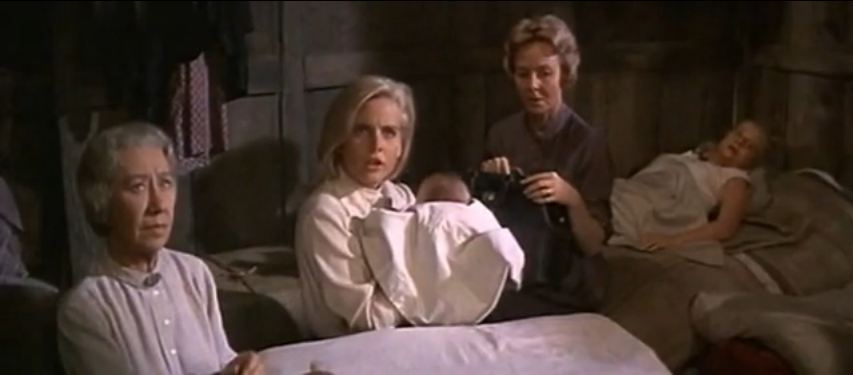
Throughout the remainder of "7 Women," Emma continues to demonstrate her ability to roll up her sleeves to do what needs to be done for the greater good of all.  When Florrie goes into labor, and all the women (except Andrews) rise to the occasion to help her, Emma asks Cartwright what she can do to assist.  Cartwright tells Emma to get Florrie a stick that she can bite on while she is in labor.  Emma immediately grabs a stick, snaps it into smaller pieces by breaking it on her knee, and brings it over to Florrie for her to bite on.  After Florrie's son is born, Emma actively participates in caring for the child and assists in his feeding.  We see how Emma has a maternal maturity about her that belies her youth.  When Andrews expresses disgust for Cartwright's sacrifice in becoming Tunga Khan's concubine, and complains about the baby, Emma finally gets fed up with the whiny Andrews and tells her, "Oh stop it!  Whatever the doctor's doing, she's doing for our good!  You should be thankful!"  In so doing, she has finally put Andrews in her place and begins to shatter her "holier-than-thou" delusions about herself and the world around her.


Despite her youthful naivete, Emma remains a realist who can handle what life has thrown her way.  Emma is the one who helps suggest to Dr. Cartwright that she can use her position as Tunga Khan's concubine to negotiate the women's release.  Cartwright smiles and admires Emma's shrewd pragmatism at recognizing the bargaining position that Cartwright is in and tells her, "You're a good kid, Emma."  However, even Emma couldn't foresee that Cartwright's success at negotiating the women's release would result in Cartwright further sacrificing herself by being left behind to face an uncertain future with Tunga Khan.  Emma asks Cartwright, "What are you?...Why are you staying here?  Why aren't you going to come with us?" only to have Cartwright scold her into leaving by telling her "Beat it!"  As the women are wheeled away in an oxen-drawn cart, Emma looks back at Cartwright and declares with admiration, "Dr. Cartwright...I'll never forget her as long as I live."


Similarly, anyone who has ever seen Sue Lyon's work as an actress isn't likely to ever forget her either.  If she did nothing else as an actress, Lyon's work in Stanley Kubrick's "Lolita" would, and indeed has, cemented her place in film history forever.  However, Lyon followed up her brilliant work for Kubrick with equally fine work for John Huston, in the aforementioned "The Night of the Iguana" and with John Ford in "7 Women."  In a short period of time, Lyon starred in leading roles with three of the finest directors in cinema history in three excellent movies.  As such, even though Sue Lyon's career was much shorter, much less prolific, and marked with probably more bumps in the road than Sandra Dee, Carol Lynley, Yvette Mimieux, and Connie Stevens, I think her career was in the long run much more rewarding because they never reached the heights of achieving brilliance the way Lyon did.  In some respects, Lyon eclipses even Tuesday Weld (who I greatly admire) because her trio of brilliance is more impressive than even the interesting and offbeat films that were the highlights of Weld's idiosyncratic career.


Later in the 1970s, Lyon's career struggled as she made appearances in B-pictures and on television that didn't take full advantage of the earthy intelligence and vitality that she had to offer.  Her last good movie was as the female lead in the bio-pic "Evel Knievel" (1971) with George Hamilton.  But, even within the limited framework offered to her, Lyon's star quality as an actress continued to shine brightly.  She was particularly good in a 1969 "Love American Style" episode entitled "Love and the Bed" where she and Roger Perry play neighbors in an apartment house who argue over ownership of a elegant brass bed being thrown out by another neighbor moving out of the building.  Even though it was a light-weight vignette, Lyon brought insouciant wit and maturity to the skit that allowed it to rank among the better segments of that series.  I also remember her charming performance in the TV movie "But I Don't Want to Get Married!" (1970), as one of the many women attracted to recently widowed, middle-aged Herschel Bernardi.  In casting that was clearly meant to draw parallels with her famous role as Lolita, Lyon's character is very attracted to Bernardi's kindness and maturity as a gentleman.  She tells Bernardi's character, "You're a nice guy.  There aren't too many around.  And I like you.  Aren't those enough reasons?...Listen, I'm a big girl now.  I know what I want."


In contrast to James Mason and Richard Burton before him, Bernardi tells Lyon's character, "I'm a grown man and I know what I can't have."  Defeated, Lyon graciously accepts Bernardi's invitation to buy her a hot chocolate at a nearby drugstore and jokes "All right, I guess a hot chocolate's better than nothing!"  Clearly, Lyon's characters continually mature and progress beyond one's expectations.  I also remember her for her touching performance in an episode of "Fantasy Island" in 1978.  She played a spoiled rich girl who pays Mr. Roarke to recreate the best summer of her life when she was still in high school and spent it with her four girlfriends from school.  Michele Lee, Pamela Franklin, and Hilarie Thompson played her classmates.  In Lyon's most affecting moment, she reveals to the others how she is not as rich as they remember her to be, that she had to get a job and save up money for this fantasy, and that she simply wanted one more chance to relive her youth before ultimately facing reality.


In so doing, Lyon's characters continually demonstrate how they are more self-aware about the realities of their lives than the ones played by other blonde 1960s starlets.  Her comparatively deeper, mature voice, vibrant intelligence, and forthright directness was a refreshing contrast to the frivolity and coyness expressed by her counterparts in their roles.  Lyon faced her share of career struggles while in Hollywood, but there is no other role that demonstrates her qualities of courage and integrity better than her performance as Christian missionary Emma Clark in John Ford's "7 Women."  Ford doesn't objectify her on screen and allows Lyon's assertive qualities as an actress to be fully explored.  Lyon has great chemistry throughout the movie with her formidable co-stars, particularly with Anne Bancroft and Margaret Leighton, and more than holds her own amidst such powerhouse performers.  It's a shame that "7 Women" wasn't a bigger success for all involved so that the public and Hollywood didn't perceive that John Ford was losing his touch as a director and so that Sue Lyon could have had a shot at playing more mature and dignified roles in her career.  Sue Lyon's stardom in Hollywood may have been shorter than it should have been, but her fine work for John Ford in "7 Women" demonstrates the extent to which her star, at its peak, did indeed truly shine bright. 

Sunday, June 9, 2013

Anna Massey brings Beauty and Humanity to Michael Powell's "Peeping Tom"


The first time I ever saw director Michael Powell's disturbing masterpiece "Peeping Tom" (1960) was on a late night airing on the KHJ Channel 9 TV station in Los Angeles in the mid-1980s.  As I realized years later, after having watched the movie again on DVD, the Channel 9 airing did not appear to have edited much of its violent and sexual content for television because the print was in color and I was able to recognize many of the scenes I witnessed from that first viewing.  In that sense, I feel fortunate that I was given as appropriate an introduction to "Peeping Tom" as possible, given the fact that the movie was attacked and censored in the U.K. upon its original release and also because the original U.S. theatrical release was in black and white and was edited by at least 15 minutes.  "Peeping Tom" is a brilliant film but I admit that it would be hard to watch if it weren't for the sympathetic performance of lovely Anna Massey as the sweet young woman who doesn't realize that the mysterious man living upstairs from her in a London boarding house is actually a serial killer of women.  Massey's pure and wholesome presence strikes a refreshing contrast to the seedy nature of the rest of the movie and gives the audience someone to identify with and root for.


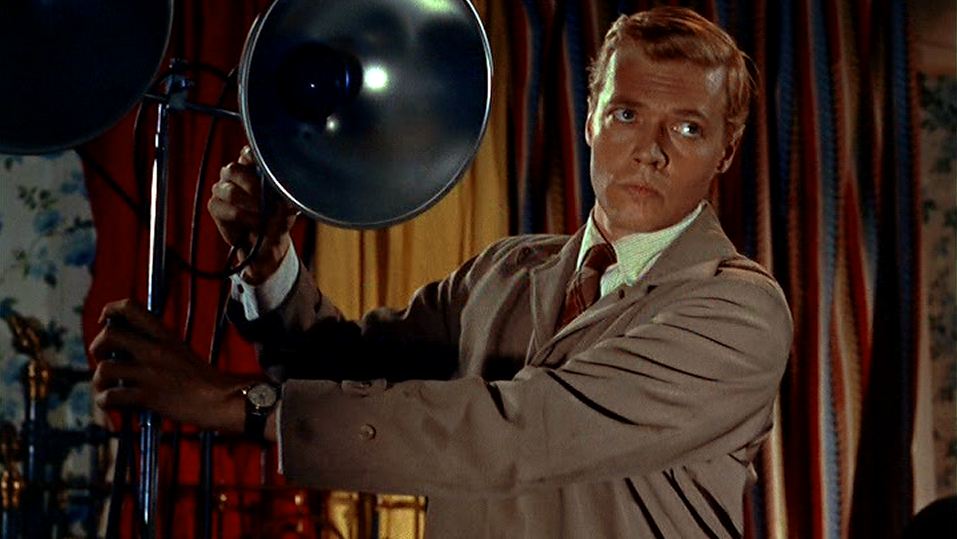
Karl Boehm stars in "Peeping Tom" as the homicidal and disturbed Mark Lewis, an aspiring film director working as a focus puller at a film studio in London who also works part time as a nudie photographer of glamorous women.  Unbeknownst to everyone, Mark is a serial killer who has been murdering women throughout the city by filming their terrified faces up close as he is murdering them.  He does this by attaching a mirror and light to his film camera, so that the women can see their own expression of fear just as he kills them with a sharp spear attached to one of the legs of his camera tripod.  Mark is obsessed with capturing images of terror in people's faces because his late psychologist father used to film and audio record images of Mark being frightened as a young child in order to study how fear affects the nervous system.  He still lives in the same house that he grew up in and rents out rooms in order to help pay for the upkeep.


Mark's complex life becomes even more so when he strikes up a friendship with the lovely young Helen Stephens, played by Anna Massey, who lives with her blind, alcoholic mother Mrs. Stephens (Maxine Audley) on the first floor of Mark's house.  Helen, who works in the children's section of a library, strikes up a friendship with Mark and asks him to help her illustrate a children's book that she has had accepted for publication.  Mark opens up to Helen about the experiments his father used to perform on him, which evokes a sense of compassion from Helen, and the two become close.  Mrs. Stephens, however, suspects something is amiss with Mark and asks him to seek psychological counseling and to stay away from her daughter.  As the police start closing in on Mark, Helen stumbles upon the films that Mark has made chronicling his murderous crimes and, in so doing, puts herself in jeopardy of becoming his next victim.


Anna Massey gives a winning and sympathetic performance as Helen, the one person who genuinely cares for Mark and has only his best interests at heart.  We first see Helen celebrating her 21st birthday party with friends and other neighbors in the boarding house when Mark is spotted peering into the window spying upon the party goers.  Rather than being put-off, Helen uses it as an opportunity to try and invite the reclusive and withdrawn Mark to join the festivities.  She later brings Mark a slice of birthday cake and, upon learning he is an aspiring filmmaker, asks if she can see some of his films.  When Mark shows Helen filmed footage that his father took of his experiments while frightening Mark as a child, she is disturbed and unsettled by what she sees.  Anna Massey is particularly good throughout this scene, demonstrating the proper sense of revulsion at reacting to what Mark is showing her.  But, rather than turning her off to Mark, the realization that he has been deeply hurt as a child only serves to make Helen more compassionate and interested in him.


I think this has to do with the fact that Helen lives with her blind and alcoholic mother, who is a very self-aware and caring woman but suffers from an underlying sense of bitterness over losing her sight.  What's amazing about Helen's personality is that she doesn't appear to have been psychologically damaged by her mother the way other people might be by their troubled parents.  I think Helen demonstrates strength of character in not allowing her mother's drinking problem and bitterness to adversely affect her.  I believe that Helen's experiences with her mother have allowed her to be sensitive to the needs of others who have a complex relationship with their own parents.  That's why I believe Helen has such interest and compassion for Mark.  She recognizes how Mark's father has hurt him and tries to provide a sense of friendship and moral support to help him rise above his difficult upbringing.  The fact that Helen doesn't outright reject Mark after having watched his father's cruel experimental films, where young Mark is emotionally tortured, makes her a very admirable individual because of her inherent sense of patience and tolerance.


My favorite scene in the movie is the one where Mark gives Helen a belated birthday present of a jeweled dragonfly pendant, after which Helen asks Mark to help her work on a children's book that has been accepted by a publisher.  Even though Mark is at first unnerved when he learns that Helen's children book is about a magic camera that photographs images of adults as they once were as children, I like the sense of genuine enthusiasm that Mark feels about Helen's book project.  You can tell that Mark is sincerely flattered and moved that Helen has sought out his consultation and knowledge as a photographer that he volunteers to take the photos himself in order to help Helen.  The scene is very touching and tragic all at once, because you can sense the deepening feelings that Mark and Helen feel for one another, but you also realize that their relationship potential is limited since he is mentally disturbed and has already killed several women.


I also like the sequence when Helen and Mark have a dinner date and Helen encourages Mark not to bring his camera and photographic equipment along on the date.  As Helen points out to Mark, before they leave for the restaurant, "I don't think I've ever seen you without it.  But are you going to need it tonight?  Well, are you and, if so, shall I bring some work with me too?"  Helen urges Mark to either let her leave the camera and photographic equipment in her room downstairs, or take it up to his own room because "I thought it (the camera) was growing into an extra limb."  With her gentle encouragement, Mark is able to leave his camera behind for once in his life and he is able to genuinely enjoy himself while at dinner with her.  Helen is trying to teach Mark to become independent and to not continue carrying the psychological burdens of his past.


During their date, Helen describes the images she needs for her children's book of images taken by a magical camera that capture adults as they once were as children.  As they return from their dinner date, Mark becomes so excited by Helen's project that he tells her "There's not a single face in the crowd that doesn't look like a child, not a single one, if you catch it at the right moment...Oh Helen, I would like to find those faces for you, with you."  In so doing, we see how Helen is able to help Mark channel his photographic talents and skills towards something positive.  We see how Mark's life could have taken a turn for the better if the two of them were acquainted before he had become a killer.


As Helen and Mark's relationship develops, we sense how Mark has become protective of her in order to ensure that he never comes to harm her.  Mark objects when Helen playfully holds his camera and then turns the camera towards herself, announcing with determination "Not you...It will never see you.  Whatever I photograph, I always lose."  I particularly like the scene when Helen's mother, Mrs. Stephens, confronts Mark in his room with her concerns about his mental state.  The thing that's interesting about this scene is that, even though Mrs. Stephens is worried about Mark's influence on her daughter, she never gets excessively cruel with him, even though he frightens her and almost kills Mrs. Stephens when he turns the camera on her.  For once, Mark reigns in his homicidal urges, partly because Mrs. Stephens admonishes him to "put that camera away" but also because he realizes that hurting Helen's mother will destroy his relationship with Helen.


Despite her inherent harshness and bitterness, and despite how she confronts Mark by getting to the root of his disturbances with her rhetorical questioning, Mrs. Stephens informs Mark that her instincts tell her "all this filming isn't healthy and that you need help.  Get it, Mark.  Get it quickly.  And, until you do, I don't want you and Helen to see each other."  When Mark promises Mrs. Stephens, "I will never photograph her.  I promise you."  Mrs. Stephens continues, "I'd rather you don't have the chance.  I mean it, Mark.  And, if you don't listen to me, one of us will move from this house.  It would be a pity, because we'd never find a cheaper place."  When Mark promises her that they will never have to move because of him, Mrs. Stephens takes Mark by the hand and approvingly says "Good boy."  Mrs. Stephens is protective of Helen, but she's not cruel about it with Mark.  She doesn't denigrate him the way another concerned parent might in a similar situation and Maxine Audley's surprisingly sympathetic performance allows one to see where Helen's inherent sense of humanity and compassion came from.


However, "Peeping Tom" must come to its inevitably tragic conclusion as the police begin closing in on Mark just as Helen realizes he is a homicidal maniac.  As Helen leaves a manuscript of her book in Mark's room as a gift, she turns on his movie projector out of curiosity.  While watching what she eventually realizes are snuff film images of women reacting in horror at witnessing their own deaths in the mirror Mark has attached to his camera, a frightened Helen backs away in terror and walks right into Mark's arms.  Anna Massey is particularly good throughout this sequence.  In one take, Massey is able to demonstrate Helen's gradually growing sense of curiosity, amusement, confusion, realization, and horror as she watches Mark's snuff films.  We realize how much Helen means to Mark when he tells her "Don't let me see you are frightened.  So leave, hurry up!"  He has no intention of harming her at all.  However, Helen refuses to leave until Mark has explained to her what these snuff film images mean.  "That film...that film...that film is just a film isn't it?  It's horrible...Horrible, but it's just a film isn't it?"  When Mark admits that the film is real, he tells Helen "You'll be safe as long as I can't see you frightened.  So stand in the shadows please."

 
Mark begins to explain how his father took audio recordings and films of his experiments in order to document his efforts to make Mark suffer from being frightened and that all the rooms in the house are wired for sound and that he's recorded conversations in every rooms.  Helen admonishes Mark to look at her and tell her what exactly he did with those girls.  "What did you do to those girls?  What did you do?  If you want to torment me for the rest of my life, then make me imagine.  What did you do to those girls?  Show me...Show me or I'll remain frightened for the rest of my life.  Show me!"  In so doing, Helen demonstrates how deeply she loves Mark that she'd rather know what he did with those girls, rather than allow her imagination to haunt her the rest of her life, by creating images in her mind that might be even worse than the reality, of something that someone she is in love with has committed.  Helen's admonition is for her own peace of mind and not out of morbid curiosity, and demonstrates Helen's strength of character that she doesn't want to spend her life in a state of denial about who Mark was.


Because Helen is such a realist in touch with her own emotions, she is able to contain her reactions and not show her fear when Mark takes out his camera equipment, with the sharp tripod leg, mirror, and light that he killed the other women with, and trains it on Helen.  In fact, rather than fearing for herself, Helen selflessly admits "I'm frightened for you."  Helen looks away and maintains a stoic expression in the face of danger in order to ensure her own safety in Mark's presence so that he doesn't become compelled to kill her as well.  Even though she loves Mark, she urges him to turn himself in to the police, who have surrounded the house, so that he can face the consequences of his actions.  Helen tries to stop Mark when he turns the camera on himself, apologizes by telling her "I wish I could have found your faces for you" and commits suicide by impaling himself onto the tripod leg.  As the movie ends, director Powell's camera lingers on the manuscript for Helen's children's book, where she had playfully inscribed just moments earlier, "From One Magic Camera which needs the help of Another!"  In so doing, Powell brings this tragic love story to its appropriate conclusion.


Karl Boehm and Anna Massey have an endearing chemistry throughout "Peeping Tom" that allows their relationship to transcend the sort of colorless romantic scenes that pad out the running times of other horror thrillers.  In this instance, the romantic subplot isn't a mere formality, and Helen herself is not simply a plot device to help resolve the story, because director Powell uses both to help illuminate Mark's inherent humanity despite his evil and homicidal acts.  Helen brings out the best in Mark and allows this tragic and dangerous individual to still come across as unexpectedly sympathetic, a morally troubling artistic decision that explains the negative reaction this film has had with some viewers.  Helen's presence and influence in the movie demonstrates the sort of bright future Mark could have had in his life if he had not already crossed the line by becoming a killer.  Throughout "Peeping Tom," we want to see Mark and Helen have a happy ending, but know that such a conclusion is simply not possible because Mark must face the consequences of the murders he has committed.


Anna Massey is superb at demonstrating Helen's intelligence, courage, compassion, and integrity.  She clearly loves Mark, even after learning he is a killer, but doesn't try to justify his actions.  The fact that she urges him to turn himself in at the end, doesn't offer to go on the lam with him, and tries to discourage him from killing himself demonstrates what a realist that she is.  Despite her love her him, she knows that there's no hope for a future with him and wants him to do the right thing in what little time he has left so that he can pay for his crimes.  Helen's insistence at knowing the truth about Mark, and her courage by not showing fear on her face when Mark films her with his camera, shows her to be a stronger "final girl" than other horror movie heroines who resort to physical violence, rather than demonstrating emotional and psychological strength and assertiveness, while directly confronting a homicidal killer.  As such, one of the many reasons why "Peeping Tom" holds up beautifully as a genuine cinematic masterpiece over 50 years later is because of the sympathetic human dimension that Anna Massey's Helen brings to the movie. 

Saturday, June 8, 2013

Shannon Tweed Guest Stars on A Very Special Episode of "Cagney & Lacey"


Shannon Tweed is best known these days as Gene Simmons' wife, after having been his longtime companion for years, as well as a reality TV personality for A&E's "Gene Simmons Family Jewels."  She is also one of the most successful Playboy Playmates-turned-actresses, having built a long, accomplished, and prolific list of credits in movies and television since the early 1980s.  She was a regular on "Falcon Crest" during its second season (1982-83) as well as on "Days of Our Lives" (1985-86) and the HBO comedy series "1st and Ten" (1989-91).  Because of her looks and Playboy background (she was Playmate of the Year in 1982) she eventually found herself typecast while starring in a series of erotic thrillers in the 1990s that went straight-to-video or played on Cinemax.  What's been overlooked is the fact that Shannon Tweed is actually a very capable actress who has given good performances throughout her career, which is reflected in her longevity and prolificacy.  Her Playboy image still limits her opportunities, but she has done comparatively better than most other Playmates who have attempted to venture in acting (the other exception being Stella Stevens).  Probably one of Tweed's more notable acting roles was her guest appearance in the "Cagney & Lacey" episode entitled "Role Call" that aired November 3, 1986 on CBS.


Tweed guest-starred as glamorous TV star Vicki Barrington, of the fictional cop show "NYPD" where she plays police detective DeeDee St. James, who hides her gun in her brassiere, frequently goes undercover as a prostitute, and nabs her suspects by calling out "Hold it, big boy!"  With the cooperation of the Mayor of New York, Vicki has come to spend a week with real police detectives as a civilian observer in an effort to better understand what they do for a living and to try and bring "realism" to the series.  Vicki requests to be assigned to follow two female police detectives, which results in her accompanying detectives Christine Cagney (Sharon Gless) and Mary Beth Lacey (Tyne Daly) in the course of their regular duties.  Cagney immediately resents Vicki's presence and goes out of her way to intimidate and humiliate Vicki in order to discourage her from continuing to observe them all week.  Meanwhile, to the surprise and annoyance of Cagney, Vicki immediately bonds with Lacey when both women discuss their children (Vicki is a single-mother of a young daughter) and the two seemingly dissimilar women become fast friends with one another.


When an unsuspecting Vicki inadvertently walks into the middle of a stakeout, followed by the media, and causes the suspect to slip away, Cagney wants her sent back in Los Angeles and have it officially noted that Vicki caused the suspect to escape.  However, Vicki apologizes to Lt. Samuels (Al Waxman) over the incident and is allowed to continue observing Cagney and Lacey.  After witnessing a heated exchange in the ladies room between Vicki and Cagney, a compassionate Lacey brings Vicki home for dinner, where she immediately charms Lacey's husband Harvey (John Karlen) and her children.  The next day, when Cagney argues with Lacey over why she likes Vicki, Lacey diplomatically reminds Cagney that she has spent years observing Cagney using her good-looks and charm to her advantage in the course of performing police work.  Lacey reasons, if it's all right for Cagney to do that, why isn't it all right for Vicki?  As Vicki's week winds down, she asks Cagney and Lacey if they will pose with her for a publicity photograph.  When Cagney refuses, the two women have it out once and for all.  Vicki informs Cagney that she's not there to denigrate her police work, and has had to face her own sets of challenges in forging a successful career.  Vicki says she would have hoped Cagney would be able to sympathize with her because they've both paid their dues.  Perhaps realizing that she may have taken her resentment of Vicki a bit too far, Cagney agrees to pose with Vicki and Lacey for a photo at the end.


A comparatively humorous and light-hearted episode, the "Role Call" segment nevertheless resonates because of the way it addresses the sorts of objectification, stereotyping and resentment that men and women feel towards glamorous, seemingly entitled individuals like Vicki.  The men in the 14th Precinct, bowled over by Vicki's beauty, glamor, and presence, spend the entire week hovering around her, asking for autographs, referring to her by her TV character's name, and calling out in-unison "Hello DeeDee!" or "Goodbye DeeDee!" whenever she arrives or exits.  In so doing, they never really see her as a genuine, flesh-and-blood individual and only regard her as a sex object.  Moreover, before he ever meets her, Lacey's husband Harvey dismisses Vicki as a "plastic Hollywood bimbo" and assumes she's a shallow and superficial individual only interested in getting more publicity for the show by spending the week at the Precinct.  Cagney resents Vicki because she feels that her TV show makes a mockery of police work and finds her presence as a civilian observer for the week condescending and patronizing.  Cagney feels that Vicki cannot begin to grasp the reality of police work and objects to her romanticization of the mundane aspects of her career.


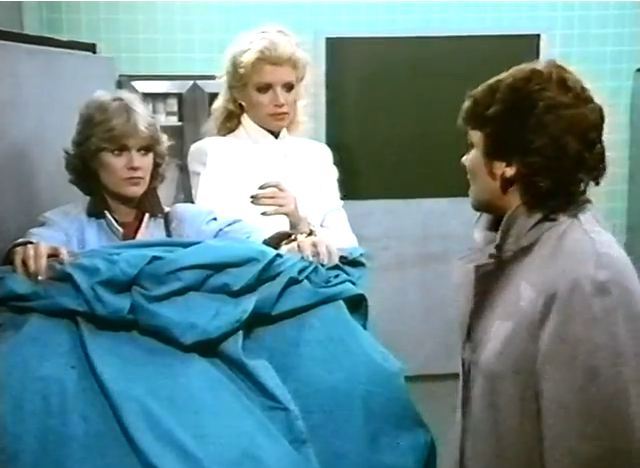
To the surprise of everyone, including the audience, the only person who gives Vicki a chance and sincerely tries to show her what police work is about is the brassy, working class Lacey.  Lacey seems genuinely flattered that Vicki is interested in learning more about who she is as an individual and how she approaches her duties as a police detective and gives her a chance.  Lacey continually tells Cagney and her husband Harvey that they're not being fair in prejudging Vicki as a "bimbo" and refutes Harvey's assertion that this is all a publicity stunt by informing him "She said that she has come to New York City to learn how to make her show better."  Lacey spends the week trying to be peacemaker between her partner Cagney and Vicki, as she likes both women and doesn't think that there should be any tension between them.  When Cagney intentionally takes Vicki to the morgue to examine a corpse, she takes delight in witnessing Vicki's discomfort at seeing a dead body.  Cagney gloats over Vicki's squeamishness and cruelly jokes how "I don't think Detective Dee Dee can take it" only to have Lacey defend Vicki by admitting that "I couldn't either my first time, could you?"  Tyne Daly is extremely funny and endearing in this episode, bringing interesting and inspired qualities to this segment, including moments of comedic awkwardness and an atypical timidity as she tries to blunt the sharpness of Cagney's barbs at Vicki.  When Vicki diplomatically brings Cagney's favorite breakfast of bagel and cream cheese, and Cagney becomes silently resentful of Vicki's kindness, Lacey reminds Cagney to "Say thank you, Christine" in a quick, humorously maternal manner that is very funny. 


Tyne Daly and Shannon Tweed have a great, effortless chemistry in this episode as they demonstrate how these two, completely different individuals find a common ground with one another while discussing their children and their love of classic movies.  The scene where they share photos of their kids is rather touching, particularly when Lacey comments how Vicki's daughter looks like "Peaches and cream" and Vicki returns the compliment by commenting on Lacey's dress by noting "Speaking of peaches, you look really great in that color.  It really compliments your skin tone."  I like how Lacey is impressed by Vicki's warmth and sincerity and lack of entitlement that she goes out of her way to try and make her week as a civilian observer a worthwhile experience.  Lacey shows how she is secure enough in herself that she doesn't feel the least bit threatened by Vicki, even after she has dinner with her family and witnesses how her husband Harvey and her sons are impressed by this glamorous TV star.  After meeting Vicki, Harvey suddenly becomes amorous that night in bed with Lacey and she comments to Cagney the next day, with a sense of wonder, "There's a chemical thing, Christine, that does something to men.  18 years of marriage, I never saw Harvey so...well, I don't even know what it was but they all had it.  Even the boys.  Even Michael.  Kind of reminded me of when they first met you."


In so doing, Lacey is able to get to the root of why Cagney resents Vicki.  The more worldly and sophisticated Cagney ultimately has a lot in common with Vicki and feels very competitive with her.  Cagney is threatened by Vicki's presence because she doesn't want to think that her looks and charm had anything to do with her success as a police detective.  She wants to believe that she got where she is solely through skill, accomplishment, and initiative, which is why I think she continually puts Vicki down throughout the episode as someone superficial, unintelligent, and a nuisance.  At one point Lacey's boyfriend David observes that the only reason Lacey dislikes Vicki is because "You're a lot alike...When you're beautiful and smart and ambitious and hard-working, people could find that intimidating."  When Lacey objects to David's observation by defensively stating "I am not intimidated by Vicki Barrington," David calmly responds "That was supposed to be a compliment.  Do you realize that she's the only thing we've talked about since she showed up at the 14th?...Chris, I don't care what the competition is, on any level, man or woman, you can handle it."


Lacey further underscores the similarities between Cagney and Vicki when she challenges Cagney's statement, "I tell you, Mary Beth, you can't trust a woman like her."  Lacey asks, "What kind of a woman is that, Christine?"  Cagney responds, "The kind of a woman who would use whatever it takes to get whatever she wants."  A bemused Lacey smiles and says nothing regarding her partner's hypocrisy which causes Cagney to declare defensively and self-servingly, "Mary Beth, when I use a little charm, I do it for a good cause...I protect people from crime."  Lacey wisely responds, "Uh huh.  So it's OK to use a little charm in your job, but it's not OK in hers...Well, it can't be easy, Christine.  She's trying to raise a child by herself, working hard at that job where people are fussing all over you every minute of the day."  When Cagney defiantly states, "I'm telling you she's as phony as the airhead she plays"  Lacey becomes indignant and defends Vicki by challenging Cagney "Now how do you know?  Did you ever bother to get to know her?"


Later on in the episode, Lacey continues to defend Vicki to Cagney by pointing out, "You know, she can't help being who she is, Christine.  I know exactly how you feel.  Same way I feel everytime we go check evidence with Cervantes...We go in together and it's 'Hello Sergeant Cagney!  How you doin' Sergeant Cagney!'  I may as well stay in the car....When we go to the lab, Solomon offers you sushi.  Me, I get fiber samples.  Don't tell me you never notice."  Cagney feels awkward and apologetic at realizing how she has inadvertently caused Lacey to feel dissed and ignored at times and says "Look, if it bothers you so much why didn't you say something?"  Lacey wisely responds, "Well, what are you supposed to do?  Stop wearing smart clothes and start retaining water?  That's the way it is, that's all.  Same thing with Vicki Barrington.  Doesn't mean she's not a nice person."


In so doing, Lacey sets the stage for the final confrontation between Vicki and Cagney when the former has asked if both detectives would take a publicity photo with her.  Vicki confronts Cagney, after she refuses to take the photo, by asking "Is it just me, or do you have a problem with all women?"  Cagney responds resentfully, "Look, it was your idea to come here.  Now nobody sent you an engraved invitation!  If you can't take the heat, get the hell out of the kitchen!"  Vicki defiantly responds "I can take anything you can dish out.  But I resent it lady.  You think all I am is a tight dress and a push-up bra...Well, you're wrong.  I answered phones, waited tables, and parked cars for my acting lessons.  And then I had to get past agents, producers and directors who still thought I should sleep my way to the top" to which Cagney derisively cracks "Look, I read 'Hollywood Wives.'  In case you hadn't noticed, I had to deal with men too."  Vicki responds, "Then you ought to know what I'm talking about.  Nobody taking me seriously, not one of them giving me credit for having a brain in my head.  And now you.  I thought you'd give me a chance to prove myself...We've both paid our dues.  But I guess you don't give a damn about any woman's career except your own."  As Vicki storms out, a humbled Cagney sarcastically jokes "Helluva performance" to try and save face, knowing full well that Vicki has called her out on her hypocrisy.  Sharon Gless does a great job in this episode at skillfully underscoring Cagney's impatience and intolerance for Vicki, and for her willingness to demonstrate unsympathetic qualities in Cagney's personality.


As for playing the catalyst of this episode, Shannon Tweed gives a very good performance playing the sympathetic and intelligent Vicki Barrington.  The script by Sandy Sprung and Marcy Vosburgh plays fair with the Vicki character by ensuring that she doesn't come across as superficial or self-indulgent.  Despite Vicki's initial naivete in understanding the realities of police work, as well as her presumptuousness in interrogating witnesses and suspects, both Tweed and the script work hard to demonstrate Vicki's sincerity in making her character Sergeant Dee Dee St. James, and her fictional TV series, "NYPD" more realistic and believable so that both can honor the sort of work that Cagney and Lacey do everyday.  As she tells Cagney earlier in the episode, "I didn't leave my kid (in LA) for a publicity stunt.  I came here to make Dee Dee a better cop...so I can feel good about what I do for a living....Look, if you don't want Dee Dee to be a bimbo, why don't you help me change her?"  Tweed demonstrates assertiveness and strength of character by demonstrating how Vicki can give as good as she can take in trading barbs with Cagney so that the character never degenerates into shallow Hollywood actress stereotypes.


The sincere warmth that Tweed demonstrates in her scenes with Tyne Daly also goes a long way towards underscoring Vicki's humane qualities as an individual.  The scene after Vicki argues with Cagney, and Vicki asks Lacey if she was sincere about her earlier statement of inviting Vicki home for dinner with Lacey's family ("I was gonna go back to my hotel, eat dinner, read some stupid scripts, try to fall asleep...unless you meant what you said about my having dinner at your place...Mary Beth, I'd love to.  I'd even bring the wine"), is touching because you see how much it means for this glamorous, beautiful TV star to feel accepted by at least one of the two detectives she is observing for the week.  You sense that Vicki wants to make friends with both Cagney and Lacey and to do right by them by making her TV show more substantial.  Tweed is particularly good in scenes where Vicki's feelings are genuinely hurt by Cagney's antagonism.  It's clear that Tweed understands and sympathizes with the presumptions and expectations that Vicki has to deal with in her life and acting career, which is why her performance has such authenticity.  Even though it is only in a single guest appearance on "Cagney & Lacey," Shannon Tweed demonstrates qualities of intelligence, warmth and integrity that she should have been allowed to represent more often in her career.